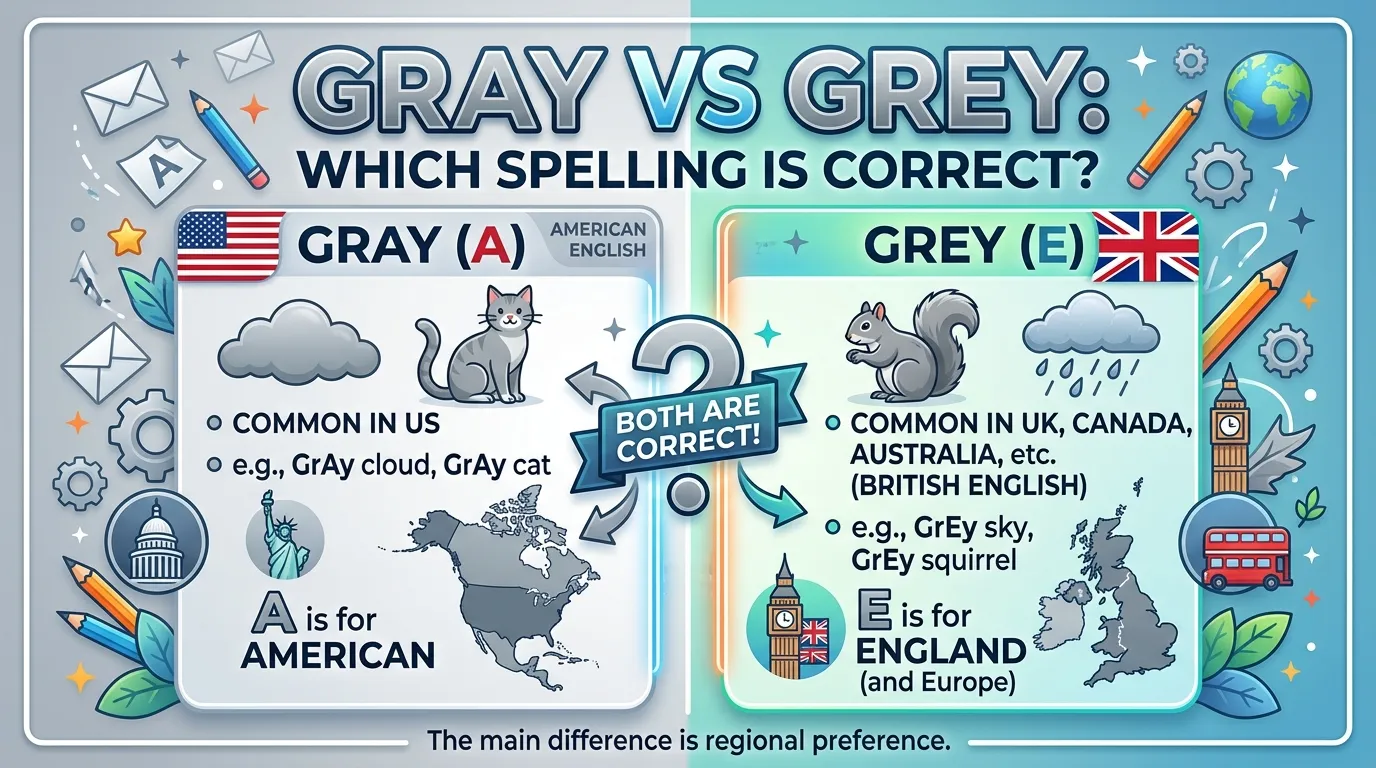
If you have ever wondered whether gray or grey is the correct spelling, the short answer is: both are correct. The main difference is regional. Gray is the standard spelling in American English, while grey is more common in British English and several other varieties of English.
The two words have the same basic meaning, pronunciation, and grammatical function. They both describe a color between black and white. They can also describe things associated with that color, such as gray hair, grey skies, or gray clothing.
However, there are some important differences in regional preference, proper names, fixed expressions, and specialized usage. Choosing the right spelling can make your writing sound more natural to your intended audience.
This guide explains gray vs grey in detail, including their meanings, pronunciation, history, American and British usage, common expressions, examples, collocations, common mistakes, and practical rules for choosing the correct form.
Quick Answer: Gray or Grey?
Gray and grey are both correct spellings of the same word.
| Spelling | Main Usage | Example |
|---|---|---|
| gray | American English | The sky is gray. |
| grey | British English | The sky is grey. |
| gray | Common in U.S. writing | He has gray hair. |
| grey | Common in UK writing | He has grey hair. |
| gray | Common in American dictionaries | The wall is gray. |
| grey | Common in British dictionaries | The wall is grey. |
The easiest rule to remember
Use gray for American English.
Use grey for British English.
Neither spelling is inherently more correct than the other.
If you are writing for an American audience, gray is usually the better choice. If you are writing for a British audience, grey is generally preferred.
What Does Gray or Grey Mean?
Gray/grey is primarily an adjective describing a color that falls between black and white.
For example:
- She wore a gray dress.
- He bought a grey jacket.
- The clouds looked gray.
- The old building had grey walls.
The word can also be used as a noun to refer to the color itself:
- Gray is a neutral color.
- Grey looks good with blue.
It can also function as a verb, although this usage is less common:
- His hair began to gray with age.
- Her hair was greying naturally.
The meaning does not change simply because the spelling changes.
Gray vs Grey: The Key Difference
The central distinction is regional spelling preference, not meaning.
Gray in American English
Gray is the preferred spelling in American English.
Examples include:
- gray hair
- gray matter
- gray area
- gray wolf
- gray water
- gray suit
- gray skies
If you are writing an American school essay, business document, website, news article, or academic paper, gray is normally the safest choice.
Grey in British English
Grey is the preferred spelling in British English.
Examples include:
- grey hair
- grey matter
- grey area
- grey wolf
- grey suit
- grey skies
British publications, schools, businesses, and government organizations generally use grey.
Is Gray or Grey More Correct?
Neither spelling is universally more correct.
The choice depends primarily on the variety of English being used.
Consider these sentences:
The old man had gray hair.
This is natural American English.
The old man had grey hair.
This is natural British English.
Both communicate exactly the same idea.
The important thing is consistency. If you are writing an American article and use gray throughout, stay with gray. Do not switch randomly between gray and grey unless a proper name or specific title requires it.
Why Do People Confuse Gray and Grey?
The confusion exists because English has two established spellings for the same word.
Unlike many spelling mistakes, grey is not simply an incorrect version of gray, and gray is not a misspelling of grey.
Both forms have a long history in English.
English spelling developed through several influences, including Old English, Middle English, French, Latin, and different regional writing traditions. As English developed on both sides of the Atlantic, spelling preferences sometimes diverged.
The result is that American and British English now use different preferred spellings for many words:
- color / colour
- favorite / favourite
- honor / honour
- center / centre
- gray / grey
So gray vs grey belongs to a larger pattern of American and British spelling differences.
Gray vs Grey Pronunciation
The two spellings have the same pronunciation.
The usual pronunciation is:
/ɡreɪ/
It sounds like the word “grate” or “great.”
Pronunciation breakdown
- g = /ɡ/
- ray = /reɪ/
So:
gray → /ɡreɪ/
grey → /ɡreɪ/
There is generally no pronunciation difference between American gray and British grey.
Example
You would pronounce both of these the same way:
- gray
- grey
The difference appears in spelling, not in normal pronunciation.
Is Gray an Adjective, Noun, or Verb?
Gray/grey can serve several grammatical roles.
Gray as an adjective
This is the most common use.
It describes something that has a gray color or appearance.
Examples:
- She bought a gray sweater.
- The grey clouds covered the sky.
- His gray eyes looked tired.
- We saw a grey horse in the field.
Gray as a noun
It can refer to the color itself.
Examples:
- Gray is a neutral color.
- I prefer grey to black.
- The room uses several shades of gray.
Gray as a verb
It can describe the process of becoming gray, especially in relation to hair.
Examples:
- His hair began to gray.
- Her hair is greying.
- The experience seemed to make him gray prematurely.
The British spelling is typically:
- grey
- greying
- greyed
The American spelling is typically:
- gray
- graying
- grayed
Gray vs Grey in American and British English
The regional distinction is one of the most important things to understand.
| Feature | American English | British English |
|---|---|---|
| Preferred spelling | gray | grey |
| Color | gray | grey |
| Hair | gray hair | grey hair |
| Skies | gray skies | grey skies |
| Color name | gray | grey |
| Verb | gray | grey |
| Present participle | graying | greying |
| Past form | grayed | greyed |
These are preferences rather than absolute laws. You may occasionally see grey in American contexts or gray in British contexts.
Are There Cases Where Grey Is Preferred in American English?
Yes.
Although gray is the normal American spelling, grey can appear in certain proper names, titles, brands, organizations, or established names.
For example, a person may have Grey as part of their name. A company, product, fictional character, publication, or organization may deliberately use Grey.
In such cases, do not change the spelling simply to follow American spelling conventions.
Proper names should retain their official spelling
If a person’s surname is Grey, write Grey.
If a business officially uses Grey in its name, preserve that spelling.
This is a general writing rule: proper names should normally be written exactly as they are officially spelled.
Gray vs Grey in Scientific and Technical Writing
Scientific and technical writing generally follows the spelling conventions of the publication, institution, or region.
For an American technical audience, gray is generally preferred.
For example:
- gray matter
- gray scale
- gray wolf
- gray water
However, specialized terminology can have its own established forms.
Gray matter
In American English:
Gray matter plays an important role in the brain.
In British English:
Grey matter plays an important role in the brain.
The underlying scientific concept is identical.
Gray scale or greyscale
You may encounter both gray scale and greyscale, depending on the technical field and regional convention.
In technical writing, it is especially important to follow the terminology used by your organization, style guide, software documentation, or professional field.
Gray vs Grey in Business Writing
For business writing, the best choice depends on your audience.
American business writing
Use gray:
- gray suit
- gray market
- gray area
- gray hair
- gray walls
British business writing
Use grey:
- grey suit
- grey market
- grey area
- grey hair
- grey walls
If your company serves an international audience, choose one spelling system and use it consistently unless you are referring to a proper name.
Gray vs Grey in Academic Writing
Academic writers should follow the style guide required by their institution or publication.
If you are writing in American English, gray is normally appropriate.
For British English, grey is normally appropriate.
The key issue is not which spelling is superior. Academic writing values consistency and adherence to the chosen style system.
Gray vs Grey in Journalism
News organizations often maintain detailed style guides.
An American publication will usually prefer gray, while a British publication will generally prefer grey.
For example:
American-style headline:
Gray skies expected across the region
British-style headline:
Grey skies expected across the region
Both are grammatically correct.
Gray vs Grey in Casual Writing
In texting, social media, and casual online writing, either spelling can be understood easily.
You might see:
- That gray hoodie looks great.
- I love that grey hoodie.
- The sky is so gray today.
- Everything looks grey.
If your audience is primarily American, gray will look more natural. For a British audience, grey will usually feel more familiar.
Dictionary-Style Definition of Gray/Grey
Gray/grey
Part of speech: Adjective, noun, verb
Adjective: A color between black and white.
Noun: The color produced by a mixture or balance of black and white or by a similar visual effect.
Verb: To become gray or to make something gray; commonly used for hair becoming gray.
Example
The gray walls made the room feel calm.
Here, gray is an adjective describing the walls.
The History of Gray and Grey
The history of these spellings is more complicated than simply saying that one is American and one is British.
Both spellings developed through the history of English and were used in different periods and places.
The word is related to older Germanic forms associated with the color. Over time, English developed different spellings, including forms resembling gray and grey.
The spelling grey became especially established in British English, while gray became strongly associated with American English.
American English spelling was influenced by efforts to simplify and standardize spelling in the United States. However, it would be inaccurate to claim that one individual simply invented the spelling gray.
Both forms existed historically.
Gray/Grey as a Color
Gray is a neutral color created by balancing black and white.
It can range from:
- very light gray
- medium gray
- dark gray
- charcoal gray
- silver-gray
- blue-gray
- warm gray
- cool gray
The spelling remains gray in American English and grey in British English.
Examples
- The walls are light gray.
- She chose a dark grey coat.
- The design uses cool gray tones.
- The sky turned blue-gray before the storm.
Common Shades of Gray/Grey
Here are some common expressions involving shades of this color:
| American English | British English |
|---|---|
| light gray | light grey |
| dark gray | dark grey |
| charcoal gray | charcoal grey |
| blue-gray | blue-grey |
| warm gray | warm grey |
| cool gray | cool grey |
| silver-gray | silver-grey |
Some standardized color systems may use their own official names, so always follow the terminology of the specific system when relevant.
Common Collocations With Gray/Grey
A collocation is a word combination that commonly appears together.
Some frequent combinations include:
Gray/grey hair
- My grandfather has gray hair.
- Her grey hair is beautiful.
Gray/grey skies
- We woke up to gray skies.
- The grey skies made the afternoon feel gloomy.
Gray/grey area
This means something that is unclear or not clearly defined.
- The situation falls into a gray area.
- The law contains several grey areas.
Gray/grey matter
This refers to brain tissue containing many nerve cell bodies.
- Exercise may support brain health and gray matter.
- The article discusses changes in grey matter.
Gray/grey market
A gray market or grey market involves goods distributed through channels that are not the official distribution network, while not necessarily being illegal.
- The company is investigating the gray market.
- The product became popular in the grey market.
Gray Area vs Grey Area
Both expressions are correct.
Gray area is preferred in American English.
Grey area is preferred in British English.
The phrase describes something that does not have a clear answer, category, rule, or boundary.
Examples:
- There is a gray area between friendship and business.
- The regulations leave a grey area regarding online sales.
- Some ethical questions fall into a gray area.
Figurative meaning
The phrase is not about physical color.
It means uncertainty or lack of a clear distinction.
Gray Market vs Grey Market
The same regional spelling rule generally applies to gray market and grey market.
American English
The retailer wants to reduce sales through the gray market.
British English
The retailer wants to reduce sales through the grey market.
The phrase can occur in business, economics, technology, retail, and international trade discussions.
Gray Hair vs Grey Hair
Both are correct.
American English:
My father started getting gray hair in his thirties.
British English:
My father started getting grey hair in his thirties.
The adjective gray/grey simply describes the color of the hair.
You may also encounter:
- gray-haired
- grey-haired
Example:
A gray-haired man entered the room.
British version:
A grey-haired man entered the room.
Gray Wolf vs Grey Wolf
The animal’s name may be written gray wolf in American English and grey wolf in British English.
American:
The gray wolf lives in several parts of North America.
British:
The grey wolf is found across parts of Europe and Asia.
When discussing a species in a scientific context, follow the terminology and spelling conventions required by the publication or organization.
Gray vs Grey: Tone and Formality
Neither spelling is inherently more formal.
This is an important distinction.
Some writers mistakenly assume that grey sounds more sophisticated or that gray sounds more modern. There is no general grammatical rule supporting that idea.
For example:
- gray suit
- grey suit
Both are neutral and appropriate in formal writing when they match the relevant regional standard.
The choice is mainly about English variety and consistency.
Gray vs Grey: Synonyms
Depending on context, synonyms or related color terms include:
- ash
- ashen
- charcoal
- silver
- slate
- smoky
- leaden
- pewter
- dusky
These words are not always exact synonyms.
For example, silver can suggest a shiny metallic appearance, while charcoal usually suggests a very dark gray.
Example
Instead of:
She wore a gray dress.
You might write:
She wore a charcoal dress.
But the meaning is slightly different because charcoal specifies a darker shade.
Gray vs Grey: Antonyms
There is no single perfect antonym for gray/grey because it describes a color rather than a simple conceptual opposite.
Depending on context, contrasts may include:
- colorful
- bright
- vivid
- saturated
For example:
The gray building looked dull beside the colorful houses.
Here, colorful provides a meaningful contrast rather than a strict dictionary antonym.
Gray/Grey in Figurative Language
Gray and grey are also used figuratively.
Gray area
An unclear situation.
The policy creates a gray area for small businesses.
Gray matter
Informally, gray matter can refer to intelligence or mental ability.
You’ll need some gray matter to solve this puzzle.
Gray world
A gray world can figuratively suggest boredom, sadness, dullness, or lack of excitement.
After the company closed, the town seemed like a gray world.
These figurative meanings usually remain the same regardless of spelling.
Political and Social Usage
The color gray/grey sometimes appears in political, social, and cultural language.
For example, gray areas can describe controversial issues where there is no simple right-or-wrong answer.
You might see:
- a political gray area
- an ethical gray area
- a legal gray area
- a moral gray area
These uses are figurative rather than references to the physical color.
The spelling still generally follows the regional variety of English.
Gray/Grey in Sports
Sports writing can use gray/grey to describe:
- uniforms
- jerseys
- team colors
- equipment
- stadium conditions
- weather
For example:
The team wore gray uniforms.
British English:
The team wore grey uniforms.
Sports organizations may also have official names that use one particular spelling. When referring to an official team, brand, or product name, preserve the official spelling.
Gray/Grey in Technology
Gray/grey appears frequently in technology and design.
Common terms include:
- gray scale
- grayscale
- gray background
- gray interface
- gray text
- gray button
- gray screen
In software and web design, terminology can vary by product, documentation, or style guide.
If you are writing technical documentation, consistency matters more than trying to force one spelling into every situation.
Gray vs Grey in Blogging and SEO
If you are writing online content, choose the spelling that matches your target audience.
Targeting American readers
Prefer:
gray
Examples:
- gray vs grey
- gray color
- gray hair
- gray area
- gray suit
Targeting British readers
Prefer:
grey
Examples:
- grey vs gray
- grey colour
- grey hair
- grey area
- grey suit
What about SEO?
Search engines can generally understand that gray and grey refer to the same concept. You do not need to awkwardly repeat both spellings throughout an article.
A better approach is to explain the distinction naturally.
For an American-focused article, use gray as your default while mentioning grey when discussing British English.
Common Mistakes With Gray and Grey
Mistake: Calling grey incorrect
Incorrect assumption:
Grey is always misspelled.
Correction:
Grey is correct in British English and several other English varieties.
Mistake: Calling gray incorrect
Incorrect assumption:
Gray is an American misspelling.
Correction:
Gray is the standard American English spelling.
Mistake: Switching spellings randomly
Awkward:
The grey clouds moved over the gray mountains and the grey road.
There is nothing grammatically wrong with the individual words, but random switching can make your writing look inconsistent.
Better American English:
The gray clouds moved over the gray mountains and the gray road.
Better British English:
The grey clouds moved over the grey mountains and the grey road.
Mistake: Changing a proper name
If a brand or person’s name officially contains Grey, do not automatically change it to Gray because you are writing American English.
Proper names retain their established spelling.
Awkward vs Natural Examples
Example 1
Awkward:
The colour of the American flag is gray.
This mixes British colour with American gray. It is not necessarily impossible, but it creates an inconsistent regional style.
Natural American English:
The color of the American flag is gray.
Natural British English:
The colour of the object is grey.
Example 2
Awkward:
She has grey hair, and she lives in an American city.
The sentence is grammatically understandable, but if the surrounding article is consistently American English, gray would normally be preferred.
Natural American English:
She has gray hair.
Example 3
Natural British English:
She has grey hair.
Both versions are correct in their respective varieties.
Formal vs Informal Alternatives
In most contexts, gray/grey itself is suitable for both formal and informal writing.
You could use more specific terms when precision is important.
General
gray shirt
More specific
charcoal-gray shirt
General
gray-blue eyes
More descriptive
slate-blue eyes
General
gray sky
More literary
an overcast, slate-colored sky
Choose the more specific term only when it adds useful information.
Memory Trick: How to Remember Gray vs Grey
A simple memory trick works well:
A = America → Gray
The word gray contains A, which can remind you of American English.
E = England → Grey
The word grey contains E, which can remind you of England.
So:
American → gray
British → grey
This is not a rule of etymology. It is simply a convenient memory aid.
Practical Recommendations
If you write American English
Use gray as your default.
Examples:
- gray hair
- gray eyes
- gray suit
- gray area
- gray market
- gray matter
If you write British English
Use grey as your default.
Examples:
- grey hair
- grey eyes
- grey suit
- grey area
- grey market
- grey matter
If you write for an international audience
Choose one main variety and stay consistent.
If your website primarily targets American readers, use gray.
If it targets British readers, use grey.
If your audience is mixed, you can explain both forms early in your content and then follow your chosen editorial style.
Gray vs Grey Comparison Table
| Category | Gray | Grey |
|---|---|---|
| Correct spelling? | Yes | Yes |
| Meaning | Color between black and white | Same |
| Pronunciation | /ɡreɪ/ | /ɡreɪ/ |
| American English | Preferred | Less common |
| British English | Less common | Preferred |
| Adjective | Yes | Yes |
| Noun | Yes | Yes |
| Verb | Yes | Yes |
| Formal writing | Yes | Yes |
| Informal writing | Yes | Yes |
| Figurative use | Yes | Yes |
| Gray/grey area | Yes | Yes |
| Gray/grey hair | Yes | Yes |
| Gray/grey matter | Yes | Yes |
Frequently Asked Questions
Is gray or grey correct?
Both gray and grey are correct. Gray is the preferred spelling in American English, while grey is preferred in British English.
Is gray American or British?
Gray is primarily the American English spelling. British English generally uses grey.
Is grey British English?
Yes. Grey is the standard and more common spelling in British English, although gray can occasionally appear in specific names or specialized contexts.
Do gray and grey mean the same thing?
Yes. Gray and grey have the same basic meaning and refer to the same color between black and white. They are different regional spellings rather than different words with different meanings.
Is gray or grey more common?
It depends on the region. Gray is more common in American English, while grey is more common in British English.
How do you pronounce gray and grey?
Both are normally pronounced /ɡreɪ/. They sound the same.
Should I use gray or grey in an American essay?
Use gray if you are writing in standard American English, unless your instructor, source, or a proper name specifically requires grey.
Should I use grey or gray in British English?
Use grey in standard British English. This is the conventional British spelling.
Is grey a misspelling of gray?
No. Grey is not a misspelling. It is a standard spelling used especially in British English and other varieties.
Which is correct: gray area or grey area?
Both are correct. Use gray area in American English and grey area in British English. Both mean a situation that is unclear or difficult to classify.
Conclusion
The difference between gray vs grey is much simpler than it may first appear. Both spellings are correct, and both refer to the same color and have the same pronunciation.
The main distinction is regional:
- Gray is the standard preference in American English.
- Grey is the standard preference in British English and is also common in several other English varieties.
The words can function as adjectives, nouns, and verbs, and they appear in common expressions such as gray/grey area, gray/grey hair, gray/grey matter, and gray/grey market.
For American writing, choose gray. For British writing, choose grey. Most importantly, maintain consistency throughout your document. If you are dealing with a person’s name, brand, organization, title, or other proper name, preserve its official spelling.
So, when deciding between gray and grey, do not ask which one is universally correct. Ask which variety of English you are writing. That simple rule will help you choose the right spelling every time.