If you have ever paused while writing a sentence like “Please ___ that everyone receives a copy,” you are not alone. Ensure vs insure is a common English usage question because the two words look and sound similar, yet they do not normally mean the same thing.
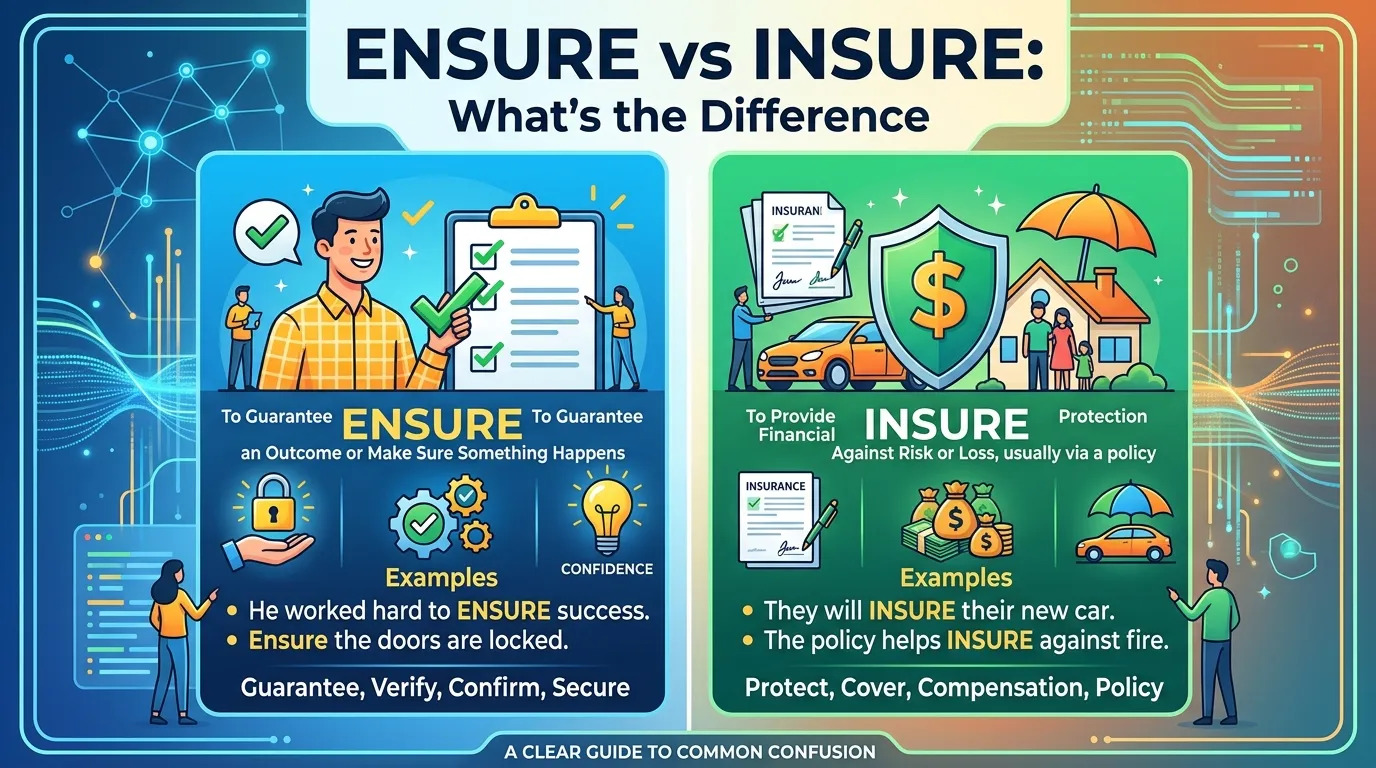
The easiest rule is this: ensure means to make certain that something happens, while insure usually means to protect against financial loss through insurance.
For example:
- “Please ensure that the door is locked.”
- “We need to insure the car.”
Both words are correct spellings. The challenge is knowing which word fits the meaning of your sentence.
This guide explains the difference between ensure and insure, including their meanings, pronunciation, grammar, history, common mistakes, regional usage, formal and informal contexts, and practical examples.
Quick Answer: Ensure vs Insure
Ensure means to make certain or guarantee that something happens.
Please ensure that all forms are completed.
Insure means to protect someone or something financially against a possible loss, damage, accident, or other risk, usually through an insurance policy.
We need to insure the house against fire.
The simplest memory trick
Think:
Ensure = make certain
Insure = insurance
If you are talking about making something happen, use ensure.
If you are talking about an insurance policy or financial protection against risk, use insure.
| Word | Main meaning | Example |
|---|---|---|
| Ensure | Make certain | Ensure that everyone understands. |
| Insure | Protect financially through insurance | Insure the vehicle against damage. |
There is also a third word worth knowing: assure.
Assure generally means to tell someone confidently that something is true or will happen.
I assured her that everything was fine.
So:
- Ensure = make certain
- Insure = provide financial protection
- Assure = give someone confidence
What Does Ensure Mean?
Ensure is a verb meaning to make certain that something happens or is true.
It often describes an action taken to guarantee a particular result.
Dictionary-style definition of ensure
Ensure (verb): to make certain, secure, or guarantee that something happens or is achieved.
Examples:
- Check the figures to ensure accuracy.
- Please ensure that the lights are turned off.
- The company introduced new rules to ensure employee safety.
- Double-check the address to ensure that the package arrives at the correct location.
The word focuses on certainty and results.
Ensure usually introduces a result
A common structure is:
ensure + that + clause
We checked the equipment to ensure that it was working properly.
Another common structure is:
ensure + noun
These measures will ensure safety.
You can also use:
ensure + something + adjective/condition
The manager ensured the room was ready.
What Does Insure Mean?
Insure is a verb associated primarily with insurance and financial protection against risk.
It means to arrange or provide insurance coverage for a person, property, vehicle, business, or other valuable thing.
Dictionary-style definition of insure
Insure (verb): to protect against financial loss or damage by obtaining or providing insurance.
Examples:
- We decided to insure the house.
- She insured her car against theft.
- The company insures commercial properties.
- You should insure expensive equipment before transporting it.
The central idea is risk protection through insurance.
Insure can involve a policy
When you use insure in its traditional sense, there is usually some connection to an insurance arrangement.
For example:
The homeowner insured the property against flooding.
The sentence suggests financial protection through an insurance policy.
Ensure vs Insure: The Key Difference
The most important difference is the type of certainty or protection being discussed.
Ensure focuses on making something happen
The teacher reviewed the instructions to ensure that students understood them.
The teacher is taking an action to make understanding more likely or certain.
Insure focuses on financial protection
The homeowner decided to insure the property against flooding.
The homeowner is protecting the property financially against a possible loss.
Compare these sentences
Please ensure that the documents are stored safely.
This means make certain the documents are stored safely.
Please insure the documents against loss.
This means obtain insurance protection for the documents.
The difference becomes much easier when you ask:
Am I making something certain, or am I protecting it financially?
Ensure vs Insure vs Assure
Many English learners confuse ensure, insure, and assure because all three relate to certainty in some way.
| Word | Meaning | Typical object |
|---|---|---|
| Ensure | Make certain something happens | A result, condition, action |
| Insure | Protect against financial loss | Property, vehicle, person, business |
| Assure | Give someone confidence | A person |
Ensure
We installed a backup system to ensure reliable service.
Insure
The company insured its equipment against damage.
Assure
The manager assured us that the problem would be fixed.
Easy memory rule
Ensure = ensure an outcome.
Insure = insurance.
Assure = assure a person.
Why Do People Confuse Ensure and Insure?
There are several reasons these words cause problems.
1. They look almost identical
Only one letter separates them:
ensure
insure
That makes them easy to mistype or substitute.
2. Their meanings overlap around “certainty”
Insurance provides a type of protection against uncertainty. Ensure also involves certainty.
Because of this conceptual overlap, people sometimes treat the words as interchangeable.
3. Their pronunciations are similar
In many varieties of English, the words are pronounced very similarly.
Ensure: /ɪnˈʃʊr/ or /ɪnˈʃɔːr/
Insure: /ɪnˈʃʊr/ or /ɪnˈʃɔːr/
The exact pronunciation can vary by accent.
4. Historical meanings have overlapped
The words are historically related to the broader idea of making something secure or certain. Modern usage, however, gives insure a much stronger connection with financial insurance.
How to Pronounce Ensure and Insure
In American English, ensure and insure are commonly pronounced very similarly.
Ensure
in-SHUR
Example:
“Please ensure the door is locked.”
Insure
in-SHUR
Example:
“We should insure the vehicle.”
Because their pronunciation is so close, context is more important than sound when distinguishing them.
This is one reason the words are easy to confuse in conversation.
Is Ensure or Insure Correct?
Both are correct words.
Neither spelling is inherently wrong.
The correct choice depends on the intended meaning.
Use ensure when you mean:
- make certain
- guarantee
- make sure
- secure an outcome
- confirm that something happens
Use insure when you mean:
- provide insurance
- obtain insurance
- protect financially
- cover against a specified risk
Incorrect
Please insure that everyone arrives on time.
Better
Please ensure that everyone arrives on time.
There is no insurance involved, so ensure is the appropriate word.
Incorrect for the traditional meaning
We need to ensure the car against theft.
Better
We need to insure the car against theft.
The sentence is about insurance coverage, so insure is the natural choice.
When Should You Use Ensure?
Use ensure when your goal is to make a result, condition, or action certain.
Workplace examples
Please ensure that the report is submitted before Friday.
Managers should ensure that employees receive proper training.
The new process was created to ensure consistency.
Academic examples
Researchers took additional steps to ensure accurate results.
Students should ensure that their sources are properly cited.
Everyday examples
Please ensure the oven is switched off.
Check the address to ensure the package goes to the right place.
We left early to ensure that we arrived on time.
Business examples
The company introduced quality controls to ensure customer satisfaction.
Regular inspections help ensure workplace safety.
In all of these cases, the word means something close to make certain.
When Should You Use Insure?
Use insure when the context involves insurance or financial protection against risk.
Vehicle insurance
You should insure your car before driving it regularly.
Home insurance
The homeowner decided to insure the property against fire.
Business insurance
The company insures its buildings and equipment.
Valuable possessions
She chose to insure the artwork against theft.
Travel-related protection
In everyday language, people more often talk about travel insurance or getting travel insurance than saying “insure the trip,” but the verb can still appear in appropriate contexts.
The important point is that insure has a strong connection with risk, coverage, policies, and financial loss.
Can Ensure and Insure Ever Be Interchangeable?
In modern standard English, you should not normally treat them as interchangeable.
There are historical and regional complications, and some older or specialized usage can blur the distinction. However, for clear modern writing, especially in American English, keeping the meanings separate is the safest approach.
Use:
Ensure the results are accurate.
Not:
Insure the results are accurate.
And use:
Insure the building against fire.
Not:
Ensure the building against fire.
This distinction makes your writing clearer and more professional.
American English vs British English
The distinction between ensure and insure is generally useful in both American and British English.
However, British English has an additional spelling worth knowing:
ensurance
It is relatively uncommon compared with insurance, and ordinary writers generally prefer clearer alternatives.
British English also uses insure in the insurance sense:
You should insure your home.
Meanwhile, ensure retains its meaning of making certain:
Please ensure that the door is locked.
What about “assure”?
British and American English both commonly use assure when referring to giving confidence to a person.
I assure you that everything is under control.
So the basic three-way distinction remains useful across major English varieties.
Ensure vs Insure in Formal Writing
In formal writing, precision matters.
Academic writing
Prefer ensure when discussing procedures or outcomes.
The researchers used multiple checks to ensure the accuracy of the data.
Use insure only when insurance is actually relevant.
The laboratory equipment was insured against accidental damage.
Business writing
Both words can appear frequently, but they perform different jobs.
Ensure:
Please ensure that all invoices are approved.
Insure:
The company insures its commercial vehicles.
Legal writing
Both can appear depending on context.
The agreement is designed to ensure compliance.
The property must be insured against specified risks.
Journalistic writing
Journalists generally choose the word that accurately represents the intended meaning.
Officials introduced new measures to ensure public safety.
versus:
The organization insured its facilities against damage.
Ensure in Technical and Professional Writing
Ensure is especially common in technical, procedural, and professional communication.
You may see phrases such as:
- ensure compliance
- ensure accuracy
- ensure safety
- ensure quality
- ensure consistency
- ensure reliability
- ensure security
- ensure proper operation
- ensure customer satisfaction
- ensure timely delivery
- ensure data integrity
- ensure effective communication
Examples
The software performs regular checks to ensure data integrity.
Engineers tested the system to ensure reliable operation.
Employees must follow these procedures to ensure workplace safety.
These expressions are natural because they describe an intended outcome.
Common Collocations With Ensure
A collocation is a group of words that commonly appear together.
Here are some useful combinations with ensure:
Ensure accuracy
Review the figures to ensure accuracy.
Ensure safety
Employees must follow the rules to ensure safety.
Ensure compliance
The company created new procedures to ensure compliance.
Ensure quality
Inspectors check every product to ensure quality.
Ensure success
Careful planning can help ensure success.
Ensure consistency
Use the same format to ensure consistency.
Ensure fairness
The rules were created to ensure fairness.
Ensure that
Please ensure that your contact information is correct.
This last construction is particularly common.
Common Collocations With Insure
Because insure is associated with insurance, its common combinations are different.
Insure a car
They insured the car against theft.
Insure a house
We need to insure the house.
Insure property
The company insures commercial property.
Insure against damage
The equipment was insured against damage.
Insure against loss
The shipment was insured against loss.
Insure against theft
The artwork was insured against theft.
You will also frequently encounter related nouns such as:
- insurance policy
- insurance coverage
- insured property
- insured vehicle
- insurance company
- insurance claim
- insurance premium
- insurance protection
Common Mistakes With Ensure and Insure
Mistake 1: Using insure to mean “make sure”
Incorrect:
Please insure that you bring your ID.
Correct:
Please ensure that you bring your ID.
Even more naturally in casual American English:
Please make sure you bring your ID.
Mistake 2: Using ensure for insurance
Incorrect:
I need to ensure my car.
Correct:
I need to insure my car.
Mistake 3: Confusing ensure with assure
Incorrect:
I ensured him that everything was fine.
Correct:
I assured him that everything was fine.
Why?
Because you assure a person, while you ensure a result or condition.
Mistake 4: Assuming the words differ only by spelling
They are not simply alternate spellings in standard modern usage.
Changing ensure to insure can change the meaning of a sentence.
Awkward vs Natural Examples
| Awkward or incorrect | Natural |
|---|---|
| Please insure that the door is locked. | Please ensure that the door is locked. |
| We need to ensure the car against theft. | We need to insure the car against theft. |
| She insured everyone understood the rules. | She ensured everyone understood the rules. |
| The company ensured its building against fire. | The company insured its building against fire. |
| I ensured him that it was safe. | I assured him that it was safe. |
These examples show why meaning matters more than spelling.
Formal vs Informal Alternatives to Ensure
In casual conversation, make sure is often more natural than ensure.
Formal
Please ensure that the door is locked.
Neutral
Please make sure the door is locked.
Professional
Please ensure that all documents are complete.
Casual
Make sure all the documents are complete.
Ensure is not necessarily overly formal, but it appears frequently in professional, academic, technical, and official writing.
Synonyms for Ensure
Depending on context, synonyms include:
- make certain
- make sure
- guarantee
- secure
- confirm
- establish
- verify
- safeguard
- assure
However, these words are not perfect substitutes in every sentence.
For example:
Please ensure that the information is correct.
Could become:
Please make sure that the information is correct.
But:
Please guarantee that the information is correct.
sounds stronger and may imply a formal promise.
Always choose a synonym based on the exact meaning you want.
Synonyms for Insure
Depending on context, related expressions include:
- provide insurance
- cover
- protect financially
- underwrite
- obtain coverage for
- take out insurance on
For example:
We need to insure the building.
Could become:
We need to obtain insurance coverage for the building.
In everyday American English, people often use get insurance rather than the verb insure.
We need to get insurance for the building.
Antonyms and Opposite Ideas
Neither ensure nor insure has one perfect antonym in every situation.
For ensure, possible opposites include:
- prevent
- undermine
- jeopardize
- endanger
- leave uncertain
For insure, related opposite ideas can include:
- leave uninsured
- expose to risk
- leave unprotected
The correct opposite depends heavily on context.
Word History and Etymology
The histories of ensure and insure help explain why they look so similar.
Both words are connected to the idea of making something secure or certain. Their development is tied to older French and Latin-related vocabulary involving ideas such as security and certainty.
Over time, English developed specialized uses.
Ensure became strongly associated with making something certain or securing a result.
Insure developed a specialized connection with insurance and protection against financial risk.
This historical relationship helps explain why the words are easy to confuse even though modern usage usually separates them.
Ensure vs Insure in Everyday American English
In everyday American speech and writing, ensure is often replaced by the more conversational phrase make sure.
For example:
Make sure you lock the door.
sounds more conversational than:
Ensure that you lock the door.
Both can be grammatically correct.
However, ensure is very common in:
- workplace communication
- instructions
- manuals
- policies
- reports
- academic writing
- professional emails
- technical documentation
- government writing
Meanwhile, insure appears naturally when discussing insurance.
Did you insure the car?
Is the house insured?
The company insures commercial properties.
Ensure vs Insure in Business Writing
Business writers frequently need both words.
Consider this example:
The company introduced new safety procedures to ensure that employees are protected. It also insured its facilities against property damage.
Both words are correct because they perform different functions.
Ensure describes an action intended to create a particular outcome.
Insured describes financial protection against risk.
Business writing tip
When proofreading a business document, search for every occurrence of insure and ask:
Is this actually about insurance?
If not, ensure may be the better choice.
Ensure vs Insure in Blogging and Content Writing
Content writers should pay particular attention to this distinction because incorrect word choice can make otherwise strong content look less polished.
Better
Follow these steps to ensure a smooth installation.
Not appropriate
Follow these steps to insure a smooth installation.
The installation is not being covered by an insurance policy. The writer means make certain.
On the other hand:
Make sure your business is properly insured.
Here insured is correct because the subject is insurance protection.
Memory Tricks for Ensure vs Insure
If you regularly mix these words up, try one of these tricks.
Memory Trick 1: Insurance = Insure
The most useful trick is:
INSURE → INSURANCE
They begin with the same insur- sound and letters.
If the sentence involves a policy, coverage, premiums, claims, property protection, or financial risk, think insure.
Memory Trick 2: Ensure = Make certain
Think:
ENSURE = ENSURE the outcome
If you could replace the word with make sure, ensure is probably correct.
Ensure that the window is closed.
→ Make sure the window is closed.
Memory Trick 3: Three-word rule
Remember:
Ensure an outcome.
Insure an asset.
Assure a person.
This simple pattern covers a large number of everyday situations.
A Simple Decision Guide
When you are unsure which word to use, ask these questions:
Question 1: Am I talking about insurance?
If yes, use insure.
We should insure the property.
Question 2: Am I making something certain?
If yes, use ensure.
We should ensure the property is secure.
Question 3: Am I giving someone confidence?
If yes, use assure.
We assured the customer that the issue was resolved.
Question 4: Would “make sure” work?
If yes, ensure is usually the right choice.
Ensure that all doors are locked.
→ Make sure all doors are locked.
Quick Comparison: Ensure vs Insure vs Assure
| Feature | Ensure | Insure | Assure |
|---|---|---|---|
| Part of speech | Verb | Verb | Verb |
| Core meaning | Make certain | Provide insurance | Give confidence |
| Common object | Result/condition | Property/risk | Person |
| Related noun | Ensurance is uncommon | Insurance | Assurance |
| Example | Ensure accuracy. | Insure the car. | Assure her everything is fine. |
| Common synonym | Make sure | Cover | Reassure |
| Insurance context | No | Yes | No |
Real-World Examples
At home
Please ensure all windows are closed before leaving.
We need to insure the house.
At work
The manager checked the report to ensure accuracy.
The business insures its office equipment.
At school
Students should ensure that their assignments are submitted on time.
In transportation
Check the fuel level to ensure the vehicle is ready.
The owner insured the vehicle against theft.
In technology
The system uses encryption to ensure data security.
In business
The company created backup procedures to ensure continuity.
The company insured its equipment against damage.
Is “Ensure That” Correct?
Yes. Ensure that is one of the most common grammatical constructions.
Examples:
Please ensure that your application is complete.
We need to ensure that the system is functioning properly.
The teacher ensured that every student received the instructions.
It means make certain that.
You can often replace it with make sure that in informal writing.
Is “Insure That” Ever Correct?
It can appear in older, regional, or less common usage, but in modern standard American English, insure that is generally best avoided when you mean make certain that.
Instead, write:
Ensure that the information is accurate.
This removes ambiguity and follows the clearest modern distinction.
If insure is being used in the literal insurance sense, it normally relates to something being covered or protected against risk.
The company insured the equipment against theft.
Which Is More Common: Ensure or Insure?
The answer depends on context.
Ensure is common in general writing because people frequently need to describe actions taken to guarantee a result.
Insure is common in financial and insurance contexts.
They should not be compared simply by frequency because they belong to different semantic fields.
For example, a workplace safety document may use ensure many times but never use insure.
An insurance policy may use insure, insured, and insurance repeatedly while having little reason to use ensure.
Frequently Asked Questions
Is ensure the same as insure?
No. Ensure usually means to make certain that something happens, while insure usually means to provide or obtain insurance protection against financial loss or risk.
Should I say “ensure” or “insure” that?
In standard modern American English, use ensure that when you mean make certain that.
Please ensure that all information is correct.
Is “insure” a correct spelling?
Yes. Insure is a standard English word. It is commonly used when talking about insurance or financial protection.
Is “ensure” a correct word?
Yes. Ensure is a standard English verb meaning to make certain or guarantee an outcome.
What is the difference between ensure and assure?
Ensure means to make something certain. Assure usually means to give a person confidence that something is true or will happen.
Ensure the report is complete.
Assure the client that the report is complete.
What is the easiest way to remember ensure vs insure?
Remember insurance = insure. If you mean make sure, use ensure.
Is “make sure” better than “ensure”?
Neither is always better. Make sure sounds more conversational, while ensure is common in professional, academic, technical, and formal writing.
Can ensure mean protect?
Sometimes ensure can imply securing a desired condition, but it does not normally mean financial protection through insurance. For insurance coverage, use insure.
Is “ensure safety” correct?
Yes. Ensure safety is a standard and natural expression.
The new rules are designed to ensure safety.
Is “insure safety” correct?
Usually not if you mean make safety certain or promote safety. In that context, use ensure safety.
Conclusion
The difference between ensure vs insure becomes easy once you focus on meaning rather than spelling.
Use ensure when you mean make certain, make sure, or guarantee that something happens.
Please ensure that everyone receives a copy.
Use insure when you mean provide or obtain insurance protection against financial loss or risk.
We need to insure the vehicle against theft.
And remember the related word assure:
I assured her that everything would be fine.
For most everyday writing, this three-part rule works well:
Ensure an outcome.
Insure an asset.
Assure a person.
If you are writing for an American audience, keeping these distinctions clear will make your grammar more precise and your writing more professional. When in doubt, replace ensure with make sure. If that substitution works, ensure is probably the word you want. If you are discussing an insurance policy, coverage, financial risk, or protection against loss, choose insure.