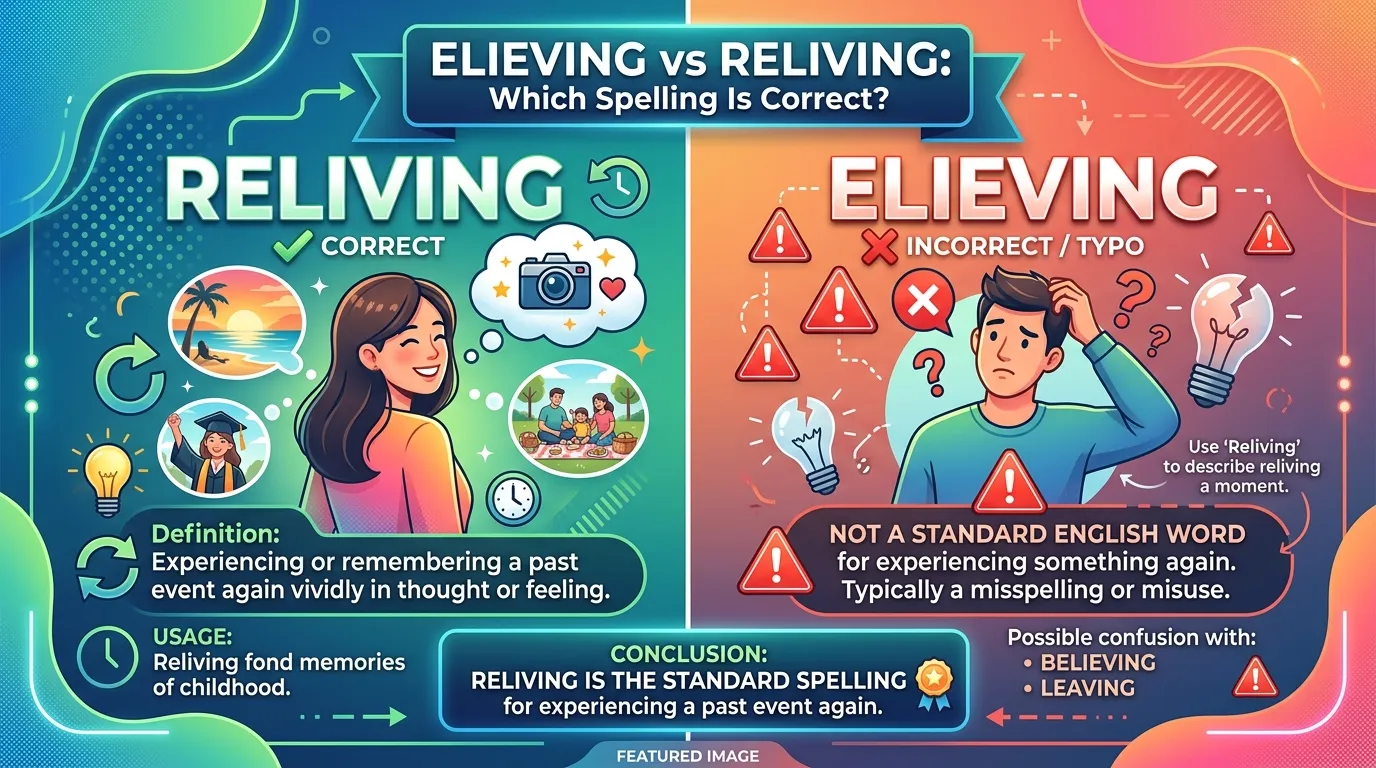
If you are wondering about elieving vs reliving, the correct standard English word is reliving. The spelling elieving is generally incorrect when you mean experiencing something again or remembering an event as though it were happening again.
Reliving comes from the verb relive, meaning to experience something again, especially a past event, memory, emotion, or moment. For example, She enjoyed reliving her childhood memories.
The confusion usually happens because the first syllable of reliving is easy to miss when the word is pronounced quickly. This article explains the difference between elieving and reliving, including their meanings, pronunciation, grammar, etymology, common mistakes, synonyms, examples, and practical usage in American and international English.
Quick Answer: Elieving vs Reliving
Reliving is the correct spelling when you mean experiencing something again.
| Word | Correct? | Meaning | Example |
|---|---|---|---|
| Reliving | ✅ Yes | Experiencing something again | He is reliving his favorite childhood memories. |
| Elieving | ❌ Generally no | Not the standard spelling of this word | She is elieving the experience. |
The simple rule
Use reliving when the idea is living or experiencing something again.
relive → reliving
The prefix re- means again, while living relates to experiencing life or an event.
Correct: I am reliving that wonderful moment.
Incorrect: I am elieving that wonderful moment.
What Does Reliving Mean?
Reliving is the present participle or gerund form of the verb relive.
To relive something means to experience it again, usually through memory, imagination, conversation, photographs, videos, or another reminder of the past.
For example:
- We spent the evening reliving our college days.
- The movie had me reliving my childhood.
- She keeps reliving the moment in her mind.
- Fans are reliving the team’s historic victory.
- Looking through old photographs brought back memories and made him feel as if he were reliving the past.
The word can describe both pleasant and unpleasant experiences.
Positive examples
- reliving a wedding day
- reliving a childhood memory
- reliving a championship victory
- reliving a family vacation
- reliving a successful performance
Difficult examples
- reliving a painful experience
- reliving a frightening event
- reliving a traumatic memory
- reliving an embarrassing moment
- reliving a stressful situation
So, reliving does not automatically have a positive or negative meaning. Its emotional tone depends on the context.
Is Elieving a Correct Word?
In standard modern English, elieving is not the normal spelling of the word meaning “experiencing again.”
If you intend to describe someone experiencing a past event again, the correct word is:
reliving
For example:
The documentary allowed viewers to relive the historic event.
Not:
The documentary allowed viewers to elieve the historic event.
Why does “elieving” appear online?
Misspellings often appear because English spelling does not always match pronunciation perfectly. People may hear reliving without clearly noticing the initial r and write elieving.
Typing mistakes, speech-to-text errors, informal online writing, and unfamiliarity with the word can also contribute to the spelling.
If you are writing for school, work, journalism, business, academic purposes, or professional communication, use reliving.
Reliving vs Elieving: Key Differences
The main difference is straightforward:
- Reliving is the standard English word.
- Elieving is generally a misspelling when used with this meaning.
Meaning
Reliving: experiencing something again, especially something from the past.
Elieving: not the standard spelling for this meaning.
Grammar
Reliving can function as:
- a present participle
- a gerund
- part of a progressive verb phrase
Examples:
She is reliving the experience.
Here, reliving is part of the present progressive verb phrase is reliving.
Reliving the memory made him smile.
Here, reliving functions as a gerund.
Spelling
The correct spelling is:
R-E-L-I-V-I-N-G
Not:
E-L-I-E-V-I-N-G
Why Do People Confuse Elieving and Reliving?
Several factors can cause this spelling confusion.
The pronunciation can hide the first sound
In natural speech, people often say words quickly. The initial r in reliving may not receive strong emphasis.
This can make the word sound less distinct to an inexperienced listener.
The base word is easy to overlook
The word comes from:
relive + ing = reliving
Understanding the base word makes the spelling much easier to remember.
English prefixes can be confusing
The prefix re- appears in many English words:
- redo
- replay
- reread
- revisit
- rebuild
- remember
- relive
Because re- commonly means again, it makes sense that relive means to live or experience again.
Typing and autocorrect
People sometimes type what they hear rather than what they know to be the correct spelling. A search for a misspelled form may then reinforce the confusion.
Reliving: Dictionary-Style Definition
Relive
Verb: to experience something again, especially an event or feeling from the past.
Reliving
Present participle / gerund: experiencing something again.
Example:
He enjoyed reliving the memories of his first trip abroad.
Simple definition
Reliving means experiencing, remembering, or emotionally revisiting something from the past as though it were happening again.
How to Pronounce Reliving
Reliving is commonly pronounced approximately as:
ree-LIV-ing
The pronunciation can be represented in IPA as:
/ˌriːˈlɪvɪŋ/
The main stress falls on the second syllable:
re-LIV-ing
Compare:
- replay: ree-PLAY
- revisit: ree-VIZ-it
- relive: ree-LIV
- reliving: ree-LIV-ing
The pronunciation reinforces the spelling because reliving clearly contains the word live.
Why Is Reliving Spelled With One “E” Before the Suffix?
The spelling becomes clearer when you start with the base verb:
relive
Then add -ing:
relive + ing
The final silent e is dropped before the -ing ending:
relive → reliving
This is the same general spelling pattern seen in words such as:
- live → living
- give → giving
- drive → driving
- write → writing
- make → making
Therefore:
relive → reliving
not relieve → relieving.
This distinction is particularly important because relieving is a real English word with a completely different meaning.
Reliving vs Relieving: An Important Difference
One reason elieving can be confusing is that it resembles relieving.
These are different words.
Reliving
Reliving means experiencing something again.
She was reliving her childhood memories.
Relieving
Relieving comes from relieve and means reducing pain, stress, difficulty, or discomfort.
The medicine is relieving his pain.
Compare them:
| Word | Base verb | Meaning |
|---|---|---|
| Reliving | relive | Experiencing again |
| Relieving | relieve | Reducing pain, stress, or difficulty |
Easy memory trick
Think:
reliving = living again
relieving = making something less difficult
Examples:
The photograph had me reliving an old memory.
The treatment is relieving the pain.
Grammatical Uses of Reliving
Reliving has several grammatical functions.
Reliving as part of a progressive verb
She is reliving her childhood.
They are reliving the excitement of the final game.
I was reliving the conversation in my head.
Reliving as a gerund
A gerund is an -ing form that functions as a noun.
Reliving the memory brought tears to her eyes.
Here, reliving the memory acts as the subject of the sentence.
Another example:
Reliving the experience helped him understand what happened.
Reliving after certain verbs
The word can follow verbs such as:
- enjoy
- avoid
- keep
- start
- begin
- continue
- imagine
Examples:
She enjoys reliving old memories.
He keeps reliving the same moment.
They began reliving their school days.
Literal and Figurative Meanings of Reliving
Reliving can be used literally or figuratively.
Literal use
A person may revisit an event through a physical experience.
The museum lets visitors relive life in an ancient village.
Here, visitors are metaphorically or practically recreating an earlier experience.
Emotional or mental use
This is one of the most common meanings.
He kept reliving the argument in his mind.
The person is not literally traveling back in time. Instead, the memory is being experienced again mentally.
Nostalgic use
Reliving often appears in nostalgic writing.
Looking through the album felt like reliving our childhood.
Sports use
Sports writers frequently use relive and reliving when discussing famous games.
Fans are reliving the team’s dramatic championship win.
The documentary allows viewers to relive the final seconds of the game.
Entertainment use
Movies, documentaries, historical programs, and video games may help audiences relive earlier events.
The film lets audiences relive one of the most important moments in the character’s life.
Common Collocations With Reliving
A collocation is a group of words that naturally appear together.
Common combinations with reliving include:
- reliving memories
- reliving the past
- reliving an experience
- reliving a moment
- reliving childhood
- reliving history
- reliving an event
- reliving a victory
- reliving a conversation
- reliving a dream
- reliving an adventure
- reliving a painful experience
- reliving old memories
- reliving happy memories
- reliving the excitement
Natural examples
She spent the afternoon reliving happy memories.
The players were reliving their championship victory.
He couldn’t stop reliving the conversation.
The documentary gives viewers a chance to relive history.
Common Phrases and Expressions With Relive
Although reliving is not normally part of a fixed idiom, several natural expressions are common.
Relive the past
He does not want to relive the past.
Relive a memory
The old song helped her relive a special memory.
Relive the moment
The replay lets fans relive the moment.
Relive an experience
We watched the video to relive the experience.
Relive childhood
The reunion gave them a chance to relive their childhood.
These expressions are useful in everyday writing, journalism, marketing, storytelling, and conversation.
Reliving in American English
In American English, reliving is the standard spelling.
It is widely used in:
- everyday conversation
- books
- journalism
- sports coverage
- entertainment writing
- personal essays
- academic writing
- business storytelling
- blogs
- social media
Examples:
I’m reliving my college days through these old photos.
The team is reliving its greatest season.
The documentary lets viewers relive the event.
There is no common American spelling variation that changes reliving to elieving.
Reliving in British English
Reliving is also the standard spelling in British English.
For this particular word, American and British English do not normally differ.
For example:
American English:
Fans are reliving the historic victory.
British English:
Fans are reliving the historic victory.
The spelling remains the same.
This is therefore not an American versus British spelling issue. It is primarily a correct spelling versus incorrect spelling issue.
Reliving in International English
English learners around the world should use reliving when referring to experiencing something again.
The same spelling is appropriate in:
- international business English
- academic English
- ESL writing
- professional communication
- online publishing
- formal correspondence
If you are unsure, remember the base verb:
relive → reliving
Reliving in Academic Writing
In academic writing, reliving can be useful when discussing memory, psychology, history, literature, personal narratives, or cultural experiences.
Examples:
The novel explores the character’s experience of reliving painful memories.
Participants described reliving important events through photographs.
The study examined how people experience memories as though they were reliving the original event.
However, academic writers should choose precise language. Depending on the subject, alternatives such as recalling, remembering, reexperiencing, or reconstructing memories may be more appropriate.
Reliving in Business and Professional Writing
The word can be useful in professional storytelling, presentations, marketing, and company histories.
Examples:
The anniversary video allows employees to relive the company’s early years.
Customers can relive memorable moments through our interactive archive.
The presentation takes the audience through the events that shaped the organization.
For highly formal documents, however, revisiting, reviewing, or recalling may sound more precise.
Reliving in Journalism
Journalists frequently use relive and reliving in human-interest stories, sports reporting, entertainment coverage, and historical features.
Examples:
Fans are reliving the dramatic final match through a new documentary.
Survivors described reliving the event decades later.
The exhibition gives visitors an opportunity to relive the city’s history.
The word is especially effective when the writer wants to emphasize the emotional experience of remembering.
Reliving in Sports Writing
Sports coverage makes frequent use of this vocabulary.
Common combinations include:
- reliving a victory
- reliving a championship
- reliving the final
- reliving the game
- reliving a historic moment
- reliving an unforgettable performance
Examples:
Fans are reliving the team’s championship run.
The replay allows viewers to relive the final seconds.
Former players gathered to relive their greatest victory.
This usage is usually figurative. Nobody is literally traveling back in time.
Reliving in Casual Conversation
In everyday conversation, reliving sounds natural and familiar.
I was just reliving that funny story from college.
These pictures have me reliving our vacation.
I keep reliving that embarrassing moment.
Let’s watch the video and relive the good times.
The expression relive the good times is particularly common in informal contexts.
Formal vs Informal Alternatives
Depending on your audience, you may replace reliving with another word.
| Context | Natural choice |
|---|---|
| Casual conversation | reliving |
| Personal writing | reliving |
| Storytelling | reliving |
| Journalism | reliving / revisiting |
| Academic writing | reexperiencing / recalling |
| Business writing | revisiting / recalling |
| Historical writing | revisiting / recreating |
| Technical writing | reexperiencing, recalling, or repeating, depending on meaning |
The best synonym depends on what you actually mean.
Synonyms for Reliving
There is no single synonym that works in every situation.
Useful alternatives include:
- reexperiencing
- recalling
- remembering
- revisiting
- recreating
- replaying
- reminiscing about
- thinking back on
- reflecting on
- going back over
Example comparison
She was reliving the memory.
Could become:
She was recalling the memory.
or:
She was revisiting the memory.
or:
She was reexperiencing the event.
However, these alternatives are not always identical.
Reliving often suggests a stronger emotional or vivid experience than simply remembering.
Antonyms of Reliving
The exact opposite depends on the context.
Possible contrasting ideas include:
- forgetting
- ignoring
- moving on
- letting go
- experiencing something for the first time
- looking toward the future
For example:
Instead of reliving the past, she decided to focus on the future.
Reliving vs Remembering
These words are related but not identical.
Remembering means bringing something from the past to mind.
Reliving can suggest experiencing the memory with stronger emotional or sensory detail.
Compare:
I remember my first day at school.
This simply states that you have a memory.
I can still relive my first day at school whenever I look at those photographs.
This suggests a more vivid return to the experience.
Reliving vs Revisiting
Revisiting can mean examining or returning to something again, either physically or mentally.
Reliving emphasizes experiencing something again.
The author revisits themes from her childhood.
The author relives her childhood through her memoir.
Both can work, but they create slightly different impressions.
Reliving vs Reexperiencing
Reexperiencing is more formal and is often used in academic, psychological, or clinical contexts.
Reliving is more accessible and conversational.
Compare:
The character is reliving the event.
The character is reexperiencing the event.
The second version sounds more technical.
Common Mistakes With Reliving
Mistake: Elieving
❌ She is elieving her childhood.
✅ She is reliving her childhood.
Mistake: Relieveing
❌ He is relieveing the moment.
✅ He is reliving the moment.
Notice that relieving and reliving are different words.
Mistake: Reliveing
❌ They are reliveing the experience.
✅ They are reliving the experience.
The final e in relive is dropped before -ing.
Mistake: Using remember when reliving is intended
The documentary makes viewers remember the event.
This is grammatically correct, but:
The documentary makes viewers relive the event.
can communicate a stronger sense of emotional or vivid experience.
Awkward vs Natural Examples
Example One
Awkward or incorrect:
She is elieving her childhood.
Natural:
She is reliving her childhood.
Example Two
Incorrect:
The fans are elieving the final.
Natural:
The fans are reliving the final.
Example Three
Incorrect:
He keeps relieveing the experience.
Natural:
He keeps reliving the experience.
Example Four
Less precise:
The photographs made her think about the past.
More vivid:
The photographs made her relive the past.
How to Remember the Correct Spelling
The easiest memory trick is:
Think “live again”
RE + LIVE = RELIVE
Then:
RELIVE + ING = RELIVING
You can break it into:
RE + LIV + ING
Remember:
Reliving contains LIVE.
That makes elieving easy to reject when you mean experiencing something again.
Another useful comparison is:
relive → reliving
just as:
live → living
A Simple Spelling Formula
Use this formula whenever you hesitate:
re + live = relive
relive + ing = reliving
Therefore:
✅ reliving
Not:
❌ elieving
And not:
❌ reliveing
And not, when you mean this particular word:
❌ relieving
Word History and Etymology of Relive
The word relive is formed from the prefix re- and the verb live.
The prefix re- is widely used in English to express ideas such as:
- again
- back
- anew
Examples include:
- rebuild
- reread
- rewrite
- replay
- revisit
- reconsider
- relive
The verb live has a long history in English and Germanic languages. Combining re- with live produces the basic idea of living or experiencing again.
The spelling reliving follows the normal English spelling rule in which the final silent e of relive is removed before adding -ing.
Does Reliving Have a Slang Meaning?
Reliving does not have a major separate slang meaning in standard American English.
However, informal speakers may use it creatively.
For example:
I’m reliving my teenage years through this playlist.
This does not mean the speaker is literally becoming a teenager again. It means the music brings back the feelings, memories, or atmosphere of that period.
Social media users may also use reliving in captions:
Reliving the best weekend ever.
Reliving this unforgettable trip.
These are informal but completely understandable uses.
Does Reliving Have a Political Meaning?
Reliving has no special political definition.
However, political commentators may use it when discussing historical events.
Examples:
The debate has brought back fears of reliving an earlier political crisis.
The country is trying to avoid reliving the mistakes of the past.
Here, the word is being used figuratively to suggest that history may repeat itself.
Does Reliving Have a Technical Meaning?
Reliving is not primarily a technical term.
However, technical or professional fields may use it in specialized discussions of:
- virtual reality
- simulations
- historical reconstruction
- digital archives
- interactive media
- memory research
For example:
The virtual museum allows users to relive historical events through immersive simulations.
In such contexts, relive still carries its ordinary meaning of experiencing something again.
Real-World Examples of Reliving
Here are examples across different situations.
Family
We spent Thanksgiving reliving stories from our childhood.
Travel
The photos let us relive our trip to the mountains.
School
The reunion gave former classmates a chance to relive their school days.
Sports
The documentary lets fans relive the team’s championship season.
Music
That song makes me relive my teenage years.
Relationships
They enjoyed reliving the memories of their first date.
History
The museum helps visitors relive an important period in the nation’s history.
Personal reflection
He spent years reliving the decision in his mind.
Entertainment
The new series allows audiences to relive the original story.
When Should You Use Reliving?
Use reliving when you want to communicate that someone is experiencing a past event, memory, feeling, or period again.
It is especially useful when the experience is:
- vivid
- emotional
- nostalgic
- memorable
- intense
- meaningful
For simple mental recall, remembering may be enough.
For a vivid return to an experience, reliving is often stronger.
When Should You Avoid Reliving?
There is no grammatical problem with reliving, but another word may be more precise in some contexts.
For example, instead of:
The researcher studied people reliving information.
you might write:
The researcher studied people recalling information.
If the meaning is simply retrieving information from memory, recalling is more precise.
Likewise, if you mean examining an old topic again, revisiting may be better.
Reliving vs Repeating
These words should not be confused.
Reliving usually involves an experience or memory from the past.
Repeating means doing or saying something again.
She is reliving the memory.
The memory is being experienced again.
She is repeating the exercise.
The exercise is being performed again.
Reliving vs Recreating
Reliving focuses on experiencing or remembering an earlier event.
Recreating means making something resemble the original event again.
The documentary helps viewers relive the event.
The museum is recreating the event for visitors.
The two concepts can overlap, but they are not identical.
SEO and Content Writing Tips for Using Reliving
If you are writing a blog post, article, headline, caption, or story, reliving is useful when the content focuses on memories or past experiences.
Natural phrases include:
- reliving old memories
- reliving childhood memories
- reliving the past
- reliving special moments
- reliving unforgettable experiences
- reliving historic moments
- reliving happy memories
- reliving a memorable journey
- reliving the best moments
- reliving an emotional experience
Avoid forcing the word into sentences where remembering, recalling, or revisiting is more accurate.
Good SEO writing should prioritize meaning and natural language rather than repeating the same keyword unnecessarily.
A Complete Comparison: Elieving vs Reliving
| Feature | Elieving | Reliving |
|---|---|---|
| Standard English word for this meaning | ❌ No | ✅ Yes |
| Meaning | Not applicable in standard usage | Experiencing something again |
| Base verb | — | Relive |
| Prefix | — | Re- |
| Common usage | Misspelling | Standard |
| American English | Not standard | Standard |
| British English | Not standard | Standard |
| Academic writing | Avoid | Appropriate when precise |
| Business writing | Avoid | Appropriate when relevant |
| Casual writing | Avoid | Common |
| Sports writing | Avoid | Common |
| Historical writing | Avoid | Common |
| Pronunciation | Not applicable as the intended standard word | ree-LIV-ing |
| Correct spelling | — | Reliving |
10 Quick Examples to Check Your Spelling
- Correct: I am reliving my favorite childhood memories.
- Correct: The movie lets us relive the past.
- Correct: Fans are reliving the team’s greatest victory.
- Correct: She keeps reliving that conversation.
- Correct: The photographs helped him relive the trip.
- Incorrect: I am elieving my favorite memories.
- Incorrect: They are elieving the championship.
- Incorrect: She is reliveing the moment.
- Incorrect: He is relieveing the experience.
- Correct: He is reliving the experience.
FAQs
Is reliving the correct spelling?
Yes. Reliving is the correct standard spelling when you mean experiencing something again. It comes from relive, which means to experience something from the past again.
Is elieving a word?
Elieving is not the standard English spelling for the idea of experiencing something again. If that is your intended meaning, use reliving.
What is the difference between reliving and relieving?
Reliving means experiencing something again, while relieving means reducing pain, stress, difficulty, or discomfort. For example, reliving a memory and relieving pain have completely different meanings.
How do you spell reliving?
The correct spelling is R-E-L-I-V-I-N-G: reliving. The final e in relive is dropped before adding -ing.
What does reliving mean?
Reliving means experiencing a past event, memory, emotion, or moment again, often in a vivid or emotional way.
How do you pronounce reliving?
Reliving is commonly pronounced ree-LIV-ing, with the main stress on LIV.
Is reliving used in American English?
Yes. Reliving is standard and common in American English. It is used in everyday conversation, journalism, sports writing, storytelling, business communication, and many other contexts.
Is reliving used in British English?
Yes. Reliving is also the standard spelling in British English. There is no major American versus British spelling difference for this word.
What are some synonyms for reliving?
Depending on the context, synonyms include reexperiencing, recalling, remembering, revisiting, recreating, replaying, reminiscing about, and thinking back on. These words are not always interchangeable.
How can I remember the spelling of reliving?
Think of reliving as living again: re + live = relive, then relive + ing = reliving. The key is remembering that the word contains live.
Conclusion
When comparing elieving vs reliving, the answer is clear: reliving is the correct standard spelling when you mean experiencing something again.
The word comes from relive, combining re-, meaning again, with live. When -ing is added, the final silent e is dropped:
relive → reliving
Do not confuse reliving with relieving, which means reducing pain or difficulty. Also avoid elieving and reliveing when you mean experiencing a past event again.
For American English, British English, academic writing, journalism, business communication, sports writing, blogging, and everyday conversation, reliving is the reliable choice.
The easiest memory trick is simple: reliving means living or experiencing something again. Once you remember the base word relive, the correct spelling becomes much easier to recognize and use.