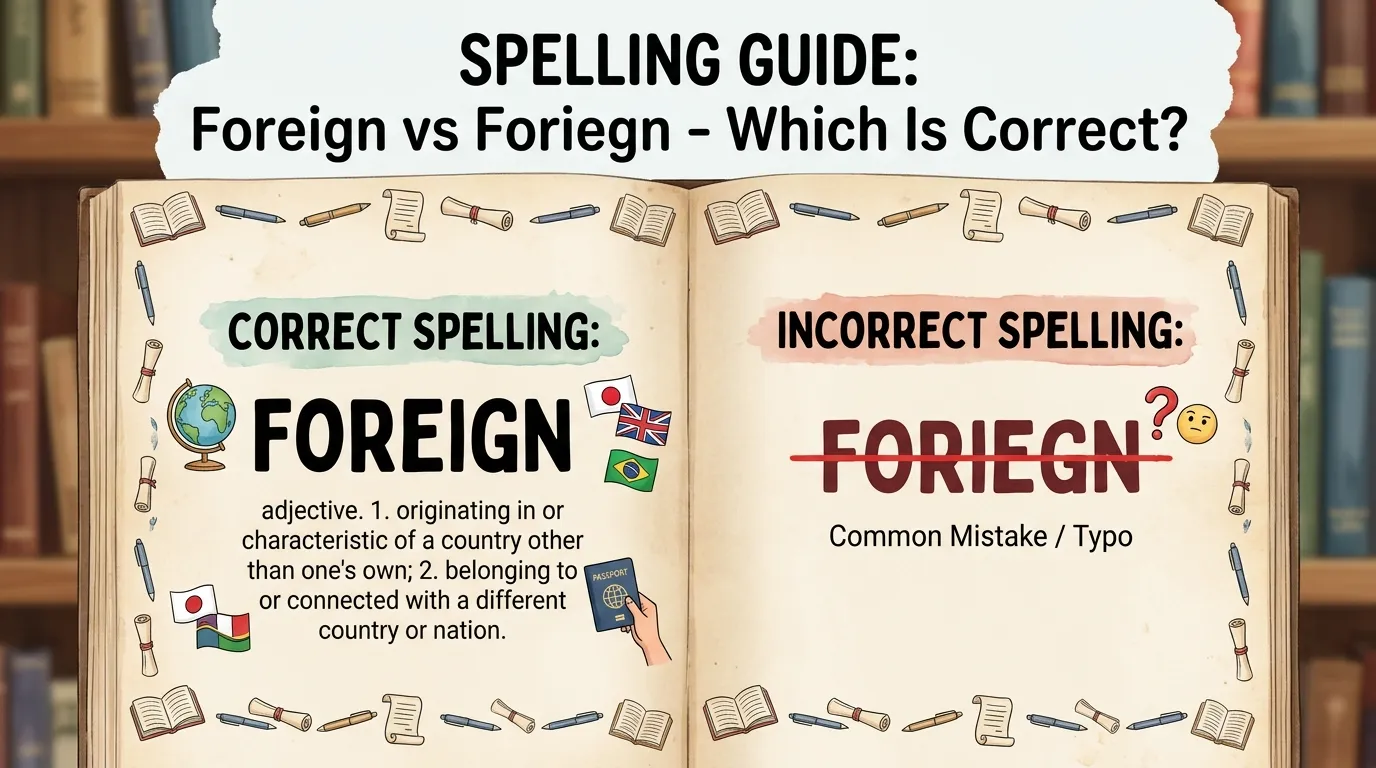
If you are wondering whether foreign or foriegn is the correct spelling, the answer is simple: foreign is correct, while foriegn is a misspelling.
The confusion is common because the word foreign does not follow the spelling pattern many English learners expect. The letters e and i appear in an unusual order, and the pronunciation does not clearly reveal how the word should be spelled. As a result, people often write foriegn when they mean foreign.
In this guide, you will learn the difference between foreign vs foriegn, their meanings, pronunciation, grammatical roles, history, common expressions, spelling mistakes, synonyms, examples, and useful memory tricks. You will also see how foreign works in American English, British English, academic writing, business communication, journalism, sports, technology, and everyday conversation.
Quick Answer: Foreign or Foriegn?
Foreign is the correct spelling.
Foriegn is incorrect.
| Spelling | Correct? | Meaning |
|---|---|---|
| foreign | Yes | Related to another country, culture, language, or place |
| foriegn | No | Common misspelling of foreign |
Correct examples
- She speaks foreign languages.
- He enjoys foreign films.
- The company imports foreign products.
- They are studying foreign policy.
- We traveled to a foreign country.
Incorrect examples
- She speaks foriegn languages.
- He watches foriegn films.
- The company imports foriegn products.
The correct spelling is always foreign.
What Does Foreign Mean?
The adjective foreign generally describes something that comes from, belongs to, or is connected with another country or another place.
A dictionary style definition would be:
Foreign: originating in, belonging to, relating to, or characteristic of a country or place other than one’s own.
The meaning depends on context.
For example:
- foreign country means another country.
- foreign language means a language from another country or a language not native to the speaker.
- foreign visitor means a visitor from another country.
- foreign company means a company based in another country.
- foreign policy means a government’s approach to relationships with other countries.
- foreign currency means money used by another country.
The word can also describe something that is unfamiliar or outside a particular group, system, or environment.
For example:
The idea was completely foreign to him.
Here, foreign does not mean another country. It means unfamiliar or strange to him.
Why Do People Spell Foreign as Foriegn?
The mistake foriegn is understandable because English spelling and pronunciation do not always match.
Many people learn spelling rules such as:
I before E except after C.
That rule can make words containing ie and ei confusing. The spelling of foreign does not follow the pattern people may expect.
The correct sequence is:
f o r e i g n
A common incorrect sequence is:
f o r i e g n
The difference is only the position of e and i, but that small change makes the spelling incorrect.
Another reason for the confusion is pronunciation. In American English, foreign is generally pronounced approximately like:
FOR-in
The g is not pronounced as a separate hard or soft consonant, and the spelling does not provide an obvious pronunciation clue.
Because the written form and spoken form are quite different, learners may remember the sound without remembering the exact spelling.
Foreign vs Foriegn: Key Difference
The main difference is spelling, not meaning.
Foreign is the standard English word.
Foriegn is simply a spelling error.
There is no separate definition for foriegn. It is not an alternative American spelling, British spelling, informal spelling, slang form, or technical term.
| Feature | Foreign | Foriegn |
|---|---|---|
| Standard English | Yes | No |
| Correct spelling | Yes | No |
| Dictionary word | Yes | No |
| Used in formal writing | Yes | No |
| Used in academic writing | Yes | No |
| Used in business writing | Yes | No |
| Used in casual writing | Yes | No |
| Pronunciation | Usually like “FOR-in” | Intended as foreign |
| Recommended usage | Use it | Avoid it |
If you are writing an email, essay, article, report, resume, school assignment, business document, or social media post, use foreign.
How to Spell Foreign Correctly
The spelling is:
F O R E I G N
Break it visually into:
FORE + IGN
Although this division is not a normal pronunciation guide, it can help you remember the letter order.
Common incorrect spellings
People may accidentally write:
- foriegn
- foriegns
- foregin
- forein
- forign
- fourign
The most common mistake is usually foriegn.
Correct forms
- foreign
- foreigner
- foreigners
- foreignness
Notice that the base spelling foreign remains recognizable in related forms.
How Do You Pronounce Foreign?
In American English, foreign is commonly pronounced approximately:
FOR-in
The phonetic pronunciation is commonly represented as:
/ˈfɔːrən/ in broad transcription, with the exact vowel varying by accent.
The final g is not pronounced as a separate sound.
Examples
foreign language
Sounds roughly like: FOR-in LANG-gwij
foreign country
Sounds roughly like: FOR-in KUN-tree
foreign policy
Sounds roughly like: FOR-in POL-uh-see
The unusual pronunciation is another reason spelling the word can be difficult.
Is Foreign an Adjective?
Yes. Foreign is primarily an adjective.
It modifies nouns and tells us that something is connected with another country, culture, place, or unfamiliar environment.
Examples
- foreign language
- foreign country
- foreign investor
- foreign student
- foreign government
- foreign market
- foreign currency
- foreign trade
- foreign travel
- foreign company
For example:
The university offers several foreign language courses.
Here, foreign modifies language.
Can Foreign Be a Noun?
In modern standard English, foreign is mainly an adjective. It is not normally used by itself as a noun to mean a foreign person.
For a person, English normally uses:
foreigner
For example:
She is a foreigner living in the city.
However, the noun foreigner can sound impersonal or outdated in some contexts, depending on how it is used. In many situations, a more specific description is clearer and more respectful.
Instead of:
A foreigner attended the meeting.
You might say:
An international visitor attended the meeting.
Or:
A visitor from Canada attended the meeting.
Context matters.
Foreign vs Foreigner
These two words are related but have different grammatical roles.
| Word | Part of speech | Meaning |
|---|---|---|
| foreign | Adjective | From or related to another country |
| foreigner | Noun | A person from another country |
Examples
She studies foreign languages.
He is a foreigner living abroad.
The company sells foreign products.
Several foreigners attended the event.
Remember that foreign describes something, while foreigner identifies a person.
Foreign vs International
These words are related but are not always interchangeable.
Foreign often emphasizes something that comes from another country or is outside one’s own country.
International often emphasizes interaction, activity, or participation involving multiple countries.
Compare:
The company sells foreign products.
This focuses on products originating outside the country.
The company operates in the international market.
This focuses on business involving multiple countries.
More examples
Foreign investment refers to investment coming from another country.
International investment can refer more broadly to investment activity involving multiple countries.
Foreign student traditionally means a student from another country.
International student is often the preferred term in universities and official communication.
Foreign vs Overseas
Foreign and overseas can overlap, but they are not identical.
Foreign means connected with another country.
Overseas traditionally refers to something across the sea, although in modern usage it often means abroad or in another country.
Examples:
The company has foreign investors.
The company has an overseas office.
The first emphasizes nationality or origin. The second emphasizes location abroad.
Foreign vs Abroad
Foreign is usually an adjective.
Abroad is commonly an adverb.
Compare:
She studies foreign languages.
She studies abroad.
You would not normally replace foreign with abroad in the first sentence.
Correct usage
- foreign country
- foreign language
- foreign company
- travel abroad
- study abroad
- work abroad
These words have related meanings but different grammatical functions.
Common Collocations With Foreign
A collocation is a combination of words that commonly appear together.
Learning common collocations can help you use foreign naturally.
Foreign country
They moved to a foreign country for work.
Foreign language
Spanish was her first foreign language.
Foreign student
The university welcomes foreign students.
Foreign investor
A foreign investor purchased shares in the company.
Foreign currency
You may need foreign currency when traveling.
Foreign market
The brand is expanding into foreign markets.
Foreign policy
Foreign policy can affect international trade.
Foreign trade
The country relies heavily on foreign trade.
Foreign affairs
The minister discussed foreign affairs.
Foreign aid
The government announced additional foreign aid.
Foreign exchange
The bank provides foreign exchange services.
Common Phrases With Foreign
Here are several natural expressions containing foreign:
- foreign language
- foreign country
- foreign culture
- foreign national
- foreign visitor
- foreign investor
- foreign company
- foreign government
- foreign policy
- foreign affairs
- foreign trade
- foreign investment
- foreign currency
- foreign exchange
- foreign market
- foreign aid
- foreign travel
- foreign media
- foreign film
- foreign literature
These phrases appear frequently in news, education, business, government, travel, and everyday communication.
Foreign in Academic Writing
The word foreign is common in academic writing, particularly in subjects such as linguistics, international relations, history, economics, political science, and education.
Examples include:
Students were asked to compare two foreign languages.
The research examines attitudes toward foreign language learning.
The study focuses on foreign investment.
Researchers analyzed foreign policy decisions.
In academic writing, always use foreign, never foriegn.
A misspelling can make an otherwise strong paper look careless.
Foreign in Business Writing
Businesses frequently use foreign when discussing international markets and organizations.
Examples:
- foreign investment
- foreign suppliers
- foreign customers
- foreign markets
- foreign currency
- foreign partners
- foreign competitors
- foreign operations
Example
The company plans to expand its foreign operations next year.
More natural business alternatives
Depending on context, international may sound more professional or neutral:
The company is expanding its international operations.
Both can be correct, but the intended meaning determines the best choice.
Foreign in Journalism
News writing frequently uses foreign in phrases involving governments, countries, economics, travel, and international relations.
Examples:
The government announced changes to its foreign policy.
Foreign investors reacted positively to the announcement.
The minister met with foreign diplomats.
However, modern journalism often chooses more precise wording when possible. Instead of vaguely referring to a person as foreign, a writer may identify the person’s nationality or country.
For example:
A foreign visitor reported the incident.
can become:
A visitor from Germany reported the incident.
The second sentence provides more useful information.
Foreign in Politics
The word foreign has an important role in political vocabulary.
Common expressions include:
- foreign policy
- foreign affairs
- foreign relations
- foreign government
- foreign interference
- foreign aid
- foreign diplomats
- foreign influence
- foreign nationals
For example:
The president outlined a new foreign policy strategy.
Here, foreign refers to matters involving other countries.
Political writing requires particular care because words describing nationality, citizenship, immigration, and international relationships can carry different meanings depending on context.
Foreign in Sports
The word foreign can appear in sports reporting, particularly when discussing athletes, players, teams, or competitions involving different countries.
Examples:
The club signed several foreign players.
The tournament attracted foreign teams.
The league has introduced limits on foreign-born players.
However, sports writers often prefer specific terms such as international, overseas, or a player’s nationality when those terms provide greater precision.
For example:
The team signed an international goalkeeper.
or:
The team signed a goalkeeper from Brazil.
Foreign in Technology
Technology uses foreign in several specialized ways.
For example:
foreign key is a technical database term.
In a relational database, a foreign key is a field or group of fields used to establish a relationship between tables.
Here, foreign does not mean that the key comes from another country. It describes a relationship with another table.
Example:
The
customer_idcolumn acts as a foreign key referencing the customer table.
This is a good reminder that words can develop specialized meanings in technical fields.
Foreign in Everyday English
In casual conversation, foreign commonly appears when people talk about languages, travel, food, movies, products, or people from other countries.
Examples:
I love foreign food.
She is learning a foreign language.
We watched a foreign movie last night.
He bought foreign currency before his trip.
They work for a foreign company.
However, natural modern English often uses more specific terms when possible.
Instead of:
I like foreign music.
You could say:
I like Korean music.
Or:
I enjoy international music.
The best choice depends on what you actually mean.
Foreign Can Mean Unfamiliar
One important meaning of foreign has nothing directly to do with nationality.
The word can describe something unfamiliar, strange, or outside someone’s experience.
For example:
The concept was completely foreign to me.
This means:
I was completely unfamiliar with the concept.
Another example:
The new system felt foreign at first.
Here, foreign means unfamiliar rather than international.
More examples
- Public speaking was foreign to her.
- The new technology seemed foreign to him.
- The idea of working remotely was once foreign to many employees.
- The customs were foreign to the visitors.
This figurative use is common in both formal and everyday English.
Literal vs Figurative Meaning of Foreign
| Type | Meaning | Example |
|---|---|---|
| Literal | From another country | They imported foreign products. |
| Cultural | Connected with another culture | She enjoys foreign literature. |
| Linguistic | From another language | He studies a foreign language. |
| Figurative | Unfamiliar or strange | The idea was foreign to me. |
| Technical | Specialized relationship or concept | The database uses a foreign key. |
Understanding context prevents confusion.
Is Foriegn Ever Correct?
No.
Foriegn is not a standard alternative spelling of foreign.
It should not be used in:
- School assignments
- College essays
- Resumes
- Cover letters
- Emails
- Business documents
- Websites
- News articles
- Academic papers
- Reports
- Formal applications
If you see foriegn, it should generally be corrected to foreign.
Common Mistakes With Foreign
Mistake: Foriegn
Incorrect:
The company has many foriegn customers.
Correct:
The company has many foreign customers.
Mistake: Foregin
Incorrect:
She studies foregin languages.
Correct:
She studies foreign languages.
Mistake: Forein
Incorrect:
He exchanged forein currency.
Correct:
He exchanged foreign currency.
Mistake: Forign
Incorrect:
They sell forign products.
Correct:
They sell foreign products.
The safest approach is to memorize the exact spelling rather than trying to reconstruct it from pronunciation.
Foreign vs Foriegn Memory Trick
A simple memory trick is:
FOREIGN has “FORE” at the beginning.
Think:
FORE + IGN = FOREIGN
Another trick is to remember:
Foreign has E before I.
So:
foreign ✅
foriegn ❌
You can also connect it with a familiar phrase:
foreign language
Write the phrase several times until the correct spelling becomes automatic.
Awkward vs Natural Examples
Example 1
Awkward:
I want to learn a foriegn language.
Correct:
I want to learn a foreign language.
Example 2
Awkward:
The store sells foriegn products.
Correct:
The store sells foreign products.
Example 3
Less precise:
A foreign person spoke at the event.
More natural:
An international guest spoke at the event.
Even better when the information is relevant:
A guest from France spoke at the event.
The spelling issue is separate from the style issue. Foreign is grammatically correct, but a more precise word can sometimes make the sentence stronger.
Foreign, International, and Global
These three words often appear in similar contexts.
Foreign generally means connected with another country.
International generally involves two or more countries.
Global refers to the world as a whole.
Compare:
The company sells foreign products.
The products come from other countries.
The company has international operations.
The company operates across countries.
The company has a global strategy.
The strategy considers the worldwide market.
These distinctions are useful in business and academic writing.
Synonyms for Foreign
The best synonym depends on context.
When meaning from another country
- international
- overseas
- external
- imported
- nonnative
- expatriate
These are not always exact replacements.
When meaning unfamiliar
- unfamiliar
- strange
- unknown
- unusual
- alien
- new
- unfamiliar to
For example:
The concept was foreign to me.
Possible alternatives include:
The concept was unfamiliar to me.
The concept was new to me.
The concept was completely unknown to me.
Antonyms of Foreign
Depending on context, possible opposites include:
- domestic
- local
- native
- familiar
- indigenous
- internal
For example:
foreign products ↔ domestic products
foreign language ↔ native language
foreign culture ↔ local culture
foreign market ↔ domestic market
There is no single antonym that works in every sentence.
Word History and Etymology of Foreign
The history of foreign helps explain why its spelling is unusual.
The English word developed through Middle English forms related to forein and forain, influenced by Old French forms such as forain. These words ultimately trace back to Latin foras, meaning outside.
The basic historical idea was therefore something that was outside one’s own place or community.
Over time, the word developed into the modern English foreign, with meanings connected to something from another country or something unfamiliar.
Its unusual spelling is partly the result of this long history of borrowing and spelling development. English contains many words whose modern spelling reflects historical influences rather than a simple pronunciation rule.
Why Foreign Is a Tricky English Word
Foreign belongs to a group of English words that can be difficult because their spelling is not strongly predictable from pronunciation.
Similar challenges occur with words such as:
- enough
- though
- through
- island
- Wednesday
- business
- separate
- pronunciation
English has inherited vocabulary from many languages, so spelling patterns are not always consistent.
For foreign, the best strategy is memorization through repeated exposure and writing.
How to Use Foreign Correctly
When writing, ask yourself two questions:
Am I describing something connected with another country?
If yes, foreign may be appropriate.
Am I describing something unfamiliar or outside someone’s experience?
If yes, foreign may also work figuratively.
Then check the spelling:
f o r e i g n
Not:
f o r i e g n
Foreign in American vs British English
The spelling foreign is standard in both American and British English.
There is no major American versus British spelling difference here.
American English:
foreign language
British English:
foreign language
Both use the same spelling.
The pronunciation may vary slightly by accent, but the spelling remains foreign.
This is different from words such as color/colour or center/centre, where American and British spelling conventions differ.
Formal and Informal Alternatives
The word foreign itself can be used in both formal and informal writing.
Formal examples
The government reviewed its foreign policy.
The company expanded into foreign markets.
The university offers foreign language instruction.
Everyday examples
I love foreign movies.
She is learning a foreign language.
We exchanged foreign currency.
Depending on the audience, terms such as international, overseas, global, or a specific country name may sometimes sound more natural.
Practical Writing Recommendations
For students
Always use foreign in assignments and exams.
For bloggers
Use foreign correctly and consider more specific terms when they improve clarity.
For business writers
Choose between foreign, international, and global according to the exact meaning.
For journalists
Prefer precise descriptions when nationality or location matters.
For technical writers
Use specialized expressions such as foreign key exactly as established by the relevant field.
For casual writers
Foreign is perfectly acceptable, but avoid the misspelling foriegn.
Foreign vs Foriegn: Final Comparison
| Question | Foreign | Foriegn |
|---|---|---|
| Is it spelled correctly? | Yes | No |
| Is it a standard English word? | Yes | No |
| Can it describe another country? | Yes | No |
| Can it mean unfamiliar? | Yes | No |
| Can it appear in formal writing? | Yes | No |
| Is it used in American English? | Yes | No |
| Is it used in British English? | Yes | No |
| Is it a technical term in some fields? | Yes | No |
| Should you use it in a school paper? | Yes | No |
| Should you use it on a resume? | Yes | No |
The choice is straightforward:
Use foreign. Never use foriegn.
Frequently Asked Questions
Is foreign or foriegn correct?
Foreign is correct. Foriegn is a misspelling. The correct spelling places e before i: f-o-r-e-i-g-n.
Why do people spell foreign as foriegn?
People commonly make this mistake because the pronunciation of foreign does not clearly show its spelling. The unusual ei sequence also causes confusion.
How do you spell foreign correctly?
Spell it:
F O R E I G N
A useful memory trick is to remember FORE at the beginning: FORE + IGN.
How do you pronounce foreign?
In American English, foreign is commonly pronounced approximately FOR-in. The final g is not pronounced as a separate sound.
Is foreign a noun or an adjective?
Foreign is primarily an adjective. It describes something associated with another country, culture, language, place, or something unfamiliar.
What is the difference between foreign and international?
Foreign often describes something associated with another country. International usually describes activity, relationships, or organizations involving multiple countries.
For example, foreign products come from another country, while an international organization may involve several countries.
Is foreign an American or British spelling?
Foreign is the standard spelling in both American and British English. There is no major spelling difference between the two varieties.
Is foriegn a word?
No. Foriegn is not a standard English word. It is a common misspelling of foreign.
What is the opposite of foreign?
The best opposite depends on context. Common choices include domestic, local, native, and familiar.
For example, foreign products can contrast with domestic products.
What is a simple sentence using foreign?
She is learning a foreign language.
Another example is:
The company sells foreign products.
Conclusion
The foreign vs foriegn question has one clear answer: foreign is the correct spelling.
The spelling foriegn is a common mistake caused by the unusual order of e and i, as well as the fact that the pronunciation does not closely match the written form.
Remember the correct sequence:
F O R E I G N
The word foreign is mainly an adjective. It can describe something connected with another country, culture, language, or place. It can also mean unfamiliar, as in “The idea was foreign to me.”
Use foreign in American English, British English, academic writing, business communication, journalism, blogging, technical writing, and everyday conversation whenever it fits the meaning. Depending on context, international, global, overseas, domestic, or a more specific country based description may be more precise.
Most importantly, do not treat foriegn as an alternative spelling. It is simply incorrect.
When in doubt, remember the simple rule:
Foreign is correct. Foriegn is wrong.