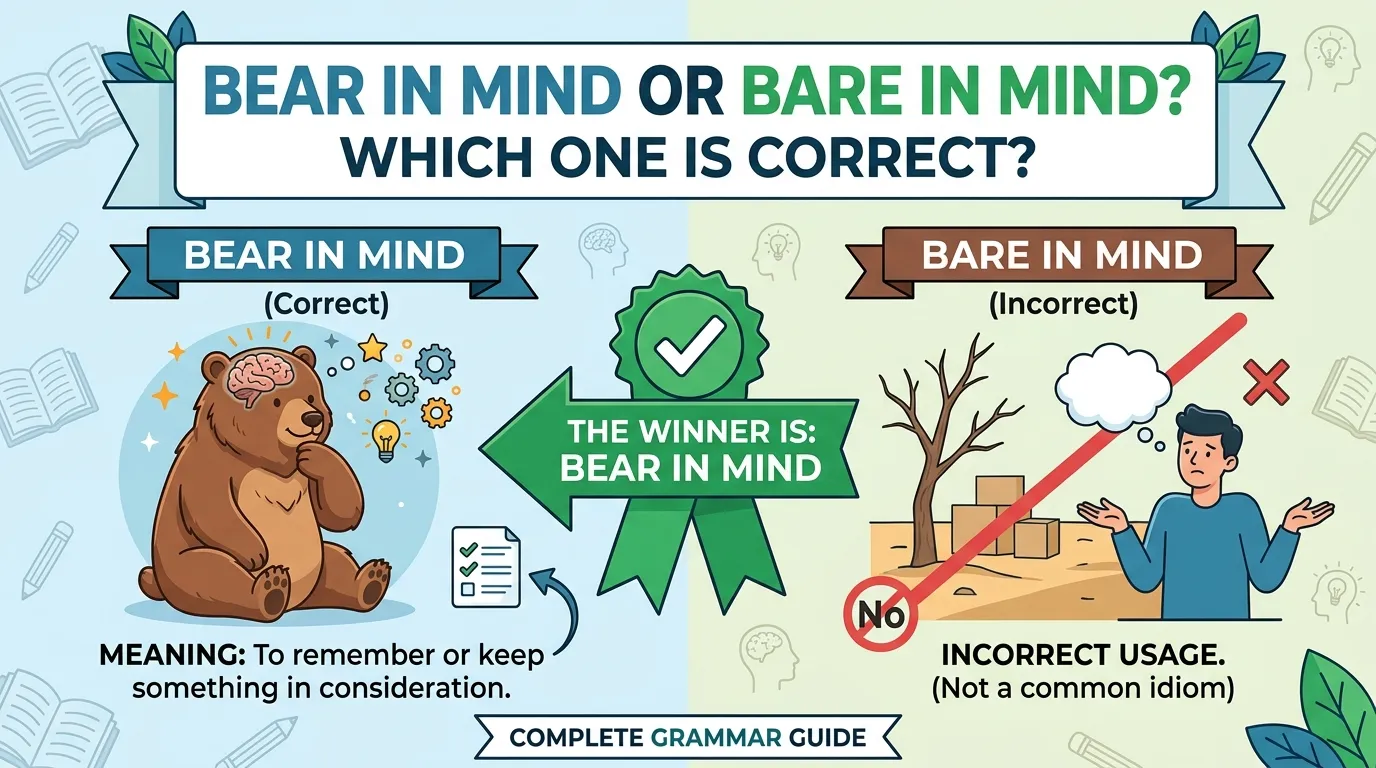
Have you ever wondered whether you should write bear in mind or bare in mind? You’re not alone. Many native English speakers and ESL learners confuse these two expressions because the words bear and bare sound exactly the same. However, only one phrase is grammatically correct in standard English.
The correct expression is bear in mind. The phrase bare in mind is incorrect and should be avoided in both American and British English. Whether you’re writing an email, completing homework, sending a business message, or preparing professional documents, knowing the difference will help you avoid a common grammar mistake.
In this guide, you’ll learn the Bear in Mind or Bare in Mind difference, understand the Bear in Mind meaning, discover its history, explore real-life examples, compare UK vs US English, and master the correct usage through simple explanations. By the end, you’ll never confuse these two phrases again.
Quick Answer
| ✅ Correct | ❌ Incorrect |
|---|---|
| Bear in mind | Bare in mind |
Correct phrase: Bear in mind
Meaning: Remember something or consider it carefully.
Incorrect phrase: Bare in mind
This expression is not accepted in standard English because bare means uncovered or exposed, which does not fit the intended meaning.
What Does “Bear in Mind” Mean?

Bear in mind means:
- Remember something
- Keep something in your thoughts
- Consider important information before making a decision
It is commonly used when someone wants another person to remember a fact or think about something carefully.
Examples
- Bear in mind that traffic is heavy today.
- Please bear in mind our company policy.
- Bear in mind that prices may change.
- You should bear in mind the weather forecast.
- Always bear in mind your budget.
Grammar Role of “Bear in Mind”
The word bear in this phrase is a verb.
It does not refer to the animal.
Instead, bear means:
- carry
- support
- hold
- keep
In bear in mind, it means to carry something in your thoughts.
Structure
Bear + in + mind
Examples:
- Bear in mind the deadline.
- Please bear this in mind.
- Keep this in mind.
Origin of “Bear in Mind”
The expression comes from the old meaning of bear, which meant to carry or to hold.
English speakers have used bear in this sense for hundreds of years.
Examples include:
- bear responsibility
- bear the cost
- bear the burden
- bear witness
In bear in mind, you are carrying an idea in your thoughts.
American English Examples
Here are ten examples of bear in mind in American English.
- Bear in mind that sales tax is added later.
- Please bear in mind our office hours.
- Bear in mind that shipping may take longer.
- You should bear in mind your monthly budget.
- Bear in mind that the meeting starts at 9 a.m.
- Always bear in mind customer satisfaction.
- Bear in mind that this offer expires tomorrow.
- We must bear in mind the company’s goals.
- Bear in mind that weather can affect flights.
- Bear in mind your doctor’s advice.
British English Examples
Here are ten examples commonly used in the UK.
- Bear in mind the train may be delayed.
- Please bear in mind the school holidays.
- Bear in mind that VAT applies.
- We should bear in mind local regulations.
- Bear in mind that the shop closes early.
- Always bear in mind public transport schedules.
- Bear in mind the weather before travelling.
- Please bear in mind the council’s guidance.
- Bear in mind that prices include VAT.
- Bear in mind the latest government advice.
Why Is “Bare in Mind” Wrong?
The word bare is an adjective or verb.
It means:
- uncovered
- naked
- exposed
Examples:
- bare feet
- bare walls
- bare hands
These meanings have nothing to do with remembering information.
Therefore:
❌ Bare in mind
is grammatically incorrect.
Incorrect vs Correct Examples
| Incorrect | Correct |
|---|---|
| Bare in mind the deadline. | Bear in mind the deadline. |
| Please bare in mind my advice. | Please bear in mind my advice. |
| Bare in mind the weather. | Bear in mind the weather. |
| Bare this in mind. | Bear this in mind. |
| Always bare in mind your budget. | Always bear in mind your budget. |
Bear in Mind vs Bare in Mind Comparison
| Feature | Bear in Mind | Bare in Mind |
|---|---|---|
| Meaning | Remember or consider | No accepted meaning |
| Grammar | Verb phrase | Incorrect phrase |
| Standard English | Yes | No |
| Dictionaries | Listed | Not listed |
| Formal writing | Correct | Incorrect |
| Academic writing | Correct | Incorrect |
| Business English | Correct | Incorrect |
| UK English | Standard | Wrong |
| US English | Standard | Wrong |
Pronunciation Guide
Although the spellings differ, both words sound exactly the same.
| Word | IPA (UK) | IPA (US) |
|---|---|---|
| Bear | /beə(r)/ | /ber/ |
| Bare | /beə(r)/ | /ber/ |
These are homophones, meaning they share the same pronunciation but have different meanings and spellings.
This is why people often write the wrong word.
Why Are They Commonly Confused?
Several reasons explain the confusion.
- They sound identical.
- English has many homophones.
- Spell-checkers may not detect the mistake.
- Many people learn the phrase by hearing it.
- Auto-correct sometimes changes the spelling.
Because of this, even experienced writers occasionally make this error.
Word Origins and Etymology
Bear
The verb bear comes from the Old English word beran, meaning:
- carry
- support
- endure
Over time, it developed meanings like:
- bear responsibility
- bear children
- bear weight
- bear witness
The phrase bear in mind follows this original idea of carrying a thought.
Bare
The word bare comes from Old English bær, meaning:
- uncovered
- exposed
- empty
Examples include:
- bare floor
- bare tree
- bare skin
It has never meant remember, so it cannot replace bear in this expression.
Bear in Mind Synonyms
| Synonym | American English | British English |
|---|---|---|
| Keep in mind | Very common | Very common |
| Remember | Very common | Very common |
| Consider | Common | Common |
| Don’t forget | Common | Common |
| Take into account | Formal | Formal |
| Be aware of | Common | Common |
| Think about | Informal | Informal |
| Note | Business | Business |
Which Synonyms Are Preferred?
In everyday conversation, both Americans and Britons often use:
- keep in mind
- remember
- don’t forget
In formal writing, you’ll frequently see:
- take into account
- consider
- be aware of
Common Mistakes
1. Writing “bare in mind”
❌ Bare in mind the deadline.
✅ Bear in mind the deadline.
2. Confusing Bear with the Animal
Many learners think the phrase refers to the animal.
It doesn’t.
The verb means carry.
3. Using Bare Because It Sounds Right
Homophones often cause spelling mistakes.
Always check the spelling.
4. Writing It as One Word
❌ Bearinmind
✅ Bear in mind
5. Capitalizing Every Word
Unless it’s a title:
✅ Please bear in mind.
6. Using It in the Wrong Context
Bear in mind is used when reminding someone.
It is not used to describe physical objects.
7. Forgetting “In”
❌ Bear mind
✅ Bear in mind
Real-Life Examples
Please bear in mind that the deadline is Friday.
Office
Bear in mind the client’s preferences before presenting.
Banking
Please bear in mind that transfer fees apply.
Invoice
Bear in mind that payment is due within 30 days.
School
Students should bear in mind the examination rules.
Social Media
Bear in mind that online comments remain public.
Rent Payment
Please bear in mind that rent is due on the first of each month.
Everyday Conversation
Bear in mind that the restaurant gets busy after six.
Bear in Mind in a Sentence
- Bear in mind that everyone learns differently.
- Bear in mind the weather forecast.
- Bear in mind your responsibilities.
- Bear in mind our appointment tomorrow.
- Bear in mind your spending habits.
- Bear in mind the instructions carefully.
- Bear in mind the company’s policies.
- Bear in mind your health.
- Bear in mind the safety rules.
- Bear in mind your audience while speaking.
Related Expressions
| Expression | Meaning |
|---|---|
| Keep in mind | Remember |
| Take into account | Consider |
| Remember | Recall |
| Don’t forget | Reminder |
| Be mindful of | Pay careful attention |
| Consider | Think carefully |
Among these, keep in mind is the closest alternative to bear in mind.
Grammar Rule Explained
The phrase contains:
- Bear → verb
- In → preposition
- Mind → noun
Together they form an idiomatic verb phrase.
The phrase usually appears:
- at the beginning of a sentence
- after “please”
- after modal verbs
Examples:
- Please bear in mind…
- You should bear in mind…
- We must bear in mind…
- Always bear in mind…
Memory Tricks
1. Bear Means Carry
Think:
Bear = Carry
Carry something in your mind.
2. Bare Means Naked
Bare feet.
Bare hands.
These meanings have nothing to do with remembering.
3. Think of Responsibility
We say:
- bear responsibility
- bear the cost
Not:
- bare responsibility
4. Replace It with “Remember”
If “remember” fits, use bear, not bare.
5. Picture Carrying an Idea
Imagine carrying a reminder inside your mind.
That image helps you remember the correct spelling.
Frequently Asked Questions
Is it bear in mind or bare in mind?
The correct expression is bear in mind.
What does bear in mind mean?
It means to remember or carefully consider something.
Is bare in mind ever correct?
No.
It is considered a spelling mistake.
Is bear in mind formal?
Yes.
It works in both formal and informal writing.
Do Americans and British people both use bear in mind?
Yes.
It is standard in both varieties of English.
What is another way to say bear in mind?
You can say:
- keep in mind
- remember
- consider
- take into account
How do you pronounce bear and bare?
Both are pronounced the same.
UK: /beə(r)/
US: /ber/
Which dictionaries recognize bear in mind?
Major dictionaries including Cambridge, Oxford, Merriam-Webster, and Collins recognize bear in mind.
Is bear in mind suitable for business writing?
Yes. It is widely used in emails, reports, presentations, and professional communication.
Can I use “keep in mind” instead?
Absolutely. It has nearly the same meaning and is common in both spoken and written English.
People Also Ask
Why do people write “bare in mind”?
Because bear and bare are homophones. They sound the same, making spelling mistakes common.
Is “bear in mind” an idiom?
Yes. It is an English idiomatic expression meaning “remember” or “consider.”
Can I use “bear in mind” in academic writing?
Yes. It is appropriate for essays, reports, research papers, and formal documents.
Is “keep in mind” more common than “bear in mind”?
In casual conversation, keep in mind is slightly more common, especially in American English. Both are correct.
Does “bear in mind” have the same meaning everywhere?
Yes. The meaning is the same in American, British, Australian, and Canadian English.
Conclusion
Understanding the difference between Bear in Mind or Bare in Mind is easier once you know the meaning behind each word. Bear in mind is the only correct expression because the verb bear means to carry or to hold, making the phrase mean to remember or to consider carefully. By contrast, bare means uncovered or exposed, so bare in mind has no logical or grammatical meaning and should never be used in standard English. This rule is the same in both UK and US English, and major dictionaries recognize only bear in mind.
You’re writing an email, completing schoolwork, preparing a report, or chatting online, remember to use bear in mind. A simple memory trick is to think of bearing an idea in your mind, just as you can bear responsibility or bear a burden. Keep this rule in mind, and you’ll avoid one of English’s most common spelling mistakes with confidence.