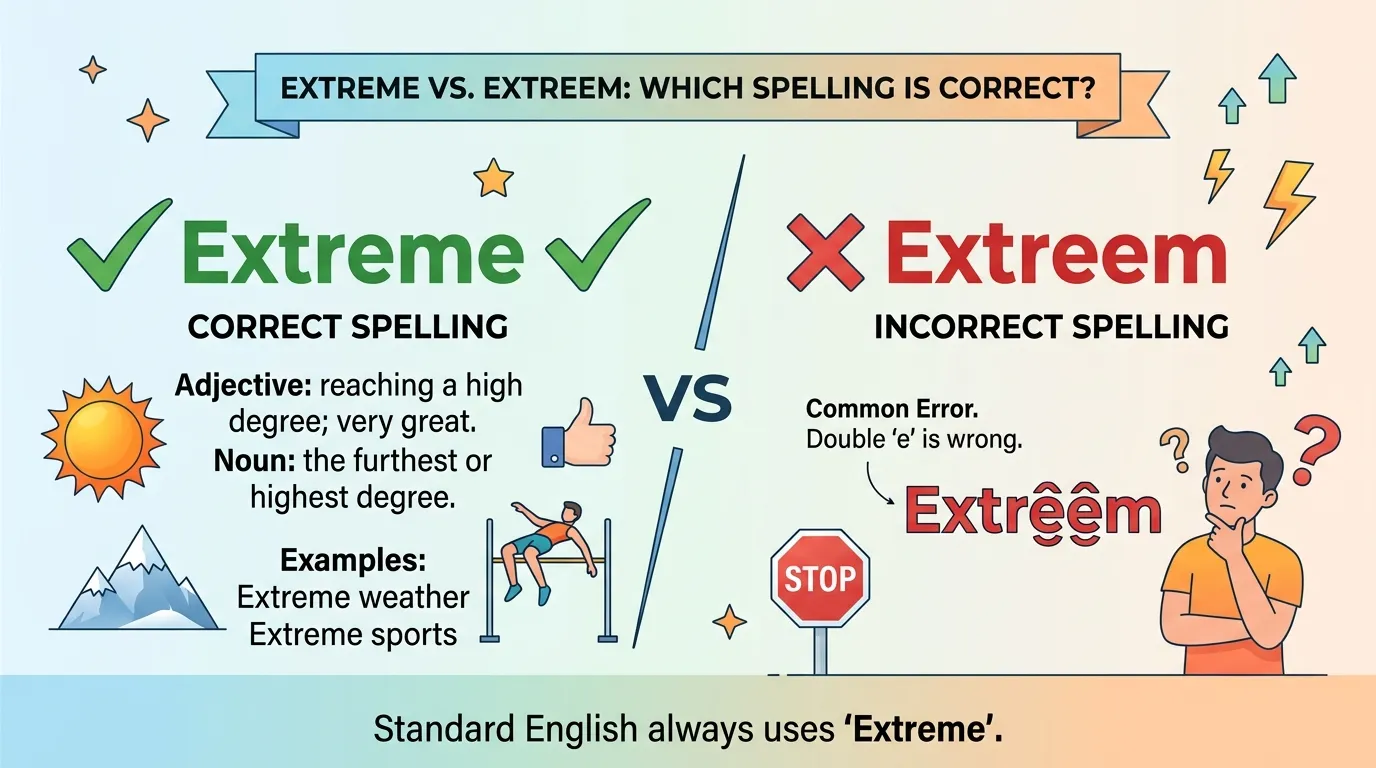
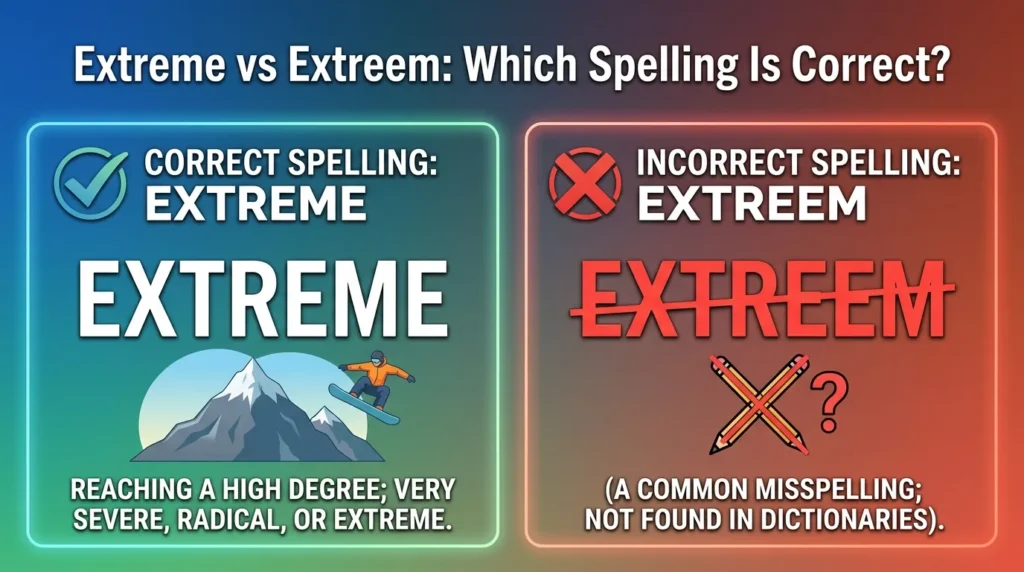
If you are comparing extreme vs extreem, the correct modern English spelling is extreme. Extreem is not the standard spelling used in contemporary American or British English.
The word extreme can describe something very intense, unusually severe, unusually large or small, or located at the farthest point of something. It can function as an adjective, noun, and, less commonly, part of fixed expressions and technical terminology.
For example:
- The weather was extreme.
- She went to extremes to solve the problem.
- The two opinions are at opposite extremes.
- The hikers reached the extreme edge of the valley.
The confusion usually comes from pronunciation. Extreme is pronounced with a long ee sound in the final syllable: ik-STREEM. Because the ending sounds like -eem, some writers may incorrectly spell it extreem.
This guide explains the difference between extreme and extreem, their meanings, pronunciation, history, grammar, common expressions, related words, and the mistakes you should avoid.
Quick Answer: Extreme or Extreem?
Extreme is the correct standard spelling.
Extreem is generally considered a misspelling of extreme in modern standard English.
| Spelling | Correct in modern standard English? | Meaning |
|---|---|---|
| extreme | ✅ Yes | Very great, severe, intense, or farthest from the center |
| extreem | ❌ No | Nonstandard spelling of extreme |
Correct
The team faced extreme pressure.
Incorrect
The team faced extreem pressure.
The same rule applies whether you are writing casually, academically, professionally, journalistically, technically, or for a website.
Use extreme. Avoid extreem.
What Does Extreme Mean?
Extreme is an adjective that generally describes something that is far beyond what is normal, ordinary, moderate, or expected.
It can also describe something positioned at the farthest point or limit.
Common meanings include:
- Very intense
- Very severe
- Very unusual
- Very strong
- Far beyond the normal range
- At the greatest or farthest possible degree
- Located at the outermost point
Examples of extreme as an adjective
- The region experienced extreme heat.
- He showed extreme patience.
- The company took extreme measures.
- The storm caused extreme damage.
- She has an extreme fear of heights.
- The experiment involved extreme temperatures.
The exact meaning depends on context.
For example, extreme cold means exceptionally cold conditions, while an extreme edge means the farthest edge.
Is Extreem a Word?
In ordinary modern English, extreem is not the standard spelling of the word.
If you are writing a sentence and mean the modern English word pronounced ik-STREEM, write extreme.
For example:
The athlete trains under extreme conditions.
Not:
The athlete trains under extreem conditions.
You may occasionally encounter unusual spellings in historical documents, names, old texts, dialect writing, or user-generated content. Such appearances do not make extreem the appropriate spelling for standard contemporary English.
For everyday writing, there is no practical reason to choose extreem.
Why Do People Confuse Extreme and Extreem?
The main reason is pronunciation.
The final part of extreme sounds like streem. English spelling does not always correspond perfectly to pronunciation, so a writer may hear the word and spell it based on its sound.
Compare:
- extreme → pronounced like ik-STREEM
- seem → pronounced seem
- theme → pronounced theme
- machine → pronounced muh-SHEEN
The long ee sound can tempt learners to write extreem.
However, spelling should not be based entirely on pronunciation.
The correct spelling contains -eme:
ex + treme = extreme
The final e is part of the established spelling even though it does not create a separate spoken syllable.
Extreme vs Extreem: The Key Difference
The difference is fundamentally spelling and standard usage, not meaning.
Extreme
Extreme is the standard English spelling.
It is used in:
- American English
- British English
- Canadian English
- Australian English
- International English
- Academic writing
- Business writing
- Journalism
- Technical writing
- Casual communication
Extreem
Extreem is generally a spelling error when the intended word is extreme.
It may appear because of:
- A typing mistake
- Phonetic spelling
- A learner’s spelling error
- Autocorrect failure
- Informal internet writing
- Historical or unusual textual usage
Simple rule
If you mean very severe, intense, unusual, or farthest, use:
extreme
Extreme: Dictionary-Style Definition
Extreme can be understood in several closely related ways.
As an adjective
Extreme means existing at a very high or low degree, going far beyond what is usual, or reaching an outer limit.
Examples:
- extreme poverty
- extreme wealth
- extreme temperatures
- extreme caution
- extreme pressure
- extreme speed
As a noun
Extreme can refer to a very high degree or one of two opposite limits.
Examples:
- The two political positions represent opposite extremes.
- The temperature moved from one extreme to another.
- Moderation is often preferable to either extreme.
The plural extremes is especially common.
How to Pronounce Extreme
The standard pronunciation of extreme is:
/ɪkˈstriːm/
It sounds approximately like:
ik-STREEM
The stress falls on the second syllable.
Break it down
ex-treme
- ex → /ɪk/
- treme → /striːm/
The ending sounds like stream without the initial s distinction being isolated in ordinary speech.
Is Extreem Pronounced Differently?
Usually, someone who writes extreem intends to pronounce it exactly like extreme.
That is another clue that extreem is normally a spelling error rather than a separate standard English word.
Is Extreme an Adjective or a Noun?
Extreme can be both an adjective and a noun.
Extreme as an adjective
It modifies a noun.
The area experienced extreme rainfall.
They were exposed to extreme conditions.
He made an extreme decision.
Here, extreme tells us what kind of rainfall, conditions, or decision is being discussed.
Extreme as a noun
It can refer to an outer limit or an exceptionally high degree.
The situation moved from one extreme to another.
Both extremes can create problems.
The noun form is less common than the adjective in everyday speech.
Extreme vs Extremely
Another common source of confusion is the difference between extreme and extremely.
Extreme
Extreme is usually an adjective.
That was an extreme reaction.
Extremely
Extremely is an adverb.
That reaction was extremely unusual.
Compare:
| Word | Part of speech | Example |
|---|---|---|
| extreme | adjective/noun | It was an extreme situation. |
| extremely | adverb | The situation was extremely serious. |
Do not substitute them randomly.
Incorrect
She was extreme tired.
Correct
She was extremely tired.
Correct
She experienced extreme tiredness.
Extreme vs Extremity
The related noun extremity has several meanings.
It can refer to:
- An extreme condition or degree
- The farthest point of something
- A limb or outer part of the body
Examples:
The extremity of the peninsula reaches into the sea.
The soldiers suffered in the extremity of the weather.
In anatomy, extremities can refer to the arms and legs.
This word is related to extreme, but it should not be confused with extreem.
Word History and Etymology of Extreme
Extreme has a long history in English and ultimately traces back to Latin.
It comes from Latin extremus, meaning outermost, farthest, or last. It is related to the Latin word exterus, associated with being outside or external.
The word entered English through French and developed through earlier forms of English.
Its historical meaning was closely connected to the idea of being at the outermost limit.
Over time, English speakers increasingly used extreme in a figurative sense to describe things that were:
- exceptionally intense,
- unusually severe,
- excessive,
- or far removed from moderation.
That explains why the word can describe both a physical position and an abstract degree.
For example:
the extreme edge
uses the older idea of a physical limit.
Meanwhile:
extreme anger
uses the word in a figurative sense to describe a very high degree of emotion.
Literal and Figurative Meanings of Extreme
One useful way to understand extreme is to separate its literal and figurative uses.
Literal meaning
The word can describe a physical outer limit.
They reached the extreme edge of the property.
The village lies at the extreme northern end of the region.
Figurative meaning
It can describe something unusually intense or severe.
She felt extreme disappointment.
The company was under extreme pressure.
The treatment requires extreme caution.
The figurative meaning is extremely common in modern English.
Common Collocations With Extreme
A collocation is a combination of words that naturally occur together.
Learning common collocations can help you use extreme correctly.
Extreme weather
The region is prepared for extreme weather.
Extreme heat
The city issued a warning because of extreme heat.
Extreme cold
The equipment must operate in extreme cold.
Extreme pressure
The workers performed well under extreme pressure.
Extreme caution
Drivers should exercise extreme caution.
Extreme danger
The climbers were in extreme danger.
Extreme measures
The organization took extreme measures to prevent further losses.
Extreme conditions
The vehicle was designed for extreme conditions.
Extreme poverty
The program aims to reduce extreme poverty.
Extreme pain
The patient reported extreme pain.
These combinations are natural and widely understood.
Common Expressions With Extreme
The word appears in several familiar expressions.
Go to extremes
To go to extremes means to take unusually strong or excessive action.
She went to extremes to protect her family.
At the extreme
This means at the farthest or most intense end of a range.
At the extreme end of the scale, the risks become significant.
Take something to the extreme
This means to carry an idea or behavior to an unusually intense degree.
Some people take healthy eating to the extreme.
From one extreme to another
This describes a movement between two very different or opposite conditions.
His schedule went from one extreme to another.
In the extreme
This is a formal expression meaning to a very great degree.
The decision was controversial in the extreme.
Extreme in Sports
Extreme is especially common in sports and adventure contexts.
You may see phrases such as:
- extreme sports
- extreme skiing
- extreme climbing
- extreme racing
- extreme endurance
- extreme conditions
Extreme sports generally refers to activities involving unusual physical challenges, speed, height, danger, or demanding environments.
Examples include activities such as:
Extreme sports attract people who enjoy high levels of challenge and excitement.
In sports journalism, extreme can also describe an unusually difficult performance or condition.
The runners competed in extreme heat.
Extreme in Business and Professional Writing
In professional writing, extreme is acceptable, but writers should use it precisely.
It can describe serious conditions:
The company faced extreme financial pressure.
The project operates under extreme time constraints.
However, excessive use can make professional writing sound dramatic.
Instead of writing:
This is an extremely extreme problem.
Use a precise description:
This problem could cause a significant delay.
Clear business writing usually benefits from measurable information rather than repeated intensifiers.
Extreme in Academic Writing
Extreme is common in academic writing when the subject genuinely involves an unusually high or low level.
Examples:
Extreme temperatures can affect the accuracy of the measurement.
The study examined responses to extreme environmental conditions.
Extreme values may influence the statistical results.
In academic writing, avoid using extreme simply to make a claim sound stronger.
If possible, explain how extreme something is.
For example:
Weak:
The experiment produced extreme results.
Stronger:
The experiment produced results significantly outside the expected range.
The second version provides more information.
Extreme in Journalism
Journalists frequently use extreme in reporting about:
- weather
- politics
- sports
- economics
- social conditions
- environmental events
- public safety
Examples:
Officials warned residents about extreme weather.
The region experienced extreme flooding.
The debate became increasingly polarized between opposing extremes.
Journalistic writing should still avoid exaggeration. The word should describe a condition that reasonably qualifies as extreme.
Extreme in Politics
Extreme can describe political positions that are considered far from a perceived mainstream or moderate position.
Examples:
The candidate was criticized for an extreme position on the issue.
Voters faced a choice between two political extremes.
However, political usage requires care.
Calling a viewpoint extreme can be evaluative rather than purely descriptive. In neutral reporting, writers may need to explain what makes a position extreme rather than simply applying the label.
For example:
Critics described the proposal as extreme because it would eliminate the existing policy entirely.
This is clearer than using extreme without explanation.
Extreme in Technical and Scientific Contexts
The word also has technical uses.
In mathematics and statistics, related forms such as extreme value can describe values at the upper or lower ends of a range.
In science and engineering, phrases such as these are common:
- extreme temperature
- extreme pressure
- extreme conditions
- extreme environment
- extreme values
The technical meaning is usually connected to a boundary, unusually high or low measurement, or demanding condition.
The spelling remains extreme, not extreem.
American English vs British English
There is no standard American-versus-British spelling difference between extreme and extreem.
Both major varieties use:
extreme
American English:
extreme weather
British English:
extreme weather
The spelling is the same.
This differs from words such as color/colour or center/centre, where American and British spelling conventions sometimes differ.
For extreme, there is no comparable standard regional spelling variation.
Is Extreem Ever Acceptable in Formal Writing?
For modern standard English, no.
If you are writing:
- an essay,
- a resume,
- an academic paper,
- a business report,
- a news article,
- a blog post,
- a website,
- an email,
- a technical document,
use extreme.
An unusual historical spelling may be appropriate when reproducing or discussing a historical source, but that is a special situation rather than ordinary spelling.
Common Mistakes With Extreme
Mistake: Writing extreem
Incorrect:
The heat was extreem.
Correct:
The heat was extreme.
Mistake: Using extreme instead of extremely
Incorrect:
The movie was extreme exciting.
Correct:
The movie was extremely exciting.
Mistake: Overusing extreme
Weak:
We had an extreme amazing and extreme fun experience.
Better:
We had an amazing experience.
Or:
The experience was unusually intense.
Mistake: Confusing extreme with extremist
Extreme is a broad adjective.
Extremist usually refers to a person or group holding views regarded as extreme, especially in political or ideological contexts.
The article discussed an extreme political position.
The report focused on an extremist organization.
They are related but not interchangeable.
Awkward vs Natural Examples
Weather
Awkward:
We experienced an extreem hot day.
Natural:
We experienced an extremely hot day.
Better when describing the weather itself:
We experienced extreme heat.
Business
Awkward:
The company took an extreem decision.
Natural:
The company took an extreme decision.
More precise:
The company took an unusually drastic decision.
Sports
Awkward:
The athletes trained in extreem conditions.
Natural:
The athletes trained in extreme conditions.
Academic
Awkward:
The data contained extreem values.
Natural:
The data contained extreme values.
Formal vs Informal Alternatives to Extreme
Depending on your context, you may be able to replace extreme with a more precise word.
Formal alternatives
- severe
- exceptional
- excessive
- intense
- extraordinary
- drastic
- radical
- substantial
- acute
Informal alternatives
- huge
- intense
- wild
- massive
- serious
- confused
Some informal alternatives change the tone significantly.
For example:
The storm caused extreme damage.
is neutral and direct.
The storm caused massive damage.
is more conversational.
The storm caused crazy damage.
is highly informal and may be unsuitable for professional writing.
Synonyms for Extreme
The best synonym depends on the meaning.
When extreme means very severe
- severe
- intense
- serious
- acute
- drastic
Example:
extreme pain → severe pain
When extreme means unusually great
- exceptional
- extraordinary
- immense
- tremendous
- enormous
Example:
extreme wealth → enormous wealth
When extreme means farthest
- outermost
- farthest
- utmost
- terminal
Example:
the extreme edge → the outermost edge
When extreme means radical
- radical
- drastic
- uncompromising
- revolutionary
The words are not perfect synonyms in every situation, so context matters.
Antonyms of Extreme
The most useful opposite of extreme is often moderate.
Other possible antonyms include:
- moderate
- mild
- ordinary
- average
- reasonable
- restrained
- balanced
- limited
Examples:
extreme temperature ↔ moderate temperature
extreme reaction ↔ measured reaction
extreme position ↔ moderate position
Again, the best opposite depends on context.
Related Words
Understanding the word family can make the spelling easier to remember.
| Word | Meaning |
|---|---|
| extreme | Very intense, severe, or farthest |
| extremely | To a very great degree |
| extremity | An extreme condition, outer limit, or bodily limb |
| extremities | Plural of extremity |
| extremist | A person associated with extreme views or actions |
| extremism | Belief or behavior characterized by extreme positions |
| extremeness | The quality of being extreme; relatively uncommon |
Notice that these related words retain the extrem- spelling pattern.
Memory Tricks for Extreme
If you frequently spell extreme as extreem, try one of these memory tricks.
Think of the word family
Remember:
extreme → extremely → extremity → extremist
They all begin with:
extrem-
Remember the silent final e
Think:
extreme ends with -eme, not -eem.
The word has the same final spelling pattern found in words such as:
- theme
- supreme
- regime
Although these words do not all share the same pronunciation pattern, visual familiarity with -eme can help.
Use the phrase
Memorize:
Extreme is extremely common.
The two words reinforce the spelling pattern.
How to Spell Extreme Correctly
The spelling is:
E-X-T-R-E-M-E
A useful visual breakdown is:
EX + TREME
Do not write:
E-X-T-R-E-E-M
The extra e in extreem is the error.
Singular and plural
Singular:
extreme
Plural noun:
extremes
Adverb:
extremely
Related noun:
extremity
Examples:
The situation was extreme.
They considered both extremes.
The situation was extremely difficult.
He was pushed to the extremity of his endurance.
Extreme vs Extreem in Online Writing
Internet communication produces many spelling variations because people type quickly.
You might see extreem in:
- social media comments
- gaming chats
- forums
- text messages
- user reviews
- informal posts
Seeing the spelling online does not mean it is correct standard English.
If you are writing for a public audience, choose extreme.
This is particularly important for:
- blog posts
- websites
- product descriptions
- professional profiles
- school assignments
- resumes
- newsletters
- business communication
Search engines can encounter misspellings, but deliberately using a spelling error is not a good SEO strategy.
SEO Recommendation: Extreme vs Extreem
If your content targets the search phrase extreme vs extreem, you can naturally discuss the misspelling without repeatedly using it in body text.
For example:
Many people search for extreme vs extreem because the word sounds like it ends in -eem. However, the standard spelling is extreme.
After establishing the difference, use the correct spelling naturally.
For SEO, prioritize:
- extreme vs extreem
- extreme or extreem
- is extreem a word
- is extreme spelled with two e’s
- how to spell extreme
- correct spelling of extreme
- extreme meaning
- extreme pronunciation
- extreme definition
- extreme spelling
- extremely vs extreme
Avoid unnatural repetition.
Practical Recommendations by Writing Context
American English
Use extreme.
British English
Use extreme.
International English
Use extreme.
Academic writing
Use extreme when the meaning is accurate, but prefer precise measurements or descriptions where possible.
Business writing
Use extreme carefully and explain the severity when it matters.
Journalism
Use extreme when supported by the facts and context.
Technical writing
Use extreme according to the relevant technical definition.
Sports writing
Use extreme for unusually demanding conditions, activities, or performance.
Blogging
Use extreme and explain extreem only when the spelling comparison is relevant.
Casual writing
Use extreme. Informal writing may tolerate mistakes, but the standard spelling remains preferable.
Quick Comparison: Extreme vs Extreem
| Feature | Extreme | Extreem |
|---|---|---|
| Standard spelling | ✅ Yes | ❌ No |
| Modern American English | ✅ | ❌ |
| Modern British English | ✅ | ❌ |
| Dictionary-standard spelling | ✅ | Generally no |
| Common misspelling | No | Yes |
| Pronunciation intended | /ɪkˈstriːm/ | Usually intended to match extreme |
| Formal writing | ✅ | ❌ |
| Academic writing | ✅ | ❌ |
| Business writing | ✅ | ❌ |
| Casual writing | ✅ | Not recommended |
Frequently Asked Questions
Is extreme or extreem correct?
Extreme is correct in standard modern English. Extreem is generally a misspelling.
Is extreem a real English word?
Extreem is not the standard modern spelling of the common English word extreme. You may encounter it in unusual, historical, or user-generated material, but modern standard writing should use extreme.
Why is extreme spelled with an e at the end?
The spelling developed historically from forms related to Latin extremus through French and English. The final e is part of the established spelling even though the word is pronounced with a long ee sound at the end.
How do you pronounce extreme?
Extreme is pronounced approximately ik-STREEM, with the IPA pronunciation /ɪkˈstriːm/. The stress falls on the second syllable.
Is extreme an adjective?
Yes. Extreme is commonly an adjective meaning very intense, severe, unusual, or farthest from the center or normal range. It can also function as a noun in contexts involving limits or opposite conditions.
What is the difference between extreme and extremely?
Extreme is commonly an adjective, while extremely is an adverb.
It was an extreme situation.
It was extremely difficult.
Is there a British spelling of extreme?
No separate standard British spelling is required. Both American and British English normally spell the word extreme.
What is the opposite of extreme?
The most common opposite is moderate. Depending on context, possible opposites include mild, ordinary, balanced, reasonable, and restrained.
Why do people spell extreme as extreem?
The most likely reason is pronunciation. Extreme ends with a sound like -eem, so some people spell it phonetically as extreem. The standard spelling, however, is extreme.
How can I remember the spelling of extreme?
Remember the spelling pattern extrem- and the related words extremely, extremity, extremist, and extremism. The correct word is extreme, not extreem.
Final Verdict
When choosing between extreme vs extreem, there is a clear winner: extreme.
Extreme is the standard spelling in modern English, including both American and British English. It can mean very severe, intense, unusual, or farthest from a center or normal point. It is widely used in everyday speech, journalism, business, academia, sports, science, and technical writing.
Extreem is generally a spelling error caused by the way extreme sounds. The final syllable is pronounced with a long ee sound, which can make the incorrect spelling seem logical. However, pronunciation does not determine the standard spelling.
The easiest rule is simple:
If you mean very intense, severe, unusual, or farthest, spell it extreme.
Use extreme in essays, emails, websites, reports, professional documents, social media, and everyday writing. If you encounter extreem, treat it as a nonstandard spelling unless you are specifically discussing a historical or unusual text.
In short:
Extreme = correct ✅
Extreem = generally incorrect ❌
When accuracy matters, always choose extreme.