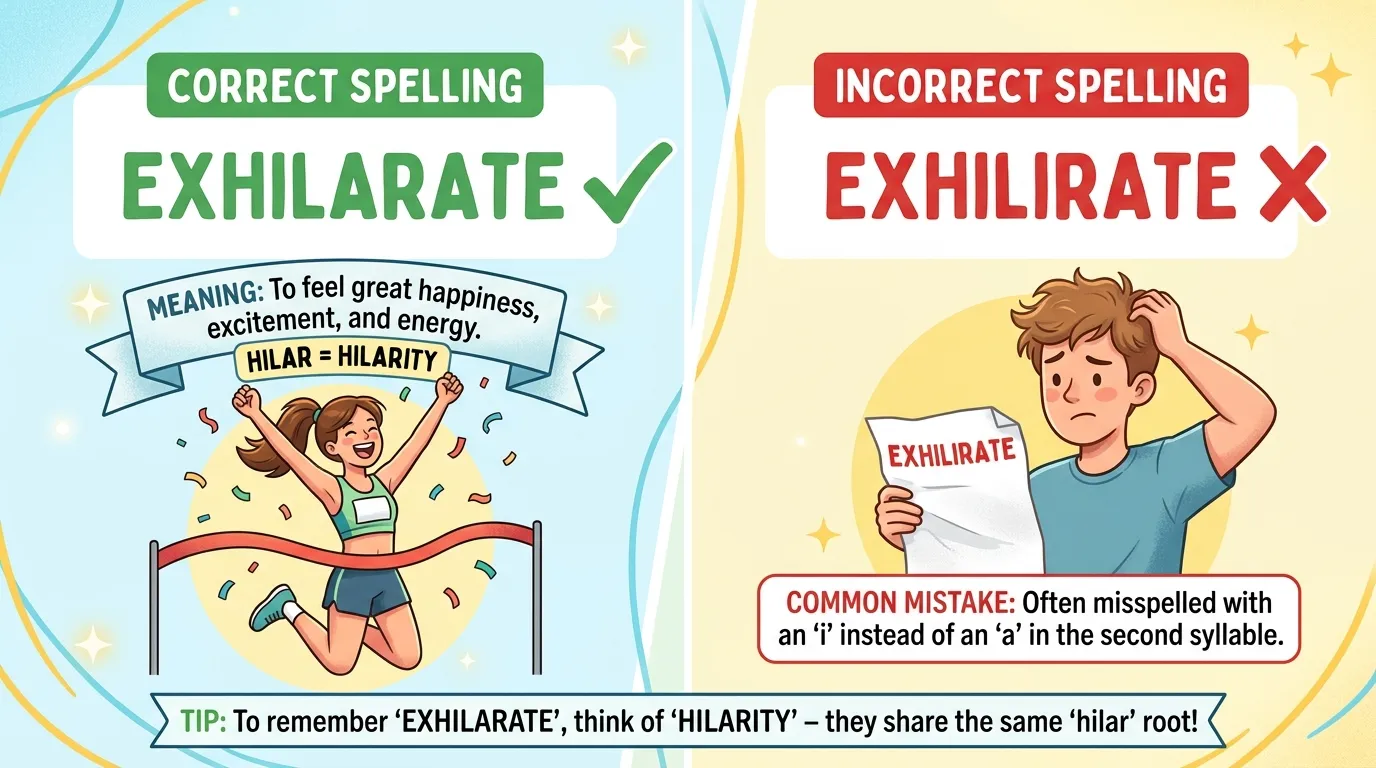
If you are wondering about exhilarate vs exhilirate, the answer is simple: exhilarate is the correct spelling. Exhilirate is a misspelling and should not be used in standard American English or formal writing.
The confusion usually happens because exhilarate is not spelled exactly the way it sounds. The middle of the word can be easy to rearrange mentally, especially when typing quickly. Once you know the correct pattern, however, it becomes much easier to remember.
In this guide, you will learn what exhilarate means, how to pronounce it, where it comes from, how to use it naturally, and why exhilirate is incorrect. You will also see practical examples, common mistakes, synonyms, antonyms, collocations, grammatical forms, and usage tips for academic, business, journalistic, casual, sports, and everyday writing.
Quick Answer: Exhilarate or Exhilirate?
Exhilarate is correct. Exhilirate is incorrect.
| Spelling | Correct? | Meaning |
|---|---|---|
| exhilarate | Yes | To make someone feel extremely happy, excited, energized, or thrilled |
| exhilirate | No | Misspelling of exhilarate |
Correct example
The roller coaster ride exhilarated everyone.
Incorrect example
The roller coaster ride exhilirated everyone.
The correct word is exhilarate, with -hila- in the middle:
ex-hil-a-rate
A useful spelling pattern is:
EXHILARATE
Not:
EXHILIRATE
What Does Exhilarate Mean?
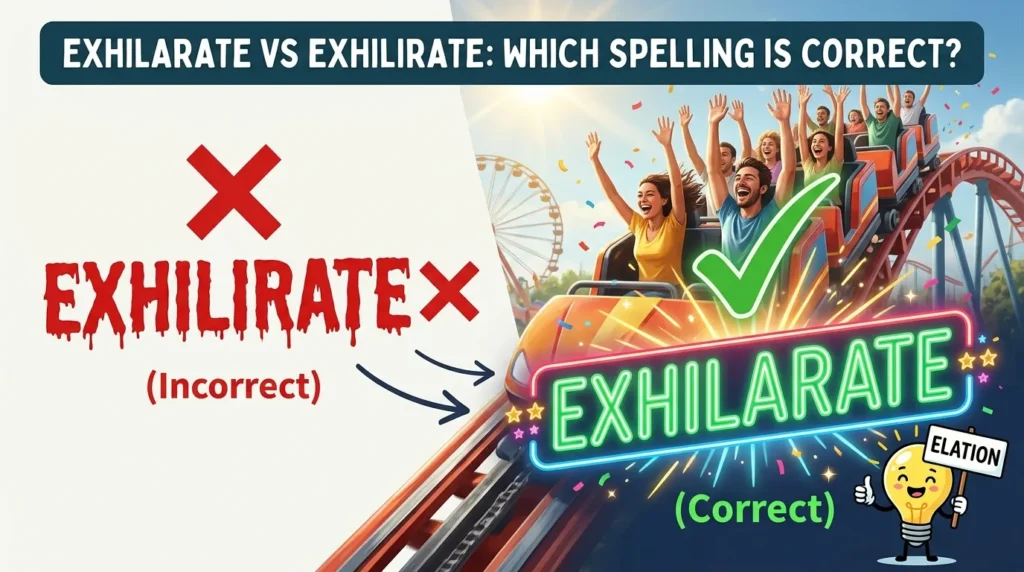
Exhilarate is a verb meaning to make someone feel extremely happy, excited, energetic, or enthusiastic.
It describes a strong positive emotional reaction. Something that exhilarates you gives you a powerful feeling of excitement or joy.
For example:
The victory exhilarated the players.
This means the victory made the players feel intensely excited and happy.
Another example is:
Flying over the mountains exhilarated her.
The experience produced a strong feeling of excitement and energy.
Dictionary style definition
Exhilarate
Verb: To make someone feel very happy, excited, lively, or enthusiastic.
Simple meaning
You can think of exhilarate as:
to fill someone with excitement and joy
It is stronger than simply saying make happy.
What Does Exhilirate Mean?
Exhilirate is not a standard English word.
It is a common spelling mistake created by rearranging the letters in exhilarate.
The incorrect spelling often looks believable because the pronunciation does not make every letter obvious. Someone may remember the sound but incorrectly place the i and a in the middle.
For example:
The breathtaking view exhilirated him.
This spelling is incorrect.
The correct version is:
The breathtaking view exhilarated him.
The important point is that exhilirate does not have a separate definition, grammatical function, or special meaning. It is simply a misspelling of exhilarate.
Why Do People Confuse Exhilarate and Exhilirate?
There are several reasons this spelling mistake is easy to make.
The pronunciation can be misleading
Exhilarate is pronounced approximately:
ig-ZIL-uh-rayt
Depending on accent and speaking speed, the middle vowels may not sound as clear as they look in writing.
When people hear the word rather than see it, they may remember the general sound but reconstruct the spelling incorrectly.
The word is less common than simpler alternatives
People frequently use words such as:
- excite
- thrill
- delight
- energize
- inspire
Because exhilarate is somewhat less common in everyday conversation, writers may recognize the word without feeling completely confident about its spelling.
The vowel sequence is easy to mix up
The correct spelling contains:
exhilarate
The incorrect spelling changes the middle pattern to:
exhilirate
That small change is enough to make the word incorrect.
Exhilarate vs Exhilirate: The Key Difference
The difference is primarily correct spelling versus misspelling.
There is no meaningful semantic distinction between the two.
| Feature | Exhilarate | Exhilirate |
|---|---|---|
| Standard English word | Yes | No |
| Correct spelling | Yes | No |
| Part of speech | Verb | Not a standard word |
| Meaning | To make extremely excited or happy | None |
| Formal writing | Appropriate | Incorrect |
| Academic writing | Appropriate when suitable | Incorrect |
| Business writing | Appropriate when suitable | Incorrect |
| Casual writing | Appropriate | Avoid |
| Dictionary word | Yes | No |
If you are writing an essay, article, email, report, business document, or social media post, use exhilarate.
How to Spell Exhilarate Correctly
Break the word into smaller parts:
EX + HIL + A + RATE
Together:
EXHILARATE
You can also remember the middle as:
HILA
So the spelling is:
EX HILA RATE
rather than:
EX HILI RATE
A simple spelling trick
Think:
Ex + HILA + rate
The unusual middle sequence is HILA.
If you remember HILA, you are much less likely to write HILI.
How Do You Pronounce Exhilarate?
The American English pronunciation is approximately:
ig-ZIL-uh-rayt
The first syllable is commonly pronounced with a sound similar to ig, followed by a stressed ZIL sound.
The final part sounds like rate.
Related forms
- exhilarate
- exhilarates
- exhilarated
- exhilarating
- exhilaration
Examples:
The competition exhilarated the audience.
Winning the championship was exhilarating.
She felt a sense of exhilaration after completing the climb.
Is Exhilarate a Verb?
Yes. Exhilarate is a verb.
It normally describes the effect something has on a person.
Basic structure
Something + exhilarates + someone
For example:
The concert exhilarated the crowd.
Here:
- The concert = subject
- exhilarated = verb
- the crowd = object
You can also use the passive form:
The crowd was exhilarated by the performance.
Exhilarate vs Excite
Exhilarate and excite are close in meaning, but they are not always interchangeable.
Excite is much more general. It can describe interest, anticipation, enthusiasm, or physical and emotional stimulation.
Exhilarate usually suggests a stronger feeling of joy, energy, thrill, or emotional uplift.
Compare:
The announcement excited the students.
This simply means the students became enthusiastic or interested.
The final victory exhilarated the students.
This suggests a much stronger emotional reaction.
Which word should you choose?
Use excite for ordinary situations.
Use exhilarate when you want to emphasize intense excitement, happiness, energy, or thrill.
Exhilarate vs Thrill
These words are also closely related.
Thrill often emphasizes a powerful feeling of excitement caused by something dramatic, surprising, dangerous, or impressive.
Exhilarate emphasizes the feeling of being energized, delighted, and uplifted.
For example:
The suspenseful movie thrilled the audience.
The mountain climb exhilarated the hikers.
Both words work, but the emotional shade is slightly different.
Exhilarate vs Delight
Delight means to give someone great pleasure or happiness.
Exhilarate suggests stronger excitement and energy.
Compare:
The gift delighted her.
The gift made her very happy.
The unexpected victory exhilarated her.
The victory produced intense excitement and emotional energy.
Exhilarate vs Energize
Energize focuses on giving someone energy or motivation.
Exhilarate focuses more on emotional excitement and joy.
For example:
The morning workout energized him.
The breathtaking race exhilarated him.
A person can be energized without being exhilarated.
Common Collocations With Exhilarate
A collocation is a combination of words that naturally appear together.
Common combinations with exhilarate and its related forms include:
- exhilarate the audience
- exhilarate the crowd
- exhilarate the senses
- exhilarate the mind
- exhilarate the spirit
- exhilarate the participants
- feel exhilarated
- become exhilarated
- an exhilarating experience
- an exhilarating ride
- an exhilarating adventure
- an exhilarating journey
- an exhilarating performance
- an exhilarating game
- a sense of exhilaration
Examples:
The championship game exhilarated the crowd.
The fast-paced ride was an exhilarating experience.
She felt exhilarated after reaching the summit.
Exhilarate in Different Contexts
The word works in many contexts, but it is especially useful when describing strong positive emotions.
Everyday English
The surprise party exhilarated him.
The news exhilarated the entire family.
Although these sentences are grammatically correct, everyday speakers may more naturally choose thrilled or excited.
Sports
Sports writing often uses exhilarating because competitions can create intense excitement.
It was an exhilarating match from beginning to end.
The final goal produced an exhilarating moment for the fans.
The victory left the players exhilarated.
Travel
The word works naturally with adventure and travel.
The helicopter ride was exhilarating.
Exploring the canyon exhilarated the travelers.
The experience gave her a feeling of exhilaration.
Business
In business writing, exhilarate is possible but should be used carefully.
The successful launch exhilarated the team.
This is grammatical, but a business writer might prefer:
The successful launch energized the team.
Or:
The successful launch gave the team a major boost.
These alternatives may sound more natural in professional communication.
Academic writing
Exhilarate can appear in academic writing when discussing emotional responses, literature, art, psychology, or human behavior.
The dramatic performance exhilarated the audience.
However, academic writers should choose the word based on meaning rather than trying to sound sophisticated.
Is Exhilarate Formal or Informal?
Exhilarate is neutral to moderately formal.
It is not slang.
It can appear in:
- everyday writing
- literary writing
- journalism
- essays
- reviews
- business writing
- academic prose
- sports writing
The adjective exhilarating is especially common.
For example:
The film delivers an exhilarating final act.
This sounds natural in a movie review.
Regional Differences: American and British English
There is no major spelling difference between American and British English for exhilarate.
Both varieties use:
exhilarate
The same applies to common related forms such as:
- exhilarated
- exhilarating
- exhilaration
Therefore, American and British writers do not need to choose different spellings here.
The incorrect spelling exhilirate is not a standard regional alternative.
Is Exhilarate a Slang Word?
No. Exhilarate is not slang.
It is a standard English verb.
You might see the related adjective exhilarating in casual conversation:
That concert was exhilarating!
But the word itself remains standard vocabulary.
Does Exhilarate Have a Political Meaning?
No specific political meaning is attached to exhilarate.
It can appear in political journalism when describing emotional reactions to political events.
For example:
The election result exhilarated the party’s supporters.
Here, exhilarated simply describes an intense feeling of happiness or excitement.
The word itself does not indicate a political position.
Does Exhilarate Have a Technical Meaning?
Exhilarate does not have a special technical meaning in fields such as computing, engineering, or science.
It retains its ordinary meaning of causing strong excitement or happiness.
A technical or professional writer may use the word in descriptive passages, but it is not a technical term.
Word History and Etymology of Exhilarate
Exhilarate comes from a long history of words connected with cheerfulness and liveliness.
It ultimately traces back to Latin hilaris, meaning cheerful or merry.
The same historical family is connected with words such as hilarious and hilarity.
This history helps explain why exhilarate is associated with joy, liveliness, and high spirits.
Related historical word family
- hilaris = cheerful or merry
- hilarity = great amusement or merriment
- hilarious = extremely funny or amusing
- exhilarate = make extremely happy, excited, or lively
- exhilaration = intense excitement or happiness
This shared origin can also provide a useful vocabulary connection.
Exhilarate Word Family
Learning the whole word family can make the spelling easier to remember.
Exhilarate
The victory exhilarated the team.
Exhilarated
Exhilarated describes someone who has experienced intense excitement or happiness.
She felt exhilarated after the race.
Exhilarating
Exhilarating describes something that produces that feeling.
It was an exhilarating experience.
Exhilaration
Exhilaration is the noun referring to the feeling itself.
He felt a rush of exhilaration.
Synonyms for Exhilarate
Depending on context, possible synonyms include:
- excite
- thrill
- delight
- elate
- stimulate
- energize
- inspire
- invigorate
- uplift
- animate
- enliven
- electrify
- encourage
The best synonym depends on the exact emotion.
Stronger alternatives
For intense excitement:
- thrill
- electrify
- elate
More general alternatives
For ordinary positive emotion:
- excite
- delight
- please
More physical or energetic alternatives
For renewed energy:
- energize
- invigorate
- stimulate
Antonyms of Exhilarate
Possible opposites include:
- depress
- discourage
- sadden
- disappoint
- dishearten
- demoralize
- dampen
- distress
For example:
The disappointing result disheartened the team.
This contrasts with:
The unexpected victory exhilarated the team.
Natural Examples With Exhilarate
Here are several examples showing how the word works in real sentences.
The breathtaking view exhilarated the hikers.
The victory exhilarated thousands of fans.
The unexpected opportunity exhilarated her.
The race was so intense that it exhilarated everyone watching.
The young athlete felt exhilarated after winning the final.
The experience was both challenging and exhilarating.
The announcement filled the office with a sense of exhilaration.
Awkward vs Natural Examples
Sometimes a sentence can be grammatically correct but still sound less natural.
Awkward
The cup of tea exhilarated me.
More natural
The cup of tea energized me.
A cup of tea can certainly make someone feel more alert, but energize is a better fit.
Awkward
The small compliment exhilarated her.
More natural
The small compliment delighted her.
The compliment may cause happiness, but delighted sounds more natural unless the emotional reaction was unusually intense.
Natural
The breathtaking flight exhilarated her.
The strong emotional reaction fits the word well.
Common Spelling Mistakes With Exhilarate
Mistake: Exhilirate
Incorrect:
The experience exhilirated him.
Correct:
The experience exhilarated him.
Mistake: Exilerate
Incorrect:
The race was exilerating.
Correct:
The race was exhilarating.
Mistake: Exhilerate
Incorrect:
The journey exhilerated the travelers.
Correct:
The journey exhilarated the travelers.
Mistake: Exhilarate spelled from pronunciation
Some writers hear the word and attempt to spell it phonetically. This can lead to missing or changing letters.
The safest solution is to remember the visual pattern:
EXHILARATE
Common Grammar Mistakes
Using exhilarate as an adjective
Incorrect:
The movie was exhilarate.
Correct:
The movie was exhilarating.
Use exhilarating to describe something that creates excitement.
Using exhilarated for the thing causing excitement
Incorrect:
The roller coaster was exhilarated.
Correct:
The roller coaster was exhilarating.
But:
The passengers were exhilarated.
A useful rule is:
Exhilarating = causing the feeling
Exhilarated = experiencing the feeling
Exhilarating vs Exhilarated
This distinction is important.
Exhilarating
Something is exhilarating when it creates excitement.
The concert was exhilarating.
The concert caused the feeling.
Exhilarated
Someone is exhilarated when they experience the excitement.
The audience was exhilarated.
The audience experienced the feeling.
Easy memory rule
Thing = exhilarating
Person = exhilarated
For example:
The mountain climb was exhilarating.
The climbers were exhilarated.
Exhilaration as a Noun
Exhilaration is the noun form.
It means a strong feeling of excitement, happiness, or energy.
She experienced a wave of exhilaration after crossing the finish line.
You can use it when you want to focus on the emotion itself rather than the person or event.
Formal vs Informal Alternatives
The best word depends on your audience.
| Situation | Natural choice |
|---|---|
| Casual conversation | excited |
| Friendly message | thrilled |
| Sports article | exhilarating |
| Travel article | exhilarating |
| Academic writing | exhilarated or exhilaration when precise |
| Business email | energized or encouraged |
| Literary writing | exhilarated or exhilaration |
| News writing | thrilled, excited, exhilarated |
| Product review | exhilarating |
| Marketing | exhilarating, thrilling |
Do not use exhilarate simply because it sounds more sophisticated. Choose it when the meaning genuinely fits.
Memory Tricks for Exhilarate
Here are several ways to remember the correct spelling.
Remember HILA
The middle is:
HILA
Not:
HILI
So think:
EX + HILA + RATE
Connect it with hilarity
Exhilarate, hilarity, and hilarious share a historical connection.
This can help you remember that hila belongs in the spelling.
Remember the related adjective
If you know:
exhilarating
you can work backward to:
exhilarate
Both contain:
EXHILA
How to Choose Between Exhilarate and Simpler Words
Before using exhilarate, ask yourself:
Is the emotion especially strong?
If yes, exhilarate may be a good choice.
If the feeling is ordinary excitement, excite may be clearer.
If the feeling is great pleasure, delight may be better.
If the situation is thrilling or dramatic, thrill may be more natural.
If the focus is increased energy, energize may be the best option.
Good writing is not about choosing the biggest word. It is about choosing the most accurate word.
Practical Recommendations for Writers
For American English
Use exhilarate and its standard forms.
Avoid exhilirate.
For British English
Use exhilarate as well. There is no standard British spelling exhilirate.
For international English
Use exhilarate when your audience is familiar with the vocabulary. If your readers may prefer simpler English, excite, thrill, or make very happy may be clearer.
For academic writing
Use the word when it precisely describes an emotional response. Avoid using it merely to make your writing sound advanced.
For business writing
Consider whether energize, motivate, or excite sounds more natural for your audience.
For journalism
Exhilarated and exhilarating can work particularly well when describing emotional reactions to sports, performances, major events, or achievements.
For blogging
Exhilarating is often more natural than exhilarate, especially in travel, entertainment, sports, lifestyle, and adventure content.
For casual writing
Simple alternatives such as excited, thrilled, and pumped may sound more conversational.
Frequently Asked Questions About Exhilarate vs Exhilirate
Is exhilarate or exhilirate correct?
Exhilarate is correct. Exhilirate is a misspelling. Use exhilarate in standard English writing.
What does exhilarate mean?
Exhilarate means to make someone feel extremely happy, excited, energetic, or enthusiastic.
Is exhilirate a real word?
No. Exhilirate is not a standard English word. It is a common misspelling of exhilarate.
How do you spell exhilarate?
The correct spelling is:
E X H I L A R A T E
A helpful way to remember it is EX + HILA + RATE.
How do you pronounce exhilarate?
In American English, exhilarate is commonly pronounced approximately ig-ZIL-uh-rayt.
What is the difference between exhilarated and exhilarating?
Exhilarated describes someone experiencing strong excitement, while exhilarating describes something that causes that excitement.
The ride was exhilarating.
I felt exhilarated after the ride.
Is exhilarate a synonym for excite?
Yes, exhilarate can be a synonym for excite, but it usually suggests a stronger sense of joy, energy, or emotional excitement.
Is exhilarate formal English?
Yes. Exhilarate is standard English and can be used in formal, academic, journalistic, and literary writing. In casual conversation, simpler words such as excite or thrill may be more common.
Is exhilarate used in American and British English?
Yes. Exhilarate is standard in both American and British English. Exhilirate is not a standard regional spelling.
What is the adjective form of exhilarate?
The most common adjective form is exhilarating.
For example:
The final race was exhilarating.
The related participle exhilarated describes someone experiencing the emotion:
The runners were exhilarated.
Conclusion: Exhilarate Is the Correct Spelling
When comparing exhilarate vs exhilirate, there is no real contest. Exhilarate is the correct English spelling, while exhilirate is a misspelling.
The verb exhilarate means to make someone feel extremely excited, happy, energetic, or enthusiastic. Its related forms include exhilarated, exhilarating, and exhilaration.
The easiest way to remember the spelling is to focus on the middle:
EXHILA
Not EXHILI.
Use exhilarate when you want to describe a strong emotional reaction, especially one involving excitement, joy, energy, or a sense of being thrilled. In simpler everyday situations, words such as excite, thrill, delight, or energize may sound more natural.
Most importantly, never treat exhilirate as an alternative spelling. Whether you are writing an academic paper, business document, blog post, sports article, email, or casual message, the standard form is always: