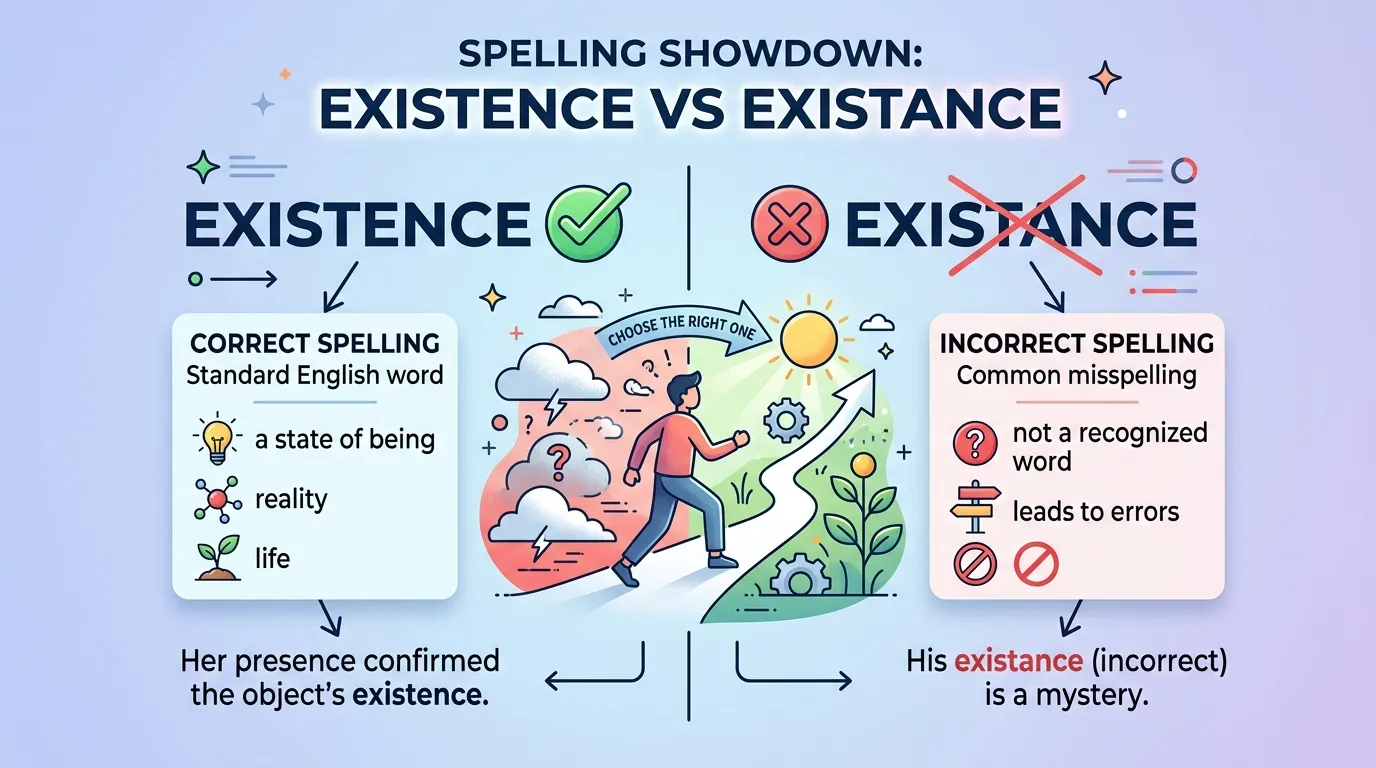
If you are wondering about existence vs existance, the correct spelling is existence. Existance is a common spelling mistake and is not the standard English spelling of the word.
Existence is a noun meaning the state of being real, alive, present, or in operation. For example, you can talk about the existence of life, the existence of a problem, or the existence of an organization.
The confusion is understandable because existence is pronounced with an -ence ending, while several related English words use different endings. The spelling can also feel unusual because the word comes from older Latin and French forms.
In this guide, you will learn the difference between existence and existance, their meanings, pronunciation, grammatical roles, history, common expressions, examples, synonyms, related words, common mistakes, and practical tips for using the correct spelling in everyday, academic, professional, and formal writing.
Quick Answer: Is It Existence or Existance?
Existence is correct.
Existance is incorrect.
| Spelling | Correct? | Meaning |
|---|---|---|
| existence | ✅ Yes | The state or fact of existing |
| existance | ❌ No | Common misspelling of existence |
Correct examples
- The scientist questioned the existence of the substance.
- Many people wonder about the existence of life on other planets.
- The company has been in existence for more than 50 years.
- The evidence supports the existence of a problem.
Incorrect example
- The scientist questioned the existance of the substance.
The last sentence should use existence.
What Does Existence Mean?

Existence is a noun that refers to the state, condition, or fact of existing.
In simple terms, if something exists, its state of being real or present can be called its existence.
For example:
The existence of water on the planet changed the researchers’ conclusions.
Here, existence means the fact that water is actually present.
The word can describe many different things:
- A person’s life
- An animal’s life
- A physical object
- A company or institution
- An idea
- A problem
- A relationship
- A condition
- A possibility
- Something believed to be real
Dictionary-style definition
Existence (noun): the state or fact of being real, living, present, or having being.
Depending on context, existence can refer to something physical or something more abstract.
For example:
- The existence of the building is easy to prove.
- The existence of the theory is well documented.
- The philosopher questioned the existence of free will.
Why Is Existance Incorrect?
The spelling existance looks reasonable because English contains many words ending in -ance.
For example:
- importance
- attendance
- appearance
- performance
- assistance
- acceptance
However, existence belongs to a different spelling pattern.
The noun comes from the verb exist, and the standard noun form is:
exist → existence
Not:
exist → existance
The ending is spelled -ence, not -ance.
This is why writing existance creates a spelling error even though many readers can understand what you mean.
Existence vs Existance: The Key Difference
The main difference is simple:
Existence is the correct English word. Existance is a misspelling.
There is no standard meaning that distinguishes the two spellings.
| Feature | Existence | Existance |
|---|---|---|
| Standard English word | Yes | No |
| Correct spelling | Yes | No |
| Part of speech | Noun | — |
| Related verb | Exist | Exist |
| Meaning | State or fact of existing | — |
| Suitable for formal writing | Yes | No |
| Suitable for academic writing | Yes | No |
| Suitable for professional writing | Yes | No |
If you are writing an essay, email, report, article, application, or business document, always use existence.
How Do You Pronounce Existence?
Existence is commonly pronounced:
/ɪɡˈzɪstəns/
A simple pronunciation guide is:
ig-ZIS-tuhns
The main stress falls on the second syllable:
ig-ZIS-tence
The ending sounds like -tuhns, not like a completely separate word such as dance.
Example
Say:
The existence of the problem was obvious.
The pronunciation is approximately:
The ig-ZIS-tuhns of the problem was obvious.
The pronunciation may vary slightly depending on accent, but the spelling existence remains standard in both American and British English.
Is Existence a Noun?
Yes. Existence is a noun.
It names the state or fact of existing.
The related verb is exist.
Word family
| Word | Part of Speech | Example |
|---|---|---|
| exist | Verb | Do aliens exist? |
| existence | Noun | Scientists debate the existence of aliens. |
| existent | Adjective | The threat is existent but limited. |
| existing | Adjective/participle | We must improve the existing system. |
| existential | Adjective | The novel raises existential questions. |
The most common words in this family are exist, existence, existing, and existential.
Existence in a Sentence
The word existence can appear in many sentence structures.
Talking about something being real
- The evidence proves the existence of the disease.
- Researchers are investigating the existence of underground water.
- Nobody could deny the existence of the problem.
Talking about life
- The accident changed the course of his existence.
- Humans have searched for meaning throughout their existence.
- The species has survived for thousands of years.
Talking about an organization
- The company has been in existence since 1985.
- The committee’s existence depends on continued funding.
Talking about an idea
- The book challenges the existence of absolute truth.
- The philosopher questioned the existence of free will.
Existence vs Exist: What Is the Difference?
Although existence and exist are closely related, they have different grammatical roles.
Exist is a verb.
Existence is a noun.
Compare these sentences:
- Does intelligent life exist?
- Scientists are studying the possible existence of intelligent life.
In the first sentence, exist describes an action or state.
In the second, existence names the state itself.
More examples
Verb:
- Some ancient traditions still exist.
- Does this species exist today?
- Such problems exist in many workplaces.
Noun:
- The existence of these traditions is well documented.
- Scientists confirmed the existence of the species.
- The report discusses the existence of workplace problems.
Common Collocations With Existence
A collocation is a group of words that commonly appear together.
Learning common collocations can make your writing sound more natural.
Common phrases with existence
- existence of
- prove the existence of
- deny the existence of
- question the existence of
- confirm the existence of
- acknowledge the existence of
- establish the existence of
- demonstrate the existence of
- evidence of existence
- the existence of life
- human existence
- earthly existence
- continued existence
- independent existence
- physical existence
- meaningful existence
- peaceful existence
- day-to-day existence
- existence of a problem
- existence of a relationship
Examples
- The researchers confirmed the existence of a new species.
- The lawyer challenged the existence of a valid agreement.
- The evidence demonstrates the existence of a connection.
- The author explores the meaning of human existence.
Common Expressions With Existence
Some expressions containing existence appear frequently in formal and everyday English.
Come into existence
This means to begin to exist.
- The organization came into existence in the early 1990s.
- The new system came into existence after years of planning.
Bring into existence
This means to cause something to exist or begin.
- The agreement brought a new partnership into existence.
- New technology can bring entirely new industries into existence.
In existence
This means currently existing or having existed for a particular period.
- The museum has been in existence for over a century.
- No records of the settlement remain in existence.
Cease to exist
This means to stop existing.
- The old organization eventually ceased to exist.
- Some languages have ceased to exist over time.
Struggle for existence
This phrase describes a difficult effort to survive.
- Many species face a constant struggle for existence.
- The business entered a serious struggle for existence during the economic crisis.
Bare existence
This refers to living or surviving with only the most basic necessities.
- The family was reduced to a bare existence.
- The novel describes his difficult and isolated existence.
Existence in Philosophy
Existence has a particularly important meaning in philosophy.
Philosophers have long asked questions such as:
- What does it mean to exist?
- Why does anything exist?
- What makes something real?
- Does consciousness exist independently of the body?
- What gives human existence meaning?
These questions are often associated with existential philosophy.
The adjective existential comes from the same word family.
For example:
- The character faces an existential crisis.
- The book explores existential questions.
- The film examines the meaning of human existence.
In this context, existence is not simply about physical presence. It can involve identity, consciousness, freedom, purpose, mortality, and meaning.
Existence in Science and Technical Writing
In scientific and technical contexts, existence usually refers to whether something is present, real, detectable, or demonstrable.
Examples include:
- Scientists found evidence supporting the existence of liquid water.
- The experiment questions the existence of a previously proposed particle.
- Researchers confirmed the existence of the pattern.
- The software checks for the existence of a file before opening it.
In technical writing, existence is often paired with words such as:
- evidence
- proof
- confirmation
- detection
- condition
- presence
- possibility
- entity
- system
- object
Existence in Business Writing
Business writers may use existence when discussing companies, contracts, risks, conditions, or organizational structures.
Examples:
- The audit confirmed the existence of the assets.
- The agreement recognizes the existence of certain obligations.
- Management was unaware of the existence of the risk.
- The company has been in existence for three decades.
However, in ordinary business communication, simpler alternatives may sometimes sound more natural.
Instead of:
We were not aware of the existence of this issue.
You could write:
We were not aware of this issue.
The second version is shorter and more direct.
Existence in Academic Writing
Existence is completely appropriate in academic writing.
It is especially common in:
- Philosophy
- Biology
- Physics
- History
- Sociology
- Psychology
- Political science
- Law
- Literature
- Theology
Examples:
- The study examines the existence of social inequality.
- The researchers investigated the existence of a relationship between the variables.
- The paper discusses competing theories about human existence.
Academic writers should still avoid using existence when a simpler word communicates the same idea more clearly.
Existence in Journalism
Journalists often use existence when reporting on evidence, investigations, organizations, threats, or historical records.
Examples:
- Officials denied the existence of a secret agreement.
- Investigators found evidence supporting the existence of the network.
- The report raises questions about the existence of the program.
In news writing, the word can be useful because it precisely describes whether something is present or real.
Existence in Sports Writing
There is no special sports spelling or meaning of existence.
However, sports writers may use it in phrases involving a team’s survival or continued operation.
For example:
- The club is fighting for its existence.
- The team secured a win that could preserve its existence in the league.
- Financial problems threatened the existence of the club.
For everyday sports commentary, simpler wording such as survival, future, or place in the league may sometimes sound more natural.
Existence in Casual Conversation
The word is grammatically normal in casual conversation, but people often choose simpler alternatives.
For example:
Formal:
I question the existence of a real solution.
More conversational:
I don’t think a real solution exists.
Both are correct.
Another example:
Formal:
The existence of the problem was obvious.
Conversational:
The problem clearly existed.
This illustrates an important writing principle: a correct word is not always the most natural word for every sentence.
Formal vs Informal Alternatives to Existence
Depending on context, you can replace existence with another word.
| Context | Possible Alternative |
|---|---|
| General | presence |
| Life | life |
| Reality | reality |
| Being | being |
| Survival | survival |
| Continuation | continuation |
| Availability | availability |
| Presence of something | presence |
| Philosophical context | being |
| Scientific context | presence or occurrence |
Example
The existence of bacteria was confirmed.
Possible alternatives:
The presence of bacteria was confirmed.
Or:
Bacteria were detected.
The best choice depends on what you want to emphasize.
Synonyms for Existence
Some common synonyms include:
- being
- presence
- reality
- life
- actuality
- occurrence
- survival
- continuation
- subsistence
- living
- state of being
These words are not always interchangeable.
For example, presence usually emphasizes that something is located somewhere, while existence emphasizes the fact that something exists.
Compare
The presence of smoke filled the room.
This focuses on smoke being present.
The existence of smoke in the room proved that something had burned.
This focuses more on the fact that smoke existed there.
Antonyms of Existence
Depending on the context, possible opposites include:
- nonexistence
- absence
- nothingness
- extinction
- disappearance
- death
- inexistence
The exact opposite depends on what existence means in the sentence.
For example:
The species faced extinction.
Here, extinction is the end of the species’ existence.
In philosophy, nonexistence or nothingness may be more appropriate.
Word History and Etymology of Existence
The spelling existence has a long history.
It ultimately relates to the Latin verb existere or exsistere, associated with ideas such as emerging, appearing, or standing forth.
The related Latin noun existentia developed into forms in French and other European languages before entering English.
English has used forms related to existence for centuries.
The modern spelling reflects this historical development. It is not formed simply by adding -ance to the verb exist.
That history helps explain why existence is the established spelling.
Why People Often Spell Existence as Existance
The error usually happens because English spelling does not always make vowel choices predictable.
Several factors can cause confusion.
The -ance and -ence endings sound similar
Compare:
- existence
- assistance
- attendance
- importance
- acceptance
The unstressed vowel in these endings can be difficult to hear clearly.
The word is related to exist
Writers may reason:
exist + ance = existance
But English does not always form nouns through such a straightforward process.
The established form is:
exist + ence = existence
Fast typing can cause the error
Because existance looks familiar, people may type it without noticing the incorrect vowel.
Spell-checkers may not always be enough
Modern software can catch many spelling errors, but writers should still know the correct form. A careful writer should recognize that existence is the standard spelling.
Common Mistakes With Existence
Mistake: Writing existance
❌ The report examines the existance of the problem.
✅ The report examines the existence of the problem.
Mistake: Using existence when exist is better
❌ We need to verify the existence of whether the system works.
✅ We need to verify whether the system works.
The first sentence is unnecessarily complicated.
Mistake: Confusing existence with presence
❌ The existence of the manager in the room was noticed.
✅ The presence of the manager in the room was noticed.
When you mean someone or something is physically located somewhere, presence is often more natural.
Mistake: Overusing existence
❌ The existence of several new problems caused concern.
✅ Several new problems caused concern.
The second sentence is more direct.
Awkward vs Natural Examples
Awkward
We discussed the existence of whether the plan was possible.
Natural
We discussed whether the plan was possible.
Awkward
She proved the existence of the fact that he was there.
Natural
She proved that he was there.
Correct but formal
The study examines the existence of social barriers.
More direct
The study examines social barriers.
The original sentence is not wrong. The better choice depends on context and emphasis.
American vs British English: Is There a Difference?
There is no standard American-British spelling difference between existence and existance.
Both American English and British English use:
existence
Examples:
- American English: the existence of the problem
- British English: the existence of the problem
The misspelling existance should be avoided in both varieties.
This is different from words such as:
- color / colour
- center / centre
- organize / organise
Existence does not have an equivalent standard regional spelling ending in -ance.
Memory Trick for Existence
A simple way to remember the spelling is:
Exist → Existence
Think:
If it exists, its existence has an E.
Another useful trick is to remember the related word:
existence
The ending is:
-ENCE
not:
-ANCE
You can also break it visually into:
EXIST + ENCE
When proofreading, pay special attention to the vowel immediately before the final -nce.
How to Remember Existence vs Existance
Use this quick rule:
Existence exists. Existance does not.
It is short, memorable, and useful.
You can also make a sentence:
The existence of the correct spelling is easy to prove.
If you see existance in your writing, replace it with existence.
Real-World Example Sentences
Here are additional examples showing how existence works in different contexts.
Everyday English
- I had no idea that such a place was in existence.
- Her experience changed the way she viewed existence.
- The problem has been in existence for years.
Education
- Students debated the existence of intelligent life beyond Earth.
- The essay examines questions about human existence.
Science
- The experiment provided evidence for the existence of the compound.
- Researchers are testing whether the phenomenon’s existence can be independently confirmed.
Business
- The company announced its continued existence after restructuring.
- The audit confirmed the existence of the reported assets.
Technology
- The program checks for the existence of the requested file.
- The database records the existence of each active account.
Law
- The court considered evidence concerning the existence of an agreement.
- The defendant disputed the existence of the contract.
History
- Archaeological discoveries support the existence of an ancient settlement.
- Historians continue to debate the existence of the legendary city.
Philosophy
- The author explores the meaning of human existence.
- The question concerns the nature of existence itself.
When Should You Use Existence?
Use existence when you specifically want to refer to:
- The fact that something exists
- The state of being alive
- The reality of something
- The continued survival of something
- The presence or reality of an abstract concept
- Philosophical questions about being
- Scientific evidence that something is real or present
For ordinary sentences, consider whether a simpler word or a direct verb would be clearer.
Instead of:
We confirmed the existence of a leak.
You can often write:
We confirmed that there was a leak.
Both are correct. The second is more conversational.
When Should You Avoid Existence?
There is no grammatical rule saying you must avoid the word. The issue is usually style, not correctness.
Avoid unnecessary uses when they make a sentence longer without adding meaning.
Wordy
The existence of multiple errors in the report resulted in its rejection.
Cleaner
Multiple errors in the report led to its rejection.
The cleaner version is easier to read.
This matters particularly in:
- Business emails
- News writing
- Blog posts
- User instructions
- General web content
- Everyday communication
Existence vs Existance: Final Comparison
| Question | Existence | Existance |
|---|---|---|
| Is it correct? | ✅ Yes | ❌ No |
| Is it a standard English word? | ✅ Yes | ❌ No |
| Part of speech | Noun | — |
| Related verb | Exist | — |
| Meaning | State or fact of existing | No standard meaning |
| American English | Standard | Incorrect |
| British English | Standard | Incorrect |
| Academic writing | Appropriate | Incorrect |
| Business writing | Appropriate | Incorrect |
| Casual writing | Appropriate | Incorrect |
| Formal writing | Appropriate | Incorrect |
Frequently Asked Questions
Is existence or existance correct?
Existence is correct. Existance is a misspelling. Use existence in American English, British English, academic writing, business writing, and everyday communication.
What is the meaning of existence?
Existence means the state or fact of being real, alive, present, or having being. For example, the phrase the existence of life refers to the fact that life exists.
Why do people spell existence as existance?
People often confuse the two because the unstressed vowels in -ence and -ance can sound similar. English also has many common words ending in -ance, which can make existance look plausible.
Is existance a word?
No. Existance is not the standard English spelling. The correct word is existence.
How do you pronounce existence?
Existence is commonly pronounced approximately ig-ZIS-tuhns, with the main stress on the second syllable. Its common IPA pronunciation is /ɪɡˈzɪstəns/.
What is the difference between exist and existence?
Exist is a verb, while existence is a noun. For example, Do aliens exist? uses the verb, while Scientists debate the existence of aliens uses the noun.
What is the adjective form of existence?
The most common related adjectives are existent, existing, and existential, although they have different meanings and uses. Existing means already present, while existential relates to existence, especially human existence and philosophical questions.
Is existence used differently in American and British English?
No major spelling difference exists. Both American and British English use existence. Existance is considered incorrect in both varieties.
What are synonyms for existence?
Depending on the context, synonyms include being, presence, reality, life, actuality, survival, continuation, and occurrence. However, these words are not interchangeable in every sentence.
How can I remember the spelling of existence?
Remember the pattern exist + ence = existence. A simple memory trick is: Existence exists. Existance does not.
Conclusion
When choosing between existence vs existance, the answer is straightforward: existence is the correct spelling.
Existence is a noun meaning the state or fact of existing. It can describe physical life, the reality of an object or idea, the continued operation of an organization, or deeper philosophical questions about being and purpose.
The incorrect form existance is easy to understand, but it should not appear in polished English writing. There is no standard American or British variant that uses existance.
Remember the basic word family:
exist → existence → existing → existential
When you need the noun, choose existence.
For casual writing, you can sometimes replace it with a simpler construction using exist, be, presence, or another more precise word. In formal, academic, scientific, business, and professional writing, existence is completely standard when its meaning is appropriate.
The easiest spelling rule to remember is:
Existence has -ence, not -ance.
So if you ever hesitate between existence and existance, choose existence every time.