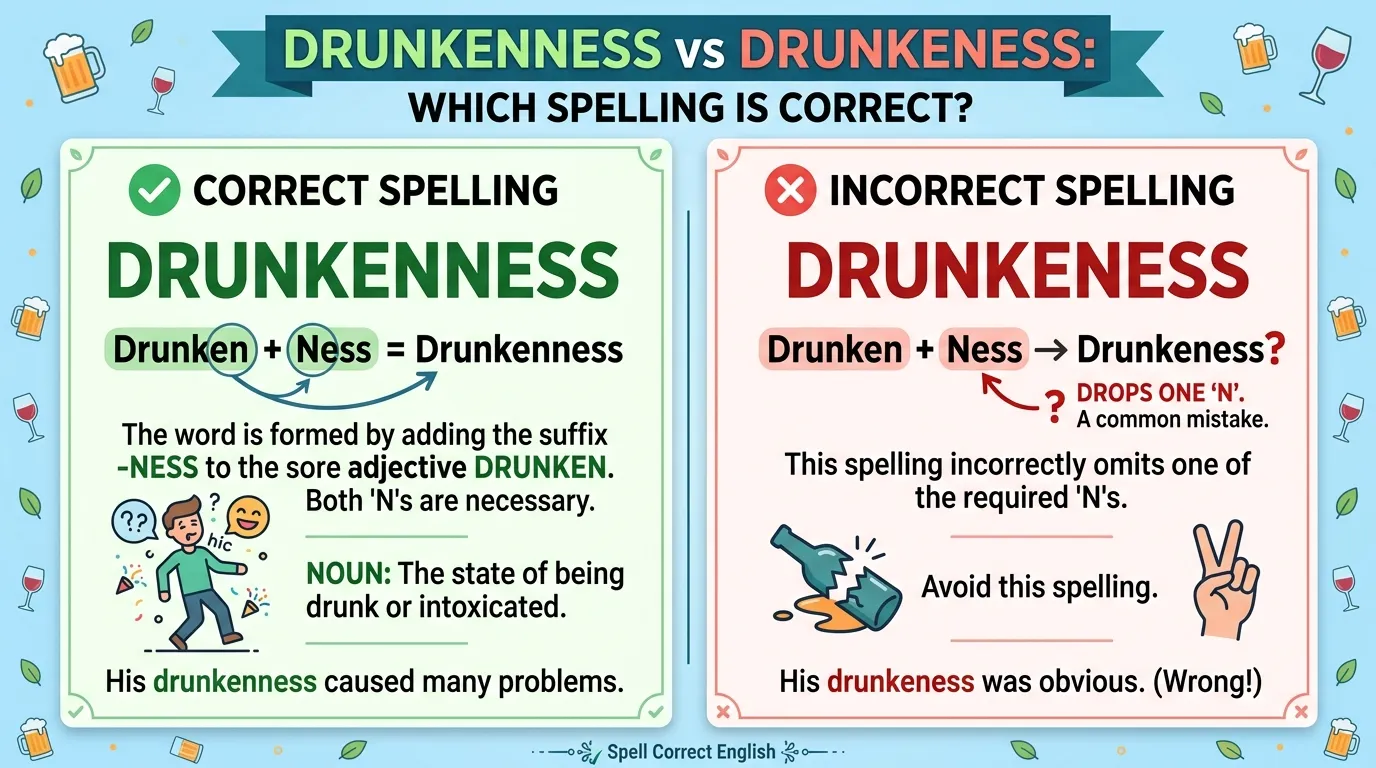
If you are wondering whether drunkenness or drunkeness is the correct spelling, the answer is simple: drunkenness is correct. Drunkeness is a misspelling.
The confusion usually happens because the word is formed from drunken + ness, and English spelling rules do not always make suffix changes obvious. Some writers also leave out the second n because the pronunciation does not strongly highlight the repeated consonant.
In this guide, you will learn why drunkenness has two n’s, what the word means, how to pronounce it, how it differs from related words such as drunk, drunken, and intoxication, and how to use it naturally in American English. You will also see common mistakes, formal and informal alternatives, word history, collocations, examples, and answers to frequently asked questions.
Quick Answer: Drunkenness or Drunkeness?
Drunkenness is the correct spelling.
Drunkeness is incorrect and should be avoided in standard English.
| Spelling | Correct? | Example |
|---|---|---|
| drunkenness | Yes | The law addresses public drunkenness. |
| drunkeness | No | This is a spelling error. |
The correct form contains two n’s before the ess ending:
drunken + ness = drunkenness
A useful way to remember it is:
drunken + ness = drunkenness
The base word drunken already ends in n, and the suffix -ness begins with another n. Both letters remain in the standard spelling.
What Does Drunkenness Mean?
Drunkenness is a noun meaning the state or condition of being drunk, especially as a result of consuming too much alcohol.
It can describe physical or behavioral intoxication caused by alcohol.
Dictionary Style Definition
Drunkenness
Noun
Meaning: The state of being drunk or intoxicated, especially from excessive alcohol consumption.
Example:
His drunkenness made it difficult for him to walk safely.
The word can refer to more than simply having consumed alcohol. It often emphasizes the condition, behavior, or state associated with being drunk.
For example:
- His drunkenness was obvious.
- The restaurant has a policy against aggressive drunkenness.
- The story describes the effects of drunkenness.
- The police officer noticed signs of drunkenness.
Why Is Drunkenness Spelled With Two Ns?
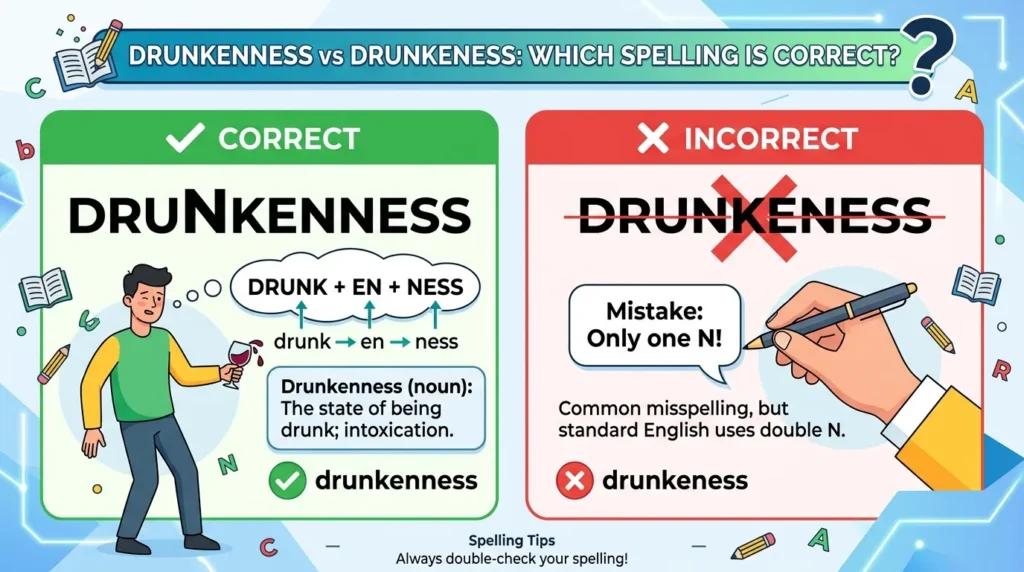
The easiest explanation is that drunkenness is formed from the adjective drunken and the suffix -ness.
The structure is:
drunken + ness → drunkenness
The word drunken ends in n.
The suffix -ness begins with n.
Therefore, the spelling contains nn:
drunkenness
The incorrect spelling drunkeness removes one of those letters.
The Same Pattern Appears in Other English Words
English contains many words in which a base word ending in a consonant combines with a suffix beginning with the same consonant.
For example:
- sudden + ness = suddenness
- thin + ness = thinness
- keen + ness = keenness
- mean + ness = meanness
- clean + ness = cleanness
This makes drunkenness easier to remember.
Drunkenness vs Drunkeness: The Key Difference
There is really only one important difference:
Drunkenness is correctly spelled. Drunkeness is not.
They do not represent two different meanings, dialects, or levels of formality.
| Feature | Drunkenness | Drunkeness |
|---|---|---|
| Standard spelling | Correct | Incorrect |
| Dictionary form | Yes | No |
| Part of speech | Noun | Not a standard word |
| Meaning | State of being drunk | Intended to mean drunkenness |
| American English | Standard | Misspelling |
| British English | Standard | Misspelling |
| Formal writing | Appropriate when relevant | Avoid |
| Academic writing | Appropriate when relevant | Avoid |
| Casual writing | Appropriate | Avoid |
If you see drunkeness in a text, it is almost certainly an accidental spelling error rather than an alternative form.
Drunkenness Meaning in Simple English
In simple English, drunkenness means being drunk.
However, there is a small difference in emphasis.
Drunk usually describes a person:
He was drunk.
Drunkenness describes the condition itself:
His drunkenness caused problems.
Think of the relationship this way:
drunk → drunken → drunkenness
These words are related, but they do not perform exactly the same grammatical job.
Drunk vs Drunken vs Drunkenness
Understanding the related forms helps prevent spelling and grammar mistakes.
Drunk
Drunk is commonly used as an adjective describing someone affected by alcohol.
He was drunk.
It can also function as a noun in some contexts:
The police removed several drunks from the area.
Drunken
Drunken is an adjective.
It often describes behavior, actions, speech, or conditions associated with being drunk.
Examples:
- drunken behavior
- drunken argument
- drunken driving
- drunken speech
- drunken violence
Notice that drunken does not normally describe a person in the same straightforward way that drunk does.
You would normally say:
He was drunk.
Rather than:
He was drunken.
However, expressions such as a drunken man are possible, especially when describing a person in a particular state or context.
Drunkenness
Drunkenness is a noun.
It names the state or condition.
The law prohibits public drunkenness.
So the basic distinction is:
| Word | Part of Speech | Basic Function |
|---|---|---|
| drunk | Adjective / noun | Describes or refers to a person affected by alcohol |
| drunken | Adjective | Describes behavior, actions, or conditions |
| drunkenness | Noun | Names the state of being drunk |
How to Pronounce Drunkenness
Drunkenness is generally pronounced approximately:
DRUNK-en-ness
A simple phonetic representation is:
/ˈdrʌŋkənəs/
The first syllable receives the main stress:
DRUNK-en-ness
The pronunciation may make the spelling confusing because the two n’s are not pronounced as two strongly separated sounds.
That is one reason some people accidentally write drunkeness.
Remember that pronunciation does not always reveal every letter in an English word.
Why Do People Spell Drunkenness as Drunkeness?
The misspelling drunkeness is understandable because English spelling is not perfectly phonetic.
Several factors can cause the mistake.
The Double N Is Easy to Miss
When people hear drunkenness, they may perceive the word as something like:
drunk-en-ess
That can encourage the incorrect spelling drunkeness.
The Word Is Less Common Than Drunk
Most people use drunk much more often in everyday conversation.
For example:
He was drunk.
is much more common in casual speech than:
His drunkenness was concerning.
Because drunkenness is less frequent, writers may hesitate when spelling it.
The Suffix Creates Confusion
The ending -ness is extremely common:
- happiness
- kindness
- darkness
- weakness
- sadness
Writers may mentally separate the word as:
drunken + ess
instead of:
drunken + ness
That can lead to the missing n.
Is Drunkenness a Noun?
Yes. Drunkenness is a noun.
It is an abstract noun because it names a condition or state rather than a physical object.
Compare:
The man was drunk.
with:
The man’s drunkenness was obvious.
In the first sentence, drunk describes the man.
In the second sentence, drunkenness names the condition.
Grammatical Examples
Subject:
Drunkenness can impair judgment.
Object:
The law addresses public drunkenness.
Possessive construction:
His drunkenness caused concern.
After a preposition:
The incident resulted from drunkenness.
Common Collocations With Drunkenness
A collocation is a combination of words that naturally appear together.
Common collocations with drunkenness include:
- public drunkenness
- excessive drunkenness
- chronic drunkenness
- habitual drunkenness
- signs of drunkenness
- symptoms of drunkenness
- drunkenness and disorder
- drunkenness and violence
- drunkenness in public
- drunkenness among adults
- drunkenness caused by alcohol
- effects of drunkenness
- consequences of drunkenness
- problems associated with drunkenness
Examples
The officer observed signs of drunkenness.
The article discusses the social consequences of drunkenness.
The venue has strict rules concerning public drunkenness.
Excessive drunkenness can affect judgment and coordination.
Public Drunkenness vs Public Intoxication
The phrase public drunkenness is common, but public intoxication is often preferred in formal, legal, or neutral contexts.
Compare:
| Expression | Tone | Typical Context |
|---|---|---|
| public drunkenness | Direct | General discussion |
| public intoxication | More formal/neutral | Legal or official contexts |
| being drunk in public | Conversational | Everyday speech |
| alcohol intoxication | Clinical/formal | Medical or technical contexts |
The best choice depends on the audience.
For a general blog post:
Public drunkenness can create safety concerns.
For a formal report:
Public intoxication may require intervention.
Drunkenness vs Intoxication
These words are closely related but not identical.
Drunkenness usually points specifically to being drunk, particularly from alcohol.
Intoxication is broader and more formal. It can refer to impairment caused by alcohol, drugs, or other substances.
| Word | Meaning | Tone |
|---|---|---|
| drunkenness | State of being drunk | General, sometimes formal |
| intoxication | State of being affected or impaired by a substance | Formal, technical |
| inebriation | State of being drunk | Formal or literary |
| drunken state | Condition of being drunk | Neutral |
| being drunk | Being affected by alcohol | Everyday |
For everyday American English, being drunk is usually the most natural phrase.
For technical or professional writing, intoxication may be more appropriate.
Drunkenness vs Inebriation
Inebriation is another noun meaning intoxication or drunkenness.
However, it sounds more formal and less common in everyday conversation.
Compare:
His drunkenness was obvious.
with:
His inebriation was obvious.
The second sentence sounds more formal and somewhat clinical or literary.
Practical Recommendation
Use:
drunkenness for ordinary formal and general writing.
Use:
intoxication for medical, legal, scientific, or professional contexts when appropriate.
Use:
being drunk for ordinary conversation.
Use:
inebriation when a more formal or literary tone is genuinely useful.
Formal and Informal Alternatives
There are many ways to express the same basic idea.
Informal
- being drunk
- getting drunk
- drunk behavior
- being really drunk
- being wasted
The last expression is highly informal and can vary by context.
Neutral
- drunkenness
- being intoxicated
- alcohol intoxication
- a drunken state
Formal
- alcohol intoxication
- acute intoxication
- inebriation
- alcohol-related impairment
The correct choice depends on your audience.
Synonyms for Drunkenness
Depending on context, possible synonyms include:
- intoxication
- inebriation
- drunken state
- impairment
- alcohol intoxication
- intoxicated condition
Some are not exact synonyms in every situation.
For example, impairment can result from many causes and does not necessarily mean alcohol use.
Antonyms and Contrasting Terms
There is no single perfect antonym for drunkenness, but several expressions contrast with it.
- sobriety
- soberness
- abstinence
- alertness
- clear-headedness
- self-control
- sobriety from alcohol
Sobriety is the strongest direct contrast in many contexts.
Example:
The program supports long-term sobriety after years of alcohol misuse.
Word History and Etymology
Drunkenness is built from the adjective drunken and the suffix -ness.
The word drunken has a long history in English and is related to the verb drink.
English developed several forms around the idea of drinking:
- drink
- drank
- drunk
- drunken
- drunkenness
The suffix -ness is used to turn adjectives into nouns expressing a state, quality, or condition.
Examples include:
- happy → happiness
- dark → darkness
- weak → weakness
- kind → kindness
- drunken → drunkenness
Therefore, drunkenness essentially means the state or condition of being drunken.
Drunkenness in American English
In American English, drunkenness is a recognized standard word.
It appears most naturally in formal, descriptive, legal, historical, and journalistic contexts.
Examples:
The report examined alcohol use and public drunkenness.
The novel portrays the effects of drunkenness on the family.
The policy addresses disorder associated with public drunkenness.
In ordinary conversation, Americans are more likely to say:
He was drunk.
rather than:
He was experiencing drunkenness.
The latter is grammatically correct but less conversational.
Drunkenness in British English
Drunkenness is also standard in British English.
There is no major British spelling variation that changes drunkenness to drunkeness.
Therefore:
American English: drunkenness
British English: drunkenness
International standard English: drunkenness
The incorrect spelling drunkeness should not be treated as a British variant.
Is Drunkeness Ever Correct?
No, not in standard English.
You may encounter drunkeness online, in informal writing, in user-generated content, or as a typographical error.
Its appearance does not make it an accepted spelling.
If you are writing:
- an essay
- a report
- a blog
- an article
- a business document
- a school assignment
- a news story
- a professional document
use drunkenness.
Common Spelling Mistakes
Here are some common mistakes and their corrections.
| Incorrect | Correct |
|---|---|
| drunkeness | drunkenness |
| drunkennes | drunkenness |
| drunkenesss | drunkenness |
| drunkeness behavior | drunkenness behavior is still awkward; use drunken behavior |
| public drunkeness | public drunkenness |
The last example also highlights an important grammar point.
Drunkenness vs Drunken Behavior
Do not automatically use drunkenness whenever you want to describe something related to being drunk.
Use drunken when you need an adjective.
Natural
The police reported drunken behavior.
Less Natural
The police reported drunkenness behavior.
Why?
Because drunken modifies behavior directly.
Drunkenness is a noun naming the state.
Compare:
His drunkenness was obvious.
His drunken behavior was disruptive.
Both are correct, but they have different grammatical structures.
Awkward vs Natural Examples
Awkward
His drunkenness behavior caused problems.
Natural
His drunken behavior caused problems.
Awkward
She was drunkenness at the party.
Natural
She was drunk at the party.
Awkward
The officer noticed public drunkeness.
Natural
The officer noticed public drunkenness.
Awkward
The report focused on drunkness.
Natural
The report focused on drunkenness.
Common Expressions With Drunkenness
Some expressions are especially useful in formal or descriptive writing.
Public Drunkenness
The city has rules addressing public drunkenness.
Signs of Drunkenness
The driver showed signs of drunkenness.
Effects of Drunkenness
The article examines the effects of drunkenness on judgment.
Consequences of Drunkenness
The story explores the personal consequences of drunkenness.
Alcohol Related Drunkenness
This phrase can be redundant because drunkenness usually refers to alcohol in ordinary usage. In technical contexts, however, more precise wording may be useful.
Drunkenness in Journalism
Journalists often choose more neutral terms depending on the story.
For example:
Police arrested the man on suspicion of public intoxication.
This sounds more neutral and official than:
Police arrested the man because he was drunk.
The choice depends on the publication’s style and the facts being reported.
A writer should avoid using drunkenness simply because it sounds formal. The most precise term is usually better.
Drunkenness in Academic Writing
Academic writing may use drunkenness, but the exact terminology should match the subject.
For example:
The study examines patterns of alcohol consumption and drunkenness among adults.
In a medical or behavioral science context, alcohol intoxication, alcohol use, or alcohol related impairment may be more precise.
Academic writing should favor accuracy over unnecessarily complicated vocabulary.
Drunkenness in Business Writing
Business writing rarely needs the word unless the subject specifically concerns workplace conduct, liability, safety, hospitality, or alcohol policies.
For example:
The company policy prohibits workplace impairment caused by alcohol.
This may be preferable to:
The company policy prohibits workplace drunkenness.
The first version sounds more professional and focuses on the workplace issue.
Drunkenness in Sports Writing
Sports coverage may mention drunkenness when discussing fan behavior, athletes, incidents, or public conduct.
Examples:
The team faced criticism over drunken behavior among some fans.
Officials introduced measures to reduce alcohol related disorder at the stadium.
In sports writing, drunken behavior often sounds more natural than drunkenness behavior.
Drunkenness in Blogging and Casual Writing
For blogs aimed at general readers, drunkenness is perfectly valid, but it can sound formal.
Compare:
The article explores the effects of drunkenness.
with:
The article explains what happens when you get drunk.
The second sentence is more conversational.
For an educational blog, either can work depending on the tone.
Memory Trick for Drunkenness
Here is a simple spelling trick:
DRUNKEN + NESS
Do not remove the second n.
Think:
drunken has an N, and ness starts with N. Keep them both.
So:
drunken + ness = drunkenness
Not:
drunken + ess = drunkeness
Another useful comparison is:
dark + ness = darkness
kind + ness = kindness
drunken + ness = drunkenness
How to Remember the Correct Spelling
Use this three step method:
- Write drunken.
- Add ness.
- Keep both n’s.
That gives you:
drunkenness
If you remember the word as a combination rather than as a single long word, the spelling becomes easier.
Which Form Should You Use in Your Writing?
Use drunkenness whenever you need the noun referring to the state of being drunk.
Use drunken when you need an adjective.
Use drunk when describing someone who is intoxicated in ordinary conversation.
Use intoxication when a more technical or neutral term fits the context.
Quick Writing Guide
| If you mean… | Use |
|---|---|
| A person affected by alcohol | drunk |
| Behavior associated with being drunk | drunken |
| The state of being drunk | drunkenness |
| A formal or technical condition of impairment | intoxication |
| A formal synonym for drunkenness | inebriation |
| The opposite condition | sobriety |
Frequently Asked Questions
Is drunkenness the correct spelling?
Yes. Drunkenness is the correct standard spelling. Drunkeness is a misspelling.
Why does drunkenness have two Ns?
The word is formed from drunken + ness. The base word ends in n, and the suffix -ness begins with n, so both letters remain: drunkenness.
Is drunkeness a word?
Drunkeness is not the standard spelling of the English word. Use drunkenness instead.
What is the meaning of drunkenness?
Drunkenness means the state or condition of being drunk, usually because of consuming alcohol.
Is drunkenness a noun?
Yes. Drunkenness is a noun, specifically an abstract noun describing a state or condition.
What is the difference between drunk and drunkenness?
Drunk commonly describes a person affected by alcohol, while drunkenness names the state of being drunk.
Example:
He was drunk.
His drunkenness caused concern.
What is the difference between drunken and drunkenness?
Drunken is an adjective, while drunkenness is a noun.
Example:
The man displayed drunken behavior.
His drunkenness was obvious.
Is drunkenness spelled the same in American and British English?
Yes. Drunkenness is the standard spelling in both American and British English.
What is another word for drunkenness?
Depending on context, alternatives include intoxication, inebriation, and being drunk. Intoxication is often more suitable in formal or technical writing.
How do you pronounce drunkenness?
It is commonly pronounced approximately DRUNK-en-ness, with the main stress on the first syllable.
Final Conclusion
The choice between drunkenness and drunkeness is straightforward: drunkenness is correct, while drunkeness is a misspelling.
The easiest way to remember the spelling is to break the word into two parts:
drunken + ness = drunkenness
The word is a noun meaning the state of being drunk. It is related to drunk and drunken, but each word has a different grammatical role. Drunk commonly describes a person, drunken describes related behavior or conditions, and drunkenness names the state itself.
For everyday conversation, being drunk is often more natural. For general formal writing, drunkenness is perfectly acceptable. In legal, medical, or professional contexts, intoxication may be more precise.
Most importantly, do not write drunkeness. If you remember that the word is drunken + ness, the correct spelling becomes much easier to keep straight.