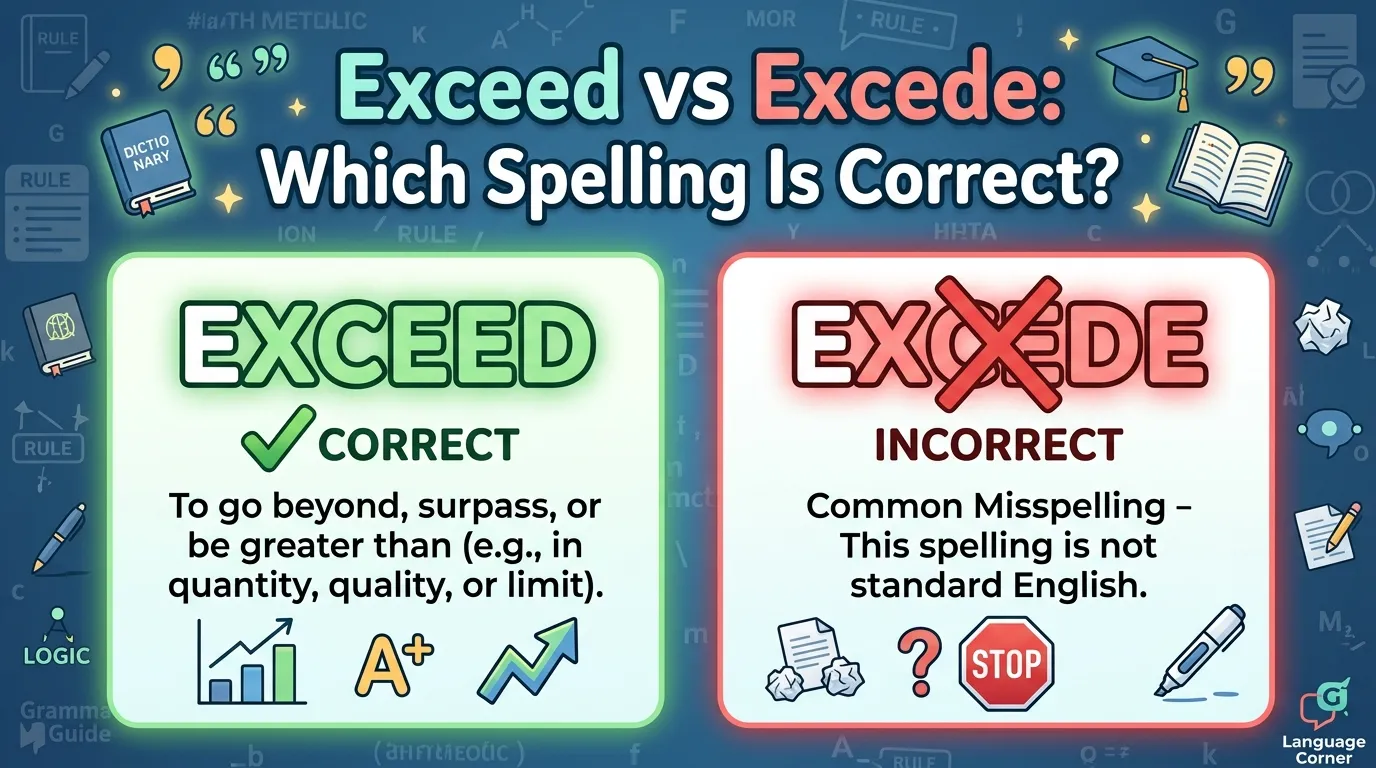
If you are wondering whether the correct spelling is exceed or excede, the answer is simple: exceed is the correct English spelling. Excede is a misspelling and should not be used in standard American or British English.
The word exceed is a verb that means to go beyond a limit, amount, expectation, standard, or level. You might say that a company exceeded its sales target, a runner exceeded expectations, or a bill exceeded the original estimate.
The confusion usually comes from pronunciation. Exceed sounds roughly like ik-SEED, so some writers incorrectly spell it as excede. The ending -ceed can also be confusing because English contains several words with different spelling patterns, such as proceed, succeed, and recede.
This guide explains the difference between exceed and excede, including their meanings, pronunciation, grammar, history, synonyms, common collocations, formal and informal usage, frequent mistakes, and practical examples.
Quick Answer: Exceed or Excede?
Exceed is correct. Excede is incorrect.
| Word | Correct? | Meaning |
|---|---|---|
| exceed | ✅ Yes | To go beyond a limit, amount, standard, or expectation |
| excede | ❌ No | Common misspelling of exceed |
Correct examples
- The project costs exceed our budget.
- Her performance exceeded expectations.
- Do not exceed the speed limit.
- Sales exceeded the company’s forecast.
- The temperature may exceed 100 degrees.
Incorrect examples
- The project costs excede our budget. ❌
- Her performance exceded expectations. ❌
- Do not excede the speed limit. ❌
The correct forms are:
- exceed
- exceeds
- exceeded
- exceeding
There is no standard English verb excede.
What Does Exceed Mean?
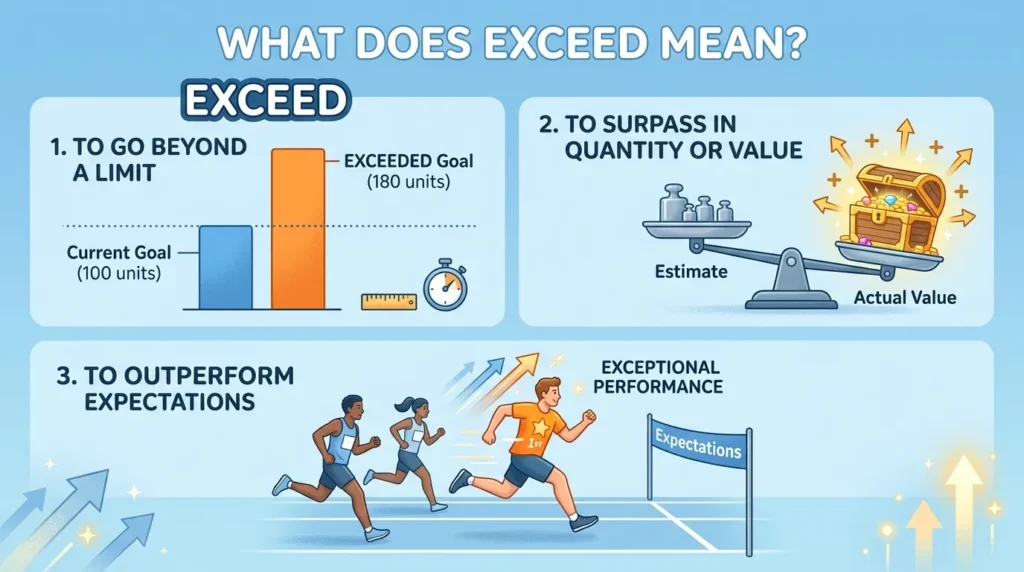
Exceed is a verb meaning to be greater than something or to go beyond a particular limit, amount, standard, or expectation.
For example:
The final cost exceeded the original estimate.
This means the final cost was higher than the original estimate.
The word can describe something measurable, such as money, weight, speed, temperature, or numbers. It can also describe something less concrete, such as expectations, standards, or performance.
Dictionary-style definition of exceed
Exceed (verb):
- To go beyond a stated limit or amount.
- To be greater than something in size, number, degree, or quality.
- To perform better than expected.
- To surpass a standard or level.
Examples
- The package cannot exceed 20 pounds.
- The number of applicants exceeded 500.
- His results exceeded the team’s expectations.
- The new model exceeds the previous version in performance.
- The repair costs exceeded the insurance estimate.
The central idea is always going beyond something.
Why Do People Confuse Exceed and Excede?

The main reason is spelling based on pronunciation.
When people hear exceed, they may think the word ends in -cede because English has words such as:
- recede
- precede
- concede
- proceed
However, exceed has a different spelling: exceed.
The pronunciation does not clearly reveal whether the ending should be spelled -ceed or -cede. English has many words whose spelling cannot be predicted perfectly from their pronunciation.
Another reason is that excede looks visually plausible. Someone who has heard the word but has rarely seen it written may naturally produce excede.
This is a classic example of a spelling error caused by phonetic confusion.
Exceed vs Excede: The Key Difference
The most important difference is that exceed is an established English word, while excede is not.
Exceed
Exceed is the standard spelling.
It can be used in everyday, professional, academic, technical, business, legal, and journalistic writing.
Examples:
- The vehicle must not exceed the posted speed limit.
- The company exceeded its quarterly goal.
- The student’s work exceeded the required standard.
- The temperature exceeded the expected level.
Excede
Excede is not the standard English spelling of the verb.
If you write excede in an essay, email, report, article, application, or business document, it will generally be treated as a spelling mistake.
Correct:
The expenses exceeded our budget.
Incorrect:
The expenses exceded our budget.
Exceed Meaning in Simple English
In simple English, exceed means to go over or be more than something.
For example:
The price exceeds $50.
This means:
The price is more than $50.
Similarly:
The car exceeded the speed limit.
This means:
The car went faster than the allowed speed.
And:
She exceeded my expectations.
This means:
She did better than I expected.
A useful shortcut is:
Exceed = go beyond = be more than = surpass
How to Pronounce Exceed
Exceed is pronounced approximately:
ik-SEED
The second syllable receives the main stress.
Its pronunciation is the same regardless of whether you are using American or British English in ordinary speech.
The spelling is:
exceed
The ending is:
-ceed
Not:
-cede
Exceed pronunciation example
Break it into two parts:
ex + ceed
The final part sounds like seed.
That pronunciation can make the spelling tricky, but remembering -ceed will help prevent the common excede error.
Is Exceed a Verb?
Yes. Exceed is a verb.
It describes an action or state in which something goes beyond another thing.
Examples:
- Costs exceed the budget.
- Demand exceeded supply.
- The athlete exceeded expectations.
- The temperature is exceeding normal levels.
- The company hopes to exceed its target.
Forms of exceed
| Verb form | Example |
|---|---|
| Base form | exceed |
| Third-person singular | exceeds |
| Past tense | exceeded |
| Past participle | exceeded |
| Present participle | exceeding |
Examples
Present:
Sales exceed our monthly target.
Third person:
The company’s revenue exceeds expectations.
Past:
The team exceeded its goal.
Past participle:
The budget has been exceeded.
Present participle:
Costs are exceeding the original estimate.
Exceed vs Surpass
Surpass is one of the closest synonyms of exceed.
Both can mean to go beyond a particular level or standard.
Compare:
Her performance exceeded expectations.
Her performance surpassed expectations.
Both sentences are natural.
However, exceed is especially common when talking about limits, quantities, measurements, expectations, and requirements.
Examples:
- exceed the limit
- exceed the budget
- exceed the maximum
- exceed expectations
- exceed requirements
- exceed the target
Surpass often emphasizes doing better than something else or reaching a higher level.
- surpass a competitor
- surpass a previous record
- surpass expectations
- surpass a milestone
Exceed vs Exceeding vs Exceeded
These forms are all correct, but they serve different grammatical purposes.
Exceed
Use the base form after words such as to, can, may, must, and will.
- The cost may exceed $1,000.
- We cannot exceed the limit.
- The company hopes to exceed its target.
Exceeds
Use exceeds with a singular third-person subject in the present tense.
- The cost exceeds the budget.
- This amount exceeds the legal limit.
- The new model exceeds the old one.
Exceeded
Use exceeded for the simple past or as a past participle.
- The project exceeded its budget.
- Sales have exceeded expectations.
- The number of visitors exceeded one million.
Exceeding
Use exceeding as the present participle or gerund.
- The company is exceeding its sales goal.
- Exceeding the limit may result in a penalty.
- Expenses are exceeding the forecast.
Common Collocations With Exceed
A collocation is a group of words that naturally appear together.
Learning common collocations is an excellent way to remember how exceed is used.
Common expressions with exceed
- exceed expectations
- exceed the limit
- exceed the budget
- exceed the target
- exceed the maximum
- exceed the minimum
- exceed the estimate
- exceed the standard
- exceed requirements
- exceed capacity
- exceed demand
- exceed supply
- exceed the forecast
- exceed the threshold
- exceed the speed limit
- exceed the weight limit
- exceed the recommended amount
- exceed the legal limit
Examples
The product exceeded customer expectations.
The truck cannot exceed the maximum weight.
Construction costs exceeded the original budget.
The temperature exceeded the seasonal average.
Demand has exceeded available supply.
These combinations are particularly common in professional and formal writing.
Exceed Expectations: What Does It Mean?
The phrase exceed expectations means to perform better than someone expected.
For example:
The new employee exceeded expectations during her first month.
This means her performance was better than expected.
The phrase is common in:
- workplaces
- education
- customer service
- performance reviews
- business
- marketing
- product descriptions
More examples
- The restaurant exceeded our expectations.
- His exam results exceeded expectations.
- The campaign exceeded the client’s expectations.
- The new software exceeded expectations for speed and reliability.
The expression is usually positive.
Exceed the Limit: What Does It Mean?
Exceed the limit means to go beyond a maximum allowed amount or level.
Examples include:
- exceed the speed limit
- exceed the weight limit
- exceed the legal limit
- exceed the credit limit
- exceed the dosage limit
- exceed the storage limit
For example:
The driver exceeded the speed limit.
The driver was traveling faster than legally permitted.
Another example:
Your luggage exceeds the airline’s weight limit.
The luggage weighs more than the permitted amount.
Exceed in Business Writing
Exceed is extremely common in business English.
Companies use it when discussing:
- sales
- revenue
- targets
- budgets
- forecasts
- performance
- expectations
- production
- customer satisfaction
Examples:
Revenue exceeded the forecast by 8 percent.
The team exceeded its quarterly target.
Operating expenses exceeded the approved budget.
Customer satisfaction scores exceeded the company’s goal.
The word is professional and precise, making it suitable for reports, presentations, emails, and financial discussions.
Exceed in Academic Writing
The word exceed is also appropriate in academic writing.
Examples:
The sample size exceeded the minimum required for the study.
The observed temperature exceeded the predicted value.
The results exceeded the researchers’ initial expectations.
The number of participants exceeded the target.
In academic writing, exceed can be useful because it communicates comparison without sounding overly informal.
Exceed in Technical Writing
Technical documents frequently use exceed to describe limits and specifications.
Examples:
The device should not exceed the recommended operating temperature.
The load must not exceed 500 kilograms.
Do not exceed the maximum pressure rating.
The system cannot exceed its rated capacity.
In technical contexts, precision matters. Using excede instead of exceed would be an unnecessary spelling error.
Exceed in Sports
Sports writing uses exceed when discussing records, expectations, performance, or targets.
Examples:
The runner exceeded the previous record.
The team exceeded expectations during the tournament.
The athlete exceeded the qualifying standard.
The player exceeded his career scoring average.
It is particularly useful when comparing actual performance with a previous benchmark.
Exceed in Journalism
Journalists commonly use exceed when reporting statistics, forecasts, limits, and expectations.
Examples:
Attendance exceeded 50,000 during the weekend.
The storm caused damage exceeding initial estimates.
The company’s profits exceeded analysts’ expectations.
The number of applications exceeded last year’s total.
The word works well because it is concise and neutral.
Is Exceed Formal or Informal?
Exceed is neutral to formal.
It is perfectly acceptable in casual conversation, but it is especially common in professional and formal contexts.
Casual
The bill was more than I expected.
Neutral
The bill exceeded my expectations.
Formal
The final expenditure exceeded the amount originally allocated.
All three are grammatically correct. The choice depends on context and tone.
Formal and Informal Alternatives to Exceed
Depending on your audience, you can replace exceed with several expressions.
| Expression | Tone | Example |
|---|---|---|
| exceed | Neutral/formal | Costs exceeded the budget. |
| go over | Informal | We went over the budget. |
| be more than | Neutral | The cost was more than expected. |
| surpass | Formal/neutral | Sales surpassed the target. |
| go beyond | Neutral | The results went beyond expectations. |
| outdo | Informal/neutral | The new product outdid the previous model. |
| top | Informal | The company topped last year’s sales. |
For professional documents, exceed is often the safest choice.
Exceed vs Go Beyond
Go beyond and exceed are often interchangeable.
Compare:
The results exceeded expectations.
The results went beyond expectations.
Both are natural.
However, exceed tends to be more concise and is particularly useful when a numerical limit or measurable standard is involved.
Costs exceeded $10,000.
This sounds more natural than:
Costs went beyond $10,000.
The second sentence is possible, but exceeded is more precise for this type of statement.
Exceed vs More Than
Sometimes more than is the simplest alternative.
Compare:
The project exceeded the budget.
The project cost more than the budget allowed.
The second version is longer but very clear.
Use exceed when you want a concise, professional expression. Use more than when writing for beginners or when a simpler sentence fits the context better.
Word History and Etymology of Exceed
The word exceed comes through French from Latin.
It ultimately traces back to the Latin excedere, meaning to go out, go beyond, or surpass.
The Latin word combines elements associated with going out or beyond.
This history explains the core meaning of modern English exceed: to go beyond a boundary or level.
The spelling developed into exceed in English rather than excede. Although the historical Latin form may look similar to the common misspelling, modern English spelling follows its own established pattern.
Understanding the history can help explain why excede may look convincing even though it is not the standard English form.
Related Words With Similar Meanings
Several English words express ideas related to exceeding something.
Surpass
To do better than or go beyond something.
The athlete surpassed the previous record.
Exceed
To go beyond a limit, amount, or expectation.
Costs exceeded the estimate.
Outdo
To perform better than someone or something.
The sequel outdid the original.
Transcend
To go beyond ordinary limits or experience.
The artist’s work transcends traditional categories.
Outstrip
To move, grow, or develop faster than something else.
Demand has outstripped supply.
These words overlap, but they are not always interchangeable.
Synonyms for Exceed
Depending on context, synonyms include:
- surpass
- go beyond
- overtake
- outdo
- transcend
- outstrip
- top
- beat
- eclipse
- exceed the limits of
- be greater than
- go over
The best synonym depends on what is being exceeded.
For example, surpass works well for achievement:
She surpassed the previous record.
Go over works well in informal speech:
We went over the budget.
Outstrip often describes rates or growth:
Demand outstripped supply.
Antonyms of Exceed
The opposite of exceed depends on the context.
Possible antonyms include:
- fall below
- remain under
- stay within
- meet
- fail to reach
- be less than
- lag behind
Examples:
Costs exceeded the budget.
Opposite:
Costs remained within the budget.
Another example:
The results exceeded expectations.
Opposite:
The results fell below expectations.
Common Mistakes With Exceed
Mistake: Excede
Incorrect:
The costs excede our budget.
Correct:
The costs exceed our budget.
Mistake: Exceded
Incorrect:
Sales exceded the forecast.
Correct:
Sales exceeded the forecast.
Mistake: Exceding
Incorrect:
Expenses are exceding the estimate.
Correct:
Expenses are exceeding the estimate.
The spelling changes because exceed already contains the double e at the end of its base form.
Why Is Exceeded Spelled With -eeded?
This is another point that can confuse writers.
The base verb is:
exceed
To form the simple past, add -ed:
exceed + ed = exceeded
Therefore:
exceeded
has three consecutive e’s around the ending:
exceed + ed → exceeded
It may look unusual, but it is correct.
Examples:
- exceed → exceeded
- exceed → exceeding
- exceed → exceeds
Do not simplify the spelling to exceded or exceding.
Memory Trick: How to Remember Exceed
A simple memory trick is:
Exceed has two e’s at the end: EXCEED.
Think:
Exceed = go beyond the need → exceed
Another useful association is:
Exceed sounds like seed.
Imagine a plant growing beyond the expected height. It exceeds the limit.
You can also remember:
Exceed = E-E at the end.
Whenever you mean go beyond, write exceed, not excede.
Awkward vs Natural Examples
Example 1
Awkward:
The expenses exceded our budget.
Natural:
The expenses exceeded our budget.
Example 2
Awkward:
The company is exceding its sales target.
Natural:
The company is exceeding its sales target.
Example 3
Awkward:
The truck must not excede the weight limit.
Natural:
The truck must not exceed the weight limit.
Example 4
Less concise:
The temperature went to a level that was higher than the expected maximum.
More natural:
The temperature exceeded the expected maximum.
Example 5
Informal:
We went over what we planned to spend.
Professional:
We exceeded our planned budget.
Everyday Examples of Exceed
Here are natural examples you might encounter in ordinary life:
- The bill exceeded my budget.
- The package exceeds the weight limit.
- The movie exceeded my expectations.
- The crowd exceeded the venue’s capacity.
- The temperature exceeded 90 degrees.
- The recipe exceeded the amount of sugar I wanted to use.
- The repair cost exceeded the estimate.
- The car exceeded the posted speed limit.
- The number of guests exceeded our original plan.
- The final price exceeded the advertised estimate.
American vs British English: Is There a Difference?
There is no major American-British spelling difference between exceed and excede.
Both American and British English use:
exceed
Neither standard variety uses excede as the normal spelling of this English verb.
Some vocabulary, punctuation, and spelling conventions differ between American and British English, but this is not one of those cases.
For example, American English commonly uses:
- color
- center
- organize
British English commonly uses:
- colour
- centre
- organise
But both use:
- exceed
- exceeds
- exceeded
- exceeding
International English Usage
English learners around the world should use exceed in standard English writing.
This applies to:
- academic essays
- international business
- professional emails
- websites
- applications
- technical documentation
- reports
- journalism
- educational materials
If you are writing for an international audience, exceed is the universally recognizable standard spelling.
Is Excede Ever Correct?
In ordinary English writing, no. Excede should not be used as the spelling of the English verb meaning go beyond.
If you encounter excede somewhere, it is most likely a typographical or spelling error.
There may be unrelated names, trademarks, specialized terms, or words in other languages that resemble excede, but that does not make it a standard English spelling of exceed.
For normal English grammar and spelling, remember:
exceed = correct
excede = incorrect
Exceed in Different Writing Contexts
Business
Use exceed freely.
Revenue exceeded expectations this quarter.
Academic
Use exceed for measurements, standards, and results.
The findings exceeded the minimum statistical threshold.
Technical
Use exceed for specifications and limits.
The operating temperature must not exceed 75°C.
Sports
Use exceed for records and performance.
The athlete exceeded the qualifying standard.
Journalism
Use exceed for statistics and forecasts.
Attendance exceeded 20,000.
Blogging
Use exceed when a professional or informative tone is appropriate.
The guide exceeds the basic requirements for beginner readers.
Casual conversation
You can use exceed, although simpler alternatives may sound more conversational.
The price exceeded what I expected.
Or:
The price was more than I expected.
Both are natural.
Practical Recommendations for Writers
If you are unsure whether to write exceed or excede, use this rule:
Always choose exceed when you mean go beyond, be greater than, or surpass.
Before publishing, check these common forms:
- exceed ✅
- exceeds ✅
- exceeded ✅
- exceeding ✅
- excede ❌
- excedes ❌
- exceded ❌
- exceding ❌
For proofreading, searching your document for excede is a quick way to catch this spelling mistake.
Quick Comparison Table
| Feature | Exceed | Excede |
|---|---|---|
| Standard English word? | Yes | No |
| Correct spelling? | Yes | No |
| Part of speech | Verb | — |
| Meaning | Go beyond or be greater than | — |
| American English | Used | Incorrect |
| British English | Used | Incorrect |
| Formal writing | Appropriate | Avoid |
| Academic writing | Appropriate | Avoid |
| Business writing | Appropriate | Avoid |
| Technical writing | Appropriate | Avoid |
| Common mistake? | No | Yes |
Frequently Asked Questions About Exceed vs Excede
Is exceed or excede correct?
Exceed is correct. Excede is a misspelling in standard English. Use exceed when you mean to go beyond a limit, amount, expectation, standard, or level.
What is the difference between exceed and excede?
There is no standard meaning difference because exceed is the correct English word, while excede is not the standard spelling. The two forms are often confused because exceed is pronounced approximately like ik-SEED.
How do you spell exceed?
The correct spelling is E-X-C-E-E-D: exceed. The word has two e’s before the final d.
Is excede a real word?
Excede is not a standard English spelling of the verb meaning to go beyond. In ordinary English writing, use exceed instead.
What does exceed mean?
Exceed means to go beyond something or to be greater than something. For example, if a cost exceeds $500, the cost is more than $500.
Is exceeded spelled with one or two e’s?
The correct spelling is exceeded. It comes from exceed + -ed. The spelling retains the double-e ending of exceed.
What is another word for exceed?
Common synonyms include surpass, go beyond, outdo, transcend, outstrip, overtake, and be greater than. The best choice depends on the context.
Is exceed formal English?
Yes. Exceed is neutral to formal English and is especially common in business, academic, technical, legal, and professional writing. It is also perfectly normal in everyday English.
Is exceed used in American and British English?
Yes. Exceed is spelled the same in both American and British English. There is no standard regional spelling such as excede.
How can I remember the spelling of exceed?
Remember that exceed ends in -ceed, not -cede. A simple memory aid is: exceed = go beyond, with double e at the end.
Final Takeaway: Exceed vs Excede
The difference between exceed and excede is straightforward once you know the correct spelling.
Exceed is the correct English word. Excede is a misspelling.
Use exceed when you mean:
- go beyond a limit
- be greater than an amount
- surpass a standard
- perform better than expected
- go beyond a target or requirement
The correct forms are exceed, exceeds, exceeded, and exceeding.
The most common errors are excede, excedes, exceded, and exceding. Avoid all of them in standard English.
Whether you are writing an academic essay, business report, technical document, news article, blog post, professional email, or casual message, exceed is the spelling you want.
The easiest rule to remember is:
When you mean go beyond, use EXCEED — never EXCEDE.
Once you connect the meaning go beyond with the spelling exceed, this commonly confused word becomes much easier to use correctly.