Fulfil vs Fulfill: Which Spelling Is Correct?

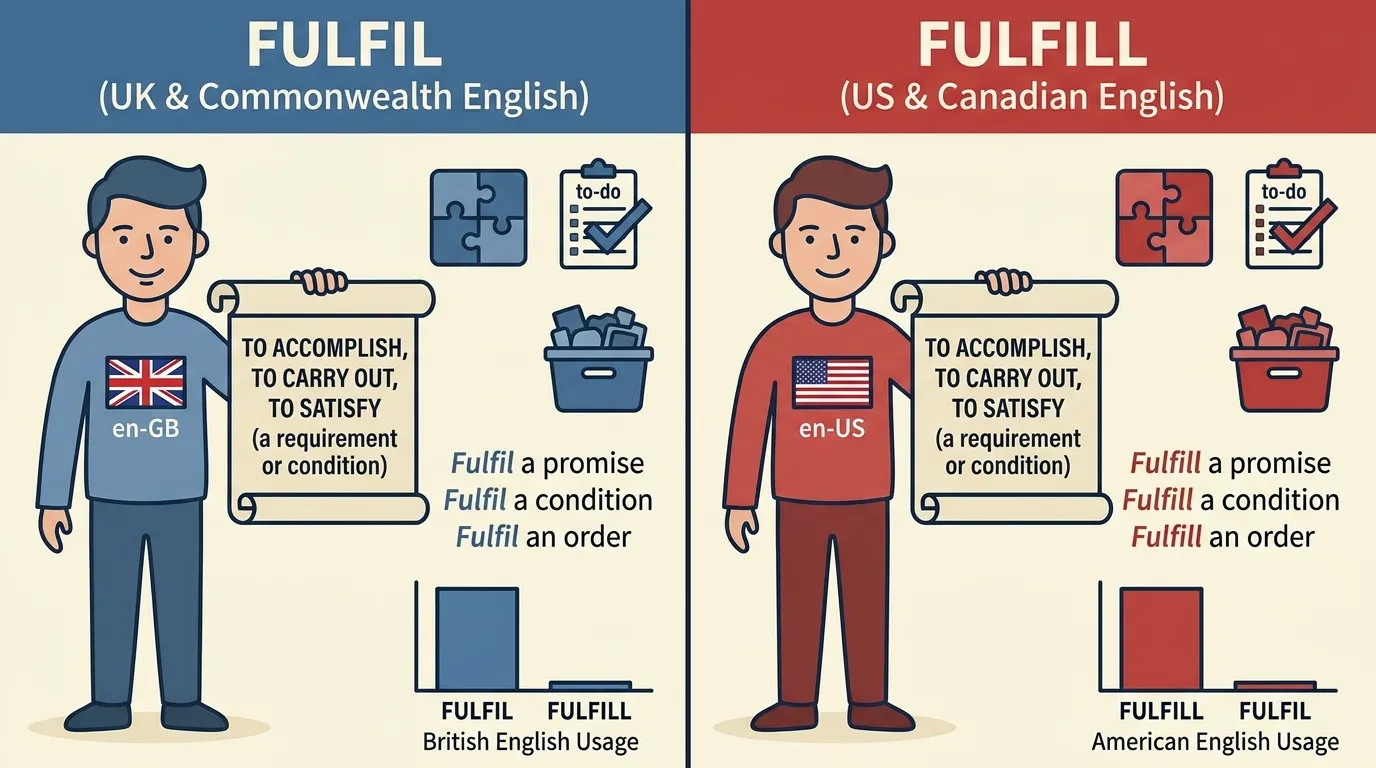
If you have ever wondered whether fulfil or fulfill is the correct spelling, you are not alone. Both spellings are correct, but they belong to different varieties of English. Fulfill is the standard spelling in American English, while fulfil is the standard spelling in British English and several other English varieties.

The difference is mainly regional, not grammatical. Both words have the same meaning, pronunciation, grammatical function, and word history. They can describe completing a requirement, achieving a goal, carrying out a promise, or satisfying a need or desire.

For example:

  • American English: She worked hard to fulfill her dream.
  • British English: She worked hard to fulfil her dream.

In this guide, you will learn the difference between fulfil vs fulfill, when to use each spelling, how they are pronounced, where each form is preferred, common mistakes, related words, useful expressions, and which spelling you should choose for American, British, academic, business, technical, journalistic, and casual writing.

Quick Answer: Is It Fulfil or Fulfill?

Fulfill is the preferred spelling in American English.

Fulfil is the preferred spelling in British English, as well as in many other varieties of English influenced by British spelling conventions.

SpellingMain usageExample
fulfillAmerican EnglishI hope to fulfill my goal.
fulfilBritish EnglishI hope to fulfil my goal.

Both spellings mean essentially the same thing.

The most important rule is simple:

Use fulfill for American English and fulfil for British English.

If you are writing for an international audience, either form can be understood. However, consistency matters. Do not switch between fulfill and fulfil randomly in the same document.

What Does Fulfill Mean?

What Does Fulfill Mean?

The verb fulfill means to complete, achieve, satisfy, perform, or carry out something that is expected, promised, required, or desired.

In American English, fulfill can describe several situations.

Fulfill a Goal

To fulfill a goal means to achieve it.

She trained for years to fulfill her dream of becoming a professional athlete.

Fulfill a Promise

To fulfill a promise means to do what you promised to do.

He returned to fulfill his promise to his family.

Fulfill a Requirement

To fulfill a requirement means to meet a condition or rule.

Applicants must fulfill all requirements before submitting the form.

Fulfill a Need

To fulfill a need means to provide what is necessary or wanted.

The new service was designed to fulfill a growing need.

Fulfill a Duty

To fulfill a duty means to perform an obligation or responsibility.

The officer remained committed to fulfilling his duty.

What Does Fulfil Mean?

Fulfil has the same meanings as fulfill. The difference is spelling rather than meaning.

British English commonly uses fulfil in expressions such as:

She hopes to fulfil her ambition.

The company must fulfil its legal obligations.

He worked hard to fulfil the requirements.

The program aims to fulfil the needs of its users.

The spelling fulfil is especially common in British English and writing that follows British spelling conventions.

Fulfil vs Fulfill: The Key Difference

The central difference is regional spelling.

Fulfill is generally American.

Fulfil is generally British.

The pronunciation does not normally change because of the spelling.

The meaning does not change either.

The grammatical role does not change.

The difference is comparable to other American and British spelling differences such as:

  • color vs colour
  • favor vs favour
  • center vs centre
  • traveled vs travelled
  • canceled vs cancelled
  • organize vs organise

The important point is that fulfill and fulfil are not two different verbs. They are regional spelling variants of the same verb.

Fulfil vs Fulfill in American English

If your audience is primarily in the United States, use fulfill.

This applies to most forms of American writing, including:

  • Business writing
  • Academic writing
  • Blog posts
  • News writing
  • Marketing content
  • Technical documentation
  • School assignments
  • Professional emails
  • Websites
  • Product descriptions
  • Legal and administrative writing

Examples:

The applicant must fulfill all eligibility requirements.

We aim to fulfill every customer order on time.

She finally fulfilled her lifelong ambition.

The product is designed to fulfill a specific purpose.

For an American audience, fulfil may look like a British spelling or an inconsistency.

Fulfil vs Fulfill in British English

If you are following British English conventions, use fulfil.

Examples:

The applicant must fulfil all eligibility requirements.

The company promised to fulfil the order within five working days.

She finally fulfilled her lifelong ambition.

The policy was created to fulfil an important social need.

British English also uses the related forms fulfilled and fulfilling.

This creates an interesting spelling pattern.

British Forms

  • fulfil
  • fulfils
  • fulfilled
  • fulfilling
  • fulfilment

American Forms

  • fulfill
  • fulfills
  • fulfilled
  • fulfilling
  • fulfillment

Notice that the distinction becomes less obvious in some forms because both varieties use fulfilled and fulfilling with double l.

Fulfilment vs Fulfillment

The noun forms follow the same regional distinction.

Fulfillment is the standard American spelling.

Fulfilment is the standard British spelling.

Compare:

American: Finding meaningful work gave him a sense of fulfillment.

British: Finding meaningful work gave him a sense of fulfilment.

This is an important related spelling difference because writers sometimes use fulfill but accidentally write fulfilment, or vice versa.

For consistent American English, use:

fulfill → fulfillment

For consistent British English, use:

fulfil → fulfilment

Fulfill vs Fulfilled vs Fulfilling

Understanding the different grammatical forms can help prevent spelling mistakes.

FormAmerican EnglishBritish English
Base verbfulfillfulfil
Third personfulfillsfulfils
Past tensefulfilledfulfilled
Present participlefulfillingfulfilling
Nounfulfillmentfulfilment

Examples:

Present tense:

She hopes to fulfill her potential.

Third person:

The company fulfills customer orders quickly.

Past tense:

He fulfilled his promise.

Present participle:

She is fulfilling her responsibilities.

Noun:

The experience brought her great fulfillment.

How Do You Pronounce Fulfil and Fulfill?

Both fulfil and fulfill are generally pronounced the same way.

A simple pronunciation guide is:

fool FIL

The first syllable sounds similar to full, while the second syllable sounds like fill.

The extra l in the American spelling does not create a separate pronunciation.

So:

fulfil = fulfill

They are normally homophones, meaning they sound alike even though they are spelled differently.

Is Fulfil a Different Word From Fulfill?

No. In modern English, fulfil and fulfill are spelling variants of the same verb.

They do not normally represent different meanings.

If someone says:

I want to fulfill my dream.

and another person says:

I want to fulfil my dream.

the intended meaning is the same.

The spelling simply reflects the variety of English being used.

Why Do People Confuse Fulfil and Fulfill?

Several factors can cause confusion.

American and British English Use Different Spellings

The biggest reason is exposure to different forms of English.

A reader in the United States may be accustomed to fulfill, while a reader in the United Kingdom may expect fulfil.

Both Forms Are Correct

Because both spellings are legitimate, a spelling checker may not always identify the other version as an error.

Online Content Is International

People regularly read websites, books, news reports, and social media posts from different countries. This exposes them to both forms.

Other Words Follow Similar Patterns

English has many regional spelling differences. Once writers learn these patterns, the difference between fulfil and fulfill becomes much easier to remember.

Dictionary Style Definition of Fulfill

Fulfill, verb

Definition: To complete, achieve, perform, satisfy, or carry out something that is required, promised, expected, or desired.

Example: She worked hard to fulfill her ambition.

American spelling: fulfill

British spelling: fulfil

Past tense: fulfilled

Related noun: fulfillment or fulfilment

The Word History of Fulfil and Fulfill

The history of fulfil and fulfill is connected to the older idea of making something complete.

The word is built around the concept of fullness or completion. Historically, it developed from older Germanic and English forms associated with making something full or complete.

Over time, English spelling developed differently in different regions. The American spelling eventually became fulfill, while British English retained the shorter fulfil form.

The two forms therefore share the same linguistic ancestry.

The spelling difference does not indicate a difference in meaning or origin.

Common Meanings of Fulfill and Fulfil

The verb can be used in several important contexts.

Achieving an Ambition

She moved abroad to fulfill her ambition of studying medicine.

Completing a Promise

He returned home to fulfill his promise.

Meeting a Requirement

You must fulfill the minimum requirements to apply.

Performing a Role

The organization works to fulfill its mission.

Satisfying a Need

The program was created to fulfill an urgent need.

Carrying Out an Obligation

The business must fulfill its contractual obligations.

Completing an Order

The warehouse is responsible for fulfilling customer orders.

This last meaning is especially common in business and e-commerce.

Fulfill in Business and E-commerce

In business writing, fulfill often means to process and complete an order.

For example:

The warehouse can fulfill orders within 24 hours.

Our team is responsible for order fulfillment.

The retailer uses several warehouses to fulfill customer orders.

In British English, you may see:

The warehouse can fulfil orders within 24 hours.

and:

The retailer has improved its order fulfilment process.

This is one of the clearest examples of how regional spelling affects professional terminology.

Fulfill in Academic Writing

In American academic writing, fulfill is the appropriate choice.

Examples:

The study seeks to fulfill three objectives.

The research was designed to fulfill the requirements of the program.

Students must fulfill the course requirements before graduation.

In British academic writing, use fulfil instead.

The most important academic rule is consistency. Do not choose a spelling simply because it looks more formal. Choose the spelling that matches your selected English variety.

Fulfill in Technical Writing

Technical writing often uses the word to describe requirements, specifications, functions, or system behavior.

Examples:

The device must fulfill the specified safety requirements.

The software was developed to fulfill a specific function.

The system must fulfill all performance criteria.

For American technical documentation, use fulfill.

For British technical documentation, use fulfil.

Fulfill in Journalism and News Writing

Journalists may use the word when describing promises, expectations, goals, or responsibilities.

American example:

The candidate promised to fulfill her campaign commitments.

British example:

The candidate promised to fulfil her campaign commitments.

Political usage does not create a separate spelling rule. The regional English standard still determines the preferred form.

Fulfill in Sports Writing

Sports writers often use the verb in connection with goals, potential, expectations, and dreams.

Examples:

The young player hopes to fulfill his potential.

The team finally fulfilled its ambition of winning the championship.

She has the talent to fulfill her potential at the international level.

Again, American publications generally use fulfill, while British publications generally use fulfil.

Fulfill in Casual Writing

In casual American writing, fulfill is completely natural.

I just want to fulfill my dream of traveling the world.

This job really fulfills me.

I finally fulfilled my goal.

In British casual writing, fulfil is equally natural.

I just want to fulfil my dream of travelling the world.

This work really fulfils me.

The spelling changes, but the conversational meaning stays the same.

Formal vs Informal Usage

Both fulfil and fulfill are neutral verbs. Neither spelling is inherently more formal.

For example:

We must fulfill the agreement.

This is professional and neutral in American English.

I want to fulfill my dream.

This is personal and conversational.

The level of formality comes from the context, not from the spelling.

More Formal Alternatives

Depending on the context, you might use:

  • achieve
  • satisfy
  • complete
  • meet
  • accomplish
  • carry out
  • execute
  • perform
  • realize
  • honor

For example:

We must fulfill the requirements.

could become:

We must meet the requirements.

Or:

She fulfilled her ambition.

could become:

She achieved her ambition.

However, these alternatives are not always exact replacements.

Fulfill vs Achieve

These words overlap, but they are not identical.

Achieve usually emphasizes successfully reaching a goal or result.

She achieved her goal.

Fulfill can emphasize making a goal, promise, responsibility, requirement, or expectation complete.

She fulfilled her promise.

You can sometimes use either word:

He fulfilled his ambition.

He achieved his ambition.

Both can work, but fulfill often carries a stronger sense of completion or realization.

Fulfill vs Complete

Complete means to finish something.

Please complete the application.

Fulfill often means to satisfy an obligation, expectation, condition, or purpose.

Please fulfill the requirements.

A task can be completed without necessarily fulfilling a broader obligation.

Fulfill vs Satisfy

Satisfy is especially common when talking about needs, conditions, or standards.

The product satisfies customer needs.

Fulfill can express a similar idea:

The product fulfills customer needs.

However, fulfill is also common with dreams, promises, duties, and ambitions, where satisfy may sound unnatural.

You would normally say:

She fulfilled her dream.

rather than:

She satisfied her dream.

Common Collocations With Fulfill

Learning common word combinations is one of the easiest ways to use fulfill naturally.

Popular collocations include:

  • fulfill a dream
  • fulfill an ambition
  • fulfill a goal
  • fulfill a promise
  • fulfill a commitment
  • fulfill a requirement
  • fulfill an obligation
  • fulfill a duty
  • fulfill a responsibility
  • fulfill a need
  • fulfill an expectation
  • fulfill a role
  • fulfill a mission
  • fulfill a purpose
  • fulfill a contract
  • fulfill an order
  • fulfill customer needs
  • fulfill potential

British English changes the spelling:

  • fulfil a dream
  • fulfil an ambition
  • fulfil a goal
  • fulfil a promise
  • fulfil a requirement
  • fulfil an obligation
  • fulfil a duty
  • fulfil a responsibility
  • fulfil a need
  • fulfil an expectation

Common Expressions With Fulfill

Here are several natural expressions worth remembering.

Fulfill a Dream

She moved to New York to fulfill her dream of becoming a writer.

Fulfill Your Potential

Education can help students fulfill their potential.

Fulfill a Promise

He returned years later to fulfill his promise.

Fulfill a Requirement

You must fulfill this requirement before graduation.

Fulfill an Obligation

The company must fulfill its legal obligations.

Fulfill a Need

The service was created to fulfill a growing need.

Fulfill an Order

The warehouse can fulfill the order today.

Common Mistakes With Fulfil and Fulfill

Mistake: Mixing Regional Spellings

The company will fulfill orders and improve order fulfilment.

For American English, use:

The company will fulfill orders and improve order fulfillment.

For British English, use:

The company will fulfil orders and improve order fulfilment.

Mistake: Thinking Fulfil Is Incorrect

Fulfil is not a spelling error.

It is the standard British spelling.

Mistake: Thinking Fulfill Is Incorrect in British English

Fulfill is not meaningless or unintelligible in British English. It is simply the American spelling and may appear in international or American influenced writing.

Mistake: Assuming the Meaning Changes

The meaning remains essentially the same.

The spelling difference is regional.

Awkward vs Natural Examples

Example One

Awkward:

The student needs to fulfil the American university requirements.

If the document consistently uses American English, this is better:

The student needs to fulfill the American university requirements.

Example Two

Awkward:

The British company will fulfill its legal obligations.

This sentence is understandable, but if the entire document follows British English, use:

The British company will fulfil its legal obligations.

Example Three

Natural American English:

She hopes to fulfill her lifelong dream.

Example Four

Natural British English:

She hopes to fulfil her lifelong dream.

How to Remember Fulfil vs Fulfill

A simple memory trick can help.

Think:

America = fulfill

The American spelling has full inside it:

full + fill = fulfill

For British English, remember the shorter form:

fulfil

You can also remember the related nouns:

American: fulfill → fulfillment

British: fulfil → fulfilment

If you are writing for an American audience, the extra l before the final syllable is your visual clue.

Which Spelling Should You Use?

Choose the spelling based on your audience.

Use Fulfill If You Are Writing For:

  • Americans
  • U.S. businesses
  • American schools
  • American universities
  • U.S. newspapers
  • American blogs
  • U.S. websites
  • American customers
  • American technical audiences
  • American government or professional contexts

Use Fulfil If You Are Writing For:

  • British readers
  • UK businesses
  • British schools
  • British universities
  • UK newspapers
  • British publishers
  • Audiences following British English conventions

For International Audiences

Either spelling can work, but consistency is essential.

If your website generally uses American spelling such as color, center, and organize, use fulfill.

If it uses British spelling such as colour, centre, and organise, use fulfil.

Do not choose between the two based only on search volume. Match the spelling to your overall editorial style.

American vs British Examples

American EnglishBritish English
fulfill a dreamfulfil a dream
fulfill a promisefulfil a promise
fulfill a requirementfulfil a requirement
fulfill a dutyfulfil a duty
fulfill an obligationfulfil an obligation
fulfill a needfulfil a need
fulfills expectationsfulfils expectations
fulfillmentfulfilment

Does Fulfill Have a Slang Meaning?

No widely recognized modern slang meaning has replaced the standard meaning of fulfill.

The word is primarily a standard English verb.

It can appear in casual speech, business language, motivational writing, advertising, sports commentary, and personal conversations, but its meaning remains connected to completing, achieving, satisfying, or carrying out something.

For example:

I finally fulfilled my dream.

This is informal in context but not slang.

Is Fulfill a Verb?

Yes.

Fulfill is a verb in American English.

It can take a direct object:

She fulfilled her promise.

They fulfilled the requirements.

The company fulfilled the order.

The British spelling fulfil is also a verb:

She fulfilled her promise.

They fulfilled the requirements.

Interestingly, the past tense uses fulfilled in both varieties.

Can Fulfill Be Used Figuratively?

Yes.

The word is frequently used in figurative contexts involving dreams, ambitions, potential, purpose, and personal satisfaction.

Examples include:

He wants to fulfill his potential.

She finally fulfilled her dream.

The experience helped him fulfill his purpose.

These uses do not mean physically completing an object. They describe bringing an aspiration or purpose into reality.

Synonyms for Fulfill and Fulfil

Depending on context, useful synonyms include:

  • achieve
  • accomplish
  • complete
  • satisfy
  • meet
  • perform
  • carry out
  • execute
  • realize
  • honor
  • discharge
  • finish
  • attain

The best synonym depends on what follows the verb.

For example:

Fulfill a dream → achieve or realize a dream

Fulfill a promise → keep or honor a promise

Fulfill a requirement → meet a requirement

Fulfill a duty → perform or carry out a duty

Fulfill an order → process or complete an order

Antonyms of Fulfill

Possible opposites include:

  • fail
  • neglect
  • abandon
  • violate
  • break
  • ignore
  • miss
  • leave incomplete

The correct antonym depends on context.

For example:

fulfill a promise

has the opposite idea of:

break a promise

While:

fulfill a requirement

can contrast with:

fail to meet a requirement

Related Words

Several words belong to the same semantic family.

Fulfilled

Means successfully completed, achieved, or satisfied.

She felt fulfilled after reaching her goal.

Fulfilling

Describes something that gives a sense of satisfaction or purpose.

Teaching can be a very fulfilling career.

Fulfillment

The noun meaning completion, achievement, satisfaction, or realization.

He found fulfillment through his work.

Fulfilment

The British spelling of fulfillment.

She found great fulfilment in helping others.

Practical SEO and Content Writing Advice

If you are creating website content, choosing one spelling and using it consistently is more important than trying to include both versions repeatedly.

For an American website, write naturally:

How to fulfill your goals

For a British website:

How to fulfil your goals

Do not force both spellings into the same paragraph simply to target the keyword fulfil vs fulfill.

Search engines can understand regional spelling differences, and readers value natural language more than repetitive keyword placement.

If your article is specifically about the spelling difference, however, it makes sense to mention both forms clearly.

Quick Decision Guide

Use this simple checklist:

Writing for the United States?

Use fulfill.

Writing for the United Kingdom?

Use fulfil.

Writing in American English?

Use fulfill and fulfillment.

Writing in British English?

Use fulfil and fulfilment.

Writing for a global audience?

Choose one English variety and stay consistent.

Wondering whether one spelling is wrong?

No. Both are correct regional spellings.

Frequently Asked Questions

Is Fulfil or Fulfill Correct?

Both fulfil and fulfill are correct. Fulfill is the standard American English spelling, while fulfil is the standard British English spelling.

Is Fulfil British or American?

Fulfil is primarily the British English spelling. It is also used in other varieties of English that follow British spelling conventions.

Is Fulfill American English?

Yes. Fulfill is the standard spelling in American English.

Do Fulfil and Fulfill Mean the Same Thing?

Yes. They have essentially the same meaning. Both can mean to complete, achieve, satisfy, perform, or carry out something.

Is Fulfilment or Fulfillment Correct?

Both are correct regional spellings. Fulfillment is standard American English, while fulfilment is standard British English.

How Do You Spell Fulfill in American English?

In American English, spell it fulfill, with two l letters before the final part of the word.

How Do You Spell Fulfil in British English?

In British English, spell it fulfil, with one l before the final l sound.

Are Fulfil and Fulfill Pronounced Differently?

Generally, no. They are normally pronounced the same way. The spelling difference is regional rather than a pronunciation difference.

Which Is Better for SEO, Fulfil or Fulfill?

Neither is universally better for SEO. The best choice depends on your target audience and the variety of English used on your website. Use fulfill for American English and fulfil for British English.

Should I Use Fulfil or Fulfill in Academic Writing?

Use the spelling required by the English variety of your institution, publisher, or target audience. American academic writing generally uses fulfill, while British academic writing generally uses fulfil.

Conclusion: Fulfil vs Fulfill

The difference between fulfil vs fulfill is simple once you know the regional rule.

Fulfill is the standard spelling in American English, while fulfil is the standard spelling in British English and other varieties influenced by British spelling.

Both words have the same meaning. Both are verbs. Both can describe achieving a dream, meeting a requirement, carrying out a promise, satisfying a need, performing a duty, or completing an order. They are also normally pronounced the same way.

The related nouns follow the same pattern:

American English: fulfillment

British English: fulfilment

For American websites, businesses, academic work, and everyday writing, choose fulfill. For British writing, choose fulfil. If you are writing for an international audience, select one spelling system and use it consistently throughout your content.

The easiest rule to remember is:

American English = fulfill

British English = fulfil

Neither spelling is universally more correct. The right choice is the one that matches your audience, regional English standard, and overall writing style.

Leave a Comment