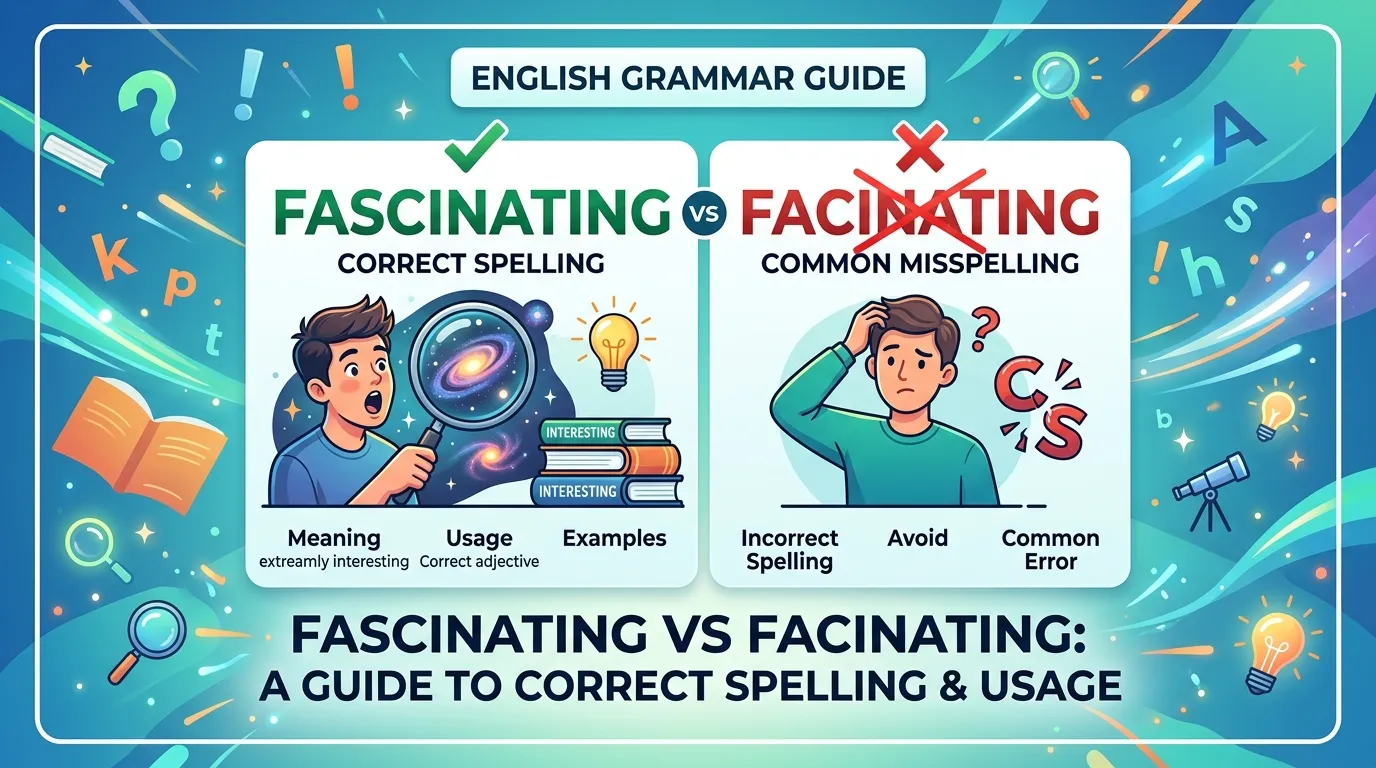
If you are wondering whether fascinating or facinating is the correct spelling, the answer is simple: fascinating is correct, while facinating is a misspelling.
The word fascinating means extremely interesting, attractive, or capable of holding someone’s attention. For example, you can say, “The history of ancient Rome is fascinating.” The spelling facinating is not considered standard English in American English or British English.
This spelling mistake is easy to make because the pronunciation of fascinating does not make every letter obvious. The s can be easy to overlook when writing quickly, especially because the word is related to fascinate, not facinate.
In this guide, you will learn the difference between fascinating vs facinating, the correct spelling, meaning, pronunciation, grammar, word history, common mistakes, synonyms, collocations, examples, and useful memory tricks. You will also see how to use fascinating naturally in casual, academic, professional, business, journalistic, and creative writing.
Quick Answer
Fascinating is the correct spelling.
Facinating is incorrect and should not be used in standard English.
| Spelling | Correct? | Meaning |
|---|---|---|
| Fascinating | Yes | Extremely interesting or captivating |
| Facinating | No | Common misspelling of fascinating |
Correct example
The scientist gave a fascinating explanation of how the brain works.
Incorrect example
The scientist gave a facinating explanation of how the brain works.
The key point is easy to remember:
Fascinating has an s after the a: fas-ci-na-ting.
Fascinating vs Facinating: The Main Difference
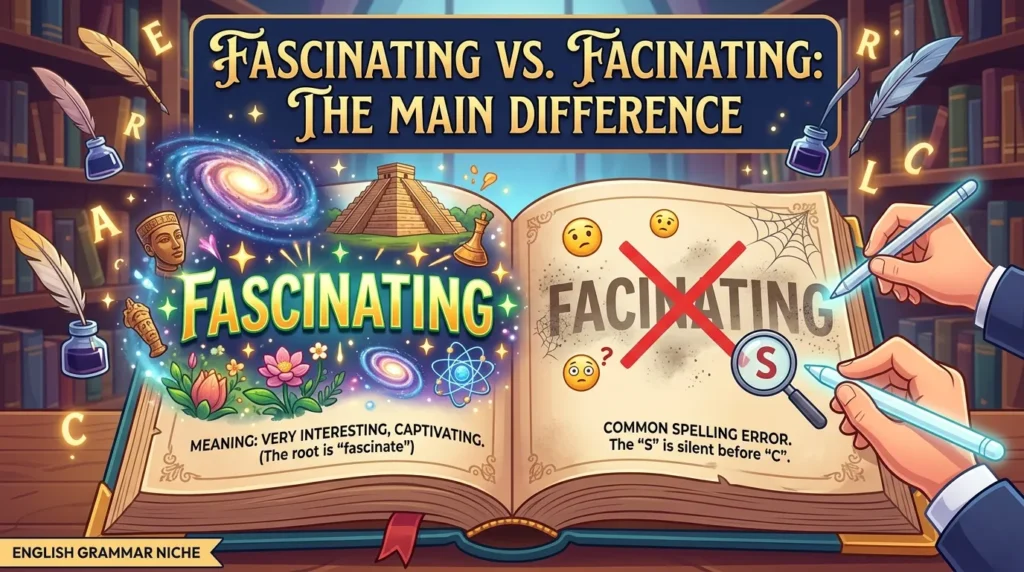
The difference is spelling rather than meaning.
Fascinating is a standard English word. It is commonly used to describe something that creates strong interest or holds someone’s attention.
Facinating is simply a spelling error. It does not have a separate definition, special slang meaning, or different grammatical function.
For example:
- Correct: That documentary was fascinating.
- Incorrect: That documentary was facinating.
The incorrect spelling may still appear in texts, social media posts, informal messages, student writing, or online comments, but its appearance does not make it an accepted spelling.
If you are writing an essay, article, email, report, application, business document, blog post, or professional message, use fascinating.
What Does Fascinating Mean?
Fascinating is an adjective that describes something extremely interesting, captivating, or absorbing.
It can describe a person, place, idea, story, subject, discovery, experience, object, event, or piece of information.
Dictionary style definition
Fascinating
Adjective: Extremely interesting or attractive in a way that captures and holds attention.
Examples
- The museum contains fascinating artifacts.
- She told us a fascinating story about her travels.
- Astronomy is a fascinating subject.
- We had a fascinating conversation.
- The documentary presented fascinating facts about marine life.
- His explanation was fascinating.
- The old building has a fascinating history.
The word often suggests more than simply being interesting. Something fascinating can make you want to keep watching, reading, listening, or learning.
Why Is Facinating Wrong?
The spelling facinating is wrong because the original word is fascinate.
When fascinate becomes fascinating, the spelling follows this pattern:
fascinate → fascinating
The s remains part of the word.
A common mistake is to mentally simplify the word to something like facinate because the s is less noticeable in pronunciation.
Compare these forms:
- fascinate
- fascinated
- fascinating
- fascination
- fascinatingly
All of these retain the s.
There is no standard English form spelled facinate, so facinating is also incorrect.
How Do You Spell Fascinating?
The correct spelling is:
F A S C I N A T I N G
Break it into parts:
fas + cin + at + ing
Or remember it through its base word:
fascinate + ing = fascinating
This is usually easier than trying to memorize the entire word letter by letter.
Correct spelling
fascinating
Common incorrect spellings
You may see variations such as:
- facinating
- fasinating
- fascintating
- fascinatting
- fascinatng
These are misspellings. The standard form is:
fascinating
Fascinating Pronunciation
In American English, fascinating is commonly pronounced approximately:
FASS uh nay ting
A simple pronunciation guide is:
/ˈfæsəneɪtɪŋ/
The first syllable receives the main stress:
FAS ci na ting
The pronunciation helps explain why some people miss the c or s when spelling the word. English spelling and pronunciation do not always correspond perfectly.
Pronunciation example
That is a fascinating idea.
The word sounds natural in everyday American English and does not have a special slang pronunciation.
Is Fascinating an Adjective or a Verb?
Fascinating can be understood as the present participle of the verb fascinate, but it is very commonly used as an adjective.
The verb fascinate means to attract someone’s strong interest or attention.
The adjective fascinating describes something that produces that effect.
Compare:
- The story fascinates me.
- The story is fascinating.
- I am fascinated by the story.
These forms are related but have different grammatical functions.
Fascinate
Verb
Ancient history fascinates me.
Fascinating
Adjective or present participle
Ancient history is fascinating.
Fascinated
Adjective or past participle
I am fascinated by ancient history.
This distinction is important because fascinating and fascinated are not interchangeable.
Fascinating vs Fascinated
A useful grammar rule is:
Fascinating describes the thing that creates the feeling.
Fascinated describes the person who experiences the feeling.
Compare:
The book is fascinating.
The book creates interest.
I am fascinated by the book.
I experience the interest.
More examples:
- The lecture was fascinating.
- The students were fascinated by the lecture.
- The scientist’s discovery was fascinating.
- The audience was fascinated by the discovery.
- The documentary was fascinating.
- We were fascinated by the documentary.
A common mistake is to say:
I am fascinating by science.
This is incorrect if you mean that science interests you.
The natural sentence is:
I am fascinated by science.
However, I am fascinating can be grammatically correct if you mean that you personally are extremely interesting to other people.
Fascinating Meaning in Different Contexts
The meaning of fascinating remains fairly consistent across different contexts, but what qualifies as fascinating can change.
In everyday conversation
It often means very interesting.
That is a fascinating story.
In education
It can describe a subject or discovery that strongly captures attention.
Biology becomes fascinating when you study how cells communicate.
In business
It can describe an unusual market trend, strategy, or customer behavior.
The company found a fascinating pattern in customer purchasing habits.
In journalism
It can describe an unusual event, investigation, or development.
The report offers a fascinating look at how the industry has changed.
In academic writing
It is grammatically acceptable, but writers may choose more precise words when making formal claims.
Instead of:
This is a fascinating result.
An academic writer might say:
This result is particularly significant because it challenges earlier assumptions.
That does not mean fascinating is incorrect in academic writing. It simply means precision is often preferred over emotional evaluation.
In blogging
The word is common because it is engaging and reader friendly.
Here are five fascinating facts about the human body.
In sports writing
It can describe an unusual game, rivalry, statistic, strategy, or performance.
The final quarter produced a fascinating tactical battle.
In technical writing
It is less common because technical documents usually prioritize precise and objective language.
Instead of:
This is a fascinating technical feature.
A technical writer might say:
This feature significantly improves processing efficiency.
Formality and Tone
Fascinating is a standard, versatile English word. It can be used in casual and formal situations.
Its tone is generally:
- Positive
- Interested
- Appreciative
- Engaging
- Expressive
Casual
That movie was fascinating.
Neutral
The study presents fascinating information about sleep.
Professional
The report reveals a fascinating trend in consumer behavior.
More formal
The findings provide valuable insight into the development of the industry.
The last example is not a replacement because fascinating is wrong. It is simply more objective.
Is Fascinating American or British English?
Fascinating is standard in both American and British English.
There is no meaningful American versus British spelling difference here.
| Variety | Correct spelling |
|---|---|
| American English | fascinating |
| British English | fascinating |
| Canadian English | fascinating |
| Australian English | fascinating |
| International English | fascinating |
Therefore, changing the spelling based on region is unnecessary.
The incorrect form facinating does not become correct in British English or another major English variety.
Word History and Etymology of Fascinating
The word fascinating comes from the verb fascinate.
Fascinate ultimately traces back to the Latin word fascinare, meaning to enchant or bewitch.
Over time, the meaning developed beyond supernatural ideas and became associated with strongly attracting someone’s attention or interest.
The modern English sense is usually positive and intellectual or emotional rather than supernatural.
Related forms include:
- fascinate
- fascinates
- fascinated
- fascinating
- fascination
- fascinatingly
This word family explains why keeping the s is essential.
Fascinating Word Family
Understanding related words is one of the best ways to remember the spelling.
| Word | Part of speech | Example |
|---|---|---|
| Fascinate | Verb | Science fascinates her. |
| Fascinates | Verb | History fascinates him. |
| Fascinated | Adjective | I am fascinated by space. |
| Fascinating | Adjective | Space is fascinating. |
| Fascination | Noun | Her fascination with space grew. |
| Fascinatingly | Adverb | Fascinatingly, the pattern repeats. |
Notice that every form keeps the s.
This creates a useful spelling anchor:
fascinate → fascinated → fascinating → fascination
Synonyms for Fascinating
The best synonym depends on the context.
Common synonyms
- Interesting
- Captivating
- Engaging
- Compelling
- Absorbing
- Intriguing
- Appealing
- Entertaining
- Stimulating
- Mesmerizing
- Enthralling
- Riveting
- Absorbing
- Thought provoking
- Remarkable
Example comparisons
The documentary was fascinating.
Possible alternatives:
The documentary was captivating.
The documentary was compelling.
The documentary was intriguing.
The documentary was absorbing.
These words are similar but not identical.
Interesting is the broadest and most neutral.
Captivating suggests that something strongly holds your attention.
Intriguing suggests curiosity or mystery.
Compelling often suggests something powerful enough to demand attention.
Riveting suggests extremely engaging, especially for stories, books, films, or events.
Antonyms of Fascinating
Depending on context, possible opposites include:
- Boring
- Dull
- Uninteresting
- Tedious
- Mundane
- Repetitive
- Ordinary
- Unexciting
- Tiresome
- Monotonous
For example:
The lecture was fascinating.
Opposite:
The lecture was tedious.
Or:
The documentary was fascinating.
Opposite:
The documentary was dull.
Common Collocations With Fascinating
A collocation is a combination of words that naturally appear together.
Common combinations with fascinating include:
- fascinating story
- fascinating idea
- fascinating subject
- fascinating history
- fascinating discovery
- fascinating fact
- fascinating person
- fascinating conversation
- fascinating discussion
- fascinating insight
- fascinating detail
- fascinating journey
- fascinating world
- fascinating experience
- fascinating topic
- fascinating question
- fascinating perspective
- fascinating possibility
- fascinating example
- fascinating explanation
Natural examples
She shared a fascinating story about her childhood.
The website explores the fascinating history of aviation.
We had a fascinating conversation about artificial intelligence.
The professor raised a fascinating question.
The researchers made a fascinating discovery.
Common Phrases With Fascinating
There are several natural phrases that frequently use fascinating.
A fascinating story
He told us a fascinating story about his grandfather.
A fascinating fact
Here is a fascinating fact about the ocean.
A fascinating insight
The interview provides a fascinating insight into modern business.
A fascinating world
Astronomy introduces us to a fascinating world beyond Earth.
Absolutely fascinating
The history of the building is absolutely fascinating.
Truly fascinating
Her explanation of the process was truly fascinating.
Particularly fascinating
The most fascinating part of the study was its conclusion.
Fascinating vs Interesting
These words are close in meaning, but fascinating is often stronger.
Interesting means something attracts your attention or makes you curious.
Fascinating often suggests a deeper or stronger level of interest.
Compare:
The book is interesting.
This is a general positive statement.
The book is fascinating.
This suggests the book strongly holds your attention.
You can think of the difference this way:
interesting = worth noticing
fascinating = hard to stop thinking about
The distinction is not absolute, but it is useful in everyday writing.
Fascinating vs Intriguing
Intriguing often suggests mystery, curiosity, or something that makes you want to know more.
The scientist proposed an intriguing theory.
Fascinating can be broader.
The scientist gave a fascinating explanation of the theory.
Something can be fascinating without being mysterious.
Fascinating vs Captivating
Captivating emphasizes the ability to hold attention.
She gave a captivating performance.
Fascinating emphasizes strong interest.
She gave a fascinating explanation of the subject.
Both are natural, but they create slightly different impressions.
Common Spelling Mistakes With Fascinating
Here are some frequent errors and their corrections.
| Incorrect | Correct |
|---|---|
| facinating | fascinating |
| fasinating | fascinating |
| fascintating | fascinating |
| fascinatting | fascinating |
| fascinatng | fascinating |
| facsinating | fascinating |
Mistake: Facinating
Incorrect:
The museum was facinating.
Correct:
The museum was fascinating.
Mistake: Fasinating
Incorrect:
She told me a fasinating story.
Correct:
She told me a fascinating story.
Mistake: Fascinatting
Incorrect:
It was a fascinatting experience.
Correct:
It was a fascinating experience.
The safest strategy is to remember the base word:
fascinate
Then add ing:
fascinating
Awkward vs Natural Examples
Correct spelling does not automatically guarantee natural wording. Word choice and sentence structure also matter.
Awkward
The thing was very fascinating to me personally.
More natural
I found it fascinating.
Awkward
This fascinating thing was interesting.
More natural
This idea was fascinating.
Awkward
The information was fascinatingly interesting.
More natural
The information was fascinating.
Awkward
I was fascinating by the presentation.
Correct
I was fascinated by the presentation.
Fascinating in Academic Writing
Fascinating is acceptable in academic writing, but use it carefully.
Academic writing often values evidence and precision. If you call a result fascinating, readers may reasonably ask why it is fascinating.
Compare:
The results are fascinating.
with:
The results are significant because they reveal a previously overlooked pattern.
The second sentence explains the value rather than simply labeling it.
Still, there are situations where fascinating is perfectly natural, especially in essays, popular science, educational writing, reviews, interviews, and explanatory articles.
Fascinating in Business Writing
In business communication, fascinating can work well when the tone is conversational or persuasive.
For example:
We discovered a fascinating trend in customer behavior.
However, highly formal reports may benefit from more specific language:
We identified a significant trend in customer behavior.
Choose based on the purpose of the document.
Good for:
- Blog posts
- Presentations
- Interviews
- Marketing content
- Thought leadership
- Informal business emails
Use more cautiously in:
- Legal documents
- Financial statements
- Highly technical reports
- Formal research papers
- Compliance documents
Fascinating in Journalism and Blogging
The word fascinating is common in journalism, magazine writing, travel writing, and blogs because it creates reader interest.
Examples:
A fascinating new study explores how people form habits.
The town has a fascinating history.
We discovered a fascinating detail hidden in the old photograph.
For SEO content, however, avoid repeatedly describing every subject as fascinating. Repetition can make writing sound exaggerated and reduce credibility.
Instead, be specific.
Rather than:
This fascinating discovery is fascinating for many fascinating reasons.
Write:
The discovery changed how researchers understand the disease.
Specific language is usually stronger than repeated praise.
Memory Tricks for Fascinating
If you frequently spell fascinating incorrectly, try one of these memory techniques.
Memory trick one: Remember fascinate
Think:
fascinate + ing = fascinating
This is probably the easiest method.
Memory trick two: Keep the S
Say to yourself:
Fascinating has an S.
Memory trick three: Learn the word family
Memorize:
fascinate → fascinated → fascinating → fascination
If you know one correct form, the others become easier.
Memory trick four: Connect it to fascination
The noun fascination clearly contains the s.
fascination
fascinating
Both keep the same spelling foundation.
How to Use Fascinating Correctly
Use fascinating when something strongly interests, attracts, or holds attention.
People
She is a fascinating person.
Places
The city has a fascinating history.
Ideas
That is a fascinating idea.
Stories
He told us a fascinating story.
Subjects
Psychology is a fascinating subject.
Experiences
Traveling through the mountains was a fascinating experience.
Information
The article contains fascinating information about language.
When Not to Use Fascinating
Avoid using fascinating when a more precise word would communicate your meaning better.
For example, if you mean something is statistically important, say:
statistically significant
rather than:
fascinating
If you mean something is unusual, say:
unusual
If you mean something is difficult to understand, say:
complex
If you mean something demands attention because of danger, say:
concerning
The best vocabulary choice depends on your intended meaning.
Fascinating in Casual, Formal, and Professional Writing
| Context | Natural example |
|---|---|
| Casual | That movie was fascinating. |
| Texting | That is fascinating! |
| Blog | Here are some fascinating facts about sleep. |
| Academic | The study reveals a fascinating pattern. |
| Business | We found a fascinating trend in sales data. |
| Journalism | The investigation uncovered a fascinating detail. |
| Technical | The system demonstrates a fascinating computational behavior. |
| Sports | The match developed into a fascinating tactical battle. |
| Creative | She lived a fascinating life. |
The word works in almost all of these settings, but the surrounding language should match the level of formality.
Is Fascinating a Slang Word?
No. Fascinating is not slang.
It is a standard English adjective and a form of the verb fascinate.
It can appear in casual speech, but casual use does not make it slang.
For example:
That’s fascinating!
is informal in tone but still completely standard English.
There is also no special political, sports, or internet slang meaning that changes the spelling.
Does Facinating Ever Become Correct?
No. Facinating does not become a correct spelling because it appears frequently online.
A misspelling can become common, but standard dictionaries and established English usage still distinguish it from the correct spelling fascinating.
If you are writing for school, work, publishing, business, journalism, or professional communication, use fascinating.
Practical Recommendation for Writers
If you are unsure between fascinating and facinating, always choose:
fascinating
For consistent writing, remember these related forms:
- fascinate
- fascinated
- fascinating
- fascination
Do not remove the s.
If a spelling checker marks facinating as an error, accept the correction to fascinating.
For formal writing, also consider whether fascinating is the most precise word. Sometimes significant, compelling, intriguing, remarkable, or noteworthy may communicate your intended meaning more clearly.
Fascinating vs Facinating: Final Comparison
| Feature | Fascinating | Facinating |
|---|---|---|
| Standard English | Yes | No |
| Correct spelling | Yes | No |
| Dictionary word | Yes | No |
| Meaning | Extremely interesting | No standard meaning |
| Grammar | Adjective or present participle | Incorrect form |
| American English | Correct | Incorrect |
| British English | Correct | Incorrect |
| Formal writing | Appropriate | Avoid |
| Casual writing | Appropriate | Avoid |
| Academic writing | Acceptable with context | Incorrect |
| Business writing | Acceptable with context | Incorrect |
| Pronunciation | /ˈfæsəneɪtɪŋ/ | Not a standard word |
| Related noun | fascination | No standard form |
| Related verb | fascinate | No standard form |
Frequently Asked Questions About Fascinating vs Facinating
Is fascinating or facinating correct?
Fascinating is correct. Facinating is a misspelling. Use fascinating in American English, British English, academic writing, business writing, casual conversation, and professional communication.
How do you spell fascinating correctly?
The correct spelling is fascinating: f-a-s-c-i-n-a-t-i-n-g. It comes from the verb fascinate, so the s should remain in the spelling.
What does fascinating mean?
Fascinating means extremely interesting, captivating, or capable of holding someone’s attention. For example, “The history of the city is fascinating.”
Why do people spell fascinating as facinating?
People often omit the s because the pronunciation does not make every letter obvious. Fast typing, unfamiliarity with the word family, and confusion about the spelling of fascinate can also cause the error.
Is facinating a word?
No. Facinating is not the standard spelling of the English word. The correct spelling is fascinating.
Is fascinating an adjective?
Yes. Fascinating is commonly used as an adjective to describe something that strongly interests or attracts attention. It can also function as the present participle of the verb fascinate.
What is the difference between fascinating and fascinated?
Fascinating describes something that creates strong interest, while fascinated describes someone who experiences that interest. For example, “The book is fascinating” and “I am fascinated by the book.”
Is fascinating formal or informal?
Fascinating is a standard English word that works in both formal and informal contexts. In highly technical or academic writing, however, a more precise term may sometimes be preferable.
What are synonyms for fascinating?
Common synonyms include interesting, captivating, intriguing, compelling, engaging, absorbing, remarkable, stimulating, riveting, and enthralling. The best choice depends on the exact context.
Is fascinating spelled differently in British English?
No. Fascinating is spelled the same way in American and British English. Facinating is not the standard spelling in either variety.
Conclusion
When comparing fascinating vs facinating, there is no real contest: fascinating is the correct spelling, and facinating is a misspelling.
The word fascinating means extremely interesting, captivating, or able to hold someone’s attention. It can describe people, stories, ideas, subjects, discoveries, experiences, places, and information.
The easiest way to remember the spelling is to start with the base verb fascinate. Add ing, and you get fascinating. The s stays in place.
The same spelling pattern appears in related words such as fascinated and fascination. Learning the whole word family can make the correct spelling much easier to remember.
For American English, British English, academic writing, professional communication, blogging, journalism, and everyday conversation, the recommendation is the same: write fascinating, never facinating.
When you need a stronger or more precise word, consider alternatives such as captivating, intriguing, compelling, remarkable, or significant. But whenever you choose this particular word, make sure you spell it fascinating.