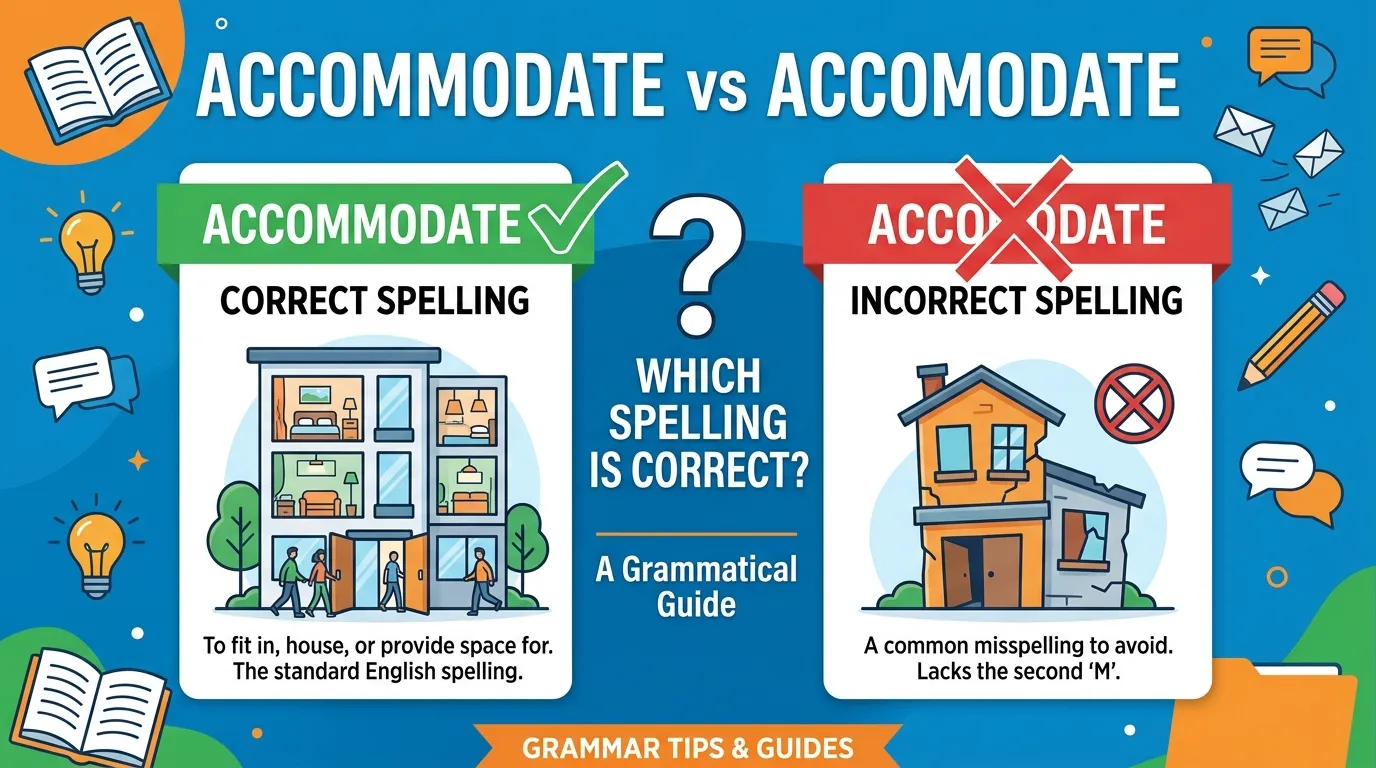
If you are wondering whether accommodate or accomodate is correct, the answer is simple: accommodate is the correct spelling in standard English. Accomodate is a common misspelling.
The confusion usually happens because the word contains two c’s and two m’s: accommodate. When people write it from memory, it is easy to leave out one of the letters, producing accomodate.
This guide explains the difference between accommodate vs accomodate, including their meanings, pronunciation, grammar, word history, common mistakes, synonyms, collocations, formal and informal usage, and practical examples. Whether you are writing an email, business document, academic paper, article, report, or casual message, you will know exactly which spelling to use.
Quick Answer: Accommodate or Accomodate?
Accommodate is correct.
Accomodate is incorrect in standard English and should be avoided in formal, academic, professional, and published writing.
| Spelling | Correct? | Example |
|---|---|---|
| accommodate | ✅ Yes | We can accommodate your request. |
| accomodate | ❌ No | We can accomodate your request. |
The correct spelling contains:
a + c + c + o + m + m + o + d + a + t + e
A useful visual reminder is:
acCO M M Odate
Or simply remember:
Accommodate has room for two C’s and two M’s.
That memory trick works especially well because the meaning of accommodate is often connected with making room for someone or something.
What Does Accommodate Mean?
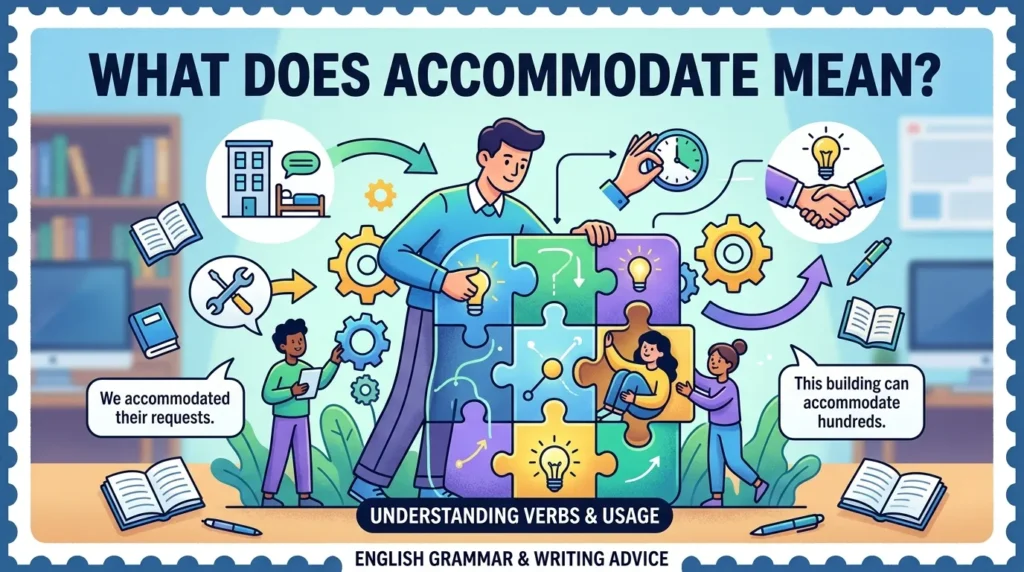
Accommodate is a verb with several related meanings. At its core, it means to make room for, provide for, adjust to, or meet the needs of someone or something.
Here are the most common meanings.
Accommodate Means to Provide Space
The word can mean to provide enough physical space for someone.
- The hotel can accommodate 200 guests.
- This hall can accommodate a large audience.
- The apartment can comfortably accommodate four people.
- The bus can accommodate several additional passengers.
In these examples, accommodate means to have enough space or capacity for.
Accommodate Means to Meet Someone’s Needs
It can also mean making an adjustment to help someone.
- The restaurant can accommodate customers with dietary restrictions.
- Our teacher agreed to accommodate students who needed extra time.
- The company tries to accommodate employees’ scheduling needs.
- We will do our best to accommodate your request.
Here, the word means to make an arrangement that suits someone’s needs or circumstances.
Accommodate Means to Adjust to Something
Accommodate can also mean adapting to a new situation or requirement.
- The schedule was changed to accommodate the new deadline.
- The software was updated to accommodate additional users.
- The building was redesigned to accommodate modern safety requirements.
In this sense, something is changed or designed so that it can work with another condition.
Accommodate Means to Accept or Allow
In some contexts, accommodate means to accept someone’s wishes or circumstances.
- The manager agreed to accommodate the customer’s request.
- The airline tried to accommodate passengers affected by the delay.
- We can accommodate your preferred meeting time.
This meaning is common in customer service, business, hospitality, education, and workplace communication.
Why Do People Spell Accommodate as Accomodate?
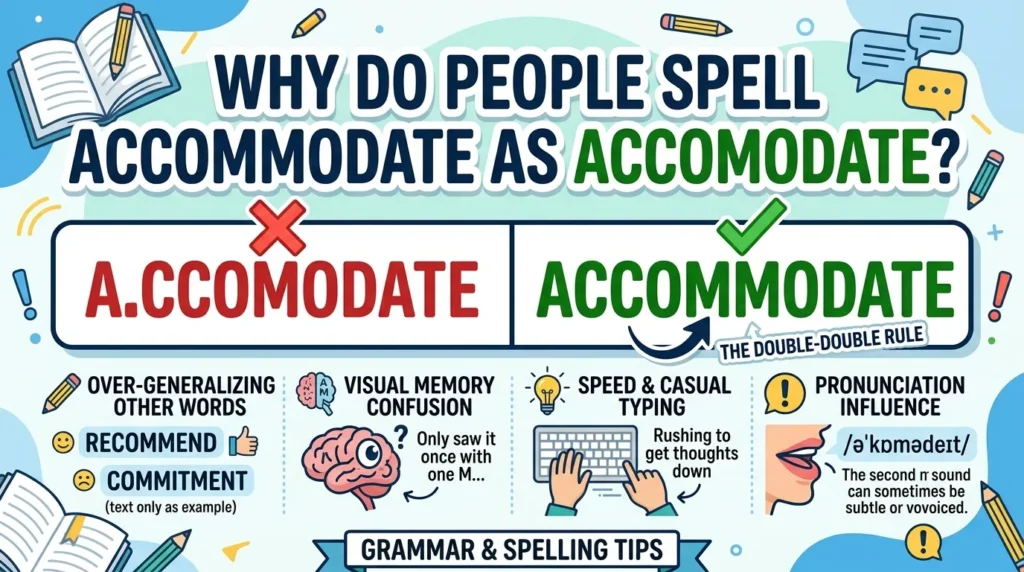
The misspelling accomodate is extremely common because accommodate has an unusual-looking sequence of repeated letters.
The correct word contains:
- cc
- mm
So the middle of the word looks like this:
accoMM…
Many writers remember only one c or one m, resulting in:
accomodate ❌
instead of:
accommodate ✅
There is another reason for the confusion: English spelling does not always allow you to predict a word’s spelling from its pronunciation. When someone hears accommodate, the repeated consonants are not obvious in speech.
This makes the word particularly easy to misspell.
Accommodate vs Accomodate: The Key Difference
There is actually no difference in meaning between the two forms because accomodate is not a standard English word.
The important distinction is spelling:
- Accommodate = standard and correct
- Accomodate = misspelling
For example:
Correct:
The hotel can accommodate 300 guests.
Incorrect:
The hotel can accomodate 300 guests.
The second sentence may still be understandable, but the spelling error can make your writing look careless, especially in professional or academic contexts.
How Do You Spell Accommodate?
The correct spelling is:
A-C-C-O-M-M-O-D-A-T-E
There are two C’s and two M’s.
A Simple Spelling Breakdown
You can divide the word mentally:
ac + com + modate
Or focus on the repeated letters:
aCCoMModate
The easiest rule is:
Accommodate has two C’s and two M’s.
If you remember that rule, you are unlikely to write accomodate by mistake.
How Do You Pronounce Accommodate?
Accommodate is generally pronounced:
uh-KOM-uh-dayt
Its IPA pronunciation is commonly represented as:
/əˈkɑːmədeɪt/ in American English.
The stress falls on the second syllable:
ac-COM-mo-date
The pronunciation does not clearly reveal the spelling of the repeated c and m sounds. That is one reason the word can be difficult for English learners and native speakers alike.
Does Accomodate Have a Different Pronunciation?
No.
Accomodate is simply a misspelling of accommodate. It is not a separate standard word with its own pronunciation.
Is Accommodate a Verb?
Yes. Accommodate is a verb.
It describes an action, such as:
- providing space
- meeting a need
- making an adjustment
- adapting to a requirement
- accepting a request
Examples:
- We can accommodate your family.
- The schedule can accommodate the change.
- The hotel will accommodate late arrivals.
- The company must accommodate new regulations.
Forms of Accommodate
Because accommodate is a regular verb, its common forms are straightforward.
| Form | Example |
|---|---|
| Base form | accommodate |
| Third-person singular | accommodates |
| Present participle | accommodating |
| Past tense | accommodated |
| Past participle | accommodated |
Examples:
- The hotel accommodates hundreds of guests.
- The staff is accommodating the visitors.
- The hotel accommodated the group last night.
- We have accommodated their request.
Notice that the double consonants remain important in related forms.
Accommodating vs Accomodating
The correct adjective and present participle is:
accommodating ✅
Not:
accomodating ❌
For example:
- She was very accommodating.
- The staff were friendly and accommodating.
- He has an accommodating attitude.
An accommodating person is generally willing to help, adjust, or meet another person’s needs.
Accommodated vs Accomodated
The correct past-tense form is:
accommodated ✅
Not:
accomodated ❌
Examples:
- The hotel accommodated our entire team.
- The teacher accommodated the student’s needs.
- The company accommodated the schedule change.
The spelling continues to use the double c and double m pattern.
Accommodate in American English vs British English
There is no major spelling difference between American and British English for this word.
Both generally use:
accommodate
So these are correct in both varieties:
- The hotel can accommodate 100 guests.
- We will accommodate your request.
- The building was designed to accommodate wheelchair users.
Unlike words such as color/colour or center/centre, accommodate does not normally change spelling between American and British English.
The misspelling accomodate should not be treated as a British or American alternative. It is simply an error.
Accommodate in Formal and Informal Writing
Accommodate works in both formal and informal English.
Formal Examples
- The university will accommodate students who require additional assistance.
- The facility was designed to accommodate increased demand.
- We will make every effort to accommodate your request.
- The policy allows employers to accommodate reasonable workplace needs.
Everyday Examples
- Can you accommodate another guest?
- We can accommodate you at 7 p.m.
- Thanks for accommodating my schedule.
- The room should accommodate everyone.
The word is versatile enough for ordinary conversation and professional communication.
Accommodate in Business Writing
Accommodate is especially common in business English.
You may see it in:
- customer service
- scheduling
- hospitality
- human resources
- sales
- operations
- management
- workplace policies
Examples:
We are happy to accommodate your preferred delivery date.
Our team will do its best to accommodate your requirements.
The conference room can accommodate up to 20 people.
In business writing, accommodate can sound professional and courteous without being overly complicated.
Accommodate in Academic Writing
The word is also useful in academic contexts.
Examples:
- The study design was modified to accommodate additional variables.
- The classroom was redesigned to accommodate different learning needs.
- The theory must accommodate evidence from multiple sources.
- The schedule was adjusted to accommodate the examination period.
Academic writers often use accommodate when discussing how a theory, system, method, or structure responds to additional information or conditions.
Accommodate in Technical Writing
Technical writing frequently uses accommodate to describe capacity, compatibility, or design.
Examples:
- The server can accommodate 10,000 simultaneous connections.
- The system was modified to accommodate larger files.
- The device can accommodate different types of sensors.
- The database was expanded to accommodate additional records.
In technical contexts, the word often means have the capacity or capability to handle something.
Accommodate in Sports
Sports writing can use accommodate when discussing facilities, players, schedules, or audiences.
Examples:
- The stadium can accommodate 50,000 fans.
- The team adjusted its schedule to accommodate the tournament.
- The facility was expanded to accommodate larger crowds.
- The coach changed the lineup to accommodate an injured player.
It is not a special sports slang term. It retains its ordinary meaning of making room or adjusting to a need.
Accommodate in Politics and Public Policy
The word can also appear frequently in political, governmental, and policy discussions.
Examples:
- The proposal aims to accommodate different interests.
- The law was changed to accommodate new circumstances.
- Policymakers must accommodate competing priorities.
- The plan attempts to accommodate regional concerns.
In these contexts, accommodate often means take different needs or interests into account.
It does not automatically mean agreeing with everyone. A government, organization, or individual can accommodate a concern by making an adjustment without fully accepting every position involved.
Common Collocations With Accommodate
A collocation is a combination of words that commonly appear together.
Some natural combinations with accommodate include:
- accommodate a request
- accommodate a need
- accommodate guests
- accommodate customers
- accommodate employees
- accommodate students
- accommodate passengers
- accommodate changes
- accommodate differences
- accommodate demand
- accommodate growth
- accommodate visitors
- accommodate a schedule
- accommodate a group
- accommodate a large audience
- accommodate additional users
Examples:
The hotel can accommodate large groups.
The manager agreed to accommodate my request.
The software can accommodate additional users.
The school must accommodate students with different learning needs.
These combinations are useful when writing naturally in English.
Common Phrases With Accommodate
Here are several useful constructions.
Accommodate a Request
This means to agree to or make room for someone’s request.
The restaurant accommodated our request for a quiet table.
Accommodate a Need
This means to adjust something to meet a particular need.
The program was designed to accommodate different learning needs.
Accommodate Someone
This can mean providing space or making an adjustment for someone.
The hotel can accommodate 250 guests.
Accommodate for
Be careful with accommodate for.
In many situations, standard English simply uses accommodate followed by the object.
Less natural:
The design was changed to accommodate for the extra weight.
More natural:
The design was changed to accommodate the extra weight.
However, account for is a different expression and may be what the writer actually means in some contexts.
Synonyms for Accommodate
The best synonym depends on the meaning.
When Accommodate Means Make Room
Possible alternatives include:
- house
- hold
- contain
- fit
- seat
- provide space for
Example:
The stadium can accommodate 40,000 people.
Possible alternative:
The stadium can seat 40,000 people.
When Accommodate Means Meet a Need
Possible alternatives include:
- assist
- support
- serve
- provide for
- meet
- adapt to
Example:
The company accommodated the employee’s needs.
Possible alternative:
The company met the employee’s needs.
When Accommodate Means Adjust
Possible alternatives include:
- adapt
- modify
- adjust
- alter
- tailor
- revise
Example:
We changed the schedule to accommodate the new deadline.
Possible alternative:
We changed the schedule to adapt to the new deadline.
No synonym works perfectly in every sentence, so choose based on the intended meaning.
Antonyms of Accommodate
Depending on the context, possible opposites include:
- reject
- refuse
- exclude
- restrict
- hinder
- prevent
- obstruct
- oppose
For example:
The company accommodated the customer’s request.
Opposite idea:
The company rejected the customer’s request.
These are contextual antonyms rather than perfect dictionary opposites in every situation.
Accommodate vs Adapt
These words are related but not identical.
Accommodate often means making room for something or adjusting something so that it can work.
Adapt generally means changing to suit a new situation or environment.
Compare:
The schedule was changed to accommodate the new deadline.
The employee had to adapt to the new schedule.
The schedule accommodates the deadline. The employee adapts to the changed circumstances.
Accommodate vs Adjust
Adjust means to change something slightly or appropriately.
Accommodate can involve adjustment, but it often emphasizes meeting another person’s needs or allowing something to fit.
Compare:
We adjusted the chair.
This simply means we changed the chair’s position or setting.
We adjusted the seating arrangement to accommodate more guests.
Here, the adjustment has a specific purpose: making room for more guests.
Accommodate vs House
When talking about people and physical space, house can sometimes replace accommodate.
The hotel can accommodate 500 guests.
The hotel can house 500 guests.
Both can work, but accommodate often sounds more neutral or professional, especially in business, hospitality, and formal writing.
Accommodate vs Oblige
In some contexts, accommodate means helping someone by accepting a request.
Oblige can have a similar meaning:
We were happy to accommodate your request.
We were happy to oblige.
However, oblige has other meanings and may sound more formal or old-fashioned depending on the sentence.
Is Accommodate a Difficult Word to Spell?
It can be. The main spelling challenge is remembering the repeated consonants.
The biggest mistake is removing one of them:
accomodate ❌
The correct spelling is:
accommodate ✅
The same issue appears in related words:
- accommodating
- accommodated
- accommodation
All retain the double c and double m pattern.
Accommodation: Another Common Spelling Challenge
The noun form is:
accommodation
Not:
accomodation ❌
Examples:
- We need hotel accommodation.
- The university provides student accommodation.
- The building offers accessible accommodation.
The connection is easy to remember:
accommodate → accommodation
Both have cc and mm.
Accommodation in American and British English
The spelling accommodation is standard in both American and British English.
The meaning can refer to:
- a place to stay
- housing
- a special arrangement
- an adjustment made to meet a need
For example:
We booked accommodation near the airport.
In education or accessibility contexts:
The school provided reasonable accommodations for the student.
Memory Tricks for Accommodate
Here are several ways to remember the spelling.
The Double C, Double M Rule
Think:
AC + COM + MODATE
Remember the two pairs:
CC + MM
Accommodate Means Make Room
A popular memory association is:
Accommodate has room for two C’s and two M’s.
Because accommodate can mean make room, the spelling itself can become a memory clue.
Think of Accommodation
If you remember the noun accommodation, you can work backward to the verb:
accommodation → accommodate
Both begin with:
accomm…
Common Mistakes With Accommodate
Mistake: Accomodate
❌ The hotel can accomodate 100 guests.
✅ The hotel can accommodate 100 guests.
Mistake: Accomodating
❌ She was very accomodating.
✅ She was very accommodating.
Mistake: Accomodated
❌ The company accomodated our needs.
✅ The company accommodated our needs.
Mistake: Accomodation
❌ We need accomodation for the conference.
✅ We need accommodation for the conference.
The common problem in all four examples is dropping one of the repeated letters.
Awkward vs Natural Examples
Correct spelling is important, but word choice matters too.
Example One
Awkward:
The hotel will accommodate for your family.
Natural:
The hotel will accommodate your family.
Example Two
Awkward:
The room accommodates for twenty people.
Natural:
The room accommodates twenty people.
Example Three
Less direct:
The company made changes because it wanted to accommodate for employee preferences.
Natural:
The company made changes to accommodate employee preferences.
Example Four
Natural:
We changed the meeting time to accommodate everyone’s schedule.
This is a particularly common and useful construction.
Real-World Examples of Accommodate
Here are examples across different settings.
Hospitality
The resort can accommodate up to 600 guests.
Customer Service
We will do our best to accommodate your request.
Education
The school can accommodate students with different learning needs.
Business
The meeting time was changed to accommodate international clients.
Technology
The platform can accommodate thousands of users.
Healthcare
The clinic was redesigned to accommodate more patients.
Transportation
The aircraft can accommodate additional passengers.
Events
The venue can accommodate large wedding parties.
Workplace
The employer agreed to accommodate the employee’s scheduling needs.
Everyday Conversation
Can you accommodate one more person at dinner?
Formal vs Informal Alternatives
Sometimes accommodate is exactly the right word. In other cases, a simpler word may sound more natural.
| Meaning | Formal/Professional | Simpler Alternative |
|---|---|---|
| Make room | accommodate | fit |
| Provide housing | accommodate | house |
| Meet a need | accommodate | meet |
| Make a change | accommodate | adjust |
| Change to suit | accommodate | adapt |
| Accept a request | accommodate | agree to |
| Provide a seat | accommodate | seat |
For example:
Formal:
We will accommodate your scheduling requirements.
Simple:
We can work with your schedule.
Neither is universally better. Choose based on your audience and purpose.
Is Accommodate Used in Slang?
No. Accommodate is not normally considered slang.
It is a standard English verb used in everyday, professional, academic, technical, and formal communication.
It may occasionally appear in humorous or informal expressions, but the word itself does not have a mainstream slang meaning that replaces its standard definitions.
Is Accommodate a Formal Word?
It can sound somewhat formal depending on the context, but it is not exclusively formal.
For example:
Can you accommodate me?
is perfectly understandable in everyday conversation.
In casual speech, people may choose simpler expressions such as:
Can you work with me on this?
or:
Can you make room for me?
Still, accommodate is common and natural in ordinary English.
Why Correct Spelling Matters
A misspelling such as accomodate usually does not prevent readers from understanding your sentence. However, repeated spelling errors can affect how your writing is perceived.
Correct spelling matters particularly in:
- résumés
- cover letters
- business emails
- academic papers
- websites
- reports
- applications
- professional documents
- published articles
A reader may overlook a typo in a casual text, but professional writing benefits from careful spelling.
Search and Writing Tip: Accommodate vs Accomodate
If you are publishing online content, use accommodate consistently.
Search engines can generally understand misspellings and related language, but that does not mean you should intentionally use incorrect spelling throughout your content.
If the topic is specifically about the spelling difference, it is reasonable to mention accomodate because it is the user’s search term and a common misspelling.
For ordinary writing, however, always use:
accommodate
Quick Comparison Table
| Feature | Accommodate | Accomodate |
|---|---|---|
| Standard English | ✅ Yes | ❌ No |
| Correct spelling | ✅ Yes | ❌ No |
| Part of speech | Verb | Not a standard word |
| Meaning | Make room, meet needs, adjust | — |
| American English | ✅ Yes | ❌ No |
| British English | ✅ Yes | ❌ No |
| Academic writing | ✅ Appropriate | ❌ Avoid |
| Business writing | ✅ Appropriate | ❌ Avoid |
| Casual writing | ✅ Appropriate | ❌ Avoid |
| Formal writing | ✅ Appropriate | ❌ Avoid |
A Simple Rule to Remember
When you are unsure whether to write accommodate or accomodate, remember:
Accommodate has two C’s and two M’s.
So:
accommodate ✅
accomodate ❌
The same pattern appears in:
accommodation
accommodating
accommodated
If you remember CC + MM, you can spell the entire word family correctly.
Frequently Asked Questions
Is accommodate or accomodate correct?
Accommodate is the correct spelling. Accomodate is a common misspelling and is not considered standard English.
How do you spell accommodate correctly?
Spell it A-C-C-O-M-M-O-D-A-T-E. The word contains two C’s and two M’s.
Why is accommodate so often misspelled?
The word contains two consecutive c’s and two consecutive m’s, which makes it easy to omit one letter. Its pronunciation also does not make the repeated letters obvious.
Is accomodate a British spelling?
No. Accomodate is not a standard British spelling. British English, like American English, uses accommodate.
Does accommodate have two C’s and two M’s?
Yes. The correct spelling contains both pairs:
CC and MM
That is one of the easiest ways to remember it.
What does accommodate mean?
Accommodate can mean to provide space, meet someone’s needs, accept a request, or adjust something to fit a particular situation.
For example:
The hotel can accommodate 300 guests.
What is the noun form of accommodate?
The common noun is accommodation.
Examples include:
We booked accommodation near the airport.
and:
The school provided reasonable accommodations for the student.
Is accommodate a verb?
Yes. Accommodate is a verb. Its forms include accommodates, accommodated, and accommodating.
What is an easy way to remember accommodate?
Remember:
Accommodate has room for two C’s and two M’s.
The idea of making room matches one of the word’s main meanings.
Is accommodate formal or informal?
It works in both formal and informal English. It is especially common in business, education, hospitality, academic, technical, and professional writing.
Conclusion
When comparing accommodate vs accomodate, there is one clear winner: accommodate.
Accommodate is the correct standard English spelling. Accomodate is a misspelling that usually occurs when a writer forgets one of the two C’s or two M’s.
The word accommodate is a useful verb with several meanings. It can mean to make room for someone, provide space, meet a need, accept a request, or adjust to a situation. It is widely used in American and British English and works naturally in casual, academic, business, technical, journalistic, and professional writing.
The most important spelling rule is simple:
accommodate = CC + MM
Remember the same pattern in accommodation, accommodated, and accommodating.
If you are writing an email, article, report, school assignment, résumé, website, or professional document, choose accommodate every time. When in doubt, remember that the correct word has room for two C’s and two M’s.