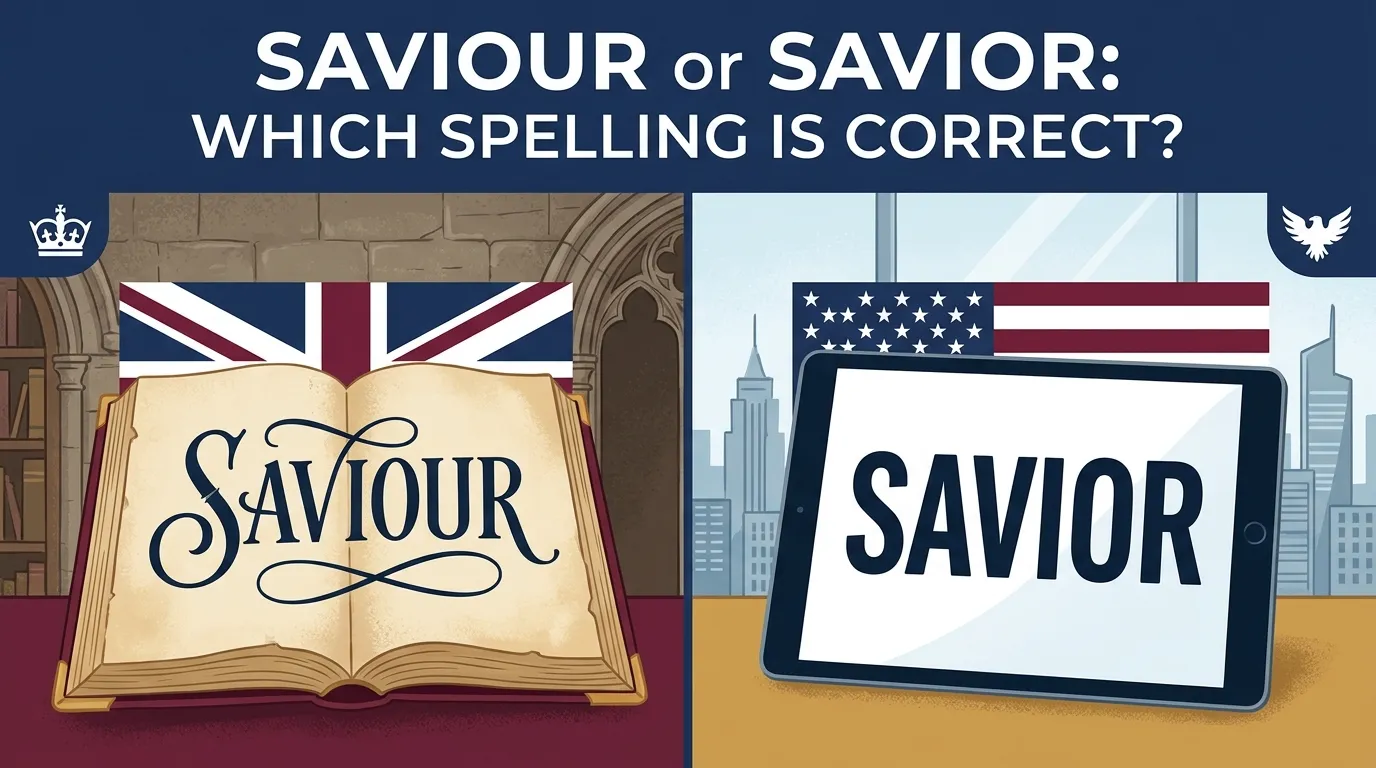
Have you ever wondered whether you should write Saviour or Savior? You are not alone. Many English learners, students, writers, and even native speakers get confused because both spellings appear in books, websites, and newspapers. The good news is that both Saviour and Savior are correct. The only real difference is the variety of English you are using.
The spelling Saviour is the standard form in British English, while Savior is the preferred spelling in American English. They have exactly the same meaning and pronunciation. The difference is simply one of regional spelling conventions, just like colour vs color, favour vs favor, and labour vs labor.
If you are writing for a UK audience, choose Saviour. If your audience is in the United States, use Savior. Understanding the difference between Saviour or Savior helps you write professionally, avoid spelling inconsistencies, and communicate clearly. This guide explains everything you need to know, including pronunciation, grammar, examples, history, common mistakes, and practical usage.
Quick Answer
| Answer | |
|---|---|
| ✅ British English | Saviour |
| ✅ American English | Savior |
| ❌ Incorrect | Neither is incorrect. The only mistake is mixing them within the same document without following one English style consistently. |
Meaning: A person who saves someone from danger, harm, or difficulty. It is also commonly used as a title for Jesus Christ in Christianity.
What Does Saviour or Savior Mean?

The word Saviour or Savior refers to someone who rescues, protects, or saves another person.
It can be used in both:
- A literal sense
- A figurative sense
- A religious sense
Examples
- The firefighter became the family’s savior.
- The doctor was called a saviour after the successful operation.
- Christians believe Jesus Christ is their Saviour.
- She considered her mentor her professional savior.
- Quick thinking made him the team’s saviour.
Grammar: What Part of Speech Is It?
Saviour/Savior is a noun.
Singular
- saviour
- savior
Plural
- saviours
- saviors
Possessive
- saviour’s
- savior’s
Related Adjective
There is no common adjective form.
Instead, English usually uses phrases like:
- saving grace
- life-saving
- redemptive
Related Verb
The related verb is:
save
Examples:
- The nurse saved his life.
- A helmet can save you during an accident.
Saviour vs Savior: The Main Difference
| Feature | Saviour | Savior |
|---|---|---|
| Meaning | Person who saves | Person who saves |
| Grammar | Noun | Noun |
| Pronunciation | Same | Same |
| British English | ✅ Standard | Rare |
| American English | Rare | ✅ Standard |
| Dictionaries | Oxford, Cambridge UK | Merriam-Webster, American Heritage |
| Religious Use | Very common | Very common |
Pronunciation Guide
Both words sound exactly the same.
| Word | IPA (UK) | IPA (US) |
|---|---|---|
| Saviour | /ˈseɪ.vjə/ | /ˈseɪ.vjɚ/ |
| Savior | /ˈseɪ.vjə/ | /ˈseɪ.vjɚ/ |
The pronunciation does not change because of the spelling.
Why Are Saviour and Savior Commonly Confused?
People confuse them because:
- Both words have identical meanings.
- They sound exactly the same.
- Movies, books, and websites use different spellings.
- American and British publishers follow different spelling rules.
- Spell checkers automatically change the spelling depending on language settings.
The confusion is similar to:
- colour vs color
- honour vs honor
- neighbour vs neighbor
- behaviour vs behavior
Word Origin and Etymology
The word comes from the Latin verb salvare, meaning to save.
The development looks like this:
Latin → Old French → Middle English → Modern English
Timeline:
- Latin: salvator
- Old French: sauvour
- Middle English: saviour
- American English later simplified many -our spellings to -or, creating savior.
This spelling reform became common during the 1800s, largely influenced by American lexicographer Noah Webster, who preferred shorter spellings.
American English Examples
Here are ten examples using Savior.
- The firefighter became our Savior.
- She called her teacher a true Savior.
- The software update was a Savior for our business.
- He believes Jesus is his Savior.
- The rescue dog was everyone’s Savior.
- A backup file became my Savior.
- The doctor was the patient’s Savior.
- Your advice was a real Savior today.
- Technology became the company’s Savior.
- That umbrella was my Savior during the storm.
British English Examples
Here are ten examples using Saviour.
- The lifeguard became the child’s Saviour.
- She thanked her Saviour after the rescue.
- Christians worship Jesus as their Saviour.
- My neighbour became my Saviour during the flood.
- His quick thinking made him everyone’s Saviour.
- The charity became a financial Saviour.
- The doctor proved to be the family’s Saviour.
- The mechanic was my car’s Saviour.
- A good friend became my emotional Saviour.
- Education became his greatest Saviour.
When Should You Use Each Spelling?
Use Saviour when writing:
- UK English
- Australia
- New Zealand
- Ireland
- Most Commonwealth countries
Use Savior when writing:
- United States
- American companies
- American universities
- US government documents
Why the Other Spelling Isn’t Wrong
Neither spelling is actually incorrect.
The only mistake is mixing both styles in the same document.
Incorrect
Our Saviour helped everyone. The Savior later received an award.
Correct (British)
Our Saviour helped everyone. The Saviour later received an award.
Correct (American)
Our Savior helped everyone. The Savior later received an award.
Saviour or Savior in Real-Life Situations
Emails
UK:
“Our Saviour Program helped many employees.”
US:
“Our Savior Program helped many employees.”
Office
- She became the team’s savior after fixing the presentation.
- He was the office saviour during the deadline.
Banking
- The emergency loan became their financial savior.
- Better budgeting became the family’s saviour.
Invoices
- The discount became a budget savior.
- Early payment proved a financial saviour.
Schools
- The tutor became my exam savior.
- Revision notes were my saviour.
Social Media
- Coffee is my morning savior.
- Weekend naps are my saviour.
Rent Payments
- My savings became my rent savior.
- My emergency fund was my financial saviour.
Everyday Conversation
- You’re my savior today!
- Thanks for being my saviour.
Synonyms of Saviour/Savior
| Synonym | Meaning | Common in US | Common in UK |
|---|---|---|---|
| Rescuer | Saves people | ✅ | ✅ |
| Hero | Brave helper | ✅ | ✅ |
| Deliverer | Frees someone | ✅ | ✅ |
| Protector | Keeps safe | ✅ | ✅ |
| Guardian | Watches over others | ✅ | ✅ |
| Champion | Supports others | ✅ | ✅ |
| Redeemer | Religious meaning | ✅ | ✅ |
Which Synonyms Are Preferred?
Both American and British English use nearly the same synonyms.
In religious writing:
- Redeemer
- Deliverer
are especially common.
Saviour vs Related Words
| Word | Meaning |
|---|---|
| Save | Verb |
| Saved | Past tense |
| Saving | Present participle |
| Savior/Saviour | Noun |
| Rescue | Verb or noun |
| Hero | Noun |
| Protector | Noun |
Example:
- The firefighter saved the child.
- The firefighter became the child’s savior.
Seven Common Mistakes
Mixing UK and US spellings
❌ The Saviour became our Savior.
✅ Use one spelling consistently.
Using it as a verb
❌ He saviored us.
✅ He saved us.
Wrong capitalization
❌ jesus is our savior.
✅ Jesus is our Savior.
Wrong plural
❌ savioures
✅ saviours
Confusing with rescue
❌ The savior rescueding everyone.
✅ The savior rescued everyone.
Using the wrong dictionary style
Writing for an American company?
Use Savior.
Writing for a British university?
Use Saviour.
Assuming one spelling is incorrect
Both are correct.
Choose according to your audience.
Grammar Rule Explained Simply
English has two major spelling systems.
British English keeps many original -our spellings.
Examples:
- colour
- honour
- favour
American English often shortens them.
Examples:
- color
- honor
- favor
However, Saviour/Savior is slightly different because the variation comes from historical spelling changes rather than a productive grammar rule. Still, the principle is the same: follow the spelling convention of your chosen variety of English and remain consistent throughout your writing.
Memory Tricks
1. UK Loves “OU”
Think:
United Kingdom → OU → Saviour
2. America Likes Shorter Spellings
US English often removes unnecessary letters.
Savior is shorter.
3. Think of Color
Color → Savior
Colour → Saviour
4. Stay Consistent
Pick one spelling and use it throughout your document.
5. Match Your Audience
British readers expect Saviour.
American readers expect Savior.
Frequently Asked Questions
Is Saviour or Savior correct?
Both are correct. Saviour is British English, while Savior is American English.
What does Savior mean?
It means someone who saves, rescues, or protects another person. It is also a title for Jesus Christ in Christianity.
Is Savior American spelling?
Yes. Savior is the standard spelling in American English.
Is Saviour British spelling?
Yes. Saviour is the preferred spelling in British English.
Are they pronounced differently?
No. They have the same pronunciation.
Which spelling do dictionaries prefer?
British dictionaries prefer Saviour, while American dictionaries prefer Savior.
Can I use either spelling?
Yes, but be consistent with the English style you are using.
Is Savior formal?
Yes. It is suitable for both formal and informal writing.
Is Saviour used in religious writing?
Yes. British churches, Christian publications, and many Bible resources commonly use Saviour.
Which spelling should ESL learners use?
Choose the version that matches the English you are learning. If you study American English, write Savior. If you study British English, write Saviour.
People Also Ask
Is there a grammar difference between Saviour and Savior?
No. The grammar is identical. Both are singular countable nouns. The only difference is regional spelling.
Which spelling appears in the Bible?
It depends on the Bible translation. British editions often use Saviour, while American editions commonly use Savior.
Can I switch between Saviour and Savior?
You should avoid switching within the same document. Consistency is important in academic, professional, and published writing.
Is Savior more common online?
Many international websites use both spellings. However, American websites usually prefer Savior, while UK-based websites generally use Saviour.
What is the best spelling for international audiences?
If your audience is primarily American, use Savior. If it is British or from Commonwealth countries, use Saviour. For global audiences, choose one variety of English and apply it consistently.
Conclusion
Choosing between Saviour or Savior is much simpler than it first appears. Both spellings are correct, both carry the same meaning, and both are pronounced the same way. The only real difference is regional preference. Saviour is the standard spelling in British English, while Savior is the accepted form in American English. Whether you are writing an email, preparing a school assignment, creating professional documents, posting on social media, or discussing religious topics, the key is to match your spelling to your audience and remain consistent throughout your writing. By understanding their meaning, grammar, pronunciation, etymology, and real-world usage, you can use either spelling with confidence. Remember the simple rule: UK uses Saviour, US uses Savior. Following this guideline will make your writing clearer, more professional, and appropriate for readers on both sides of the Atlantic.