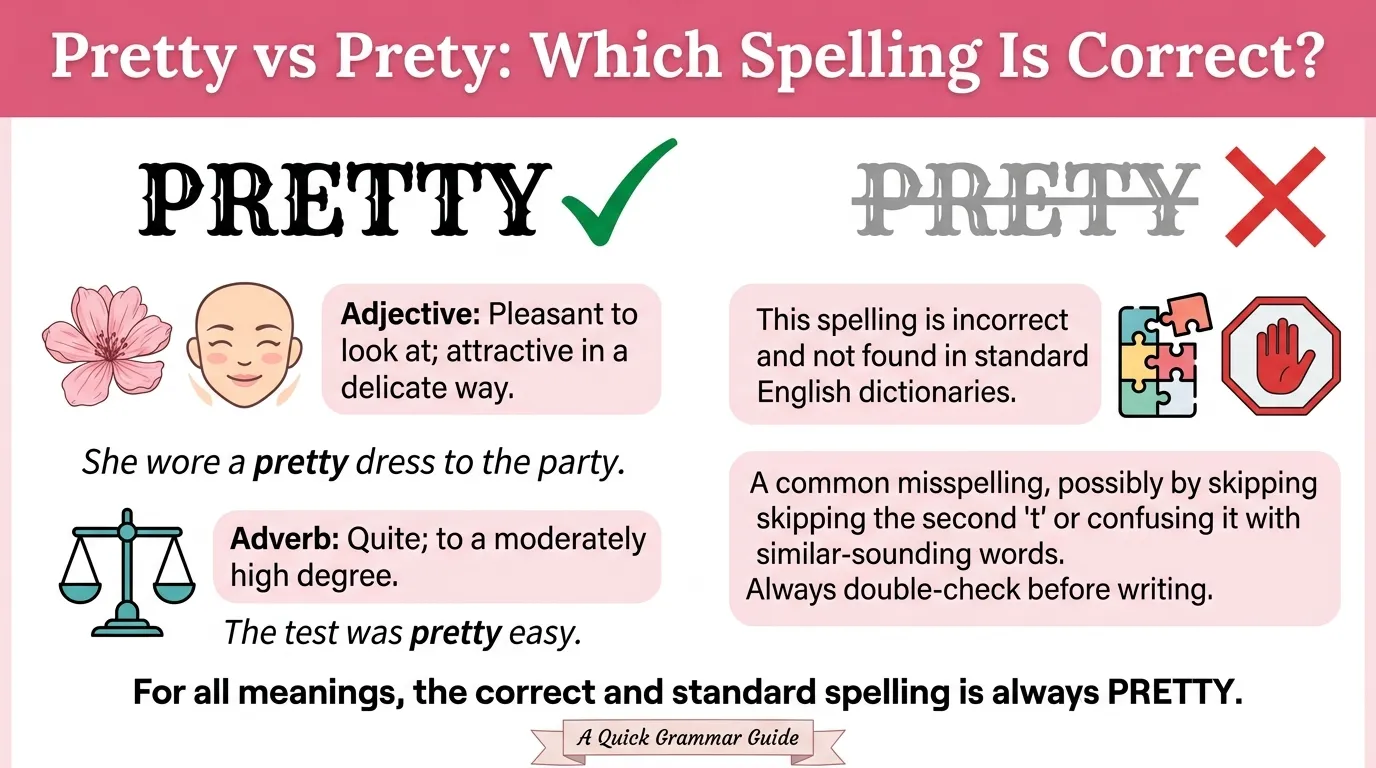
If you’ve ever typed prety and wondered whether it’s a real word, you’re not alone. Many English learners and native speakers accidentally misspell pretty because of its double t. The good news is simple:
Quick Answer
✅ Pretty is the correct English spelling.
❌ Prety is incorrect and is considered a spelling mistake in standard English.
Whether you’re writing an email, school assignment, blog post, social media caption, or business document, you should always use pretty.
In this guide, you’ll learn:
- Why pretty is correct and prety is not
- The meaning of pretty
- Why people commonly misspell it
- Grammar and pronunciation
- Real-life examples
- Common mistakes
- Synonyms and alternatives
- Memory tricks
- Regional usage
- Frequently asked questions
By the end, you’ll know exactly when and how to use pretty confidently.
Is It Pretty or Prety?
The correct spelling is pretty.
| Word | Correct? | Meaning |
|---|---|---|
| Pretty | ✅ Yes | Attractive, fairly, pleasant |
| Prety | ❌ No | Misspelling of “pretty” |
There is no standard English word spelled prety.
Spell checkers, dictionaries, teachers, editors, and style guides all recognize only pretty.
What Does “Pretty” Mean?
The word pretty has several meanings depending on how it is used.
As an Adjective
It describes someone or something that is attractive or pleasing.
Examples:
- She has a pretty smile.
- That’s a pretty garden.
- We stayed in a pretty little village.
It often suggests beauty that is delicate, pleasant, or charming rather than dramatic.
As an Adverb
Pretty can also mean fairly, quite, or rather.
Examples:
- I’m pretty tired today.
- The movie was pretty interesting.
- She’s pretty good at tennis.
In conversational American English, this use is extremely common.
Why Do People Write “Prety”?
Several reasons explain this common spelling mistake.
1. Double Letters Are Easy to Forget
English contains many words with double consonants.
Examples include:
- little
- better
- happy
- middle
- pretty
People often simplify them by mistake.
2. Fast Typing
When typing quickly, many people accidentally skip one t.
Instead of:
pretty
they type:
prety
3. English Isn’t Completely Phonetic
English spelling doesn’t always match pronunciation perfectly.
Since pretty sounds like:
“prit-ee”
some writers assume only one t is needed.
4. Autocorrect Doesn’t Always Catch It Immediately
Some devices may not immediately correct short misspellings, especially when:
- using names
- writing quickly
- typing in games
- sending text messages
Dictionary-Style Definition
Pretty
Pronunciation
/ˈprɪti/
Adjective
Attractive in a delicate or pleasant way.
Example:
The child wore a pretty dress.
Adverb
To a fairly high degree.
Example:
The test was pretty easy.
Noun (Rare)
Something attractive or pleasing.
This usage is uncommon in modern English.
Pronunciation
The correct pronunciation is:
PRIT-ee
Breakdown:
prit + ee
Not:
- pree-tee
- pray-tee
- pret-ee
Parts of Speech
The word pretty serves multiple grammatical roles.
| Part of Speech | Example |
|---|---|
| Adjective | A pretty flower |
| Adverb | Pretty amazing |
| Informal Intensifier | Pretty much finished |
Pretty vs Prety Comparison
| Feature | Pretty | Prety |
|---|---|---|
| Correct spelling | ✅ Yes | ❌ No |
| Found in dictionaries | Yes | No |
| Used in formal writing | Yes | No |
| Used in academic writing | Yes | No |
| Accepted in business writing | Yes | No |
| Appears in spell check | Yes | Usually flagged |
| Recommended usage | Always | Never |
Why “Pretty” Has Two Ts
Many English words developed through centuries of language change.
The double t became part of the accepted spelling and has remained consistent in modern English.
Although it might seem unnecessary today, English preserves many historical spellings.
Examples include:
- little
- better
- butter
- pretty
The spelling is now fixed.
Word History and Etymology
The word pretty comes from Old English and Middle English forms related to cleverness, trickiness, and skill.
Over time, its meaning gradually changed.
Historical meanings included:
- clever
- crafty
- neat
- elegant
- attractive
Eventually, pretty became associated mainly with beauty and pleasant appearance.
Today, it also commonly means fairly or quite.
Pretty as an Adjective
This is the most familiar use.
Examples:
- She bought a pretty necklace.
- What a pretty sunset.
- Their new puppy is pretty.
- That’s a pretty painting.
- He lives in a pretty neighborhood.
Pretty as an Adverb
This use means:
- fairly
- quite
- rather
Examples:
- It’s pretty cold outside.
- I’m pretty excited.
- The meeting was pretty short.
- She’s pretty confident.
- That pizza tastes pretty good.
Tone and Formality
The word fits many writing situations.
| Context | Appropriate? |
|---|---|
| Casual conversation | ✅ Yes |
| Business writing | ✅ Yes |
| Journalism | ✅ Yes |
| Academic writing | Yes, when appropriate |
| Blogs | ✅ Yes |
| Marketing | ✅ Yes |
| Emails | ✅ Yes |
| Social media | ✅ Yes |
American vs British English
Good news:
Both American and British English spell the word exactly the same.
| Region | Preferred Spelling |
|---|---|
| United States | Pretty |
| United Kingdom | Pretty |
| Canada | Pretty |
| Australia | Pretty |
| New Zealand | Pretty |
There is no regional spelling variation.
Pretty in Different Types of Writing
Academic Writing
Acceptable when describing appearance or moderate degree.
Example:
- The results were pretty consistent.
However, academic writing often prefers more precise alternatives like:
- relatively
- moderately
- considerably
Business Writing
Suitable in emails and informal communication.
Example:
- The project is pretty close to completion.
For formal reports, consider:
- nearly
- largely
- relatively
Journalism
Frequently used in quotations and conversational reporting.
Example:
The coach said the team looked pretty confident.
Blogging
Very common because it sounds natural.
Example:
This recipe is pretty easy to make.
Technical Writing
Less common.
Technical documents usually favor more exact wording.
Instead of:
The software is pretty fast.
Use:
The software performs efficiently.
Synonyms of Pretty
When It Means Attractive
- beautiful
- lovely
- charming
- cute
- elegant
- appealing
- attractive
- delightful
- graceful
- pleasant
When It Means Fairly
- fairly
- rather
- quite
- moderately
- relatively
- reasonably
- somewhat
Antonyms
When meaning attractive:
- ugly
- unattractive
- plain
- unpleasant
When meaning fairly:
There isn’t a perfect opposite, but alternatives include:
- barely
- hardly
- slightly
Common Collocations
English speakers naturally combine pretty with many words.
Examples:
- pretty face
- pretty smile
- pretty house
- pretty flowers
- pretty dress
- pretty close
- pretty difficult
- pretty simple
- pretty obvious
- pretty good
- pretty bad
- pretty much
- pretty soon
Common Expressions
Popular everyday phrases include:
- Pretty good.
- Pretty nice.
- Pretty amazing.
- Pretty cool.
- Pretty much.
- Pretty soon.
- Pretty obvious.
- Pretty lucky.
- Pretty expensive.
- Pretty impressive.
Idioms and Fixed Expressions
Some common expressions include:
Pretty Much
Meaning:
Almost completely.
Example:
- We’ve pretty much finished the project.
Pretty Soon
Meaning:
In the near future.
Example:
- Dinner will be ready pretty soon.
Pretty Good
Meaning:
Better than average.
Example:
- She’s pretty good at math.
Everyday Examples
Correct:
- Your handwriting is pretty neat.
- That’s a pretty lake.
- I’m pretty busy today.
- He’s pretty funny.
- We had a pretty relaxing vacation.
- This phone is pretty expensive.
- She looks pretty today.
- That’s a pretty smart idea.
- The movie was pretty entertaining.
- Everything looks pretty clean.
Formal vs Informal Alternatives
| Informal | More Formal |
|---|---|
| pretty good | satisfactory |
| pretty big | substantial |
| pretty easy | relatively simple |
| pretty fast | efficient |
| pretty likely | highly probable |
| pretty clear | evident |
| pretty sure | reasonably certain |
Awkward vs Natural Examples
| Awkward | Natural |
|---|---|
| She is prety. | She is pretty. |
| It was prety cold. | It was pretty cold. |
| That is a prety flower. | That is a pretty flower. |
| I feel prety tired. | I feel pretty tired. |
| This looks prety good. | This looks pretty good. |
Common Mistakes
Mistake 1
❌ She is prety.
✅ She is pretty.
Mistake 2
❌ That cake looks prety.
✅ That cake looks pretty.
Mistake 3
❌ I’m prety sure.
✅ I’m pretty sure.
Mistake 4
❌ It is prety expensive.
✅ It is pretty expensive.
Memory Trick
Remember this simple phrase:
Pretty has TWO Ts because beauty deserves TWO compliments.
Another trick:
Think of:
beTTer
Both better and pretty contain double t.
How Spell Checkers Treat These Words
Modern spell checkers:
✅ Accept:
- pretty
Flag as incorrect:
- prety
If you’re proofreading, always check for missing double letters.
Can “Prety” Ever Be Correct?
In standard English, no.
The only rare exceptions might be:
- usernames
- brand names
- fictional names
- intentional stylized spellings
For normal writing, prety should never replace pretty.
Should You Ever Use “Prety”?
No.
Whether you’re writing:
- homework
- resumes
- blog posts
- books
- business emails
- academic papers
- text messages
- professional reports
Always use:
pretty
Best Usage Recommendations
Here are the best practices for different writing styles.
| Writing Type | Recommended Word |
|---|---|
| American English | Pretty |
| British English | Pretty |
| Academic papers | Pretty (or more precise alternatives when needed) |
| Journalism | Pretty |
| Business communication | Pretty |
| Technical manuals | Use more precise wording where possible |
| Sports writing | Pretty |
| Blogging | Pretty |
| Social media | Pretty |
| Creative writing | Pretty |
| International English | Pretty |
Final Comparison Table
| Feature | Pretty | Prety |
|---|---|---|
| Standard English | ✅ | ❌ |
| Dictionary word | ✅ | ❌ |
| Correct spelling | ✅ | ❌ |
| Grammar approved | ✅ | ❌ |
| Academic use | ✅ | ❌ |
| Business use | ✅ | ❌ |
| Professional writing | ✅ | ❌ |
| Recommended | Always | Never |
Frequently Asked Questions
Is “prety” a real English word?
No. Prety is not recognized as a standard English word. It is simply a misspelling of pretty.
Why does “pretty” have two Ts?
The spelling comes from the word’s historical development in English. The double t is part of the standard spelling and should always be used.
Is “pretty” an adjective or an adverb?
It can be both. As an adjective, it means attractive. As an adverb, it means fairly or quite.
Is “pretty” formal or informal?
It works well in both casual and professional writing, although very formal or technical writing may benefit from more precise alternatives such as relatively, moderately, or considerably.
Do Americans and British people spell it differently?
No. Both American and British English use the spelling pretty.
Can spell check automatically fix “prety”?
Most modern spell checkers identify prety as a misspelling and suggest pretty, but it’s still a good idea to proofread your writing.
What are good alternatives to “pretty” when it means “fairly”?
Good substitutes include quite, rather, fairly, reasonably, relatively, and moderately, depending on the context.
Is it okay to use “pretty” in business emails?
Yes. It’s common in everyday business communication, but for formal reports or legal documents, a more precise word may be preferable.
Why do people often misspell “pretty”?
The most common reasons are forgetting the double t, typing too quickly, and assuming the pronunciation suggests only one t.
What’s the easiest way to remember the correct spelling?
Think of the phrase: “Pretty has two Ts because it always takes two Ts to spell it correctly.” Repeating this simple memory trick can help you avoid the common mistake.
Conclusion
When comparing pretty vs prety, the answer is straightforward: pretty is the only correct spelling in standard English. It functions as both an adjective meaning attractive or pleasing and an adverb meaning fairly or quite, making it one of the most versatile words in everyday English. Prety, on the other hand, is simply a misspelling caused by dropping one of the two required t letters.
To write clearly and professionally, always use pretty in academic papers, business emails, journalism, blogs, social media, and everyday conversations. If you’re aiming for a more formal tone, consider alternatives such as relatively, moderately, or reasonably when pretty is used as an adverb. By remembering that pretty always has two Ts, you’ll avoid a common spelling mistake and communicate with greater confidence and accuracy.