If you have ever seen “yea” and “nay” together, especially in a formal vote, you may have wondered whether yea simply means “yes” and nay means “no.” In most contexts, that is the basic idea—but there is an important distinction between yea, yeah, and yes that can cause confusion.
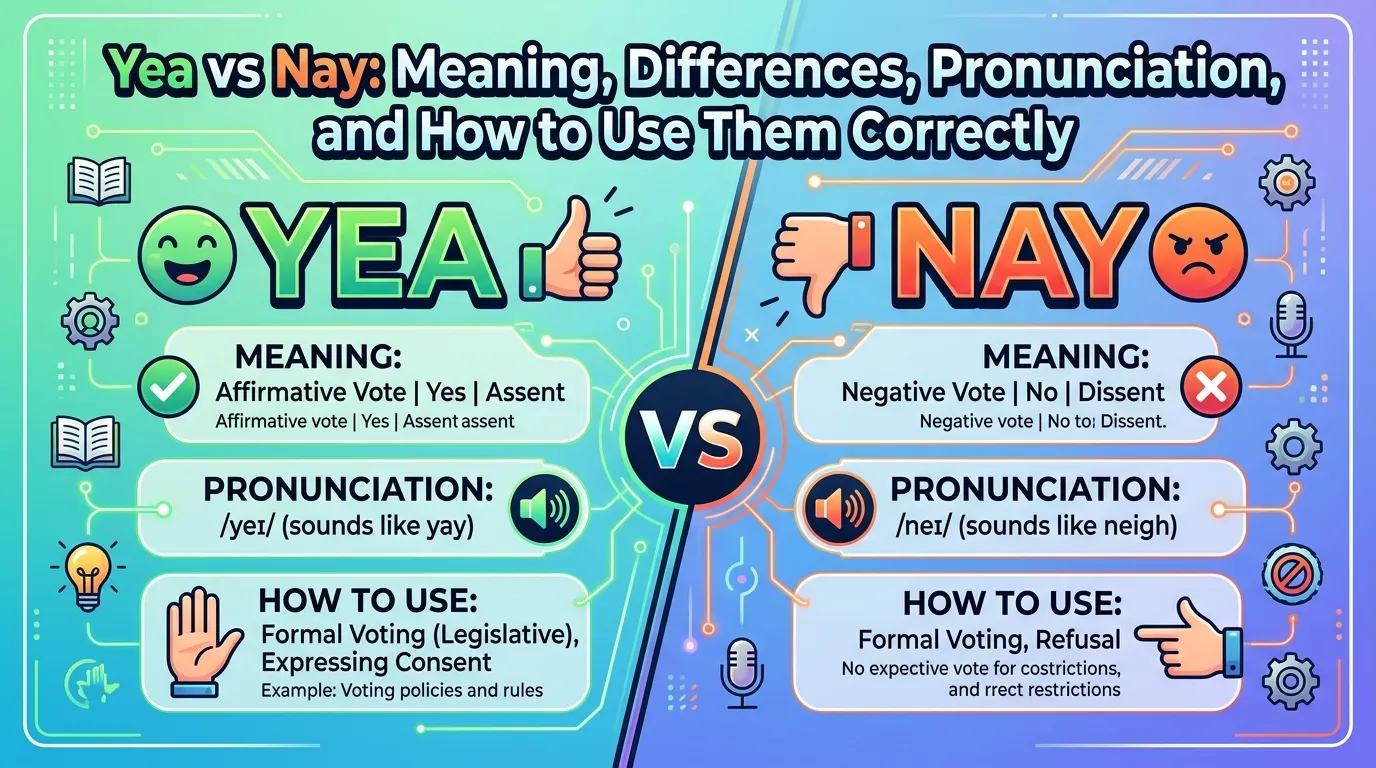
Yea is an old or formal word meaning yes, approval, or an affirmative vote. Nay means no, refusal, or a negative vote. They are commonly associated with formal voting, historical writing, legal language, religious texts, and deliberately old-fashioned speech.
For example:
“All in favor, say yea; all opposed, say nay.”
In this sentence, yea means “yes” or “I approve,” while nay means “no” or “I oppose.”
However, yea can have another meaning. In phrases such as “yea, even unto death,” it can mean “indeed,” “truly,” or “even.” Meanwhile, nay can sometimes mean more than a simple “no” and can introduce a stronger correction, as in “He was not merely angry, nay, he was furious.”
This guide explains yea vs nay in detail, including their meanings, pronunciation, history, grammatical roles, formal and informal uses, common mistakes, examples, and the difference between yea, yeah, yes, nay, and no.
Quick Answer: Yea vs Nay
Yea means yes, especially when expressing approval or casting an affirmative vote.
Nay means no, especially when expressing disapproval or casting a negative vote.
| Word | Basic Meaning | Typical Use | Tone |
|---|---|---|---|
| Yea | Yes; approval | Formal votes, historical language | Formal/old-fashioned |
| Nay | No; rejection | Formal votes, historical language | Formal/old-fashioned |
| Yeah | Yes | Everyday conversation | Informal |
| Yes | Yes | General English | Neutral/formal |
| No | No | General English | Neutral |
Simple example
Yea: “I vote yea on the proposal.”
Nay: “I vote nay on the proposal.”
In everyday conversation, most Americans would simply say:
“Yes, I agree.”
“No, I disagree.”
What Does Yea Mean?
Yea is an English word that traditionally means yes, indeed, or an affirmative response.
Today, one of its most recognizable uses is in voting.
For example:
“The motion passed with 42 yeas and 8 nays.”
Here, the yeas are the people or votes supporting the motion.
The word can also function as an adverb meaning indeed or even in older or literary expressions.
Dictionary-style definition of yea
Yea (noun): An affirmative vote or expression of agreement.
Yea (adverb): Indeed; certainly; even.
Examples
- “The proposal received more yea votes than nay votes.”
- “I cast my yea vote.”
- “Yea, though I walk through the valley…”
- “He was strong, yea, remarkably strong.”
The last two examples show the older or literary sense of yea, rather than the voting sense.
What Does Nay Mean?
Nay traditionally means no, especially when someone rejects something or casts a negative vote.
It is the direct counterpart of yea in formal voting language.
For example:
“The final count was 27 yeas and 19 nays.”
That means 27 votes supported the proposal and 19 opposed it.
Dictionary-style definition of nay
Nay (noun): A negative answer, refusal, or negative vote.
Nay (adverb): No; indeed not; more accurately or rather.
Examples
- “The bill passed despite several nays.”
- “I vote nay.”
- “Nay, I will not accept the offer.”
- “It was not difficult; nay, it was surprisingly easy.”
That final use demonstrates another meaning of nay: it can introduce a stronger or more precise statement.
Yea vs Nay: The Main Difference
The simplest distinction is:
Yea = yes or approval
Nay = no or opposition
They are traditionally used as opposites.
Compare these examples:
“Do you support the proposal?”
- Yea = Yes, I support it.
- Nay = No, I do not support it.
In a vote:
- Yea vote = Vote in favor.
- Nay vote = Vote against.
In ordinary conversation:
Instead of:
“Yea, I agree.”
A modern American speaker would usually say:
“Yeah, I agree.”
Or:
“Yes, I agree.”
Likewise, instead of:
“Nay, I don’t want it.”
Modern English normally uses:
“No, I don’t want it.”
Yea vs Yeah: Why This Causes Confusion
One of the most common mistakes is confusing yea with yeah.
Although they look and sound similar, they are not the same word.
Yea
Yea is an older or formal word meaning yes, particularly in voting.
Example:
“The senator voted yea.”
Yeah
Yeah is an informal form of yes.
Example:
“Yeah, I’ll come with you.”
Comparison
| Yea | Yeah |
|---|---|
| Formal or historical | Informal |
| Often associated with voting | Common in conversation |
| Means yes/affirmative vote | Means yes |
| “The motion passed with 30 yeas.” | “Yeah, that sounds good.” |
| More old-fashioned | Very common in modern American English |
Easy memory trick
Think:
Yea = vote
Yeah = conversation
This is not an absolute rule, but it is a useful way to remember the difference.
Yea vs Yes: Are They the Same?
Not exactly.
Both can express agreement, but they belong to different styles of English.
Yes is the standard modern word.
Yea is much more specialized.
Compare:
“Yes, I agree with your proposal.”
This sounds completely natural today.
“Yea, I agree with your proposal.”
This sounds formal, archaic, theatrical, or intentionally old-fashioned unless it is referring to a vote.
But:
“I cast my yea vote.”
sounds appropriate in a formal voting context.
When should you use “yes”?
Use yes for:
- Everyday conversation
- Emails
- Business communication
- Academic writing
- General nonfiction
- Customer service
- Modern journalism
- Most professional writing
When is “yea” appropriate?
Use yea when:
- Discussing formal votes
- Referring to historical voting
- Writing historical dialogue
- Reproducing traditional language
- Creating an intentionally old-fashioned tone
- Discussing parliamentary or legislative terminology
Yea vs Nay in Voting
Voting is where yea vs nay remains especially important.
A yea vote indicates support.
A nay vote indicates opposition.
For example:
“The resolution passed, with 58 yeas and 41 nays.”
The meaning is straightforward:
- 58 members voted for the resolution.
- 41 members voted against it.
Yea and nay compared with yes and no
You may hear:
“Those in favor, say yea.”
This means:
“Those who support this, say yes.”
Similarly:
“Those opposed, say nay.”
means:
“Those who oppose this, say no.”
The words are particularly associated with formal voting procedures.
Why Do People Say “Yea” Instead of “Yes” in a Vote?
There is a practical reason.
In some formal voting systems, the distinction between a person’s response and their vote can be important.
Yea clearly identifies an affirmative vote.
Nay clearly identifies a negative vote.
You might therefore see phrases such as:
- Yea
- Nay
- Present
- Abstain
depending on the voting system.
The exact procedure varies by institution.
How to Pronounce Yea and Nay
Both words are easy to pronounce.
Yea
Yea is pronounced like “yay.”
IPA pronunciation:
/jeɪ/
It rhymes with:
- day
- say
- way
- play
- stay
Nay
Nay is pronounced like “nay.”
IPA pronunciation:
/neɪ/
It rhymes with:
- day
- say
- way
- pay
- may
Important pronunciation point
Yea and yeah are generally pronounced alike in modern English.
The difference is primarily in spelling, meaning, and usage, not pronunciation.
Is Yea a Correct English Word?
Yes.
Yea is a legitimate English word.
However, being grammatically correct does not mean it is appropriate in every situation.
Modern English has many words that are correct but rarely used in casual conversation.
Yea is one of them.
For example:
“I vote yea.”
Correct.
But:
“Yea, I just got home.”
This may sound unusual or intentionally old-fashioned.
A modern speaker would normally write:
“Yeah, I just got home.”
or:
“Yes, I just got home.”
Is Nay a Correct English Word?
Yes.
Nay is also a standard English word, although it is relatively uncommon in everyday American speech.
It remains useful in formal voting terminology and literary or historical writing.
For example:
“The committee recorded 12 yeas and 5 nays.”
That is perfectly natural in the right context.
But in casual conversation:
“Nay, I don’t want pizza.”
sounds theatrical or archaic.
Most people would simply say:
“No, I don’t want pizza.”
Why Do People Confuse Yea, Yeah, Yes, Nay, and No?
Several factors create confusion.
1. Yea and yeah sound alike
This makes the spelling easy to mix up.
2. Yea and yes have similar meanings
Both can express agreement, but their usage is different.
3. Nay and no have similar meanings
Again, nay is an older or more formal alternative in certain contexts.
4. Historical language appears in modern media
People encounter yea and nay in:
- Movies
- Television
- Historical novels
- Bible translations
- Political reporting
- Parliamentary discussions
- Legal or institutional documents
5. “Yea” has more than one historical meaning
It does not always simply mean “yes.”
Depending on context, it can mean indeed, certainly, or even.
Yea vs Nay: Formality and Tone
Tone is one of the biggest differences between these words and their modern equivalents.
| Expression | Formality | Modernity |
|---|---|---|
| Yes | Neutral to formal | Very modern |
| No | Neutral to formal | Very modern |
| Yeah | Informal | Very modern |
| Yea | Formal/archaic | Specialized |
| Nay | Formal/archaic | Specialized |
Modern professional setting
Prefer:
“Yes, I approve the proposal.”
rather than:
“Yea, I approve the proposal.”
Formal voting setting
Appropriate:
“The vote was 24 yeas to 11 nays.”
Historical dialogue
Appropriate:
“Nay, my lord, I shall not surrender.”
The old-fashioned tone is intentional.
Yea vs Nay in American English
In contemporary American English, yea and nay are most likely to appear in formal voting terminology.
You may encounter them when reading about:
- Legislative votes
- Parliamentary procedures
- Board decisions
- Committee meetings
- Historical elections
- Formal resolutions
For everyday American English, use yes and no.
For casual conversation, yeah is also extremely common.
American examples
Formal:
“The measure passed with 35 yeas and 12 nays.”
Casual:
“Yeah, I think we should go.”
Neutral:
“Yes, I agree.”
Yea vs Nay in British English
Both words are understandable in British English, particularly in formal, historical, or parliamentary contexts.
However, modern British speakers do not normally use yea and nay as everyday replacements for yes and no.
You would generally hear:
“Yes, I agree.”
or:
“No, I don’t agree.”
The words yea and nay have a stronger historical and formal association.
Yea and Nay in Historical English
The history of these words explains why they can sound old-fashioned today.
Yea and nay are old English terms that survived long after many similar forms disappeared from everyday speech.
They were particularly useful when English had multiple ways of expressing affirmation and negation.
Over time, yes and no became the dominant everyday forms.
But yea and nay remained in specialized contexts.
This is why modern readers may recognize the words immediately while rarely using them themselves.
The Etymology of Yea
Yea comes from Old English and has a long history in Germanic languages.
Its older forms were used to express affirmation or agreement.
Over centuries, its spelling and pronunciation developed into the modern yea.
Although it became less common in ordinary speech, it survived in formal, religious, literary, and voting contexts.
Its connection with affirmative voting helped preserve it in modern institutional language.
The Etymology of Nay
Nay also has Old English and Germanic roots.
Historically, it expressed negation or rejection.
It survived into Middle and Early Modern English and eventually became less common in ordinary conversation.
Like yea, however, nay continued to appear in formal and literary contexts.
Its survival as the opposite of yea is especially noticeable in voting terminology.
The Second Meaning of Yea: “Indeed” or “Even”
One interesting feature of yea is that it does not always mean simply “yes.”
In older English, yea could strengthen a statement.
For example:
“He was a great leader, yea, one of the greatest of his age.”
Here, yea is closer to:
- indeed
- certainly
- in fact
- even
This use is now literary or archaic.
Another example
“She was exhausted, yea, completely unable to continue.”
A modern writer would probably say:
“She was exhausted—indeed, she was completely unable to continue.”
The Second Meaning of Nay: “Rather” or “More Precisely”
Nay can also be used to correct or strengthen a previous statement.
For example:
“He was not disappointed; nay, he was delighted.”
The speaker is effectively saying:
“Not disappointed. Rather, he was delighted.”
This construction is formal and literary.
More examples
- “It was not difficult, nay, it was remarkably easy.”
- “He was not merely successful, nay, he became a legend.”
- “She did not hesitate; nay, she acted immediately.”
These examples demonstrate why translating nay simply as “no” can sometimes miss the intended meaning.
Yea vs Nay in Religious and Biblical Language
Readers may encounter yea and nay in older Bible translations and traditional religious writing.
For example, older English religious language often uses yea in ways that modern translations may express as:
- yes
- indeed
- surely
- even
Likewise, nay may appear where modern English would use:
- no
- rather
- instead
- indeed not
The exact meaning depends on the passage.
Why does biblical English use these words?
Many traditional English Bible translations were produced in periods when yea and nay were more familiar parts of written English.
As English changed, these words became increasingly formal or archaic.
This is why modern readers may find older religious translations more difficult to understand.
Yea vs Nay in Politics
Politics is another context where you may encounter these terms.
A report might say:
“The bill received 210 yea votes and 185 nay votes.”
This simply means:
- 210 lawmakers supported it.
- 185 lawmakers opposed it.
However, modern political reporting often uses:
- votes for
- votes against
- yes votes
- no votes
- affirmative votes
- negative votes
So the choice depends on the specific voting system and writing style.
Yea vs Nay in Business
In business writing, yea and nay are usually unnecessary unless you are specifically discussing a formal vote.
Less natural
“Please provide your yea or nay regarding the marketing plan.”
This is understandable, but it can sound stiff.
More natural
“Please let us know whether you approve or reject the marketing plan.”
Or:
“Please vote yes or no on the proposal.”
When “yea or nay” can work
If a company has a formal board or committee vote, the expression can be appropriate:
“The board recorded six yeas and two nays.”
Yea or Nay: What Does the Phrase Mean?
The phrase “yea or nay” means “yes or no” or “for or against.”
Example:
“We need a yea or nay before moving forward.”
In modern language, this means:
“We need a yes or no before moving forward.”
“Yea or nay” can sound playful
Because the phrase is old-fashioned, writers sometimes use it humorously.
For example:
“Yea or nay: Should we order another pizza?”
The writer is deliberately making a simple question sound grand or dramatic.
“By Yea or Nay” Meaning
The phrase “by yea or nay” means by an affirmative or negative response.
For example:
“The members decided the issue by yea or nay.”
A more modern version would be:
“The members decided the issue by a yes-or-no vote.”
Yea and Nay as Nouns
Both words can function as nouns.
Yea as a noun
“The bill received 60 yeas.”
Here, yeas means affirmative votes.
Nay as a noun
“There were 20 nays.”
Here, nays means negative votes.
This plural form is especially common in voting contexts.
Yea and Nay as Adverbs
Both words also have older adverbial uses.
Yea
“Yea, it was a remarkable achievement.”
Meaning:
“Indeed, it was a remarkable achievement.”
Nay
“Nay, that is not what I meant.”
Meaning:
“No, that is not what I meant.”
These uses are grammatically possible but sound old-fashioned today.
Yea vs Nay vs Yeah vs Yes vs No
Here is the complete comparison:
| Word | Meaning | Common Today? | Main Context |
|---|---|---|---|
| Yea | Yes; affirmative | Limited | Voting, historical/literary |
| Nay | No; negative | Limited | Voting, historical/literary |
| Yeah | Yes | Very common | Casual speech |
| Yes | Yes | Very common | General English |
| No | No | Very common | General English |
Best general rule
If you are writing ordinary modern English:
Use “yes” instead of “yea.”
Use “no” instead of “nay.”
If you are talking about a formal vote:
Use “yea” and “nay” when that terminology fits the voting system.
Common Mistakes With Yea and Nay
Mistake 1: Using “yea” as casual “yeah”
Awkward:
“Yea, I’ll call you later.”
Natural:
“Yeah, I’ll call you later.”
Mistake 2: Using “nay” in normal conversation
Awkward:
“Nay, I don’t want coffee.”
Natural:
“No, I don’t want coffee.”
Mistake 3: Thinking yea always means yes
Sometimes yea means indeed or even, especially in older writing.
Always consider the surrounding sentence.
Mistake 4: Assuming yea and yeah are interchangeable
They are pronounced similarly, but their spelling and usage differ.
Yea: formal/historical affirmative term.
Yeah: informal form of yes.
Mistake 5: Using “yea” and “nay” without understanding the context
If you are writing about a formal vote, they may be perfect.
If you are writing an everyday email, they may sound unnecessarily archaic.
Awkward vs Natural Examples
| Awkward or Unusual | Natural Modern Alternative |
|---|---|
| “Yea, I’ll be there.” | “Yeah, I’ll be there.” |
| “Nay, I disagree.” | “No, I disagree.” |
| “Give me a yea or nay.” | “Give me a yes or no.” |
| “Do you yea the idea?” | “Do you approve of the idea?” |
| “I said yea to my friend.” | “I said yes to my friend.” |
Context where yea is natural
“The committee recorded 15 yeas and 4 nays.”
That is perfectly appropriate.
Context where nay is natural
“The motion failed after receiving 8 yeas and 13 nays.”
Again, the formal voting context makes the vocabulary natural.
Synonyms for Yea
Depending on context, synonyms include:
- Yes
- Certainly
- Indeed
- Absolutely
- Affirmative
- Agreed
- Approval
- In favor
- Aye
Be careful with aye, because it is another traditional affirmative voting term.
Example
“The motion passed with 20 ayes and 5 nays.”
In some voting systems, aye is preferred over yea.
Synonyms for Nay
Depending on context, synonyms include:
- No
- Not
- Negative
- Opposed
- Against
- Rejection
- Refusal
- Disapproval
- Rather
Again, the correct synonym depends on the sentence.
Antonyms of Yea and Nay
The primary opposites are:
Yea ↔ Nay
and in modern English:
Yes ↔ No
Other relationships include:
- approval ↔ disapproval
- agreement ↔ disagreement
- affirmative ↔ negative
- acceptance ↔ rejection
- support ↔ opposition
- for ↔ against
Common Collocations With Yea
You may encounter phrases such as:
- yea vote
- yea votes
- yeas and nays
- yea or nay
- vote yea
- cast a yea vote
- recorded yeas
- number of yeas
Example
“The resolution passed after a majority of members voted yea.”
Common Collocations With Nay
Common combinations include:
- nay vote
- nay votes
- yeas and nays
- vote nay
- cast a nay vote
- recorded nays
- number of nays
Example
“The proposal received 18 yeas and 7 nays.”
Is “Yea or Nay” Formal or Informal?
“Yea or nay” is generally formal, old-fashioned, or deliberately playful.
Its tone depends heavily on context.
Formal
“Members were asked to vote yea or nay.”
Literary
“Yea or nay, the king would have his answer.”
Playful
“Yea or nay: Is pineapple good on pizza?”
The final example intentionally uses an old-fashioned expression for humor.
Is “Yea” Still Used Today?
Yes, but its use is limited.
You are most likely to encounter it in:
- Formal voting
- Historical writing
- Religious or traditional texts
- Literary writing
- Political discussions
- Deliberately humorous speech
You are much less likely to hear it in ordinary conversation.
Is “Nay” Still Used Today?
Yes, but it is similarly uncommon in everyday speech.
Its strongest modern use is as the negative counterpart to yea in formal voting.
It also survives in literary and rhetorical language.
How to Remember Yea vs Nay
Use this simple memory trick:
Yea = Yes
Nay = No
Then add:
Yea/Yeah: “Yea” is formal or old-fashioned; “yeah” is casual.
You can also remember:
Yea = Yay! I approve.
Nay = No way!
This is not an exact linguistic rule, but it makes the distinction easy to remember.
Which Should You Use in Modern Writing?
The best choice depends on your audience.
For American casual writing
Use:
- yes
- no
- yeah
- nope
Avoid yea and nay unless you want a special tone.
For academic writing
Usually use:
- yes
- no
- affirmative
- negative
- approved
- rejected
Use yea/nay only when discussing the terminology of a vote or quoting a historical context.
For business writing
Prefer:
- approved
- rejected
- agree
- disagree
- yes
- no
For journalism
Follow the terminology used by the institution or voting system.
For historical writing
Yea and nay can help establish the period and voice.
For creative writing
They can create a formal, dramatic, medieval, biblical, theatrical, or humorous effect.
Yea vs Nay in Sports
Sports discussions may occasionally use yea or nay in informal commentary.
For example:
“Yea or nay: Should the team trade its star player?”
Here, the phrase is simply a playful way of asking for a yes-or-no opinion.
It is not usually specialized sports terminology.
A sports writer would normally use:
- yes or no
- approve or reject
- for or against
- support or oppose
Yea vs Nay in Blogging and Social Media
Bloggers and social media writers sometimes use yea or nay because it is short and memorable.
For example:
Yea or Nay: Is This Fashion Trend Coming Back?
This can work well as a headline because it creates a simple decision.
However, if your audience is looking for plain, modern language, yes or no is clearer.
Frequently Asked Questions
Is yea the same as yes?
Yea can mean yes, especially when expressing approval or an affirmative vote. However, it is more formal, old-fashioned, or specialized than modern yes.
Is nay the opposite of yea?
Yes. In voting terminology, yea means an affirmative or supporting vote, while nay means a negative or opposing vote.
Is yea pronounced like yeah?
Yes. In modern English, yea is generally pronounced like “yay,” and it sounds the same as yeah in many varieties of English. Their meanings and uses differ.
Should I use yea or yeah?
Use yeah for casual conversation and informal writing. Use yea when referring to formal voting, historical language, or an intentionally old-fashioned style.
Should I use yea or yes?
For normal modern English, use yes. Use yea mainly for formal votes or historical/literary contexts.
Should I use nay or no?
Use no in ordinary modern English. Use nay in formal voting terminology, historical writing, literary language, or when you deliberately want an old-fashioned tone.
What does “yea or nay” mean?
“Yea or nay” means “yes or no” or “for or against.” It is commonly associated with formal voting and can also be used playfully.
What does “yeas and nays” mean?
“Yeas and nays” refers to affirmative and negative votes. For example, “The measure passed with 40 yeas and 15 nays” means 40 members voted in favor and 15 voted against.
Is yea still used in American English?
Yes, but it is not common in everyday conversation. It appears most often in formal voting terminology, historical texts, religious language, and literary or humorous writing.
Can nay mean “rather” instead of “no”?
Yes. In older or literary English, nay can introduce a correction or stronger statement, roughly meaning “rather,” “indeed,” or “more accurately.”
Conclusion
The difference between yea vs nay is straightforward once you understand their context.
Yea generally means yes, approval, or an affirmative vote. Nay generally means no, opposition, or a negative vote. Together, they form a traditional pair, especially in formal voting.
The biggest modern confusion is between yea and yeah. Although they sound similar, yeah is the everyday informal form of yes, while yea has a more formal, historical, or specialized role.
For ordinary American English, the safest choices are:
- Yes for standard agreement
- Yeah for casual agreement
- No for standard disagreement
- Yea for formal or historical affirmative voting
- Nay for formal or historical negative voting
If you remember just one rule, remember this:
Yea = yes/for. Nay = no/against.
Use yea and nay when the context calls for formal voting language or an intentionally traditional style. In everyday modern writing and conversation, yes and no will almost always sound more natural.