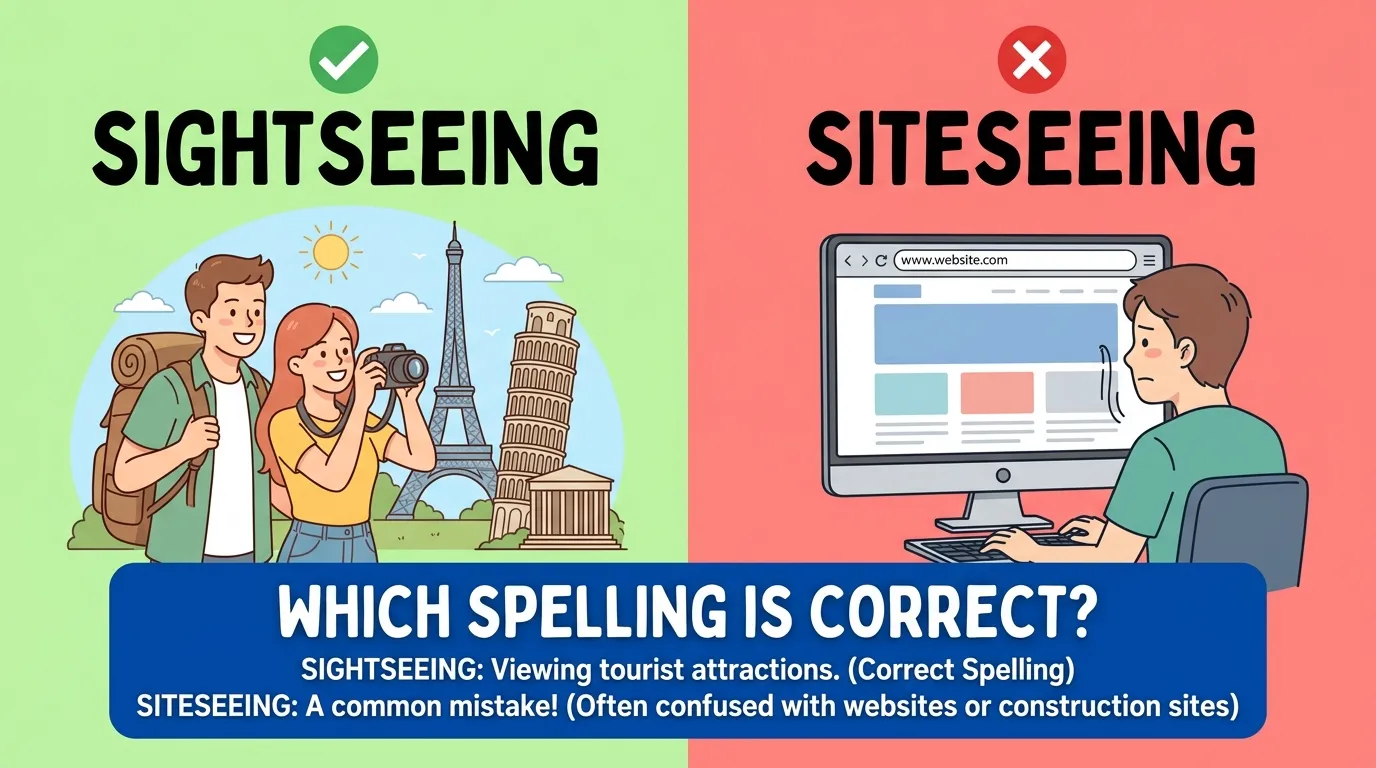
If you are wondering whether sightseeing or siteseeing is the correct spelling, the answer is simple: sightseeing is the standard and correct word in English. Siteseeing is generally a misspelling caused by confusing sight with site.
Sightseeing means visiting interesting or famous places, especially while traveling. For example, you might go sightseeing in New York, Paris, London, or another city to see landmarks, museums, historic buildings, monuments, and other attractions.
The confusion happens because sight and site are both real English words and sound similar in some accents. However, they have completely different meanings.
This guide explains sightseeing vs siteseeing in detail, including their meanings, pronunciation, grammar, word history, common mistakes, regional usage, collocations, examples, and practical memory tricks. By the end, you will know exactly which spelling to use in everyday, academic, professional, journalistic, and travel writing.
Quick Answer: Sightseeing or Siteseeing?
Sightseeing is the correct standard spelling.
Sightseeing means traveling around an area to look at interesting places and attractions.
Siteseeing is usually an incorrect spelling of sightseeing. It combines the word site, meaning a location or place, with seeing, but that is not the standard spelling of the travel activity.
| Word | Correct? | Meaning |
|---|---|---|
| Sightseeing | Yes | Visiting interesting places and attractions |
| Siteseeing | No, generally | Usually a misspelling of sightseeing |
| Sight seeing | Usually no | Normally written as the single word sightseeing |
The correct sentence
We spent Saturday sightseeing around the city.
The incorrect sentence
We spent Saturday siteseeing around the city.
So, if you are writing about tourism, travel, landmarks, or visiting attractions, choose sightseeing.
What Does Sightseeing Mean?
Sightseeing is the activity of visiting and looking at places that are interesting, beautiful, famous, historic, or culturally important.
A person who goes sightseeing may visit:
- Famous landmarks
- Historic buildings
- Museums
- Monuments
- Parks
- Castles
- Religious buildings
- Natural attractions
- Tourist districts
- Scenic viewpoints
- Famous streets
- Cultural attractions
For example:
- We went sightseeing in Rome.
- They spent the afternoon sightseeing.
- Our hotel is close to several popular sightseeing attractions.
- She loves sightseeing when she travels.
- The tour includes three hours of sightseeing.
The word is strongly associated with travel and tourism, although it can be used more broadly.
What Does Siteseeing Mean?
In standard English, siteseeing is generally not the correct spelling of the travel activity.
People sometimes write siteseeing because they think the word refers to seeing different “sites.” This seems logical at first because tourists do visit different sites.
However, the established English word is sightseeing, not siteseeing.
The word comes from sight, referring to something seen or something worth seeing, combined with seeing.
Therefore:
sight + seeing = sightseeing
Not:
site + seeing = siteseeing
Why Does Siteseeing Look Reasonable?
The mistake is understandable because site is closely related to travel.
For example:
The tour visits several historic sites.
Here, sites is correct because the sentence refers to specific locations.
But when you mean the general activity of visiting attractions, the standard word is:
We went sightseeing.
The distinction becomes easier when you remember that sightseeing is an established compound word with its own meaning.
Sight vs Site: The Source of the Confusion
The easiest way to understand this spelling issue is to separate sight and site.
Sight
Sight is connected with seeing or the ability to see.
Examples:
- The mountain was an amazing sight.
- The accident happened within my sight.
- She has excellent sight.
- The sunset was a beautiful sight.
It can also refer to something worth looking at:
The ancient castle was an impressive sight.
Site
Site usually means a particular place or location.
Examples:
- The construction site is closed.
- They visited the archaeological site.
- The company chose a new site for its headquarters.
- The hotel is located near a historic site.
The key difference
Sight = something seen or the ability to see
Site = a place or location
That is why sightseeing is the correct word for tourism.
Sightseeing vs Siteseeing: Key Differences
Here is the central difference in one table:
| Feature | Sightseeing | Siteseeing |
|---|---|---|
| Standard English | Yes | No, generally |
| Correct spelling for tourism | Yes | No |
| Basic idea | Seeing interesting places | Not a standard travel word |
| Root word | Sight | Site |
| Common use | Travel and tourism | Usually a spelling error |
| Example | We went sightseeing. | We went siteseeing. |
| Recommended in formal writing | Yes | No |
If you remember only one thing, remember this:
Tourists go sightseeing, not siteseeing.
Why People Confuse Sightseeing and Siteseeing
Several factors make this spelling mistake common.
Similar pronunciation
Sight and site are homophones in standard English. Both are normally pronounced /saɪt/.
That means:
- sight = /saɪt/
- site = /saɪt/
Because they sound identical, you cannot always determine the correct spelling by pronunciation alone.
The connection with tourist sites
Tourists often visit sites, so siteseeing may appear logical.
Someone might think:
Tourists see sites, so it should be siteseeing.
The problem is that English does not build the word that way. The established term is sightseeing.
The word seeing adds to the confusion
The second part of the word is seeing, which makes people focus on what tourists physically do.
However, spelling is based on the established compound sightseeing, rather than a literal combination of “site” and “seeing.”
Pronunciation of Sightseeing
Sightseeing is usually pronounced:
/ˈsaɪtˌsiːɪŋ/
A simple pronunciation guide is:
SIGHT-see-ing
The first part sounds like sight, while the second part sounds like seeing.
Example:
We spent the morning SIGHT-see-ing downtown.
Because sight and site sound the same, pronunciation will not help you distinguish the two spellings.
This is an important lesson for English learners: homophones often require you to remember spelling from context and word meaning.
Is Sightseeing One Word or Two?
The standard form is one word:
sightseeing
Not:
sight seeing
For example:
We went sightseeing after breakfast.
The single-word form is the normal choice in modern English.
However, related constructions may appear differently depending on grammatical structure.
Compare:
We went sightseeing.
with:
We spent the day sightseeing.
The activity itself is normally written as the single compound word.
Is Sightseeing a Noun or a Verb?
This is an important grammar point.
Sightseeing can function as a noun and also appears as a present participle or gerund form.
Sightseeing as a noun
Examples:
Sightseeing is popular in the old city.
We have planned some sightseeing for tomorrow.
The hotel offers transportation for sightseeing.
Here, sightseeing refers to the activity.
Sightseeing after go
One of the most common patterns is:
go + sightseeing
Examples:
- We went sightseeing.
- They are going sightseeing tomorrow.
- She wants to go sightseeing in Boston.
- We went sightseeing after lunch.
This construction is extremely common in everyday English.
Sightseeing as a modifier
The word can also modify another noun.
Examples:
- sightseeing tour
- sightseeing bus
- sightseeing trip
- sightseeing guide
- sightseeing cruise
- sightseeing excursion
- sightseeing attractions
- sightseeing itinerary
For example:
We booked a sightseeing tour of the city.
Sightseeing Meaning in Different Contexts
The meaning remains fairly stable, but the context can change what type of activity it describes.
Sightseeing while traveling
This is the most common use.
We spent three days sightseeing in Chicago.
The travelers are visiting attractions and famous places.
Sightseeing in your own city
You do not have to be a tourist from another country.
My cousin is visiting, so I’m taking her sightseeing around town.
A local person can go sightseeing with visitors.
Historical sightseeing
This may involve visiting:
- Battlefields
- Ancient ruins
- Historic homes
- Monuments
- Museums
- Old city centers
Example:
The students spent the afternoon sightseeing at historical landmarks.
Nature sightseeing
Sightseeing can include natural attractions.
We went sightseeing along the coast.
The national park is perfect for sightseeing.
In these cases, the sights may include mountains, waterfalls, forests, beaches, or scenic landscapes.
Common Sightseeing Collocations
A collocation is a combination of words that commonly appear together.
Learning common collocations makes your English sound more natural.
Common verbs with sightseeing
- go sightseeing
- enjoy sightseeing
- spend time sightseeing
- spend the day sightseeing
- do some sightseeing
- plan sightseeing
- include sightseeing
Examples:
We plan to go sightseeing tomorrow.
They spent the day sightseeing.
We had time to do some sightseeing before our flight.
Common nouns with sightseeing
- sightseeing tour
- sightseeing trip
- sightseeing bus
- sightseeing cruise
- sightseeing excursion
- sightseeing attraction
- sightseeing guide
- sightseeing itinerary
Examples:
The hotel arranged a sightseeing tour.
We took a sightseeing cruise along the river.
Sightseeing vs Tourist Attractions
These expressions are related but not identical.
Sightseeing is the activity.
Tourist attractions are the places or things people visit.
For example:
The Eiffel Tower is a tourist attraction.
Visiting the Eiffel Tower is part of sightseeing.
You can therefore think of the relationship this way:
Attraction = what you visit
Sightseeing = what you do
Sightseeing vs Visiting
These words overlap, but they are not always interchangeable.
Visiting is broader.
You can visit:
- A friend
- A doctor
- A relative
- A museum
- A city
- A company
- A country
Sightseeing specifically suggests looking at interesting attractions or places.
Compare:
I visited my grandmother.
This is not normally called sightseeing.
But:
I went sightseeing around the historic district.
This clearly means exploring attractions.
Sightseeing vs Exploring
Exploring can be broader and more adventurous than sightseeing.
We went sightseeing in the city.
This suggests visiting notable attractions.
We explored the city on foot.
This can suggest discovering neighborhoods, restaurants, streets, local areas, and less famous places.
The two words can overlap:
We spent the day exploring and sightseeing.
That sentence is completely natural.
Formality and Tone of Sightseeing
Sightseeing is a neutral, standard English word.
It works well in:
- Everyday conversation
- Travel writing
- Tourism websites
- Business communication
- Academic writing
- Journalism
- Brochures
- Blogs
- Travel guides
For example:
Casual:
What are you doing tomorrow?
We’re going sightseeing.
Professional:
The itinerary includes a full day of sightseeing.
Travel writing:
Visitors can enjoy sightseeing throughout the historic city center.
The word is neither strongly formal nor strongly informal.
American vs British English
Sightseeing is standard in both American English and British English.
There is no major regional spelling difference here.
Americans write:
We went sightseeing.
British speakers also write:
We went sightseeing.
The same spelling is used in many other varieties of English as well.
Therefore, siteseeing is not an alternative British spelling of sightseeing.
If you are writing for an American audience, British audience, international audience, or ESL learners, sightseeing is the safe standard form.
Sightseeing in Academic and Professional Writing
The word is perfectly acceptable in formal writing when the context concerns travel or tourism.
Examples:
The study examines how sightseeing affects visitor behavior in historic cities.
The package includes transportation, accommodation, and sightseeing.
The company developed a sightseeing itinerary for international visitors.
In professional tourism writing, related terms such as tourism, attractions, landmarks, destinations, excursions, and guided tours may also be useful.
Sightseeing in Journalism
Journalists commonly use sightseeing when reporting about travel, tourism, public events, or visiting cities.
Examples:
Visitors spent the weekend sightseeing in the capital.
The delegation had time for sightseeing after the conference.
Thousands of tourists arrived for sightseeing during the holiday season.
The word is straightforward and neutral, which makes it suitable for news writing.
Sightseeing in Business Writing
Business travelers may also go sightseeing.
For example:
The conference schedule allows attendees one afternoon for sightseeing.
Guests can arrange sightseeing activities through the hotel.
The company organized a sightseeing tour for international delegates.
This use is especially common in event planning, hospitality, travel management, and tourism.
Sightseeing in Sports Contexts
Sightseeing is not a technical sports term, but athletes and fans may use it when traveling for competitions.
Examples:
The team went sightseeing before the tournament began.
Fans enjoyed sightseeing between matches.
The players had an afternoon free for sightseeing.
In these examples, sightseeing simply describes tourism during a sports trip.
Sightseeing in Blogging and Casual Writing
Travel bloggers often use sightseeing because it clearly communicates the activity.
Examples:
We spent our first morning sightseeing.
Here are five things you should know before sightseeing in the city.
Comfortable shoes make sightseeing much easier.
For casual writing, you might also use:
- exploring
- checking out the sights
- looking around
- touring the city
- seeing the sights
These alternatives can make travel writing more conversational.
Synonyms for Sightseeing
No synonym matches sightseeing perfectly in every context, but several expressions are close.
Common alternatives
- touring
- exploring
- seeing the sights
- visiting attractions
- taking a tour
- looking around
- traveling around
- going on a tour
Examples:
We spent the day touring the city.
We spent the day exploring the city.
We spent the day seeing the sights.
All are natural, but their exact meanings can differ slightly.
Antonyms of Sightseeing
There is no perfect single-word antonym for sightseeing.
Depending on the context, contrasting activities might include:
- staying indoors
- staying at the hotel
- resting
- working
- remaining at home
- avoiding tourist attractions
For example:
Instead of sightseeing, we stayed at the hotel and rested.
Related Words and Expressions
Several words are closely associated with sightseeing:
- tourist
- tourism
- attraction
- landmark
- destination
- excursion
- tour
- guide
- itinerary
- monument
- museum
- landmark
- travel
- vacation
- holiday
- exploration
- visitor
- sightseeing tour
These words are useful when creating travel-related content or describing a trip.
Common Expressions With Sightseeing
Here are natural expressions you will frequently encounter.
Go sightseeing
We’re going sightseeing tomorrow.
Go sightseeing around the city
We went sightseeing around the old town.
Spend the day sightseeing
They spent the day sightseeing.
Do some sightseeing
We have a few hours to do some sightseeing.
Sightseeing tour
We booked a sightseeing tour.
Sightseeing attractions
The city has many sightseeing attractions.
Sightseeing bus
The sightseeing bus stops near the museum.
Sightseeing cruise
We took a sightseeing cruise along the river.
Common Mistakes and Corrections
Mistake: Siteseeing
Incorrect:
We went siteseeing in Paris.
Correct:
We went sightseeing in Paris.
Mistake: Sight seeing
Less natural as the name of the activity:
We spent the day sight seeing.
Preferred:
We spent the day sightseeing.
Mistake: Sight-seeing
You may encounter the hyphenated form in older or historical writing, but modern standard usage normally favors the closed compound:
sightseeing
For contemporary writing, use the single word.
Awkward vs Natural Examples
| Awkward or Incorrect | Natural |
|---|---|
| We went siteseeing. | We went sightseeing. |
| We did some sight seeing. | We did some sightseeing. |
| I love siteseeing when I travel. | I love sightseeing when I travel. |
| Let’s go siteseeing tomorrow. | Let’s go sightseeing tomorrow. |
| The city is great for siteseeing. | The city is great for sightseeing. |
Natural examples in conversation
Are you going sightseeing today?
Yes, we’re visiting the museum and the old market.
Natural example in formal writing
The itinerary includes two days of sightseeing and cultural activities.
Natural example in a travel blog
Our first day was packed with sightseeing, local food, and photography.
How to Remember the Correct Spelling
A simple memory trick can make this spelling easy.
Memory Trick: Sight = Something Worth Seeing
Think:
Sightseeing = seeing sights
A sight is something you see.
So:
sight + seeing = sightseeing
Do not let the word site confuse you just because tourists visit sites.
Another useful sentence to remember is:
I go sightseeing to see the sights.
Notice that both sight and sights appear in the correct expression.
A Second Memory Trick: Think About the Sights
If you can replace the word with:
seeing the sights
then you need sightseeing.
For example:
We spent the afternoon sightseeing.
can be understood as:
We spent the afternoon seeing the sights.
This connection makes the spelling easier to remember.
When Should You Use Site Instead?
Use site when you mean a location, place, or position.
Examples:
The construction site is dangerous.
Archaeologists discovered an ancient site.
The company purchased a new site.
The website’s server is located at another site.
The wedding site is near the lake.
Remember:
site = place
sight = something seen
This distinction is useful far beyond the word sightseeing.
Sight, Site, and Cite: A Useful Comparison
English learners often confuse these three homophones.
| Word | Meaning | Example |
|---|---|---|
| Sight | Something seen or ability to see | The mountain was a beautiful sight. |
| Site | A place or location | They visited the historical site. |
| Cite | To refer to or quote a source | The researcher cited several studies. |
The pronunciations are similar or identical in standard English, but their spellings and meanings are different.
Compare all three
The historical site was a beautiful sight, and the guide asked us to cite the source in our report.
This may seem tricky at first, but the meanings become clear once you connect each spelling with its function.
Does Sightseeing Have a Figurative Meaning?
Sightseeing is primarily literal.
It normally describes physically visiting and looking at attractions.
It is not a major slang term and does not have a common political or technical figurative meaning.
Occasionally, writers may use it humorously or metaphorically, but those uses depend on context rather than being established dictionary meanings.
For example:
The manager spent the afternoon sightseeing through the new offices.
This could jokingly mean looking around the offices, but the normal meaning remains travel-related.
Is Siteseeing Ever Correct?
In ordinary modern English, siteseeing should not be used as the spelling for tourist activities.
There could theoretically be specialized contexts in which a writer creates a wordplay expression involving site and seeing, especially in advertising, branding, or a creative title. But that does not make siteseeing the standard spelling of the travel activity.
If you are writing an article, email, school assignment, travel guide, business document, or professional website, use:
sightseeing
Practical Recommendations for Writers
Use sightseeing when writing about:
- Tourism
- Travel
- Vacations
- City tours
- Tourist attractions
- Landmarks
- Historic places
- Museums
- Guided tours
- Travel itineraries
- Cultural exploration
Avoid siteseeing unless you have a very specific creative reason to use the term as wordplay.
For American English
Use:
sightseeing
For British English
Use:
sightseeing
For international English
Use:
sightseeing
For academic writing
Use:
sightseeing
For business writing
Use:
sightseeing
For journalism
Use:
sightseeing
For blogging
Use:
sightseeing
For casual conversation
Use:
sightseeing
There is essentially no context in standard English where siteseeing is preferable to sightseeing for this meaning.
Quick Comparison: Sightseeing vs Siteseeing
| Category | Sightseeing | Siteseeing |
|---|---|---|
| Spelling | Correct | Generally incorrect |
| Meaning | Visiting attractions | Usually intended to mean sightseeing |
| Grammar | Standard English | Nonstandard in this meaning |
| Pronunciation | SIGHT-see-ing | Usually pronounced the same |
| Tourism usage | Very common | Avoid |
| American English | Standard | Incorrect |
| British English | Standard | Incorrect |
| Formal writing | Recommended | Avoid |
| Casual writing | Recommended | Avoid |
| Travel blogging | Recommended | Avoid |
| Academic writing | Acceptable | Avoid |
| Business writing | Acceptable | Avoid |
Everyday Examples of Sightseeing
Here are more examples to reinforce the correct usage:
We went sightseeing after checking into the hotel.
I’m planning to go sightseeing this weekend.
The city offers excellent sightseeing opportunities.
They spent their vacation sightseeing and trying local food.
We took a sightseeing bus around downtown.
She enjoys sightseeing when she travels abroad.
The guide showed us the best sightseeing spots.
Our itinerary includes sightseeing, shopping, and a museum visit.
The weather was perfect for sightseeing.
We had only one afternoon for sightseeing.
They wanted to do some sightseeing before leaving.
The historic district is ideal for sightseeing.
Final Spelling Test
Which sentence is correct?
A. We went siteseeing in London.
B. We went sightseeing in London.
The answer is:
B. We went sightseeing in London.
Now try another:
A. The tour includes sightseeing attractions.
B. The tour includes siteseeing attractions.
The correct answer is:
A. The tour includes sightseeing attractions.
One more:
A. We spent the afternoon sight seeing.
B. We spent the afternoon sightseeing.
The preferred answer is:
B. We spent the afternoon sightseeing.
Frequently Asked Questions
Is sightseeing or siteseeing correct?
Sightseeing is correct. It is the standard English word for visiting interesting places and attractions, especially while traveling. Siteseeing is generally a misspelling caused by confusing sight with site.
Why is sightseeing spelled with sight?
The word contains sight because it refers to seeing things that are interesting or worth looking at. Sightseeing is an established compound word meaning the activity of visiting and viewing attractions.
Is siteseeing a real word?
Siteseeing is not the standard spelling for the travel activity. It may appear as a typo or as intentional wordplay, but it should not replace sightseeing in normal English writing.
Is sightseeing one word or two words?
Sightseeing is normally written as one word. For example: “We spent the day sightseeing.” The closed compound form is the standard choice in modern English.
How do you pronounce sightseeing?
Sightseeing is commonly pronounced approximately SIGHT-see-ing. The first part, sight, sounds like site, which is one reason the spelling can be confusing.
What is the difference between sightseeing and visiting?
Visiting has a much broader meaning. You can visit a person, place, business, doctor, museum, or city. Sightseeing specifically refers to looking at interesting attractions or notable places, usually while traveling.
What is the difference between sight and site?
Sight relates to seeing or something that is seen, while site means a place or location. For example, “The mountain was a beautiful sight” uses sight, while “The archaeological site is nearby” uses site.
Can sightseeing be used in formal writing?
Yes. Sightseeing is a standard, neutral word that works in formal and informal writing. It is appropriate for academic papers, business communication, journalism, tourism materials, travel blogs, and everyday conversation.
Is sightseeing spelled differently in British English?
No. Sightseeing is the standard spelling in both American and British English. Siteseeing is not a standard British alternative.
What is an easy way to remember sightseeing?
Remember the phrase seeing the sights. The word sightseeing is connected to sights, meaning interesting things or places worth seeing. Think: sight + seeing = sightseeing.
Conclusion
The difference between sightseeing vs siteseeing is ultimately a spelling issue, but understanding the reason behind it makes the answer easy to remember.
Sightseeing is the correct standard word. It describes the activity of visiting and looking at interesting places, landmarks, museums, monuments, natural attractions, and other sights, especially while traveling.
Siteseeing is generally a misspelling. Although the error makes sense because tourists often visit different sites, the established word is based on sight, not site.
Remember the simplest rule:
Sight = something you see.
Site = a place.
Sightseeing = seeing the sights.
Use sightseeing in American English, British English, academic writing, business communication, journalism, travel blogs, and everyday conversation. If you are describing a tourist activity, there is no need to hesitate: go sightseeing, not siteseeing.