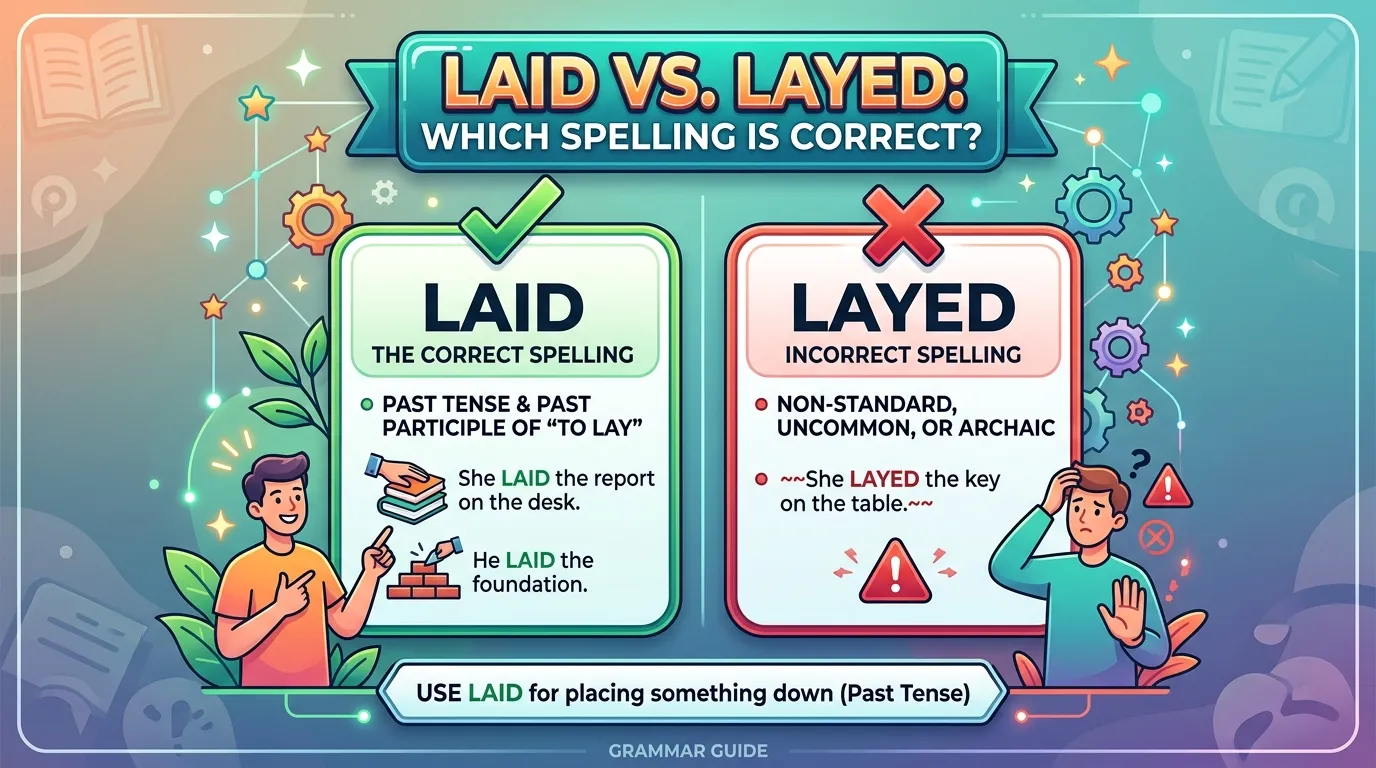
If you are wondering whether laid or layed is the correct spelling, the answer is simple: laid is the standard English word when you need the past tense or past participle of lay. Layed is generally considered a misspelling in modern standard English.
For example:
- Correct: She laid the book on the table.
- Incorrect: She layed the book on the table.
The confusion happens because English has several closely related verbs: lay, lie, laid, and layed. The verb lay means to put or place something somewhere, while lie means to recline or rest. Once you add past tense forms, the pattern becomes less obvious.
This guide explains laid vs layed, including their meanings, grammar, pronunciation, history, common mistakes, examples, formal and informal usage, and easy ways to remember which form to use.
Quick Answer: Laid or Layed?
Laid is correct. Layed is normally incorrect in standard modern English.
| Word | Standard English? | Meaning | Example |
|---|---|---|---|
| laid | Yes | Past tense and past participle of lay | He laid the keys on the desk. |
| layed | No, in ordinary modern usage | Usually a misspelling of laid | He layed the keys on the desk. ❌ |
Use laid when you mean that someone put, placed, or arranged something somewhere.
She laid the baby gently in the crib.
However, there is an important distinction:
He lay on the sofa yesterday.
Here, lay is the past tense of lie, not the present tense of lay.
Understanding this difference is the key to avoiding mistakes.
What Does Laid Mean?
Laid is the past tense and past participle of the verb lay.
The basic meaning of lay is to put or place something in a particular position.
Dictionary-style definition of laid
Laid means:
Put, placed, set, or arranged something somewhere.
Examples:
- She laid the papers on my desk.
- He laid his phone beside the bed.
- They laid the foundation for the building.
- The chef laid the ingredients on the counter.
- We laid the blankets on the grass.
The important grammatical point is that lay usually takes an object.
You lay something.
You do not normally just lay by itself when using this meaning.
More examples of laid
- Maria laid her coat on the chair.
- The worker laid the tiles carefully.
- Dad laid the tools on the garage floor.
- The farmer laid seeds in the soil.
- The teacher laid the worksheets on each desk.
In each sentence, something is being placed.
Is Layed a Correct Word?
In standard modern English, layed is not normally the correct spelling.
If you want the past tense of lay, use laid.
Incorrect
She layed the clothes on the bed.
Correct
She laid the clothes on the bed.
Incorrect
He layed the documents on the table.
Correct
He laid the documents on the table.
For ordinary American English writing, academic work, business communication, journalism, blogging, and professional documents, avoid layed.
There are rare historical, dialectal, or specialized uses of layed, but these do not make it an appropriate substitute for laid in standard contemporary English.
If you are writing for a general audience, the safest rule is:
Use laid, not layed.
Why Do People Confuse Laid and Layed?
The confusion comes from the unusual conjugation of lay.
Many English verbs form their past tense by adding -ed:
- walk → walked
- talk → talked
- clean → cleaned
- play → played
- work → worked
Because of this familiar pattern, people may naturally assume:
lay + ed = layed
But English does not always follow that simple pattern.
The correct form is:
lay → laid → laid
For example:
- Present: I lay the book down.
- Past: I laid the book down.
- Past participle: I have laid the book down.
This irregular pattern is similar to:
- go → went → gone
- take → took → taken
- see → saw → seen
- write → wrote → written
You cannot always create a correct past tense simply by adding -ed.
Laid vs Lay: The Important Difference
A major source of confusion is that laid and lay are both forms connected to the verb lay.
| Form | Grammatical role | Example |
|---|---|---|
| lay | Present/base form | I lay the book here every day. |
| laid | Past tense | I laid the book here yesterday. |
| laid | Past participle | I have laid the book here before. |
The verb lay requires an object in its usual meaning.
Present tense
I lay my phone on the desk every morning.
Past tense
I laid my phone on the desk this morning.
Present perfect
I have laid my phone on the desk.
Notice that layed does not appear in the standard conjugation.
Laid vs Lie: The Bigger Grammar Problem
If you often confuse laid and layed, you may also be struggling with lay vs lie.
These verbs have different meanings.
Lay
Lay means to put or place something somewhere.
It normally needs an object.
Please lay the book on the table.
You are placing the book.
Lie
Lie means to recline or rest in a horizontal position.
It does not normally take a direct object.
I need to lie down.
You are not placing an object. You are describing your own position.
The forms
| Meaning | Present | Past | Past participle |
|---|---|---|---|
| Put or place | lay | laid | laid |
| Recline or rest | lie | lay | lain |
This produces the famous confusing sequence:
lie → lay → lain
and
lay → laid → laid
That is why the sentence below is correct:
Yesterday, I lay on the couch.
But this is also correct:
Yesterday, I laid the book on the couch.
The first sentence describes a person resting. The second describes someone placing an object.
Laid vs Layed Examples
Here are practical examples showing how laid should be used.
Everyday examples
- She laid her bag on the floor.
- I laid the keys beside the door.
- He laid his jacket over the chair.
- We laid the plates on the table.
- They laid the baby in the crib.
- She laid the phone next to her laptop.
Work examples
- The manager laid the documents on the conference table.
- The technician laid the cables along the wall.
- The contractor laid the pipes underground.
- The team laid the groundwork for the project.
Academic examples
- The researcher laid out the evidence clearly.
- The professor laid the foundation for the argument.
- The author laid out the main assumptions.
Writing examples
- The journalist laid out the facts in chronological order.
- The writer laid the manuscript on the editor’s desk.
- The report laid out several possible explanations.
Common Mistakes With Laid and Layed
Mistake: Adding -ed to lay
Incorrect:
They layed the carpet yesterday.
Correct:
They laid the carpet yesterday.
The problem is treating lay as though it were a regular verb.
Mistake: Using laid when you mean rested
Incorrect:
I laid on the bed for an hour.
Correct:
I lay on the bed for an hour.
Here, you mean that you rested or reclined, so the verb is lie. Its past tense is lay.
Mistake: Using lay when you need a past form of place
Incorrect:
Yesterday, she lay the book on the desk.
Correct:
Yesterday, she laid the book on the desk.
The action happened in the past, so laid is required.
A Simple Laid, Lay, Lie, and Lain Chart
This chart can make the whole system easier to remember.
| Meaning | Present | Past | Past Participle |
|---|---|---|---|
| Put something down | lay | laid | laid |
| Rest or recline | lie | lay | lain |
Examples:
Put something down:
I lay the book down.
I laid the book down yesterday.
I have laid the book down.
Rest:
I lie on the sofa.
I lay on the sofa yesterday.
I have lain on the sofa all afternoon.
This distinction is far more useful than simply memorizing that layed is wrong.
How to Remember Laid
Here is an easy memory trick:
Lay takes an object, and its past is laid
Think:
Lay it → laid it
Examples:
I lay the clothes on the bed.
Yesterday:
I laid the clothes on the bed.
Another useful trick is:
No object? Think lie.
Object? Think lay.
Compare:
I lie down.
There is no object.
I lay the book down.
The object is the book.
In the past:
I lay down yesterday.
But:
I laid the book down yesterday.
Pronunciation of Laid
Laid is pronounced like made, paid, and shade.
In American English, its pronunciation is commonly represented as:
/leɪd/
The vowel sound is the same basic sound found in:
- day
- say
- play
- made
- paid
For example:
laid
played
paid
These words share a similar long a sound.
Is Laid pronounced like Lay?
Not exactly.
Lay ends with the long vowel sound:
/leɪ/
Laid adds a d sound:
/leɪd/
Compare:
lay → /leɪ/
laid → /leɪd/
Laid vs Layed in American English
In American English, laid is the standard spelling.
If you are writing:
- an essay
- a school assignment
- a business email
- a report
- a blog post
- a news article
- a résumé
- a professional document
use laid.
The spelling layed may occasionally appear in informal writing because people spell the word according to how they think the verb should behave. It can also occur in historical or dialectal material. But it is not the standard modern choice for the ordinary past tense of lay.
Laid vs Layed in British English
British English also uses laid as the standard past tense and past participle of lay.
For example:
She laid the table before dinner.
The same grammatical rule applies in American and British English.
This is therefore not a major US versus UK spelling difference.
Both varieties generally use:
lay → laid → laid
rather than:
lay → layed → layed
Is Laid Formal or Informal?
Laid is completely neutral in tone.
It works in casual conversation as well as formal writing.
Casual
I laid my phone on the couch.
Professional
The committee laid the documents before the board.
Academic
The study laid the groundwork for later research.
Journalistic
Officials laid out the timeline during the briefing.
There is no need to replace laid simply because the writing is formal.
Laid in Figurative Language
The word laid is not limited to physically placing objects.
It is frequently used in figurative expressions.
Laid the foundation
The early research laid the foundation for modern treatment methods.
This means that something created the basic conditions for future development.
Laid the groundwork
The agreement laid the groundwork for future cooperation.
This means it prepared the way for something that came later.
Laid out
The report laid out the company’s strategy.
Here, laid out means explained or presented clearly.
Laid bare
The investigation laid bare the weaknesses in the system.
This means something hidden was exposed.
Laid to rest
The evidence finally laid the rumor to rest.
This means the evidence ended or settled the issue.
Common Collocations With Laid
A collocation is a combination of words that commonly appear together.
Some useful expressions containing laid include:
- laid the foundation
- laid the groundwork
- laid the table
- laid the groundwork for
- laid out a plan
- laid out the facts
- laid out the evidence
- laid down the law
- laid down rules
- laid to rest
- laid bare
- laid low
- laid siege
- laid waste
Examples
The agreement laid the groundwork for cooperation.
The teacher laid out the rules before the test.
The investigation laid bare the problems.
The manager laid down the law about workplace safety.
These expressions can be literal or figurative depending on context.
Laid in Business and Professional Writing
In business English, laid often appears in phrases involving planning, rules, foundations, and explanations.
Examples include:
- The company laid out its expansion strategy.
- The report laid out the financial risks.
- The agreement laid the foundation for a long-term partnership.
- The policy laid down clear requirements.
- The presentation laid out the next steps.
In these cases, laid is standard and professional.
Laid in Sports Writing
Sports writing also uses laid in both literal and figurative expressions.
Examples:
The coach laid out a new strategy for the second half.
The defender laid down a challenge near midfield.
The team laid the groundwork for its championship run during the regular season.
Some sports phrases are highly idiomatic, so the exact meaning depends on context.
Laid in Technical Writing
Technical and scientific writing frequently uses laid when describing construction, installation, arrangement, or the development of a system.
Examples:
Engineers laid the cables beneath the roadway.
Workers laid the pipeline across the site.
The researchers laid out the experimental procedure.
The designers laid the components in a specific sequence.
The word remains grammatically ordinary even when the context is highly technical.
Laid in Politics and Public Affairs
The word laid can appear frequently in political and institutional language.
Examples:
The minister laid out the government’s proposed reforms.
The committee laid down new guidelines.
The agreement laid the foundation for future negotiations.
The report laid bare serious weaknesses in the system.
These uses are usually figurative rather than literal.
Synonyms for Laid
The best synonym depends on the context.
When laid means placed
Possible alternatives include:
- placed
- put
- set
- positioned
- arranged
- deposited
- positioned carefully
Example:
She laid the book on the desk.
Possible alternatives:
She placed the book on the desk.
She put the book on the desk.
When laid out means explained
Possible alternatives include:
- explained
- presented
- described
- outlined
- detailed
- demonstrated
Example:
The report laid out the proposal.
Could become:
The report outlined the proposal.
Antonyms of Laid
There is no single opposite for laid in every situation because its meaning changes with context.
Depending on the sentence, possible opposites include:
- removed
- lifted
- picked up
- took away
- concealed
- withdrew
For example:
She laid the book on the table.
A contextual opposite might be:
She picked the book up from the table.
Laid vs Put
Laid and put can sometimes have similar meanings.
She laid the keys on the table.
She put the keys on the table.
Both can be correct, although put is more general and extremely common.
One important advantage of put is that its form does not change:
put → put → put
By contrast:
lay → laid → laid
This difference can make put easier for English learners.
Laid vs Placed
Placed is often more formal or precise than laid.
Compare:
She laid the documents on the desk.
She placed the documents on the desk.
Both are grammatically correct.
Placed can emphasize the act of positioning something deliberately, while laid often suggests putting something down horizontally or in a particular arrangement.
The exact difference depends on context.
Awkward vs Natural Examples
Example One
Awkward or incorrect:
He layed his wallet on the counter.
Natural:
He laid his wallet on the counter.
Example Two
Incorrect:
She layed the baby in the crib.
Natural:
She laid the baby in the crib.
Example Three
Incorrect:
They layed the foundation last year.
Natural:
They laid the foundation last year.
Example Four
Incorrect:
I laid down because I was tired.
This can be wrong when you mean that you reclined.
Natural:
I lay down because I was tired.
But:
I laid the blanket down because it was cold.
Here, an object is being placed.
Formal vs Informal Alternatives
Sometimes you may want a different verb for clarity or style.
| Original | Alternative |
|---|---|
| She laid the papers on the desk. | She placed the papers on the desk. |
| He laid out the plan. | He explained the plan. |
| They laid the foundation. | They established the foundation. |
| She laid the clothes on the bed. | She placed the clothes on the bed. |
Still, laid is not informal or incorrect. It is a normal standard English word.
Laid vs Layed in Academic Writing
Academic writers should use laid when it is the appropriate grammatical form.
Examples:
The study laid the foundation for later research.
The researchers laid out their methodology.
The experiment laid bare several limitations.
Avoid:
The study layed the foundation for later research. ❌
The second version contains a spelling and verb-form error.
Laid vs Layed in Journalism
Journalists commonly use expressions such as:
- laid out the facts
- laid out the evidence
- laid the groundwork
- laid the foundation
- laid bare
For example:
The investigation laid bare several weaknesses in the agency’s procedures.
This is standard journalistic English.
Laid vs Layed in Blogging and Online Writing
Bloggers, content writers, and website owners should also use laid.
Incorrect spelling can reduce reader confidence, especially when the content is educational or professional.
If you are editing an article and see:
The author layed out five important reasons.
Change it to:
The author laid out five important reasons.
This is particularly important in articles about English grammar, spelling, vocabulary, and language learning, where readers expect precise word usage.
A Practical Test for Choosing Laid
When you are unsure, ask:
Am I talking about putting or placing something?
If yes, the past tense is usually laid.
For example:
She ___ the book on the desk yesterday.
You are describing the placement of the book.
Answer:
She laid the book on the desk yesterday.
If you mean that a person was resting, use the past tense of lie:
She lay on the sofa yesterday.
This simple test solves many problems.
Quick Comparison: Laid vs Layed vs Lay vs Lie
| Word | Meaning | Example |
|---|---|---|
| lay | Put or place | I lay the book here. |
| laid | Past of lay | I laid the book here yesterday. |
| layed | Generally nonstandard spelling | Avoid in standard English. |
| lie | Rest or recline | I lie on the bed. |
| lay | Past of lie | I lay on the bed yesterday. |
| lain | Past participle of lie | I have lain on the bed. |
The repeated appearance of lay is what makes the system confusing.
Why English Learners Find This Difficult
English learners often expect regular verb patterns.
For a regular verb:
work → worked
So they may assume:
lay → layed
But lay is an irregular verb.
Its standard forms are:
lay → laid → laid
There is no need to memorize dozens of complicated rules. Focus on the meaning and grammatical role.
Lay something down.
Laid something down yesterday.
Have laid something down.
That pattern is enough for most everyday situations.
Memory Trick for English Learners
Try this three-word pattern:
Lay it. Laid it.
Present:
I lay it on the table.
Past:
I laid it on the table.
Perfect:
I have laid it on the table.
Then remember:
Lie down. Lay down yesterday.
Present:
I lie down.
Past:
I lay down yesterday.
Past participle:
I have lain down.
This distinction may feel strange at first, but repeated exposure makes it much easier.
Common Questions About Laid vs Layed
Is layed a word?
Layed can appear in historical, dialectal, or specialized material, but it is not the standard modern past tense of lay. In ordinary American English, use laid.
Is laid the past tense of lay?
Yes. Laid is both the past tense and past participle of the verb lay.
Present: I lay the book down.
Past: I laid the book down.
Perfect: I have laid the book down.
Is layed ever correct?
For ordinary modern standard English, do not use layed as the past tense of lay. Some historical or specialized sources may contain the spelling, but that is not the normal contemporary form.
Is it laid down or layed down?
The standard form is laid down.
He laid down the rules.
She laid down the book.
However, be careful with lay down versus lie down. If you mean to recline yourself, the past tense is lay down:
Yesterday, I lay down for a nap.
Is it laid or layed the foundation?
The correct standard form is laid the foundation.
The invention laid the foundation for future developments.
Is it laid or layed out?
The standard form is laid out.
She laid out the evidence clearly.
Is it laid or layed to rest?
The correct expression is laid to rest.
The new evidence laid the rumor to rest.
Is lay the past tense of lie?
Yes. This is one of the most confusing features of English grammar.
I lie down every afternoon.
Past:
I lay down yesterday.
Past participle:
I have lain down.
But laid is the past tense of lay:
I laid the book on the table.
How do you remember laid vs layed?
Remember:
Lay → laid → laid
Think of laid as an irregular past form, like paid or made.
Conclusion
When choosing between laid vs layed, the standard answer is clear: use laid when you need the past tense or past participle of lay.
The standard pattern is:
lay → laid → laid
For example:
I lay the book on the table every morning.
I laid the book on the table yesterday.
I have laid the book on the table.
Layed is generally a spelling mistake in modern standard English, so it should be avoided in American English, British English, academic writing, professional communication, journalism, blogging, and most other formal or informal contexts.
The bigger challenge is remembering the difference between lay and lie. Lay means to put or place something, while lie means to rest or recline. The past tense of lay is laid, but the past tense of lie is lay.
The easiest rule is simple: if you are placing something, use lay and laid. If you are resting yourself, use lie, lay, and lain.
Once you learn that pattern, laid vs layed becomes much easier to get right.