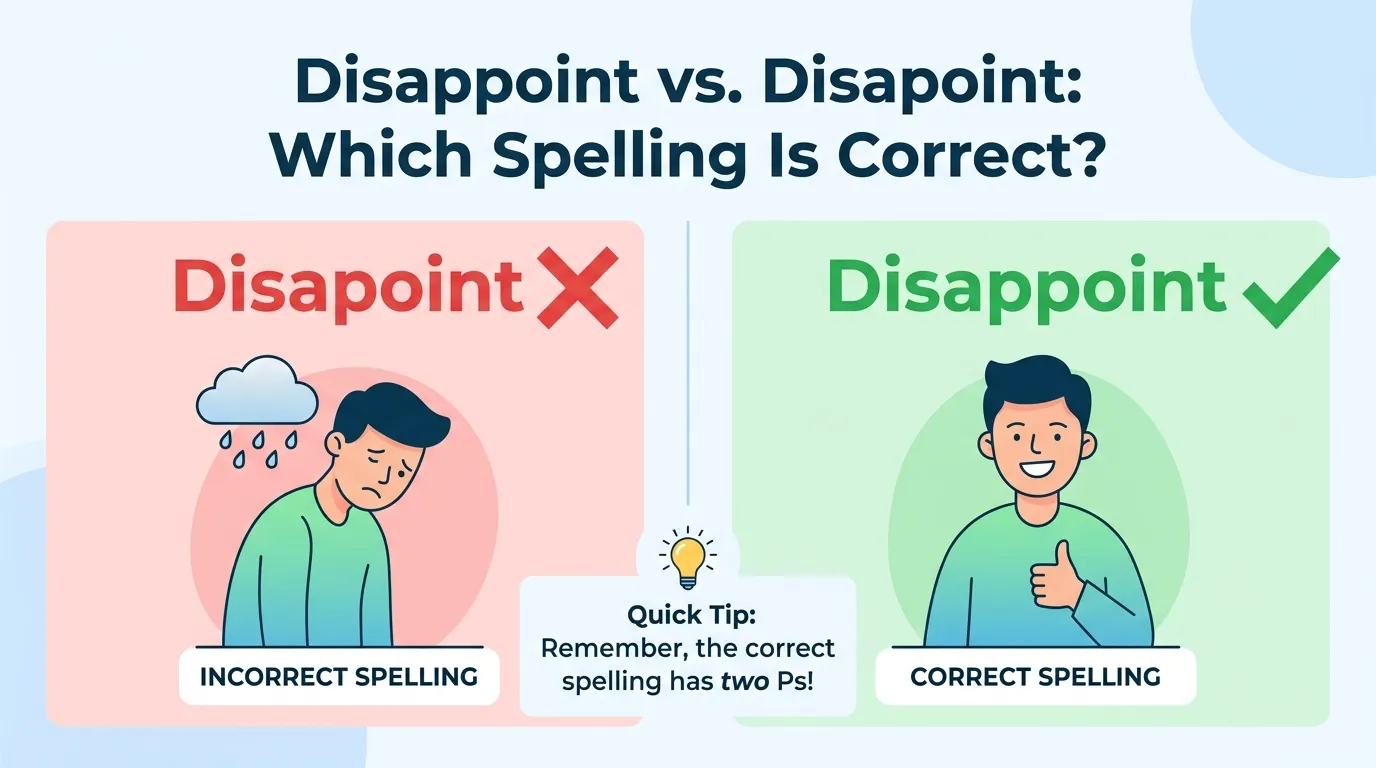
If you’ve ever wondered whether to write disappoint or disapoint, the short answer is simple:
✅ Disappoint is the correct spelling.
❌ Disapoint is a misspelling and should never be used in standard English.
This spelling mistake is surprisingly common because of the way the word is pronounced. Many people hear only one “p” sound and accidentally leave out the second p when writing it.
In this guide, you’ll learn the difference between disappoint vs disapoint, why the confusion happens, how to remember the correct spelling, when to use the word, common mistakes to avoid, and dozens of practical examples.
Quick Answer
| Word | Correct? | Meaning |
|---|---|---|
| Disappoint | ✅ Yes | To fail to meet someone’s expectations or hopes |
| Disapoint | ❌ No | Incorrect spelling of disappoint |
Always write: disappoint
Is It “Disappoint” or “Disapoint”?
The only correct spelling is disappoint.
The version disapoint is a spelling error caused by omitting one of the two consecutive p letters.
Correct
- I don’t want to disappoint my parents.
- The movie didn’t disappoint.
- She was disappointed by the results.
Incorrect
- I don’t want to disapoint my parents.
- The movie didn’t disapoint.
- She was disapointed by the results.
Notice that every form of the word keeps the double pp:
- disappoint
- disappointed
- disappointing
- disappointment
Why Do People Misspell “Disappoint”?
Several reasons explain why this mistake is so common.
1. Pronunciation
When speaking quickly, the double pp doesn’t sound much different from a single p.
People often write words exactly as they hear them.
2. Fast Typing
While typing, it’s easy to accidentally leave out one letter.
This happens frequently with double consonants like:
- accommodate
- recommend
- embarrass
- occasion
- disappoint
3. Confusion with Similar Words
Some English words use one consonant where others use two.
For example:
- disappear (double p)
- disappoint (double p)
- disappointingly (double p)
Because English spelling isn’t always predictable, learners sometimes guess incorrectly.
Dictionary Definition of “Disappoint”
Verb
Disappoint means:
To fail to fulfill someone’s hopes, expectations, or wishes.
It can also mean:
- to let someone down
- to fail to satisfy
- to produce an unexpected negative result
Simple Definition
If something doesn’t happen the way someone hoped, it disappoints them.
Example:
I expected the concert to be amazing, but it disappointed me.
Pronunciation
Disappoint
IPA:
/ˌdɪs.əˈpɔɪnt/
It sounds like:
dis-uh-POINT
Notice that although there are two p’s in spelling, they create only one consonant sound.
Part of Speech
Disappoint is a verb.
Related forms include:
| Word | Part of Speech |
|---|---|
| disappoint | Verb |
| disappointed | Adjective / Past tense verb |
| disappointing | Adjective / Present participle |
| disappointment | Noun |
| disappointingly | Adverb |
Meaning in Different Contexts
Personal Relationships
Someone fails to meet another person’s expectations.
Example:
- I never want to disappoint my family.
School
Example:
- His exam score disappointed his teacher.
Sports
Example:
- The team’s performance disappointed its fans.
Business
Example:
- Sales disappointed investors.
Entertainment
Example:
- The sequel disappointed many viewers.
Disappoint vs Disapoint Comparison Table
| Feature | Disappoint | Disapoint |
|---|---|---|
| Correct spelling | ✅ Yes | ❌ No |
| Found in dictionaries | Yes | No |
| Accepted in formal writing | Yes | No |
| Used in academic writing | Yes | No |
| Used in journalism | Yes | No |
| Should you use it? | Absolutely | Never |
Word Origin (Etymology)
The word disappoint comes from the Old French desappointer, meaning:
to undo an appointment, remove from an assigned position, or frustrate expectations.
Over time, the meaning shifted toward:
failing to satisfy someone’s hopes.
The historical spelling developed into modern English with the double pp, which remains today.
Why Does “Disappoint” Have Two P’s?
The spelling comes from its historical development rather than modern pronunciation.
English preserves many traditional spellings.
Other examples include:
- approve
- appear
- disappear
- appointment
- disappoint
Notice the connection:
- appoint
- appointment
- disappoint
Since appoint already contains pp, disappoint keeps the same spelling.
Grammar and Usage
Present Tense
- I disappoint nobody intentionally.
- They disappoint their customers.
Past Tense
- She disappointed everyone.
Present Participle
- The results are disappointing.
Past Participle
- We were disappointed.
Examples in Everyday English
Family
- I don’t want to disappoint my parents.
Friends
- He disappointed his best friend.
School
- Missing class disappointed the teacher.
Work
- The delayed project disappointed the client.
Travel
- The hotel didn’t disappoint.
Shopping
- This product won’t disappoint.
Formal vs Informal Usage
The word works well in every style of English.
| Context | Suitable? |
|---|---|
| Academic writing | ✅ |
| Business writing | ✅ |
| Journalism | ✅ |
| Legal writing | ✅ |
| Blogging | ✅ |
| Social media | ✅ |
| Everyday conversation | ✅ |
American vs British English
There is no spelling difference.
Both American English and British English use:
disappoint
Neither variety accepts disapoint.
International English
Whether you’re writing in:
- the United States
- Canada
- the United Kingdom
- Australia
- New Zealand
- Ireland
- India
- South Africa
the correct spelling remains:
disappoint
Academic Writing
Correct:
- The findings disappointed researchers.
Incorrect:
- The findings disapointed researchers.
Business Writing
Correct:
- We apologize for disappointing our customers.
Professional example:
We regret that shipping delays may disappoint some customers.
Journalism
Example:
- The economic report disappointed analysts.
Technical Writing
Example:
- Initial performance tests disappointed engineers.
Sports Writing
Example:
- The defending champions disappointed supporters.
Blogging
Example:
This budget smartphone did not disappoint.
Casual Conversation
- Don’t disappoint me.
- That game really disappointed us.
- She looked disappointed.
Literal vs Figurative Meaning
Literal
Someone expected something good that didn’t happen.
Example:
- The gift disappointed him.
Figurative
An object, event, or idea fails expectations.
Example:
- The ending disappointed fans.
Common Collocations
Native speakers often pair disappoint with these words:
- disappoint someone
- disappoint fans
- disappoint customers
- disappoint voters
- disappoint investors
- disappoint parents
- disappoint expectations
- deeply disappoint
- slightly disappoint
- never disappoint
Common Phrases
- Don’t disappoint me.
- I hate to disappoint you.
- Sorry to disappoint.
- Failed to disappoint
- Did not disappoint
Synonyms
Depending on context:
- let down
- fail
- discourage
- frustrate
- upset
- sadden
- dissatisfy
- underwhelm
Example:
The movie underwhelmed audiences.
Antonyms
- satisfy
- impress
- delight
- please
- exceed expectations
- fulfill
- encourage
Example:
The performance delighted everyone.
Related Words
- appointment
- appoint
- disappointment
- disappointed
- disappointing
- disappointingly
- expectation
- satisfaction
Common Mistakes
Mistake 1
❌ disapoint
✅ disappoint
Mistake 2
❌ disapointed
✅ disappointed
Mistake 3
❌ disapointing
✅ disappointing
Mistake 4
❌ disapointment
✅ disappointment
Incorrect vs Correct Examples
| Incorrect | Correct |
|---|---|
| I hope I don’t disapoint you. | I hope I don’t disappoint you. |
| She was disapointed. | She was disappointed. |
| The game was disapointing. | The game was disappointing. |
| His disapointment was obvious. | His disappointment was obvious. |
Awkward vs Natural Sentences
Awkward
I was very disappoint with the outcome.
Natural
I was very disappointed with the outcome.
Awkward
The service was disappoint.
Natural
The service was disappointing.
Awkward
This result makes disappoint.
Natural
This result is disappointing.
Memory Trick
Here’s an easy way to remember the spelling.
Think of the word:
appoint
Now simply add dis-
appoint → disappoint
Since appoint has two p’s, disappoint also has two p’s.
Another trick:
If you’re disappointed, don’t drop a P.
Keep both p’s.
Real-World Examples
Customer Review
The product didn’t disappoint.
Teacher
I know you can do better. Don’t disappoint yourself.
Coach
The players disappointed their supporters.
Parent
You didn’t disappoint us—we’re proud of your effort.
Workplace
Missing deadlines can disappoint clients.
SEO Summary Table
| Question | Answer |
|---|---|
| Is disapoint correct? | No |
| Is disappoint correct? | Yes |
| Which spelling should I use? | disappoint |
| Is disapoint in the dictionary? | No |
| American spelling | disappoint |
| British spelling | disappoint |
Best Usage Recommendations
For Students
Always use disappoint.
For Academic Writing
Use disappoint in every context.
For Professional Emails
Use:
- disappointed
- disappointing
- disappointment
Never use misspelled forms.
For Bloggers
Use the standard spelling to maintain credibility and improve SEO.
For Journalists
Always proofread for the correct double pp spelling.
For Business Professionals
Correct spelling reflects professionalism and attention to detail.
Frequently Asked Questions (FAQs)
1. Is disapoint a real English word?
No. Disapoint is not a recognized English word. It is simply a misspelling of disappoint.
2. Why does disappoint have two p’s?
It inherits the double p from the related word appoint, and the spelling has been preserved throughout the word’s history.
3. Is disappoint spelled the same in American and British English?
Yes. Both American and British English use disappoint with a double p.
4. What does disappoint mean?
It means to fail to meet someone’s expectations, hopes, or wishes.
5. How do you spell disappointed?
The correct spelling is disappointed.
6. How do you spell disappointment?
The correct spelling is disappointment, with a double p.
7. Why do people write disapoint?
Most often because they write the word as it sounds or accidentally omit one of the two p letters while typing.
8. Can spell check detect disapoint?
Yes. Most modern spell checkers identify disapoint as an error and suggest disappoint.
9. What is an easy way to remember the correct spelling?
Remember the word appoint. Since it has two p letters, disappoint keeps both of them.
10. Is disappoint a verb or an adjective?
Disappoint is a verb. Related forms include disappointed (adjective or past participle), disappointing (adjective), and disappointment (noun).
Conclusion
When comparing disappoint vs disapoint, the choice is straightforward: disappoint is the only correct spelling, while disapoint is always a mistake. The confusion usually arises because the double p is not strongly emphasized in pronunciation, leading many writers to omit one letter.
A simple way to remember the correct form is to think of the related word appoint. Since appoint contains two p letters, disappoint does as well. This pattern carries through all related forms, including disappointed, disappointing, and disappointment.
Whether you’re writing an academic paper, a business email, a news article, a blog post, or a casual message, using the correct spelling helps your writing look polished, professional, and trustworthy. By mastering this common spelling confusion, you’ll avoid an easy-to-make mistake and communicate more clearly in every context.