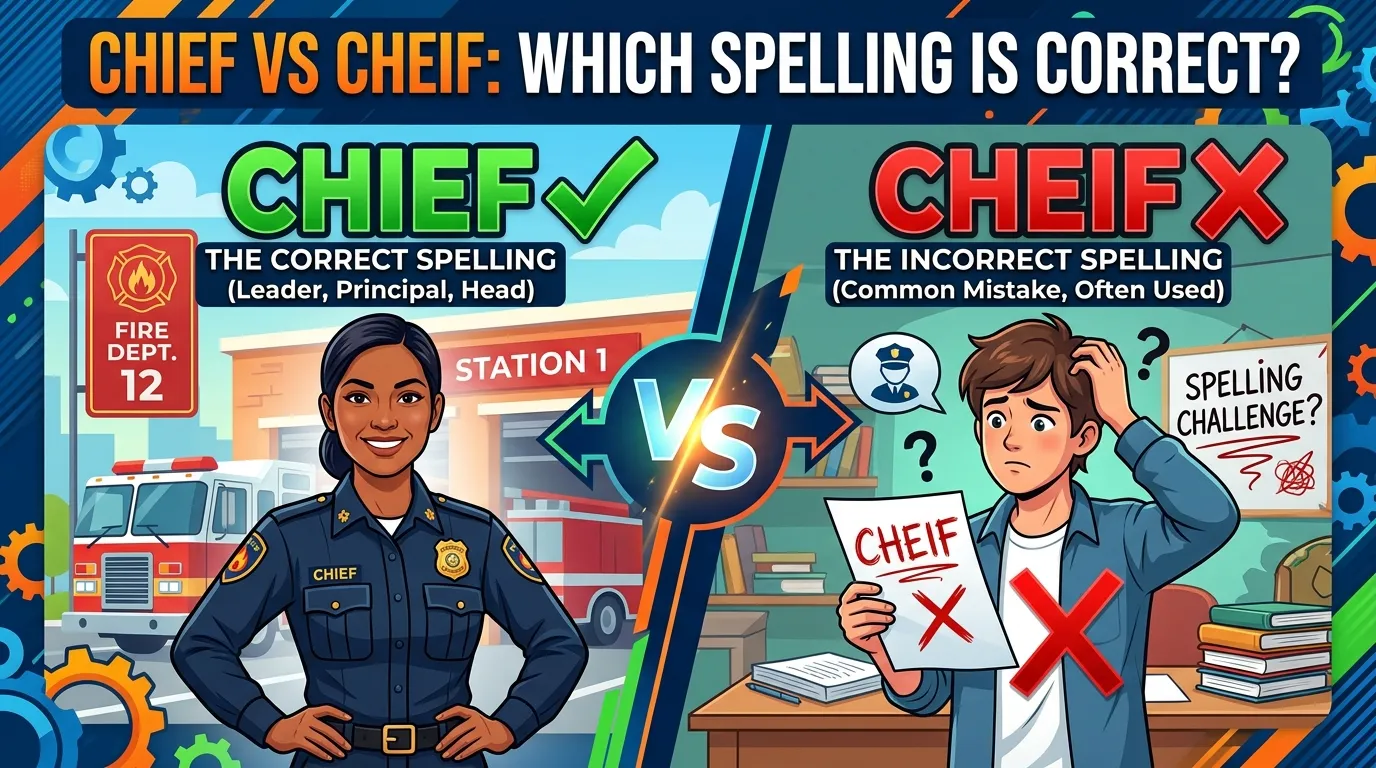
The firehouse kitchen table is the loudest quiet room in the city. Six firefighters, one pot of coffee, and a whiteboard with tomorrow’s duty roster. At the top of the roster, in the captain’s handwriting, is a title: “Chief.” The new recruit, copying the roster into the station log, writes cheif — with the E and the I swapped — and does not notice, because the word looks like it should follow the rule every child learns: “I before E, except after C.” The chief’s title has a C in it. The rule says the E should come first. The rule, in this case, is wrong.
The correct spelling is chief. The misspelling cheif is one of the most common errors in English, and it happens because the most famous spelling rhyme in the language betrays the writer. Chief breaks the rule. It is the exception that proves the rhyme is not a rule at all.
The Firehouse Kitchen Table
Start with the station, because the station shows the word’s range. The chief is the head of the department — the fire chief, the police chief, the chief of staff. The title means leader, head, the person in charge. “The chief called the meeting.” “The fire chief ordered the evacuation.” “She was appointed chief in March.” In every case, the word names authority.
The word also names a head in less formal settings. A chief in a company is a senior executive: chief executive officer, chief financial officer, chief operating officer. A chief in a tribe is the leader. A chief in a kitchen is the head chef — and here the word’s history shows, because chief and chef are the same word, split by pronunciation. The firehouse kitchen has a chief and a cook, and the two words are cousins.
There is also the adjective: chief meaning main, principal, most important. “The chief reason for the delay.” “Her chief concern.” “The chief suspect.” This use is the same word, doing a different job — naming the head of a list rather than the head of a department. The spelling is the same in both jobs: C-H-I-E-F.
Chef’s Cousin: The French Root
Here is the fact that explains the spelling. Chief comes from the Old French chef, meaning “head” — from the Latin caput, head. The French word entered English twice: once as chief, keeping the French spelling but anglicizing the pronunciation, and once as chef, keeping the French pronunciation and spelling, for the head of a kitchen. The two words are twins separated at birth: same parent, same meaning, different clothes.
The French origin explains the IE. In French, the combination ie is common — ami, pie, chef itself is spelled with an E, not IE, but the related forms carry the IE pattern. English borrowed the word with its French vowel pair intact: C-H-I-E-F. The IE is not an English choice. It is a French import, and it kept its passport.
The root also explains the word’s family. Chief, chef, capital, captain, chapter, cape — all come from caput, head. The family is large, and the spellings vary, because each member entered English at a different time, through a different door. Chief came through French. Capital came through Latin. Captain came through both. The family reunion is a spelling lesson in itself.
The Rule Chief Breaks
The rhyme every English-speaking child learns is: “I before E, except after C, or when sounded like A, as in neighbor and weigh.” The rhyme is a useful guide — it correctly predicts believe, field, piece, receive, deceive, ceiling. But it has more exceptions than followers, and chief is one of the most prominent. The word has a C, and the I comes before the E anyway. The rhyme says cheif. The dictionary says chief.
The exceptions are worth listing, because they show that chief is not alone. Ancient, efficient, sufficient, science, society, species, seize, weird, height, protein, caffeine — all of them break the rhyme in one way or another. Linguists have counted: the rhyme correctly predicts the spelling of only about three-quarters of IE/EI words, and it fails on some of the most common ones. Chief is not an oddity. It is evidence that the rhyme is a guideline, not a law.
Why does the rhyme fail? Because English spelling records history, not sound. Chief is spelled IE because it came from French. Receive is spelled EI because it came from Latin recipere through French, where the EI was already established. Weird is spelled EI because it came from Old English wyrd, fate. Each word’s spelling is a fossil of its journey, and the rhyme is a rough map that does not fit every fossil. The map is useful. The fossils are the truth.
Chief vs Chef vs Boss vs Head
Chief has close neighbors, and keeping them distinct sharpens a sentence. A chef is the head of a kitchen — the French twin, pronounced “shef.” A boss is a supervisor, informal, American in flavor. A head is the person in charge of a department or school — “head of department,” “head teacher.” A leader is the general term, covering anyone who leads. A captain is the head of a ship, a team, or a police precinct.
The choice among them is a matter of what you want to say. If the point is formal authority, use chief. If the point is the kitchen, use chef. If the point is everyday supervision, use boss. If the point is a department or school, use head. If the point is a ship or team, use captain. The neighbors overlap, but they are not identical, and the sentence improves when the word matches the meaning.
There is one pair worth separating firmly: chief vs chef. The two words are the same root, but they have split by profession. A chief runs a fire department. A chef runs a kitchen. A “chief chef” is the head chef — the chief of the chefs — and the sentence is correct, if a little dizzying. The firehouse kitchen has both: the chief eats there, and the chef cooks there. The words share a table and a root, and they spell differently.
Chiefs in Tribes, Companies, and Kitchens
In tribal contexts, chief names the leader of an Indigenous group — a usage that is ancient, respectful, and still current. “The tribal chief.” “The chief of the clan.” The word carries a history of colonial misuse — applied loosely to leaders who had their own titles — and modern writing uses it carefully, preferring the group’s own term when known. The spelling is the same. The sensitivity is new.
In corporate contexts, chief has exploded: chief executive officer (CEO), chief financial officer (CFO), chief operating officer (COO), chief technology officer (CTO), chief marketing officer (CMO). The C-suite is a forest of chiefs, and the word has become the standard prefix for top leadership. The titles are usually abbreviated, which sidesteps the spelling — but the full form, when written out, is chief, with IE.
In everyday speech, the word appears in fixed phrases: “chief among them,” “the chief culprit,” “chiefly responsible,” “in chief” (as in “editor in chief,” “commander in chief”). Chiefly is the adverb: “He is chiefly remembered for…” The family is large, and the IE holds through every form: chief, chiefs, chiefly, chiefdom, chieftain. The I comes first in all of them.
Chief in Names and Titles
The word chief appears in proper names and titles that repay attention. The Chief Justice of the United States heads the Supreme Court — the title is “Chief Justice,” not “Chief Judge,” a distinction that matters in legal writing. The Commander in Chief is the president’s military title, from the Constitution itself. The Editor in Chief heads a publication. The Chief of Staff runs a political office or a military headquarters. In each case, the word is capitalized as part of the title, and the spelling is the same: C-H-I-E-F.
The word also appears in place names and surnames. The Chieftain is the head of a Scottish clan — a related word, spelled C-H-I-E-F-T-A-I-N, with the IE holding through the suffix. Surnames like Chief exist, rare but real. And in the American West, the word appears in the names of peaks, rivers, and towns — Chief Mountain in Montana, a peak sacred to the Blackfeet, among them. The word’s geography is as wide as its grammar.
There is also the informal chief of direct address: “Hey, chief.” The usage is old, slightly patronizing, and still current in some American speech — a way of addressing a stranger with false familiarity. The tone is the opposite of the title’s formality, and the contrast is a reminder that the same word can carry authority and irony in the same breath.
The I-Before-E Exception List
Here is the lock-in, and it is the exception list doing its work. Chief is one of the words that breaks the rhyme, and it is worth memorizing the small club it belongs to: chief, weird, seize, protein, caffeine, ancient, science, sufficient. All of them have a C or a similar trigger, and all of them spell IE. If you remember that chief is in this club, you will never write cheif again — because the club is defined by breaking the rule.
And one final check for the keyboard: when the word appears in your draft, look at the vowel pair. If you see -ei- — cheif — the rhyme has tricked you. Swap them. Ch-ie-f. The firehouse roster, the C-suite, and the kitchen all agree: the I comes first, the E second, and the rhyme, for once, is wrong.