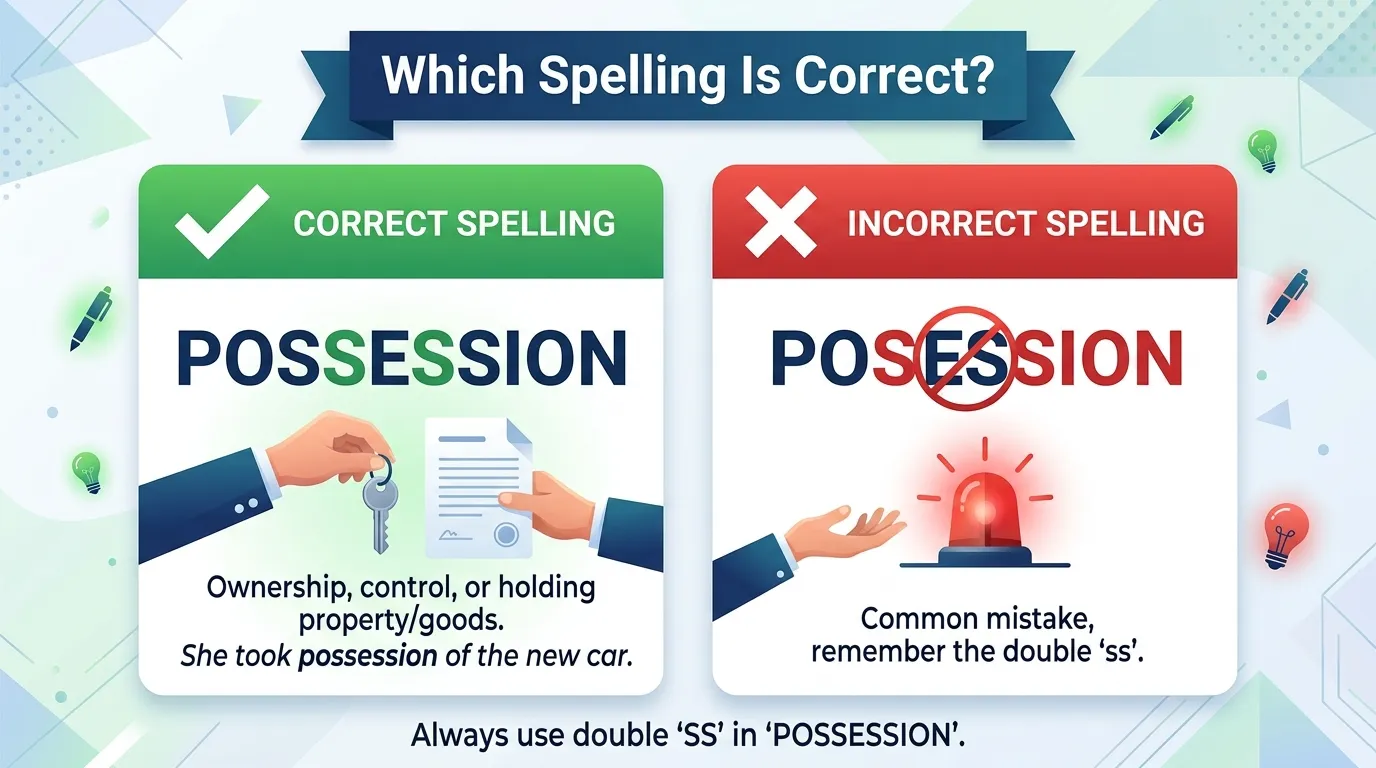
Possession vs Posession: Which Spelling Is Correct?

If you are unsure whether the correct spelling is possession or posession, the answer is simple: possession is correct, while posession is a misspelling.

The confusion usually happens because the word contains a repeated s sound, making it easy to leave out one of the letters when writing. The correct spelling is possession, with two s’s after the e: pos-session.

In this guide, you will learn the difference between possession vs posession, what possession means, how to pronounce it, why the misspelling is so common, and how to use the word naturally in everyday, academic, business, legal, sports, and formal writing. You will also find examples, spelling tricks, related words, common expressions, and frequently asked questions.

Quick Answer: Possession or Posession?

Possession is the correct English spelling.

Posession is incorrect and should not be used in standard English.

SpellingCorrect?Meaning
Possession✅ YesSomething owned, controlled, or held
Posession❌ NoCommon misspelling of possession

Correct examples

  • She lost possession of her phone.
  • The house is now in his possession.
  • The team maintained possession of the ball.
  • He packed his personal possessions before moving.
  • The police found illegal items in his possession.

Incorrect example

  • ❌ She lost posession of her keys.

Correct version

  • ✅ She lost possession of her keys.

The key point is easy to remember: possession has “ss” twice.


What Does Possession Mean?

Possession is a noun that generally refers to owning, having, holding, or controlling something.

It can describe physical ownership, temporary control, legal ownership, or even control of something in a game.

For example:

The keys are in my possession.

This means that I currently have or hold the keys.

The word can also describe something that belongs to someone:

Her favorite necklace is one of her most valuable possessions.

Here, possessions means things that a person owns.

The meaning changes slightly depending on context, but the central idea is usually having, owning, or controlling something.


Why Is “Posession” Incorrect?

Posession is simply a spelling error.

The standard English spelling contains two consecutive s’s after “po” and another two s’s around the ending:

pos + sess + ion = possession

The correct word is:

P O S S E S S I O N

A common mistake is to write:

P O S E S S I O N

That version leaves out one s and produces posession, which is not the accepted spelling in standard English.

The pronunciation can contribute to the confusion because English spelling does not always make every letter sound obvious.


Possession Spelling Breakdown

Breaking the word into smaller parts can make the spelling easier to remember.

Possession can be viewed as:

possess + ion

The base word is possess.

When -ion is added, the result is:

possess + ion → possession

Notice that the two s’s in possess remain important.

Remember:

  • possess = correct
  • possession = correct
  • posess = incorrect
  • posession = incorrect

This relationship is one of the easiest ways to avoid the spelling mistake.


Possession vs Posession: Key Difference

There is actually no difference in meaning between the two spellings because posession is not a standard English word.

The real distinction is:

  • Possession = correct spelling and standard noun
  • Posession = misspelling
FeaturePossessionPosession
Standard spellingYesNo
Dictionary wordYesNo
NounYesNo
Used in formal writingYesNo
Used in academic writingYesNo
Used in business writingYesNo
Acceptable in edited EnglishYesNo

If you are writing an essay, email, article, report, résumé, legal document, or professional message, use possession.


What Is the Pronunciation of Possession?

Possession is commonly pronounced approximately:

puh-ZESH-un

The pronunciation can be represented as:

/pəˈzɛʃən/

The word has three main syllabic beats:

pos-ses-sion

The stress falls on the middle syllable:

pos-ZESS-ion

The spelling may look more complicated than the pronunciation sounds, which is another reason people sometimes misspell it.

Example

The suspect had the documents in his possession.

In normal speech, the word flows naturally and does not sound like every individual letter is being pronounced separately.


Is Possession a Noun?

Yes. Possession is primarily a noun.

It can refer to:

  1. Something that someone owns.
  2. The act of owning something.
  3. Physical control of something.
  4. Legal control or ownership.
  5. Control of the ball or object in sports.
  6. A state of being controlled, especially in some religious or supernatural contexts.

Examples

  • That watch is my most treasured possession.
  • The company took possession of the property.
  • The midfielder kept possession of the ball.
  • The documents were found in his possession.

Possession as Ownership

One of the most common meanings of possession is something that a person owns.

Examples

Her books are among her most valued possessions.

He sold several personal possessions before moving.

The painting became a family possession.

In this sense, the plural form possessions is particularly common.

Common phrases

  • personal possessions
  • valuable possessions
  • private possessions
  • household possessions
  • material possessions
  • worldly possessions
  • personal property and possessions

Possession as Physical Control

Possession can also mean having something physically with you.

For example:

I have the documents in my possession.

This does not necessarily mean you own the documents. It may simply mean you are currently holding or controlling them.

Compare these sentences:

Ownership:

The laptop is my possession.

Physical control:

The laptop is currently in my possession.

The second sentence can mean you have the laptop with you even if someone else owns it.


Possession in Legal Language

Possession is an important term in legal and property-related writing.

Legal possession can involve having control over property or an object, although possession and ownership are not always identical concepts.

For example:

The tenant took possession of the apartment on Monday.

This means the tenant officially received control or occupancy of the property.

Another example:

The items were found in his possession.

In legal contexts, the exact meaning of possession can depend on the relevant law and circumstances.

For general writing, however, you can remember:

Possession often means having or controlling something, while ownership specifically refers to having legal rights over it.


Possession vs Ownership

These words are related but are not always interchangeable.

Ownership focuses on who legally owns something.

Possession focuses more broadly on who has, holds, or controls it.

Example

Imagine that Sarah owns a car, but James is driving it.

  • Sarah has ownership of the car.
  • James may have possession of the car at that moment.

This distinction is especially useful in legal, business, property, and everyday contexts.


Possession in Sports

In sports, possession often means control of the ball, puck, or another object used in play.

This meaning is especially common in soccer, basketball, hockey, and football.

Examples

  • The team dominated possession in the second half.
  • United had more possession but failed to score.
  • The midfielder regained possession.
  • The quarterback’s team took possession after the turnover.
  • The player lost possession near the goal.

Common sports expressions

  • have possession
  • maintain possession
  • regain possession
  • lose possession
  • take possession
  • retain possession
  • possession percentage
  • possession time

For example:

The team had 65% possession during the match.

Here, possession means control of the ball.


Possession in Business and Professional Writing

The word is also common in professional communication.

Examples include:

The buyer will take possession of the property next month.

Please keep all company equipment in your possession until the project ends.

The records remain in the company’s possession.

In professional writing, possession sounds neutral and precise.

Depending on the situation, alternatives such as control, ownership, custody, or holding may be more appropriate.


Possession in Academic Writing

Academic writing frequently uses possession when discussing ownership, property, control, history, or social behavior.

Examples

Material possessions can influence consumer behavior.

The study examined attitudes toward personal possessions.

Historical records indicate that the property came into the family’s possession during the nineteenth century.

For academic writing, avoid the misspelling posession completely.

Because academic work is formally edited and evaluated, spelling errors can affect the perceived quality of your writing.


Possession in Journalism

News writing may use possession in legal, sports, crime, property, and general reporting.

Examples

Police reported finding the device in the man’s possession.

The home remained in the family’s possession for generations.

The visiting team controlled possession throughout the first half.

The word is versatile enough to work naturally in both formal reports and everyday journalism.


Possession in Casual Writing

You can also use possession in ordinary conversation and informal messages.

Examples:

Is your passport still in your possession?

I left my wallet in my possession—I just can’t find it.

That old guitar is my favorite possession.

However, in casual speech, people often use simpler words such as have, own, or have with me.

Instead of:

I have possession of your charger.

A more natural casual sentence would be:

I have your charger.

The first is grammatically possible but sounds more formal than necessary.


Possession vs Have: When Should You Use Each?

The word have is much more common in everyday English.

Compare:

I have your book.

with:

I have possession of your book.

Both can communicate a similar basic idea, but the second sounds formal, legal, or deliberate.

Natural everyday English

  • I have your keys.
  • Do you have my phone?
  • She has the documents.

More formal English

  • The documents are in her possession.
  • The company took possession of the property.
  • The records remain in the organization’s possession.

Use the simpler word when there is no reason to sound formal.


Possession vs Property

These words overlap but have different uses.

Property can mean something owned, especially in legal or economic contexts.

Possession can mean something owned or something currently held or controlled.

Examples

The house is his property.

The keys are in his possession.

The house is something he owns. The keys are something he currently has.


Possession vs Belonging

Belonging can refer to something that belongs to someone, especially in everyday language.

For example:

She packed her belongings.

This means she packed her personal items.

You could also say:

She packed her possessions.

Both are correct, but belongings often sounds more natural in everyday situations involving someone’s personal items.

Examples

  • Pack your belongings.
  • Protect your personal possessions.
  • He left all his belongings behind.
  • She donated some of her possessions.

Possession vs Control

These words can be related, especially in sports or legal situations.

Control emphasizes the ability to direct or manage something.

Possession emphasizes having or holding it.

Example

The team had possession of the ball.

This tells us who had the ball.

The team controlled the game.

This describes broader dominance over the match.

Possession can contribute to control, but the two words are not identical.


Common Collocations With Possession

A collocation is a group of words that naturally appear together.

Some common collocations include:

  • in possession of
  • take possession
  • take possession of
  • have possession
  • regain possession
  • lose possession
  • retain possession
  • personal possessions
  • valuable possessions
  • material possessions
  • physical possession
  • legal possession
  • exclusive possession
  • possession of property
  • possession of the ball
  • possession of a document

Examples

The company took possession of the building.

She was found in possession of the documents.

The player regained possession.

He packed his personal possessions.

Learning these combinations can help you use possession more naturally.


Common Phrases With Possession

In possession of

This means someone has or controls something.

She is currently in possession of the keys.

Take possession of

This means to receive or gain control of something.

The buyer will take possession of the property next week.

Lose possession

This means to stop having or controlling something.

He lost possession of the ball.

Regain possession

This means to get control back.

The team quickly regained possession.

Keep possession

This means to continue holding or controlling something.

Try to keep possession of the ball.


Idioms and Expressions Related to Possession

One famous expression is:

Possession is nine-tenths of the law.

This saying suggests that physically having something can make a person’s claim to it appear stronger, although the phrase should not be treated as a precise statement of modern law.

Another expression is:

In one’s possession

Example:

The original document is still in her possession.

A related phrase is:

Possession of something

Example:

Possession of the ticket is required for entry.


Literal and Figurative Meanings of Possession

The most common meanings of possession are literal, but the word can also appear in figurative or religious contexts.

Literal possession

He has possession of the keys.

This means he physically has them.

Ownership-related possession

The artwork is one of her most valuable possessions.

This refers to something she owns.

Sports possession

The team maintained possession.

This means control of the ball or playing object.

Religious or supernatural usage

In religious writing, possession can describe a belief that a person is being controlled by a supernatural being or spirit.

For example:

The story describes a case of alleged spiritual possession.

This usage is different from ordinary ownership and should be understood within its religious or cultural context.


Possession and Spiritual or Religious Language

The word appears in discussions of spiritual possession, particularly in religious texts, traditions, historical accounts, and popular culture.

In this context, possession does not mean ownership of an object. Instead, it describes a belief involving supernatural influence or control over a person.

Examples:

  • spiritual possession
  • demonic possession
  • alleged possession
  • stories of possession
  • beliefs about possession

When writing about religious or cultural beliefs, it is often better to distinguish between a belief or tradition and an established factual claim.


Regional Variations: American vs British English

The spelling possession is standard in both American and British English.

There is no major regional spelling difference between:

  • American English: possession
  • British English: possession
  • Canadian English: possession
  • Australian English: possession

Posession is not the preferred standard spelling in these varieties.

So you do not need a special American or British spelling rule here.


Formal vs Informal Alternatives

Depending on your audience, you may replace possession with a simpler or more specific word.

SituationPossible alternative
Everyday conversationhave
Ownershipown
Legal contextcustody
Property contextownership
Physical holdingholding
Sportscontrol
Personal itemsbelongings
Formal writingpossession

Example

Formal:

The documents remain in our possession.

Casual:

We still have the documents.

Both are natural, but the second is simpler.


Possession Word Family

Understanding related words can help you remember the spelling.

Possess

Possess is a verb meaning to own, have, or control.

She possesses excellent communication skills.

Possesses

Third-person singular form:

He possesses the necessary qualifications.

Possessed

Past tense or past participle:

She possessed the documents.

Possessing

Present participle:

He was possessing the information.

This form is grammatically possible in certain contexts but is usually less natural than having or holding.

Possession

Noun:

The document is in her possession.

Possessions

Plural noun:

He packed his possessions.


Synonyms for Possession

The best synonym depends on the meaning.

When possession means ownership

  • ownership
  • property
  • belongings
  • assets
  • goods

When possession means physical holding

  • custody
  • control
  • holding
  • charge

When possession means sports control

  • control
  • command
  • ball control

No synonym works perfectly in every sentence.

For example, you can say:

The team regained control of the ball.

But replacing possession with ownership would sound unnatural in that sports context.


Antonyms of Possession

Depending on the meaning, possible opposites include:

  • loss
  • absence
  • surrender
  • dispossession
  • release
  • relinquishment

For example:

The loss of possession gave the opposing team an opportunity.

In property contexts, dispossession is a particularly relevant term.


Common Mistakes With Possession

Mistake 1: Writing “posession”

❌ The book is in my posession.

✅ The book is in my possession.

Mistake 2: Writing “possesion”

❌ She lost possesion of the ball.

✅ She lost possession of the ball.

Mistake 3: Confusing possess and possession

❌ He possession a large collection.

✅ He possesses a large collection.

Remember:

  • possess = verb
  • possession = noun

Mistake 4: Using possession when “have” is more natural

Awkward:

I am currently in possession of your pen.

Natural:

I have your pen.

The formal version is not necessarily grammatically wrong, but it can sound unnecessarily stiff in casual conversation.


Awkward vs Natural Examples

Awkward or unnecessaryMore natural
I am in possession of your bag.I have your bag.
She took possession of her lunch.She got her lunch.
He possesses a phone.He has a phone.
The player lost control of possession.The player lost possession.
Give me possession of the keys.Give me the keys.

The formal versions may still be appropriate in legal, official, or highly formal contexts.


How to Remember the Spelling of Possession

Here are several easy memory tricks.

Trick 1: Remember “possess”

Start with:

possess

Then add:

-ion

You get:

possession

Trick 2: Think “double S”

The correct spelling has multiple s letters.

PO + SS + E + SS + ION

Trick 3: Remember the family

If you can spell possess, you can usually remember:

possess → possession

Trick 4: Avoid the “one S” trap

When writing quickly, check whether you accidentally wrote:

posession

If so, stop and add the missing s:

possession


Practical Writing Recommendations

Use these rules whenever you are unsure.

For American English

Write possession.

For British English

Write possession.

For academic writing

Use possession and choose more precise alternatives such as ownership, custody, or control when appropriate.

For business writing

Use possession when discussing property, documents, equipment, or control.

For journalism

Use possession in sports, legal, property, and general reporting.

For casual writing

Use possession when it fits, but consider simpler words such as have, own, or belongings.

For blogging

Use the correct spelling consistently. If your topic targets the search phrase possession vs posession, you can explain the common misspelling without repeatedly using it unnaturally.


Possession vs Posession: Quick Comparison

CategoryPossessionPosession
SpellingCorrectIncorrect
MeaningHaving, owning, or controlling somethingNo standard meaning
Part of speechNounNone in standard English
American EnglishCorrectIncorrect
British EnglishCorrectIncorrect
Formal writingRecommendedAvoid
Academic writingRecommendedAvoid
Business writingRecommendedAvoid
SportsCommonIncorrect
Legal writingCommonIncorrect

Everyday Examples of Possession

Here are natural examples you might encounter in daily life:

  1. My passport is in my possession.
  2. She keeps her valuables in a safe place.
  3. He packed his personal possessions.
  4. The keys are now in my possession.
  5. The children gathered their belongings.
  6. The company took possession of the building.
  7. He lost possession of his phone.
  8. The team regained possession of the ball.
  9. That photograph is one of my favorite possessions.
  10. The documents remain in the lawyer’s possession.

Formal Writing Examples

For professional or academic contexts:

The organization assumed possession of the property after the transaction.

The documents remained in the institution’s possession.

The study considered the relationship between income and material possessions.

The company maintained possession of the equipment throughout the project.

These examples show why possession remains useful in precise writing.


What Should You Use in a Sentence?

If you are deciding between possession and posession, always choose:

possession

For example:

❌ The evidence was in his posession.

✅ The evidence was in his possession.

❌ The team lost posession.

✅ The team lost possession.

❌ She has many valuable posessions.

✅ She has many valuable possessions.


Frequently Asked Questions About Possession vs Posession

Is “posession” a correct spelling?

No. Posession is a misspelling. The correct spelling is possession, with the additional s.

What is the correct spelling: possession or posession?

The correct spelling is possession. The spelling posession is incorrect in standard English.

Why do people spell possession as posession?

People often omit one s because of the repeated letters and the way the word sounds when spoken. The related word possess can help you remember the correct spelling.

What does possession mean?

Possession means having, owning, holding, or controlling something. It can refer to property, personal items, documents, or control of a ball in sports.

Is possession a noun or a verb?

Possession is a noun. The related verb is possess.

For example:

She possesses several valuable paintings.

The paintings are her possessions.

Is possession spelled the same in American and British English?

Yes. Possession is the standard spelling in both American and British English.

What is the difference between possession and ownership?

Ownership usually refers to having legal or recognized rights over something. Possession can mean ownership, but it can also simply mean having physical control or custody of something.

How do you remember how to spell possession?

Remember the base word possess and add -ion:

possess + ion = possession

Is “in possession of” correct English?

Yes. In possession of is a standard phrase meaning to have or control something.

Example:

She is in possession of the original document.

What is the plural of possession?

The plural is possessions.

Example:

He packed his possessions before moving.


Conclusion: Possession vs Posession

When comparing possession vs posession, there is one clear answer: possession is the correct spelling, and posession is a misspelling.

The word possession is a noun that can mean ownership, physical holding, control, or something that a person owns. It is common in everyday English as well as legal, academic, business, journalistic, and sports writing.

The easiest way to remember the spelling is to connect it with the verb possess:

possess → possession

If you see posession in your writing, correct it to possession.

For casual situations, simpler words such as have, own, hold, or belongings may sound more natural. In formal contexts, however, possession is often the precise word you need.

So the final rule is simple:

✅ possession — correct
❌ posession — incorrect

Whenever you are unsure, remember the double s pattern and the word possess. That small spelling check will help you use possession correctly in virtually any type of English writing.

Leave a Comment