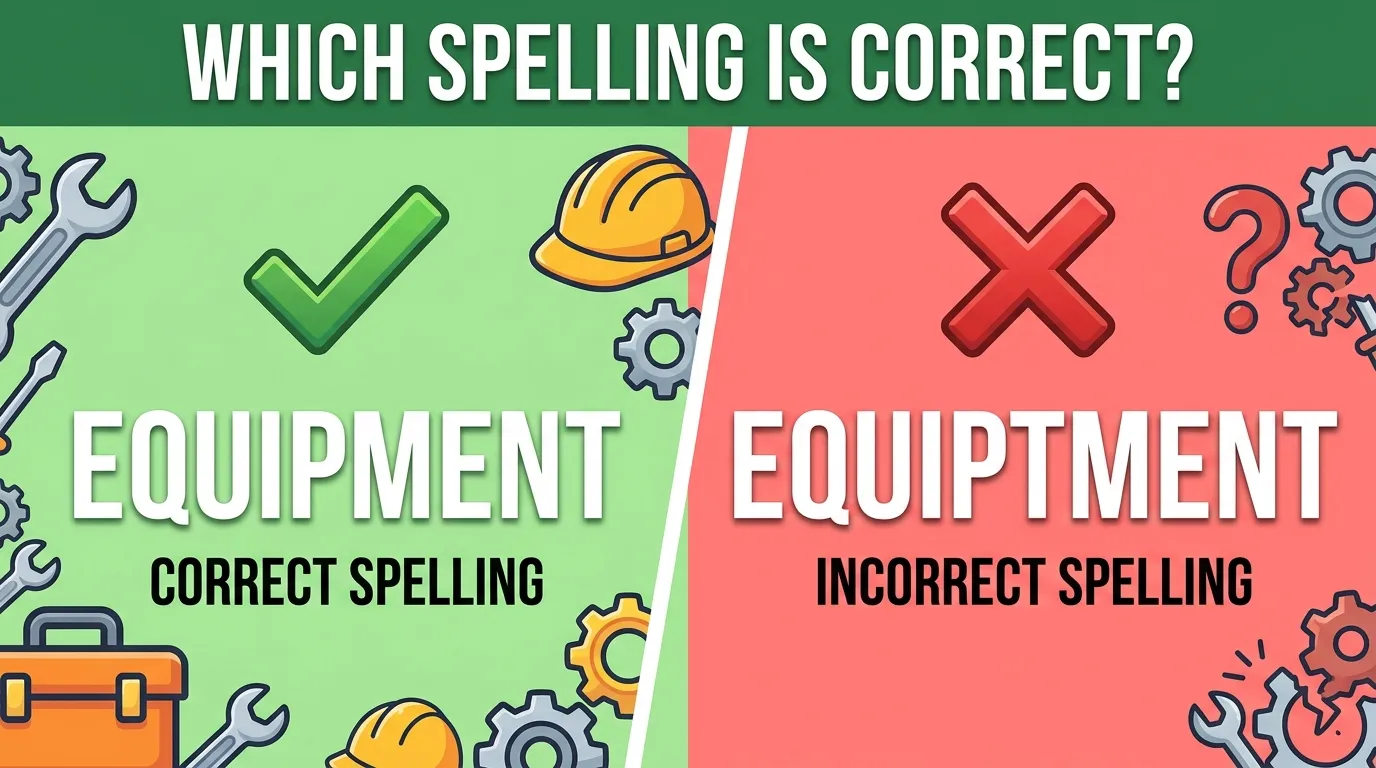
The camping trip was three days away, and the packing list was spread across the kitchen table. Tent, sleeping bags, stove, lantern, first-aid kit, rain gear. At the bottom, in a friend’s handwriting, one more item: “Don’t forget the equiptment.” The trip leader stared at it. Equiptment looked plausible — it had the T that equip seemed to promise. But it was wrong. The correct spelling is equipment: E-Q-U-I-P-M-E-N-T, with no T after the P. Equiptment is a misspelling, and it is one of the most persistent in English, because it is produced by a reasonable instinct about how words are built.
This article explains where the phantom T comes from, why equipment has no plural, how it differs from gear and apparatus, and how to use it naturally in every context from gyms to laboratories.
The Packing List
Start with the meaning, because the meaning is the most practical word on any packing list. Equipment is a noun that names the tools, machines, devices, supplies, or other items needed for a particular activity, job, sport, or purpose. “The gym has modern equipment.” “We need new safety equipment.” “The laboratory equipment is expensive.” “Please inspect the equipment before use.” In each sentence, the word covers a whole collection of things — not one tool, but the set of tools the task requires.
The misspelling equiptment appears in the same contexts: inventory lists, requisition forms, gym reviews, school supply orders. “The school needs new sports equiptment.” “Check the equiptment before the match.” The error is understandable, because the word’s family seems to demand a T. The verb is equip. The adjective is equipped. The noun for the process is equipping. If equip ends in P, and the other forms add endings to equip, surely the noun should be equip + t + ment? English says no, and the reason is in the word’s history.
The correct spelling is equip + ment, with nothing in between: E-Q-U-I-P-M-E-N-T. The suffix is -ment, one of the most common noun-forming suffixes in English (development, movement, agreement, improvement), and it attaches directly to the base word. There is no T in the suffix, and there is no T in the base word. The phantom T is an invention — a letter the brain inserts to make the word feel more complete.
Equip + -ment: Where the Phantom T Comes From
Why does the brain insert a T that is not there? Three forces push writers toward equiptment. First, there is a real family of English words where a T appears between a base and the -ment suffix — but in those words, the T belongs to the base, not to the suffix. Commit → commitment. Admit → admittance. Submit → submission (with a spelling change). In each case, the T was already in the base word. Equip has no T, so equipment has no T. The pattern is real; the application is wrong.
Second, there is the word equipped, the past tense and past participle of equip. Equipped is spelled with a double P — E-Q-U-I-P-P-E-D — because the doubling rule doubles the final consonant before -ed when the final syllable is stressed. The double P makes the word look longer and more complex, and writers who remember equipped sometimes transfer its complexity to the noun, adding a T for good measure. The noun, however, is simpler than the participle: one P, no T.
Third, there is the pronunciation. Equipment is pronounced eh-KWIP-ment — three syllables, with the stress on the second. The transition from P to M (KWIP-ment) creates a tiny pause, a small click in the mouth, that the ear can mistake for a T. The mouth produces something that sounds like a T, the hand writes a T, and the misspelling is born. The sound is an artifact of the P-to-M transition, not a letter in the word.
The history confirms the spelling. Equipment came into English from the French équipement, which came from the verb équiper — to fit out, to furnish, to supply. The French word has no T between the P and the M, and English kept the French spelling. The word’s relatives in other languages agree: German Equipment, Spanish equipamiento, Italian equipaggiamento. None of them has a T in that position. The phantom T is an English-only invention.
Equipment Has No Plural
Equipment is an uncountable noun — a mass noun, like water, information, or furniture. It has no plural form. You cannot write equipments in standard English. “The equipments are ready” is wrong. “The equipment is ready” is right, even when the equipment consists of fifty separate items.
This matters in practice, because writers who need to count equipment reach for workarounds. The standard workarounds are: pieces of equipment (“We need three pieces of equipment”), items of equipment (“The lab ordered five items of equipment”), sets of equipment (“The gym bought two sets of equipment”), and types of equipment (“The factory uses several types of equipment”). Each workaround puts the counting word in front of equipment and leaves equipment itself unchanged.
The uncountable nature of equipment also governs verb agreement. Equipment takes a singular verb, always: “The equipment is expensive.” “The equipment has arrived.” “The equipment needs inspection.” Even when the equipment is a room full of machines, the verb stays singular, because the noun is singular. This is the same rule that governs furniture (“The furniture is new”), luggage (“The luggage has arrived”), and machinery (“The machinery is running”).
One exception is worth knowing: in some technical and military contexts, equipments appears as a specialist plural, meaning different kinds or systems of equipment. “The ship’s equipments include radar and sonar.” This use is rare, jargon-bound, and best avoided in general writing. For everyday English, equipment has no plural.
Equipment vs Gear vs Apparatus vs Kit
Equipment has close neighbors, and choosing among them is a matter of register and scope. Gear is the casual word — the word of athletes, soldiers, and hobbyists. “Grab your gear.” “Fishing gear.” “Camping gear.” Gear is shorter, more informal, and more personal than equipment. A soldier carries gear; a factory owns equipment.
Apparatus is the formal, scientific word — the word of laboratories, gymnasiums, and technical manuals. “Laboratory apparatus.” “Gymnastic apparatus.” Apparatus is slightly more specific than equipment: it suggests a connected system or a set of instruments designed for a particular purpose, where equipment can mean any collection of tools.
Kit is the compact word — a set of items packaged together for a specific purpose. “First-aid kit.” “Tool kit.” “Repair kit.” A kit is equipment in a box, ready to go. Kit is more common in British English than in American English, where set often does the same job (“a tool set”).
Equipment sits at the center of this group because it is the general word — the one that covers all the others. Gear is a kind of equipment. Apparatus is a kind of equipment. A kit is a package of equipment. When the specific word does not fit, equipment is the safe choice, and it is the word that appears in formal writing: contracts, safety manuals, procurement documents, insurance policies.
Equipment in the Workplace: Safety, Labs, and Offices
Equipment does heavy work in professional writing, and three contexts cover most of it. First, safety: personal protective equipment (PPE) — helmets, gloves, goggles, masks, harnesses — is the phrase that governs workplace safety in every English-speaking country. “All workers must wear personal protective equipment.” “PPE” is one of the most common abbreviations in industrial English, and it always stands for equipment, never equiptment.
Second, laboratories and medicine: medical equipment, laboratory equipment, diagnostic equipment, surgical equipment. In these contexts, equipment names instruments whose precision matters — and whose names are spelled precisely in procurement documents, where a misspelling can delay an order or void a warranty.
Third, offices and technology: office equipment (printers, scanners, desks), computer equipment, network equipment, audio equipment. In IT writing, equipment often appears alongside hardware and infrastructure, and the three words divide the territory: hardware is the machines, infrastructure is the systems, equipment is the collection of physical items the work requires.
In all three contexts, the word pairs with a small set of verbs: install equipment, inspect equipment, maintain equipment, upgrade equipment, replace equipment, calibrate equipment. These collocations are worth learning because they are the phrases that appear in real documents, and they all use the standard spelling.
The Equipment Check
When the word appears in your draft, run one check: is there a T between the P and the M? If there is, delete it. The word is equip + ment — E-Q-U-I-P-M-E-N-T — with no T, no plural, and a singular verb. The camping trip went ahead with the right equipment, the packing list was corrected, and the phantom T stayed home, where it belonged: nowhere.










