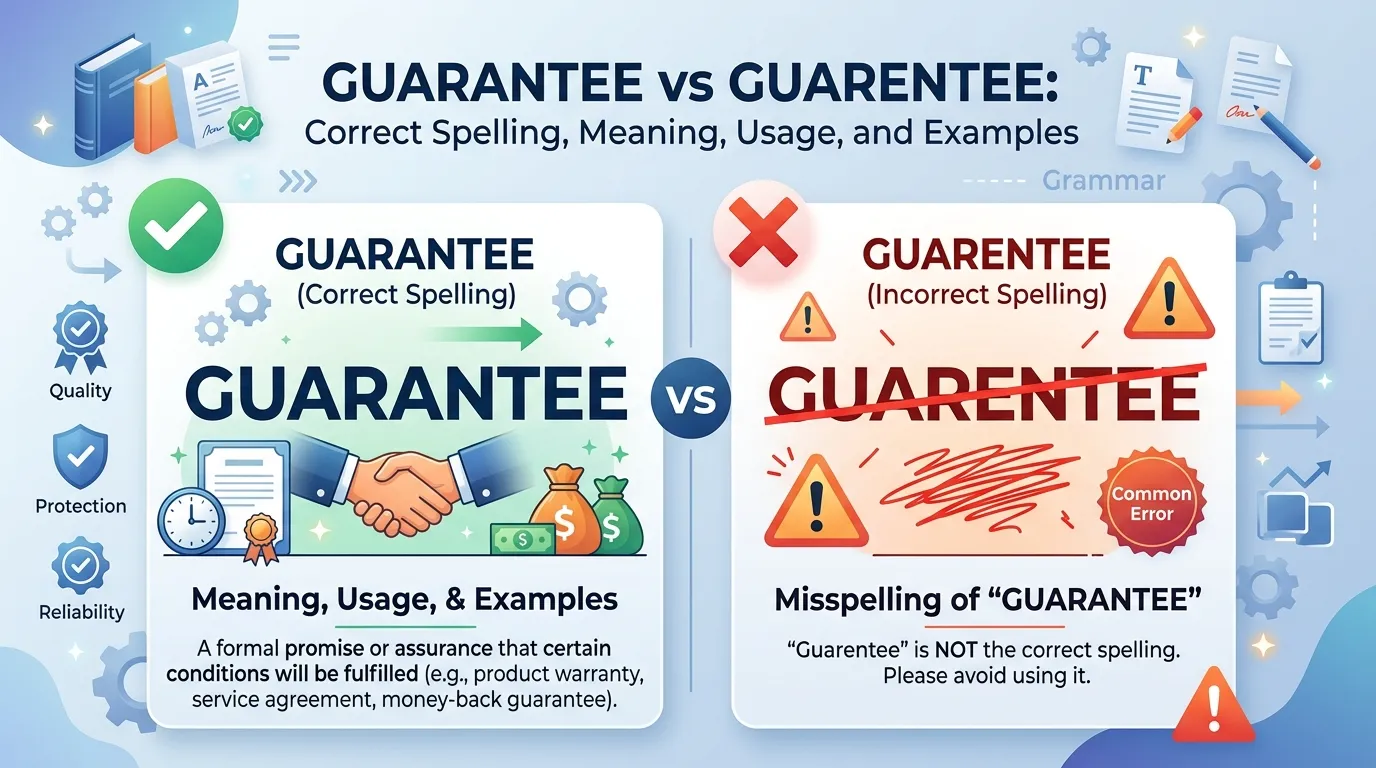
If you are unsure whether to write guarantee or guarentee, you are not alone. These two spellings look very similar, and the pronunciation can make the correct spelling harder to remember. However, there is one important rule to keep in mind: guarantee is the correct spelling, while guarentee is a misspelling.
The word guarantee can function as both a noun and a verb. It can describe a promise that something will happen, an assurance that a product or service will meet certain standards, or a commitment to take responsibility if something goes wrong.
For example:
The company guarantees customer satisfaction.
You would never write:
The company guarentees customer satisfaction.
The second version contains the common spelling error.
In this guide, you will learn the difference between guarantee vs guarentee, why people confuse the spellings, how to pronounce guarantee, how to use it as a noun and verb, common expressions and collocations, regional usage, formal and informal examples, related words, memory tricks, and common mistakes.
Quick Answer: Guarantee or Guarentee?
Guarantee is the correct spelling.
Guarentee is incorrect and should not be used in standard English.
| Spelling | Correct? | Meaning |
|---|---|---|
| guarantee | Yes | A promise, assurance, or commitment |
| guarentee | No | Common misspelling of guarantee |
Correct examples
- We guarantee the quality of our products.
- The store offers a money back guarantee.
- I cannot guarantee that the weather will improve.
- This product comes with a two year guarantee.
Incorrect examples
- We guarentee the quality of our products.
- The store offers a money back guarentee.
- I cannot guarentee the result.
The spelling guarentee is understandable because the ending sounds like tee, but standard English spells the word guarantee, with guarantee ending in tee when pronounced but tee represented by the letters tee? More precisely, the written ending is tee as part of the spelling sequence -tee, while the complete word is spelled g-u-a-r-a-n-t-e-e.
A simple way to remember it is:
GUARANTEE = GUARAN + TEE
Do not replace the final -tee sound with -tee after changing the middle spelling. The correct sequence is guarantee.
What Does Guarantee Mean?

Guarantee has several closely related meanings, but they all involve some form of assurance, promise, certainty, or responsibility.
As a noun, a guarantee is a promise or assurance that something will happen or that a product or service will meet a particular standard.
As a verb, guarantee means to promise or assure that something will happen or be true.
Guarantee as a noun
A guarantee can be a formal or informal promise.
For example:
- The product comes with a money back guarantee.
- There is no guarantee that the plan will succeed.
- The company gave us a written guarantee.
- Hard work is not always a guarantee of success.
In these examples, guarantee is a noun.
Guarantee as a verb
As a verb, guarantee means to promise or make something certain.
For example:
- I guarantee that you will enjoy the experience.
- We cannot guarantee delivery by Friday.
- This method does not guarantee success.
- The manufacturer guarantees the product for two years.
Here, guarantee describes an action.
Why Do People Confuse Guarantee and Guarentee?
The main reason is pronunciation.
The word guarantee is commonly pronounced approximately as:
GAR un TEE
Its pronunciation makes the final part sound like tee, which can encourage people to spell it incorrectly.
The middle of the word also creates confusion. The sequence guaran is less visually familiar than many common English spelling patterns.
People may write guarentee because they hear the ending and naturally produce a spelling that seems to match the sound.
English has many words where pronunciation does not perfectly reveal spelling. Guarantee is one of them.
Other words that can cause similar spelling uncertainty include:
- separate
- definitely
- privilege
- occurrence
- maintenance
- accommodate
- necessary
The best solution is to memorize the spelling of guarantee rather than trying to spell it entirely from pronunciation.
Guarantee Pronunciation
In American English, guarantee is generally pronounced:
GAR un TEE
Its phonetic pronunciation is approximately:
/ˌɡærənˈtiː/
The final syllable receives the strongest stress.
Say it in parts
You can mentally divide the word like this:
guar + an + tee
The final sound is similar to the word tea.
For example:
I can guarantee it.
The final part of guarantee sounds like tee.
Does guarantee have different pronunciations?
There can be small differences in pronunciation between speakers and regional varieties of English, but the spelling remains guarantee in standard American and British English.
There is no standard regional spelling guarentee.
Guarantee vs Guarentee: Key Difference
The difference is simple:
Guarantee is correct. Guarentee is incorrect.
This is not a case where two English variants have different meanings.
It is also not a British versus American spelling issue.
You should use guarantee in:
- American English
- British English
- Canadian English
- Australian English
- Academic writing
- Business writing
- Journalism
- Technical writing
- Professional communication
- Casual writing
- Blogging
- Advertising
The spelling does not change simply because the audience is from another English speaking country.
Is Guarentee Ever Correct?
In standard modern English, guarentee is not the accepted spelling of the word.
If you see guarentee online, in an email, on a website, or in an informal message, it is almost certainly a spelling mistake for guarantee.
For professional writing, correct it.
Incorrect
We guarentee fast delivery.
Correct
We guarantee fast delivery.
Incorrect
Our service comes with a satisfaction guarentee.
Correct
Our service comes with a satisfaction guarantee.
Guarantee as a Noun
When guarantee is a noun, it usually refers to a promise, assurance, or commitment.
Examples
- The product includes a lifetime guarantee.
- There is no guarantee of success.
- The seller provided a written guarantee.
- The company offers a satisfaction guarantee.
- His reputation is a guarantee of quality.
A guarantee may be legally binding in some situations, but the word itself does not automatically mean that a promise is legally enforceable.
Context matters.
Guarantee as a Verb
As a verb, guarantee means to promise, assure, or make something certain.
Examples
- I guarantee that you will receive a response.
- We guarantee high quality.
- Nothing can guarantee a positive result.
- The manufacturer guarantees the equipment.
- Good planning does not always guarantee success.
The verb can be followed by different grammatical structures.
Guarantee + noun
The company guarantees customer satisfaction.
Guarantee + that clause
I guarantee that the work will be completed.
Guarantee + object
The policy guarantees customers a refund.
Guarantee + gerund
Regular maintenance cannot guarantee preventing every problem.
The exact construction should depend on what you want to express.
Guarantee vs Warranty
Guarantee and warranty are related, but they are not always interchangeable.
A guarantee is generally a promise or assurance about quality, performance, results, or responsibility.
A warranty is usually a specific promise concerning the condition, quality, or repair or replacement of a product, often within a defined period.
Compare these examples
The company offers a satisfaction guarantee.
This emphasizes a promise about customer satisfaction.
The laptop has a one year warranty.
This usually refers to a formal product protection agreement.
In everyday language, the terms can overlap, especially in commercial contexts, but warranty often has a more specific legal or product related meaning.
Guarantee vs Promise
A promise is broader and more personal.
A guarantee often sounds stronger and more certain.
Compare:
I promise I will call you tomorrow.
This is a personal commitment.
I guarantee that the package will arrive tomorrow.
This sounds like a strong assurance.
A guarantee may also involve responsibility if the promised result does not occur.
Guarantee vs Assurance
Assurance refers to confidence or a statement intended to remove doubt.
Guarantee generally carries a stronger sense of commitment or certainty.
For example:
The manager gave us assurance that the problem would be investigated.
This emphasizes reassurance.
The company guarantees a full refund.
This emphasizes a specific commitment.
Guarantee vs Certainty
A guarantee does not always mean that an outcome is objectively certain.
For example:
There is no guarantee that the team will win.
This means nobody can promise the result.
Even when someone says:
I guarantee it will work.
The speaker is making a very strong assurance, but the real world may still produce an unexpected result.
This distinction matters in professional, scientific, financial, and technical writing.
Common Collocations With Guarantee
A collocation is a group of words that commonly appear together.
Knowing common collocations can make your English sound more natural.
Common noun collocations
- money back guarantee
- satisfaction guarantee
- lifetime guarantee
- written guarantee
- full guarantee
- quality guarantee
- product guarantee
- performance guarantee
- personal guarantee
- bank guarantee
- guarantee period
- guarantee policy
Common verb collocations
- guarantee success
- guarantee quality
- guarantee safety
- guarantee results
- guarantee delivery
- guarantee payment
- guarantee protection
- guarantee performance
- guarantee access
- guarantee satisfaction
Natural examples
The company offers a money back guarantee.
The manufacturer provides a lifetime guarantee.
No strategy can guarantee success.
The contract includes a performance guarantee.
Common Phrases With Guarantee
Several everyday expressions use guarantee.
Money back guarantee
A promise that a customer can receive their money back if certain conditions are met.
The course comes with a 30 day money back guarantee.
Personal guarantee
A commitment by an individual to accept responsibility for an obligation.
The lender required a personal guarantee.
Guarantee of quality
An assurance that something meets a particular standard.
The label represents a guarantee of quality.
Guarantee of success
An assurance that something will succeed.
There is no guarantee of success.
This phrase is especially common because success is often uncertain.
Without guarantee
This means something is offered without a promise that a particular result will occur.
Admission is offered without guarantee.
Common Expressions and Idiomatic Uses
Guarantee is also used in figurative and conversational English.
A dead cert versus a guarantee
In some contexts, people may describe something as a certainty or use informal expressions to indicate that an outcome seems extremely likely.
For example:
He is a sure bet to win.
This does not literally mean that a formal guarantee exists.
Similarly:
That’s a guarantee.
can be an emphatic conversational statement.
The exact expression may vary by region and context.
Guarantee in Business English
The word guarantee is extremely common in business communication.
Companies may use it to communicate confidence in their:
- products
- services
- delivery
- customer support
- quality
- performance
- refund policies
- security
- workmanship
Examples
We guarantee same day processing for eligible orders.
Our service includes a satisfaction guarantee.
Delivery times are estimates and cannot be guaranteed.
The final example is especially useful because businesses often need to distinguish between an estimated result and a promised result.
Guarantee in Legal and Financial Contexts
In legal and financial writing, guarantee can have a more specific meaning.
A person or organization may agree to be responsible for an obligation if another party fails to meet it.
For example:
The director provided a personal guarantee for the company’s loan.
A bank guarantee can similarly involve a financial institution promising payment or performance under specified conditions.
Because legal meanings depend heavily on jurisdiction and contract language, writers should avoid assuming that every everyday use of guarantee creates the same legal obligation.
Guarantee in Technical Writing
Technical writing often uses guarantee carefully because technical results depend on conditions.
For example:
The update does not guarantee compatibility with older devices.
This is often better than making an absolute claim.
Technical writers frequently distinguish between:
- guaranteed behavior
- expected behavior
- recommended behavior
- possible behavior
- supported behavior
- estimated performance
Natural technical examples
The configuration guarantees a minimum level of capacity under the stated conditions.
This setting does not guarantee improved performance on every system.
The manufacturer guarantees the component for five years.
Guarantee in Academic Writing
Academic writing usually avoids unsupported absolute claims.
Instead of:
This method guarantees better learning.
A more careful sentence might be:
This method may improve learning outcomes under certain conditions.
If a genuine guarantee exists, the word can still be used.
For example:
The protocol guarantees consistent results when all specified conditions are maintained.
The key issue is not whether guarantee is formal enough. It is whether the claim is accurate and defensible.
Guarantee in Journalism
Journalists may use guarantee when reporting promises, policies, or statements.
Examples include:
The company guarantees refunds under the new policy.
Officials said the program would guarantee access to essential services.
Journalistic writing should distinguish between what someone claims to guarantee and what is actually established as certain.
Guarantee in Sports
Sports writing frequently uses guarantee in both literal and figurative ways.
Literal usage
The league guarantees players a minimum salary under the agreement.
Figurative usage
A strong defense is no guarantee of victory.
Conversational usage
Nothing is guaranteed in the playoffs.
Sports commentary often uses the word to emphasize uncertainty because games can change unexpectedly.
Guarantee in Blogging and Online Writing
Bloggers and marketers often use guarantee in headlines and promotional language.
Examples:
Five habits that can improve your writing
is generally more cautious than:
Five habits that guarantee perfect writing
The second headline makes a much stronger claim.
For trustworthy content, avoid using guarantee simply to make a headline sound more powerful. Strong claims should match the evidence and the actual promise being made.
American vs British English
There is no spelling difference between American and British English for this word.
Both use:
guarantee
Not:
guarentee
American English
The company guarantees free shipping.
British English
The company guarantees free delivery.
The spelling of guarantee stays the same.
What may change is vocabulary around it, such as shipping versus delivery, depending on context.
Formal vs Informal Usage
Guarantee is appropriate in both formal and informal English.
Formal
The manufacturer guarantees the equipment against defects for the stated period.
Neutral
I can guarantee that the information is accurate.
Informal
I guarantee you’ll love this place.
The word itself is not overly formal.
The surrounding vocabulary determines the overall tone.
Synonyms for Guarantee
Depending on the context, useful synonyms include:
- assure
- promise
- warrant
- ensure
- secure
- confirm
- certify
- pledge
- vouch for
- give one’s word
These words are not always exact substitutes.
Guarantee vs ensure
This distinction is especially important.
Guarantee means to promise or assure an outcome.
Ensure means to make sure that something happens.
Compare:
We guarantee delivery by Friday.
This is a promise.
We checked the address to ensure delivery by Friday.
This describes an action taken to make the result more likely or secure.
Antonyms of Guarantee
Depending on context, possible opposites include:
- uncertainty
- doubt
- risk
- possibility
- chance
- unpredictability
There is not always one exact antonym.
For example:
A guarantee of success
can contrast with:
uncertainty about success
rather than simply using one opposite word.
Related Words
Several words are closely connected to guarantee.
Guaranteed
The adjective or past participle form.
The service includes guaranteed delivery.
Guaranteeable
A relatively uncommon word meaning capable of being guaranteed.
In everyday writing, it is usually better to rewrite the sentence.
Guarantor
A person or organization that provides a guarantee.
The bank acted as guarantor.
Guaranteed
This is also common in business and everyday language.
Results are not guaranteed.
Guaranteeable vs guaranteed
Do not confuse these forms.
Guaranteeable describes something that can potentially be guaranteed.
Guaranteed describes something that has been guaranteed.
Word History and Etymology of Guarantee
The history of guarantee helps explain why its spelling is not as straightforward as its pronunciation.
The word developed through older European forms associated with the idea of protecting, assuring, or making something secure. English received the word through French influence, with forms related to garant, meaning a person who provides assurance or protection.
The spelling and pronunciation developed over time as the word entered and settled into English.
This historical background explains why guarantee does not follow a simple sound to letter pattern.
It also helps explain why the word is related to terms such as guarantor and warranty, even though their modern uses differ.
Common Misspellings of Guarantee
The most common error is:
❌ guarentee
Correct:
✅ guarantee
Other errors can occur when writers accidentally rearrange letters.
Examples include:
- guarentee
- garantee
- guaranty when guarantee is intended
- guarentee
One related word deserves special attention: guaranty.
Guarantee vs Guaranty
Guarantee and guaranty are related words, but they are not simply two spellings of the same word in every context.
Guarantee is the much more common general English word.
Guaranty appears especially in legal and financial contexts in American English and can refer to a formal promise or undertaking.
For ordinary writing, use guarantee unless a specific legal context calls for guaranty.
Example
The company offers a satisfaction guarantee.
This is the normal everyday form.
A legal document may use guaranty in a specialized context.
Memory Tricks for Guarantee
If you repeatedly misspell guarantee, try one of these memory tricks.
Think of TEE
Break the ending into:
GUARAN + TEE
The word ends with tee, represented by -tee.
Think of GUARAN
Start with:
GUARAN
Then add:
TEE
Together:
GUARANTEE
Use a sentence
I guarantee this spelling is correct.
The sentence itself reinforces the correct spelling.
Remember the rule
Guarantee has an E after the T.
The final sequence is:
T E E
not:
T E
and not a different spelling such as T E E preceded by the wrong middle sequence.
Common Mistakes and Corrections
Mistake: Guarentee
❌ We guarentee excellent service.
✅ We guarantee excellent service.
Mistake: Using guarantee when you mean ensure
❌ Please guarantee that the door is locked.
If you mean “make sure,” a more natural sentence is:
✅ Please ensure that the door is locked.
Mistake: Making an unsupported absolute claim
❌ This exercise guarantees weight loss.
A more responsible alternative is:
✅ This exercise may support a healthy fitness routine.
Mistake: Confusing guarantee with warranty
❌ The phone has a five year guarantee, meaning it automatically includes every type of repair.
This may not accurately describe the product’s actual terms.
A better approach is to use the exact terminology provided by the manufacturer or contract.
Awkward vs Natural Examples
| Awkward or Incorrect | Natural or Correct |
|---|---|
| We guarentee quality. | We guarantee quality. |
| This guarentee lasts one year. | This guarantee lasts one year. |
| I guarentee it will work. | I guarantee it will work. |
| The result is guaranteed by the evidence. | The evidence supports the result. |
| This guarantees you will win. | This gives you a better chance of winning. |
| Please guarantee the door is locked. | Please ensure the door is locked. |
The key lesson is that correct spelling and correct word choice are two different issues.
Everyday Examples of Guarantee
Here are natural examples you might encounter in daily life.
Shopping
This blender comes with a two year guarantee.
Customer service
We guarantee a full refund if the order is canceled within the stated period.
Conversation
I guarantee you’ll have a good time.
School
Good grades are not guaranteed by studying the night before an exam.
Work
I can’t guarantee that the project will be finished today.
Travel
The airline cannot guarantee a specific seat.
Sports
A strong start does not guarantee victory.
Technology
The update does not guarantee compatibility with every device.
When Should You Use Guarantee?
Use guarantee when you mean:
- make a promise
- give an assurance
- accept responsibility for a result
- promise a product standard
- promise a refund or replacement under stated conditions
- express strong certainty
- describe a formal guarantee
For example:
The manufacturer guarantees the product for three years.
When Should You Use Another Word?
Choose another word when guarantee sounds too strong or does not express your intended meaning.
Use ensure when you mean make sure.
Please ensure that all forms are complete.
Use assure when you mean give someone confidence.
I assure you that we are working on the issue.
Use promise for a personal commitment.
I promise I will call tonight.
Use warrant in certain formal contexts involving justification or assurance.
The evidence does not warrant that conclusion.
Choosing the right word makes your writing clearer and more precise.
A Simple Rule for Writers
Whenever you are deciding between guarantee and guarentee, choose:
GUARANTEE
If your spelling checker highlights guarentee, replace it with guarantee.
If you are unsure about the meaning, ask yourself what you intend to say:
- A promise? Guarantee
- An assurance? Guarantee may work
- Make sure? Ensure
- Give someone confidence? Assure
- Personal commitment? Promise
- Product protection terms? Warranty may be more precise
This small distinction can make professional writing much more polished.
SEO and Content Writing Tip
Writers sometimes intentionally repeat a misspelled search phrase because users may search for it.
For example, someone might search:
guarantee vs guarentee
That does not mean the misspelling should be used repeatedly in the article.
A better SEO approach is to mention the misspelling naturally while consistently using the correct spelling.
For example:
If you searched for guarantee vs guarentee, the answer is simple: guarantee is correct, while guarentee is a common misspelling.
After that, use the correct spelling normally.
This keeps the content useful without encouraging incorrect English.
Guarantee vs Guarentee: Final Comparison
| Feature | Guarantee | Guarentee |
|---|---|---|
| Standard spelling | Yes | No |
| Standard American English | Yes | No |
| Standard British English | Yes | No |
| Noun | Yes | No |
| Verb | Yes | No |
| Common in business | Yes | No |
| Common in academic writing | Yes | No |
| Common in casual writing | Yes | No |
| Meaning | Promise or assurance | No standard meaning |
| Recommended | Use it | Avoid it |
Frequently Asked Questions
Is guarantee or guarentee correct?
Guarantee is correct. Guarentee is a misspelling. Use guarantee in American English, British English, academic writing, business communication, journalism, blogging, and everyday conversation.
How do you spell guarantee correctly?
The correct spelling is g-u-a-r-a-n-t-e-e: guarantee. A useful memory trick is to remember the final -tee sound and the spelling guaran + tee.
Why do people spell guarantee as guarentee?
People often write guarentee because of pronunciation. The word is commonly pronounced approximately GAR un TEE, so writers may naturally spell the ending according to the sound they hear.
What is the difference between guarantee and guarentee?
There is no difference in meaning because guarentee is not a standard spelling. Guarantee is the correct word for a promise, assurance, or commitment.
Is guarentee a British spelling?
No. Guarentee is not a standard British spelling. British English uses guarantee, just as American English does.
Is guarantee a noun or a verb?
Guarantee can be both a noun and a verb. As a noun, it means a promise or assurance. As a verb, it means to promise or assure that something will happen or be true.
What is the difference between guarantee and warranty?
A guarantee is generally a promise or assurance about a result, quality, or performance. A warranty is often a more specific product related promise concerning defects, repairs, replacement, or performance during a stated period.
What is the difference between guarantee and ensure?
Guarantee means to promise or assure an outcome. Ensure means to make sure that something happens. For example, a company may guarantee delivery, while an employee may check an address to ensure successful delivery.
Can guarantee be used in formal writing?
Yes. Guarantee is completely appropriate in formal, professional, academic, business, legal, technical, and journalistic writing. However, writers should avoid making guarantees when the evidence cannot support an absolute claim.
What is the easiest way to remember guarantee?
Remember the spelling GUARAN + TEE = GUARANTEE. If you see guarentee, remember that the middle of the word is guaran, not guaren.
Conclusion
When comparing guarantee vs guarentee, there is a clear winner: guarantee is the correct spelling.
Guarentee is a common spelling mistake, usually caused by the way guarantee sounds when spoken. It is not an accepted American or British spelling.
Remember that guarantee can be both a noun and a verb. You can offer a money back guarantee, provide a product guarantee, guarantee quality, guarantee delivery, or say that something is not guaranteed.
For everyday writing, business communication, academic work, journalism, technical content, blogging, and professional documents, always use guarantee.
If you are choosing between related words, remember the basic distinctions:
Guarantee = promise or assurance
Ensure = make sure
Assure = give someone confidence
Promise = commit to something
Warranty = specific product or service protection
Guaranty = specialized legal or financial term in some contexts
The most important spelling rule is simple:
GUARANTEE is correct. GUARANTEE is the spelling to remember.
Once you recognize the GUARAN + TEE pattern, this common spelling mistake becomes much easier to avoid.