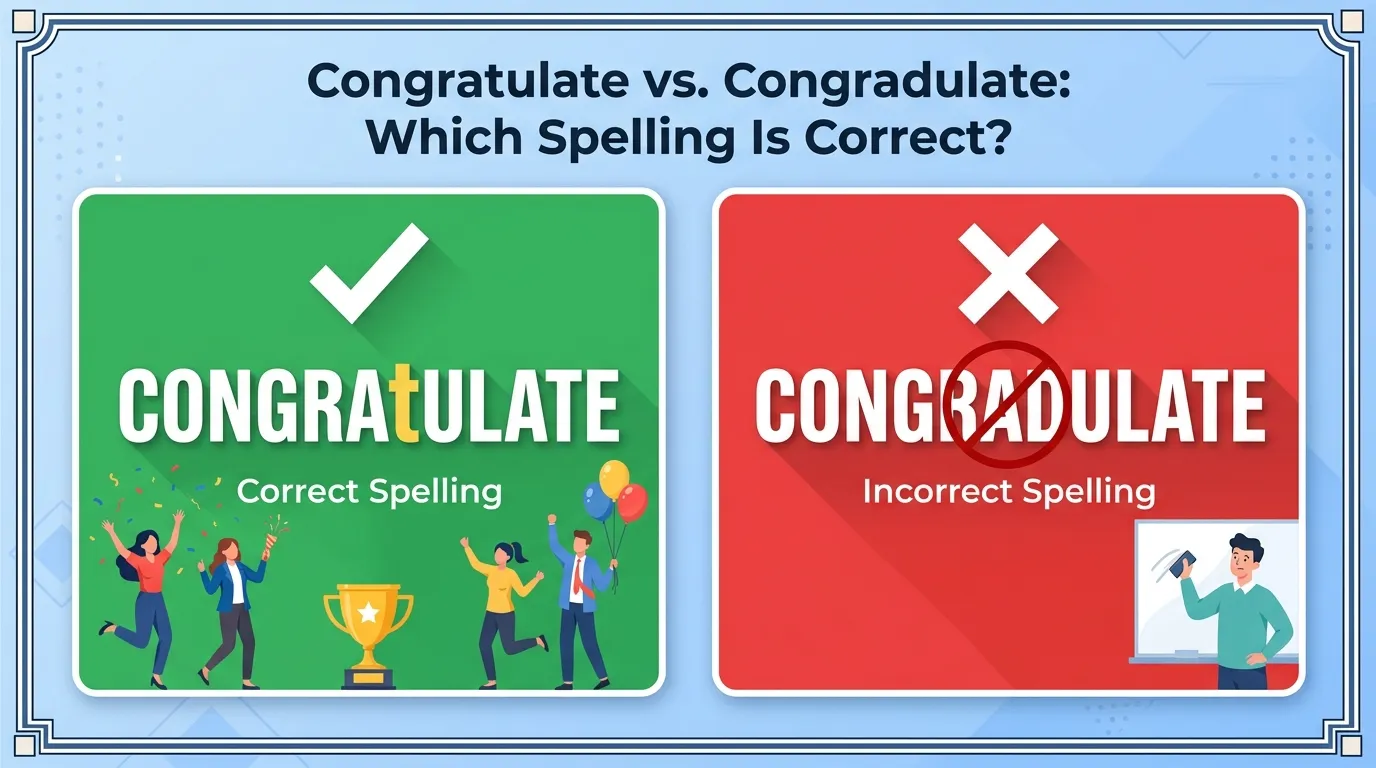
Is It Congratulate or Congradulate? The Correct Spelling Explained

If you are wondering whether congratulate or congradulate is the correct spelling, the answer is simple: congratulate is correct. Congradulate is a common misspelling, not a standard English word.

The confusion is understandable because congratulate contains the sound /ɡrætʃ/, which can make the middle of the word difficult to spell. People sometimes insert a d and write congradulate, possibly because words such as graduate and graduation are familiar.

In this guide, you will learn the difference between congratulate vs congradulate, how to pronounce and use congratulate, why the spelling mistake happens, which grammatical patterns are correct, and how to avoid the error in emails, schoolwork, business writing, social media, and everyday conversation.

You will also see examples of natural and awkward usage, common expressions, related words such as congratulations and congratulatory, synonyms, word history, regional considerations, and answers to common questions about this easily confused spelling.

Quick Answer: Congratulate or Congradulate?

Congratulate is the correct spelling.

SpellingCorrect?Meaning
congratulate✅ YesTo praise or express pleasure to someone for an achievement or success
congradulate❌ NoCommon misspelling of congratulate

Correct examples

  • I want to congratulate you on your promotion.
  • We congratulate the winning team.
  • She called to congratulate him on graduating.
  • Please congratulate Sarah on her new job.

Incorrect spelling

  • I want to congradulate you on your promotion. ❌
  • We congradulate the winners. ❌

The correct form is always congratulate in standard English.

A useful memory trick is:

CONGRATULATE = CONGRATULATIONS + -ATE

Think of the word congratulations when you spell congratulate. There is no d in either word.


What Does Congratulate Mean?

What Does Congratulate Mean?

The verb congratulate means to express pleasure, approval, or praise because someone has achieved something positive.

For example:

I congratulated Maya on winning the scholarship.

Here, congratulated means that I expressed my happiness and approval because Maya won the scholarship.

The word can be used for many kinds of achievements:

  • winning a competition
  • getting a new job
  • graduating
  • getting married
  • having a baby
  • receiving an award
  • completing a difficult project
  • reaching a personal goal
  • being promoted
  • achieving an important milestone

Dictionary-style definition

Congratulate (verb): to express pleasure or praise to someone because of an achievement, success, event, or good fortune.

Simple meaning

In everyday English, congratulate someone means:

Tell someone that you are happy about their success or achievement.

For example:

  • I congratulated my brother on his graduation.
  • The manager congratulated the employees on completing the project.
  • Everyone congratulated the athlete after her victory.

Why Is Congradulate Incorrect?

Congradulate is not the standard spelling of the verb.

The correct spelling is:

c-o-n-g-r-a-t-u-l-a-t-e

Not:

c-o-n-g-r-a-d-u-l-a-t-e

The incorrect d is often inserted because English contains several familiar words related to education and achievement, including:

  • graduate
  • graduated
  • graduation
  • graduating

Someone may mentally connect congratulate with graduate, especially when congratulating someone on graduating.

However, the words have different spellings and histories.

Remember the difference

Graduate:

She will graduate next month.

Congratulate:

I will congratulate her on graduating.

The two words can appear in the same sentence, but congratulate does not contain the letter d.


Congratulate vs Congradulate: The Key Difference

The most important difference is that one is a standard English word and the other is a spelling error.

FeatureCongratulateCongradulate
Standard English wordYesNo
Correct spellingYesNo
VerbYesNo
Used in formal writingYesNo
Used in everyday EnglishYesNo
Appears in dictionaries as the standard verbYesNo
Appropriate for academic writingYesNo
Appropriate for professional writingYesNo

If you are writing an email, essay, article, résumé, business message, greeting card, or social media post, use congratulate.


How Do You Spell Congratulate?

The spelling is:

C-O-N-G-R-A-T-U-L-A-T-E

Break it into smaller parts:

con + grat + ulate

A practical spelling memory device is:

Congratulate has no D.

You can also connect it to:

Congratulations → congratulate

For example:

  • congratulations
  • congratulate
  • congratulated
  • congratulating
  • congratulatory

None of these standard forms requires a d after grat.

Common misspellings of congratulate

Although congradulate is especially common, people may also make other spelling errors, such as:

  • congradulate ❌
  • congratualte ❌
  • congratulatte ❌
  • congratulait ❌
  • congratulater ❌

The standard spelling is:

congratulate


How Do You Pronounce Congratulate?

In American English, congratulate is commonly pronounced approximately:

kuhn-GRATCH-uh-layt

IPA:

/kənˈɡrætʃəleɪt/

The main stress falls on the second syllable:

con-GRAT-u-late

The middle sound is important. The t + u sequence contributes to the /tʃ/ sound, similar to the sound in church or teacher.

Pronunciation breakdown

con → /kən/
grat → /ɡræt/
u → /ʃə/
late → /leɪt/

So the word sounds roughly like:

kuhn-GRATCH-uh-layt

The pronunciation can contribute to spelling confusion because the written t does not always sound like a simple /t/ when followed by the vowel sound in this word.


Is Congratulate a Verb?

Yes.

Congratulate is a transitive verb, which means it normally takes an object.

You congratulate someone.

For example:

  • I congratulated John.
  • She congratulated her sister.
  • We congratulated the winners.
  • They congratulated the team.

It is especially common in the pattern:

congratulate + person + on + achievement

Examples:

  • I congratulated him on his promotion.
  • She congratulated me on passing the exam.
  • We congratulated them on their wedding.
  • The coach congratulated the players on their victory.

Congratulate Someone on Something

One of the most important grammar patterns is:

congratulate someone on something

This is the standard construction for identifying the achievement or event.

Examples

  • Congratulations on your promotion.
  • I congratulate you on your success.
  • We congratulated Maria on her graduation.
  • The teacher congratulated the students on their excellent results.
  • He congratulated his friend on getting the job.

The preposition on is particularly important in this construction.

Natural

I congratulated her on her promotion.

Less natural or incorrect in standard usage

I congratulated her for her promotion.

Although congratulate someone for something can occur in English, especially in certain contexts, congratulate someone on something is the established and safest pattern when you are referring to an achievement or occasion.

For formal and polished writing, prefer on.


Congratulate Someone for Doing Something

You may sometimes see congratulate someone for + -ing, particularly when the focus is on an action or behavior.

For example:

The teacher congratulated the student for working so hard.

This construction can be grammatical depending on context, but on is generally the more conventional choice when congratulating someone about an achievement:

The teacher congratulated the student on working so hard.

In everyday English, both patterns can appear, but learners should remember the core structure:

congratulate someone on something

This is the most useful pattern to learn first.


Congratulate vs Congratulations

These words are related, but they are not interchangeable in every sentence.

Congratulate

Congratulate is a verb.

I want to congratulate you.

Congratulations

Congratulations is a noun, commonly used as an expression of praise or good wishes.

Congratulations on your new job!

Compare:

WordPart of speechExample
congratulateVerbI congratulate you.
congratulatedPast-tense verbShe congratulated him.
congratulatingPresent participle/gerundThey are congratulating her.
congratulationsNoun/exclamationCongratulations on your success!
congratulatoryAdjectiveHe sent a congratulatory message.

Congratulate vs Congratulated vs Congratulating

The form changes depending on the grammar of the sentence.

Congratulate

Present/base form:

I want to congratulate you.

Congratulates

Third-person singular present:

The coach congratulates the players.

Congratulated

Past tense and past participle:

We congratulated her yesterday.

Congratulating

Present participle:

Everyone is congratulating the winner.

Congratulatory

Adjective:

She received a congratulatory message.


Congratulation vs Congratulations

There is another related spelling and usage point worth knowing.

The noun congratulation exists, but the plural congratulations is much more common when expressing praise or good wishes.

For example:

Congratulations on your graduation!

This is much more natural than:

Congratulation on your graduation.

In ordinary modern English, use congratulations as the expression.

Why is it plural?

Congratulations is conventionally used as a plural noun in expressions of praise or good wishes.

Common examples include:

  • Congratulations!
  • Congratulations on your promotion!
  • Congratulations on passing your exam!
  • Many congratulations!
  • Heartfelt congratulations!

Congratulatory: The Adjective Form

Congratulatory is an adjective meaning expressing congratulations or praise.

Examples:

  • a congratulatory message
  • a congratulatory email
  • a congratulatory speech
  • a congratulatory card
  • congratulatory remarks
  • a congratulatory note

Example sentences

The CEO sent a congratulatory email to the new employees.

Her family prepared a congratulatory message after the graduation.

The mayor gave a congratulatory speech to the winning team.

This word is more formal than simply saying congratulations.


Word History and Etymology of Congratulate

The history of congratulate helps explain why congradulate is not the correct form.

The English verb comes through French from Latin congratulārī, meaning to congratulate or express joy with someone.

The Latin formation is associated with the idea of sharing or expressing joy.

This history is important because congratulate is not derived from graduate. Although the words may appear together frequently in modern sentences, they have different origins.

That is why inserting the d from graduate into congratulate creates a spelling error.

Congratulate and graduate are different words

Compare:

congratulate

I congratulate you on your achievement.

graduate

She will graduate from college.

A person may graduate, and another person may congratulate them, but the words are not spelling variants of one another.


Why Do People Confuse Congratulate and Congradulate?

There are several reasons for this common error.

The word graduate is familiar

People often say:

Congratulations on your graduation!

Because graduation is strongly associated with congratulations, the mind may incorrectly blend the spelling of graduate into congratulate.

The pronunciation can be misleading

The word congratulate does not sound exactly as its letters might suggest to a beginning English learner.

The middle -tu- produces a /tʃ/ sound in common pronunciation, which can make the spelling harder to remember.

English has many irregular spellings

English spelling frequently does not match pronunciation perfectly. Learners may therefore spell unfamiliar words based on how they sound.

Fast typing encourages spelling errors

Congradulate is also easy to type accidentally, particularly when writing quickly about graduation, promotions, or achievements.


Common Mistakes With Congratulate

Mistake: Adding a D

Incorrect:

I want to congradulate you.

Correct:

I want to congratulate you.

Mistake: Using the wrong preposition

Less natural:

I congratulated her for her promotion.

Preferred:

I congratulated her on her promotion.

Mistake: Using congratulate without an object

Awkward:

I congratulated on his success.

Correct:

I congratulated him on his success.

The person being congratulated normally comes directly after the verb.

Mistake: Confusing congratulate and congratulations

Incorrect:

I congratulations you!

Correct:

I congratulate you!

Or:

Congratulations!

Mistake: Writing congratulation as an expression

Less natural:

Congratulation on your new job!

Natural:

Congratulations on your new job!


Awkward vs Natural Examples

Awkward or incorrectNatural and correct
I congradulate you.I congratulate you.
I congratulations you.I congratulate you.
Congratulation on your win!Congratulations on your win!
I congratulated him for his promotion.I congratulated him on his promotion.
She congratulated on passing.She congratulated me on passing.
We congradulated the team.We congratulated the team.
Please congradulate Sarah.Please congratulate Sarah.

Formal and Informal Ways to Congratulate Someone

The verb congratulate works in both formal and informal situations.

Formal

I would like to congratulate you on your appointment.

Please accept my sincere congratulations on this achievement.

We congratulate you on your outstanding performance.

Professional

Congratulations on your promotion. We wish you continued success in your new role.

I would like to congratulate the team on completing the project ahead of schedule.

Casual

Congrats on the new job!

Congratulations! You did it!

I’m so happy for you. Congrats!

The abbreviation congrats is informal and common in texts, social media, and casual conversation.


Congratulate in Business Writing

Congratulate is completely appropriate in professional communication.

Examples include:

  • employee promotions
  • awards
  • successful projects
  • company milestones
  • new appointments
  • professional certifications
  • business achievements

Example business sentence

We would like to congratulate our team on reaching this important milestone.

Another example

Please join us in congratulating David on his promotion to senior manager.

The second construction is especially common in workplace announcements.


Congratulate in Academic Writing

The word is also suitable for academic contexts.

Examples:

The university congratulates the graduating class on completing their degrees.

The department congratulated the researcher on receiving the award.

We congratulate the students on their outstanding examination results.

In academic writing, avoid the misspelling congradulate because spelling accuracy matters in formal work.


Congratulate in Journalism

Journalists frequently use congratulate and congratulations when reporting achievements.

Examples:

The organization congratulated the athlete after her record-breaking performance.

Officials congratulated the team following its championship victory.

Messages of congratulations poured in after the announcement.

The word is neutral and suitable for news reporting.


Congratulate in Sports

Sports writing uses the word frequently because victories, championships, records, and individual awards create many occasions for praise.

Examples:

The coach congratulated the players after the final whistle.

Fans congratulated the team on winning the championship.

The federation congratulated the athlete on breaking the national record.

Common sports collocations

  • congratulate the winner
  • congratulate the team
  • congratulate the champion
  • congratulate the players
  • congratulate an athlete
  • congratulate someone on a victory
  • congratulate someone on a record

Congratulate in Social Media

Social media often uses shorter forms.

Common expressions include:

  • Congrats!
  • Congratulations!
  • Congrats on the win!
  • Congratulations on your new job!
  • So happy for you!
  • Well deserved!
  • Huge congratulations!
  • Big congratulations!
  • Congratulations to the happy couple!

The full verb congratulate is still correct:

I want to congratulate my friend on her achievement.

But casual users often prefer the shorter noun:

Congrats!


Common Collocations With Congratulate

A collocation is a combination of words that naturally appear together.

Common patterns include:

Congratulate someone on something

We congratulated her on her promotion.

Congratulate someone on doing something

I congratulated him on passing the exam.

Congratulate the winner

The presenter congratulated the winner.

Congratulate the team

The manager congratulated the team.

Congratulate someone for an achievement

Everyone congratulated him for his achievement.

Congratulate someone personally

I personally congratulated her after the ceremony.

The most important pattern for learners is:

congratulate + person + on + achievement


Common Phrases With Congratulations

Some natural expressions include:

  • Congratulations!
  • Congratulations on your success!
  • Congratulations on your promotion!
  • Congratulations on your graduation!
  • Congratulations on your wedding!
  • Congratulations on your new job!
  • Congratulations on the achievement!
  • Many congratulations!
  • Heartfelt congratulations!
  • Warm congratulations!
  • Huge congratulations!
  • A big congratulations to everyone involved!

Casual alternatives

  • Congrats!
  • Big congrats!
  • Well done!
  • You did it!
  • Great job!
  • Way to go!
  • That’s amazing!
  • You earned it!

These alternatives are not always exact synonyms, but they can perform a similar social function.


Synonyms for Congratulate

There is no single synonym that works perfectly in every context, but several expressions can communicate a similar idea.

Common alternatives

  • praise
  • applaud
  • commend
  • compliment
  • celebrate
  • salute
  • express approval
  • offer congratulations
  • praise someone’s achievement

However, these words have different shades of meaning.

Praise means expressing approval or admiration.

The manager praised the employee’s work.

Commend is more formal and often suggests official recognition.

The committee commended her for her dedication.

Applaud can be literal or figurative.

Critics applauded the director’s decision.

Compliment usually means saying something positive about someone or something.

She complimented him on his presentation.

Congratulate specifically focuses on someone’s success, achievement, good fortune, or significant event.


Antonyms of Congratulate

There is no perfect one-word antonym for congratulate in every context.

Depending on the situation, possible contrasting actions include:

  • criticize
  • condemn
  • blame
  • discourage
  • commiserate

Commiserate is especially interesting because it means expressing sympathy with someone over difficulty or misfortune rather than celebrating their success.

For example:

We congratulated him on winning the award.

versus:

We commiserated with him after the disappointing result.

These words describe opposite emotional responses in certain situations, although commiserate is not a direct dictionary antonym of congratulate.


Literal and Figurative Uses

Congratulate is primarily used in a social or interpersonal sense. It does not have a special technical or slang meaning in standard American English.

Literal use

I congratulated my sister on her promotion.

The speaker directly expressed congratulations.

Figurative or extended use

The verb can sometimes be used humorously or ironically.

For example:

Well, congratulations—you managed to break the record for the longest meeting.

Depending on tone and context, this could be sincere or sarcastic.

Another example:

I congratulate you on finding the one parking space left in the city.

Here, the speaker may be using the expression playfully.

The spelling remains congratulate even in humorous or sarcastic usage.


Is Congratulate Used in Politics?

Yes. Congratulate is common in political and diplomatic language.

Politicians, governments, organizations, and public officials may congratulate:

  • election winners
  • newly appointed leaders
  • heads of state
  • athletes
  • award recipients
  • countries celebrating national achievements

Examples:

The president congratulated the newly elected leader.

The government congratulated the national team on its victory.

Political usage does not change the spelling or core meaning of the word.


Is Congratulate a Technical Term?

No. Congratulate is a general-purpose English verb rather than a specialized technical term.

It can appear in technical and professional documents when people are discussing achievements, but it does not have a specialized scientific, engineering, medical, or computing definition.

For example:

The company congratulated the engineering team on completing the project.

Here, congratulated has its ordinary meaning.


Regional Variations: American vs British English

The spelling congratulate is standard in both American English and British English.

There is no major US-versus-UK spelling difference such as:

  • color/colour
  • center/centre
  • organize/organise

For this word, both varieties use:

congratulate

Likewise, congratulations is standard in both.

American English

Congratulations on your promotion!

British English

Congratulations on your promotion!

The spelling is the same.

Pronunciation can vary slightly between speakers and accents, but the spelling does not change to congradulate in standard British English.


Congratulate in International English

English learners around the world use congratulate in professional, academic, and everyday communication.

If English is not your first language, the safest rule is simple:

Use congratulate, never congradulate.

This applies whether you are writing:

  • an academic essay
  • a work email
  • a job announcement
  • a LinkedIn post
  • a text message
  • a greeting card
  • a school assignment
  • a business report
  • a social media caption

Formal vs Informal Alternatives

SituationNatural expression
Formal letterI would like to congratulate you on…
Business emailCongratulations on your promotion.
AcademicWe congratulate the students on their achievement.
NewsOfficials congratulated the winner.
Social mediaCongrats!
Text messageCongrats on the new job!
Greeting cardCongratulations and best wishes!
SpeechPlease join me in congratulating…

The choice depends on tone, not spelling.


Real-World Examples of Congratulate

Graduation

I want to congratulate you on graduating from college.

New job

Everyone congratulated Maya on her new position.

Promotion

Please join us in congratulating James on his promotion.

Wedding

We would like to congratulate the newly married couple.

Competition

The referee congratulated the winning team.

Award

Her colleagues congratulated her on receiving the award.

Personal achievement

I congratulated my friend on completing her first marathon.

Business milestone

The CEO congratulated the entire staff on reaching the company’s annual goal.

Exam result

Her parents congratulated her on earning excellent grades.


When Congratulate Sounds Awkward

The word should generally be connected to a positive achievement, event, or piece of good fortune.

For example:

I congratulated him on losing his wallet.

This sounds inappropriate unless the sentence is deliberately sarcastic or the loss somehow represents an achievement.

A more natural use would be:

I congratulated him on finding his wallet.

Likewise:

I congratulated her on failing the exam.

This would normally sound wrong unless it is being used sarcastically.

The important idea is that congratulate normally expresses positive approval.


Can You Congratulate Someone on Something Bad?

Normally, no.

The standard meaning is associated with success, achievement, good fortune, or a positive event.

However, context can change the meaning.

Sarcasm

Congratulations! You deleted the entire presentation.

The speaker is not genuinely congratulating the person. The expression is sarcastic.

Irony

I congratulate you on making the situation even more complicated.

Again, the speaker is using the language of praise ironically.

In ordinary sincere communication, use congratulate for something positive.


Memory Tricks for Congratulate

If you repeatedly write congradulate, try one of these memory methods.

Memory trick 1: Think congratulations

Remember:

CONGRATULATE → CONGRATULATIONS

Both begin with:

CONGRAT-

Neither contains the unwanted d.

Memory trick 2: Separate graduate from congratulate

You can say:

You graduate, and I congratulate you.

The two words are related in meaning in some situations, but they are not related spellings.

Memory trick 3: Remember “no D”

Say:

Congratulate has no D.

This is probably the fastest way to remember the spelling.

Memory trick 4: Use the word family

Learn the family together:

  • congratulate
  • congratulated
  • congratulating
  • congratulations
  • congratulatory

Seeing these forms repeatedly makes the spelling easier to remember.


A Simple Spelling Test

If you are unsure, complete this sentence:

I want to ______ you on your success.

The answer is:

congratulate

Not:

congradulate

Another test:

Please ______ Sarah on her promotion.

Again:

congratulate


Which Form Should You Use in Professional Writing?

Use congratulate without hesitation.

For example:

We would like to congratulate you on your successful completion of the program.

This is appropriate for a professional email.

Avoid:

We would like to congradulate you…

The second version contains a spelling error that may make an otherwise polished message look careless.

For business communication

Prefer:

Congratulations on your promotion.

or:

I would like to congratulate you on your promotion.

For casual communication

Prefer:

Congrats on the promotion!

All three are natural. The difference is mainly tone and grammatical structure.


Which Form Should You Use in Academic Writing?

Always use congratulate.

Academic and educational writing places a high value on correct spelling, grammar, and word choice.

Examples:

The university congratulated the graduating students.

The professor congratulated the researcher on completing the study.

The department issued a congratulatory statement.

Avoid congradulate in essays, assignments, reports, research papers, and other formal documents.


Which Form Should You Use on Social Media?

Both congratulate and congrats are appropriate depending on your style.

Full and polished

I want to congratulate my sister on graduating!

Casual

Congrats on graduating! 🎓

Professional social media

Congratulations to our team on reaching this important milestone.

Do not use congradulate, even in informal posts. Informal writing allows abbreviations and slang, but it does not make a standard misspelling correct.


Is Congradulate Ever Correct?

In standard modern English, no.

If you encounter congradulate online, it is generally a spelling mistake for congratulate.

It may appear in:

  • social media posts
  • informal comments
  • text messages
  • user-generated content
  • learner writing
  • quickly typed messages

Its appearance in those contexts does not make it an accepted alternative spelling.

For edited or professional English, use congratulate.


Common Search Questions About Congratulate vs Congradulate

People often search for this pair because spelling checkers, autocorrect, or online writing have exposed them to both forms. The safest approach is to remember that congratulate is the standard English spelling.

If you are proofreading a document and find congradulate, replace it with congratulate.

If you are writing a congratulatory message, you can also avoid the verb entirely and simply use Congratulations! or Congrats!


Frequently Asked Questions

Is it congratulate or congradulate?

Congratulate is correct. Congradulate is a misspelling. The standard verb is spelled c-o-n-g-r-a-t-u-l-a-t-e.

Is congradulate a real word?

Congradulate is not a standard English spelling. It commonly appears as a misspelling of congratulate, especially when people associate the word with graduate or graduation.

Why do people spell congratulate with a D?

People may confuse congratulate with graduate because both words are frequently used around events such as graduation. The pronunciation and spelling of congratulate can also make it easy to misremember.

How do you spell congratulate correctly?

The correct spelling is:

C-O-N-G-R-A-T-U-L-A-T-E

A useful memory trick is: congratulate has no D.

Do you congratulate someone on or for something?

The most standard and widely useful pattern is congratulate someone on something.

For example:

I congratulated her on her promotion.

The construction congratulate someone for can also occur, especially when focusing on an action, but on is the safest general choice for achievements and occasions.

Is congratulations a verb?

No. Congratulations is a noun used as an expression of praise or good wishes. Congratulate is the verb.

For example:

Congratulations on your new job!

but:

I congratulate you on your new job.

What is the difference between congratulate and congratulations?

Congratulate is a verb, while congratulations is a noun or conventional expression.

I want to congratulate you.

Congratulations on your success!

Is congratulate the same in American and British English?

Yes. Congratulate is the standard spelling in both American and British English. There is no standard British spelling congradulate.

What is the noun form of congratulate?

The common noun is congratulation, while congratulations is the usual form when expressing praise or good wishes.

For example:

Congratulations on your achievement!

The adjective is congratulatory.

What is a casual way to say congratulations?

Common casual alternatives include Congrats!, Well done!, Way to go!, and You did it! The choice depends on the situation and relationship between the speakers.


Final Verdict: Congratulate vs Congradulate

The choice is straightforward:

Congratulate = correct ✅

Congradulate = incorrect ❌

Use congratulate when you want to express pleasure, praise, or approval because someone has achieved something or experienced a positive event.

The most useful grammatical pattern to remember is:

congratulate + someone + on + something

For example:

I congratulate you on your success.

She congratulated him on his promotion.

We congratulated the team on winning the championship.

When you want to use the noun as an expression, choose congratulations:

Congratulations on your new job!

For casual situations, congrats is perfectly natural.

The main spelling lesson is simple: there is no D in congratulate. The word may be associated with graduate and graduation, but it is not spelled with the d from those words.

Whether you are writing an academic assignment, business email, news article, sports report, social media post, greeting card, or everyday message, congratulate is the standard spelling to use. Remembering the word family—congratulate, congratulations, congratulated, congratulating, congratulatory—will make the correct spelling much easier to recognize and use.

Leave a Comment