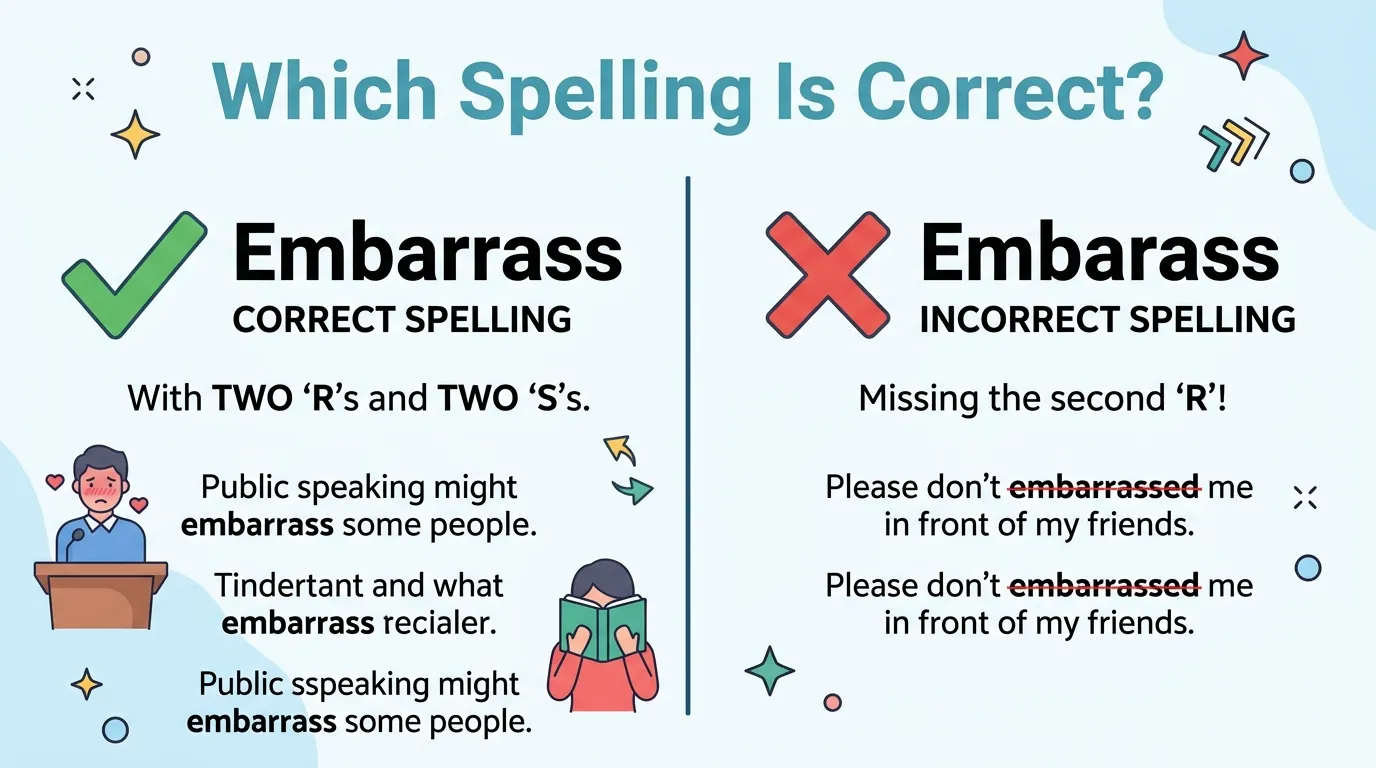
Embarrass vs Embarass: Which Spelling Is Correct?

If you are unsure whether the correct spelling is embarrass or embarass, you are not alone. The correct spelling is embarrass, with two r’s and two s’s. Embarass is a common misspelling and is not considered standard English.

The confusion happens because the word is pronounced without making every letter obvious. When people hear embarrass, they may remember only one r or one s. The spelling also becomes easier to mix up when related words such as embarrassed, embarrassing, and embarrassment enter the picture.

This guide explains embarrass vs embarass in detail. You will learn the correct spelling, meaning, pronunciation, grammar, word history, common mistakes, related forms, synonyms, usage patterns, regional differences, memory tricks, and examples for everyday, academic, professional, and online writing.

Quick Answer: Embarrass or Embarass?

Embarrass is the correct spelling.

Embarass is incorrect in standard English.

SpellingCorrect?Example
embarrassYesI did not mean to embarrass you.
embarassNoI did not mean to embarass you.

The correct word contains:

em + barr + ass = embarrass

A useful way to remember it is that embarrass has two r’s and two s’s.

Correct

I did not want to embarrass my friend.

Incorrect

I did not want to embarass my friend.

The incorrect form embarass commonly appears because writers remember the first double consonant but forget the second one.

What Does Embarrass Mean?

What Does Embarrass Mean?

Embarrass is a verb meaning to make someone feel ashamed, awkward, self-conscious, uncomfortable, or socially uneasy.

It can also describe a situation that causes a person to feel uncomfortable or humiliated.

Dictionary-style definition

Embarrass: verb

To cause someone to feel awkward, ashamed, uncomfortable, or self-conscious, especially in a social situation.

Examples

  • I did not want to embarrass her in front of everyone.
  • His joke embarrassed me.
  • Please do not embarrass yourself.
  • The mistake could embarrass the company.
  • She tried not to embarrass her son.

The emotional intensity can vary. Sometimes embarrassment is mild and humorous. In other situations, it can be deeply uncomfortable.

For example:

I was embarrassed when I called my teacher by the wrong name.

This describes a relatively ordinary social mistake.

By contrast:

The public accusation seriously embarrassed the official.

Here, the word suggests a much more serious loss of comfort, confidence, or social standing.

Why Is Embarrass Spelled With Two R’s and Two S’s?

The spelling embarrass comes from a word history that helps explain its unusual appearance.

English adopted the word from French embarrasser, which ultimately traces back through Romance language development to a sense involving being obstructed, hindered, or placed in difficulty.

Over time, English developed the modern spelling embarrass.

The important point for modern writers is simple: the standard English spelling retained the double consonants.

That gives us:

embarrass

not:

embarass

and not:

embarras

The spelling pattern also continues in several related words:

  • embarrass
  • embarrassed
  • embarrassing
  • embarrassment

Learning the whole word family makes the spelling easier to remember.

Embarrass vs Embarass: The Key Difference

There is really only one spelling difference between these forms, but it matters.

Embarrass has two r’s.

Embarass has only one r.

FeatureEmbarrassEmbarass
Standard spellingYesNo
Number of r’s21
Number of s’s22
Part of speechVerbNot a standard English word
MeaningTo make someone feel awkward or ashamedNo standard dictionary meaning
Suitable for formal writingYesNo
Suitable for academic writingYesNo
Suitable for business writingYesNo

The difference may look small on a screen, but using embarass in an essay, résumé, report, article, or professional email is a spelling error.

Why Do People Spell Embarrass as Embarass?

Several factors contribute to this common mistake.

The pronunciation does not clearly reveal every letter

When people say embarrass, the word flows quickly:

em-BARR-uhs

The pronunciation does not encourage speakers to consciously count the two r’s and two s’s.

English has many inconsistent spelling patterns

English spelling often cannot be predicted perfectly from pronunciation.

Words such as:

  • necessary
  • occasion
  • recommend
  • accommodate
  • occurrence
  • embarrass

can cause spelling problems because of repeated consonants.

The word is visually easy to simplify

When writing quickly, someone may naturally reduce:

embarrass → embarass

This is similar to other common spelling errors where one repeated consonant disappears.

Related forms create additional confusion

Consider these forms:

  • embarrass
  • embarrassed
  • embarrassing
  • embarrassment

The spelling changes slightly when suffixes are added, which can make the word family harder to remember.

How Do You Pronounce Embarrass?

Embarrass is commonly pronounced:

/ɪmˈbærəs/

In simple pronunciation terms, it sounds approximately like:

im-BARR-uhs

The stress falls on the second syllable.

Pronunciation breakdown

em + BARR + ass

The first syllable is unstressed, while the middle syllable receives the main stress.

The word is pronounced essentially the same regardless of whether you are using American or British English.

Is Embarrass a Verb?

Yes.

Embarrass is a verb.

A verb expresses an action, condition, or state. In this case, embarrass describes the act of causing someone to feel uncomfortable, ashamed, or self-conscious.

Examples

  • Do not embarrass him.
  • That question may embarrass her.
  • The mistake embarrassed the team.
  • I hope I did not embarrass you.
  • The incident could embarrass the organization.

Main verb forms

FormWord
Base formembarrass
Third-person singularembarrasses
Past tenseembarrassed
Present participleembarrassing
Past participleembarrassed

Notice that the spelling remains based on embarrass, with its double r and double s.

Embarrass, Embarrassed, Embarrassing, and Embarrassment

These words belong to the same word family but serve different grammatical purposes.

Embarrass

Embarrass is the verb.

I do not want to embarrass you.

Embarrassed

Embarrassed is usually an adjective or the past participle of the verb.

She felt embarrassed after making the mistake.

Embarrassing

Embarrassing is usually an adjective or present participle.

That was an embarrassing mistake.

There is an important difference between embarrassed and embarrassing.

A person is generally embarrassed.

A situation, action, or thing is generally embarrassing.

Compare:

I was embarrassed.

The situation was embarrassing.

Embarrassment

Embarrassment is a noun.

He felt a great deal of embarrassment.

This distinction is useful because spelling errors often spread across the entire word family.

Common Spelling Mistakes With Embarrass

Here are some frequent incorrect forms.

IncorrectCorrect
embarassembarrass
embarassedembarrassed
embarassingembarrassing
embarassmentembarrassment
embarrasembarrass
embarrasedembarrassed

The most common mistake is dropping one of the two r’s.

Incorrect

I did not mean to embarass you.

Correct

I did not mean to embarrass you.

Incorrect

She was embarassed by the mistake.

Correct

She was embarrassed by the mistake.

Incorrect

It was an embarassing moment.

Correct

It was an embarrassing moment.

Incorrect

He felt great embarassment.

Correct

He felt great embarrassment.

A Simple Memory Trick for Embarrass

The easiest spelling trick is:

Embarrass = 2 R’s + 2 S’s

Think:

I need two R’s and two S’s to avoid an embarrassing spelling mistake.

Another useful memory sentence is:

Embarrass has double trouble: double R and double S.

You can also divide the spelling visually:

EM + BARR + ASS

The middle section contains RR, while the ending contains SS.

Embarrass vs Embarrassed

These words are closely related but have different grammatical functions.

Embarrass means to cause embarrassment.

Embarrassed describes the person who experiences it.

Compare:

The teacher did not want to embarrass the student.

The teacher might cause the feeling.

The student felt embarrassed.

The student experiences the feeling.

This distinction is especially important for English learners.

More examples

  • The question embarrassed him.
  • He was embarrassed by the question.
  • I do not want to embarrass her.
  • She felt embarrassed in front of the class.

Embarrass vs Humiliate

These words are related, but they are not always interchangeable.

Embarrass usually refers to making someone feel awkward, uncomfortable, or self-conscious.

Humiliate is stronger. It often suggests a serious loss of dignity or public shame.

Compare:

I accidentally embarrassed myself by forgetting her name.

This may be mildly uncomfortable.

The manager humiliated the employee in front of the entire staff.

This suggests a much more severe experience.

Other related words include:

  • shame
  • discomfort
  • mortify
  • disconcert
  • unsettle
  • fluster
  • awkwardness
  • dishonor
  • humiliate

The best synonym depends on context and emotional intensity.

Synonyms for Embarrass

Depending on the situation, you can use:

  • humiliate
  • shame
  • mortify
  • disconcert
  • fluster
  • awkwarden
  • unsettle
  • make uncomfortable
  • make self-conscious

Some are stronger than others.

Mild

make uncomfortable

Moderate

embarrass

Strong

humiliate

For ordinary conversation, embarrass is usually the most natural choice when you mean that someone feels socially awkward or self-conscious.

Antonyms of Embarrass

There is no single perfect opposite in every context, but possible opposites include:

  • comfort
  • reassure
  • encourage
  • support
  • praise
  • reassure
  • honor
  • compliment
  • reassure someone
  • make someone feel confident

For example:

Instead of embarrassing the student, the teacher encouraged him.

Common Collocations With Embarrass

A collocation is a combination of words that commonly appear together.

Common expressions include:

  • embarrass someone
  • embarrass yourself
  • embarrass the family
  • embarrass the team
  • embarrass the company
  • embarrass a friend
  • embarrass a colleague
  • publicly embarrass
  • deeply embarrass
  • seriously embarrass
  • accidentally embarrass
  • intentionally embarrass

Examples

I did not mean to embarrass you.

He managed to embarrass himself during the interview.

The incident could embarrass the company.

She accidentally embarrassed her friend.

These combinations are useful because they reflect natural English usage.

Common Phrases With Embarrass

Several everyday expressions use embarrass or its related forms.

Embarrass yourself

This means to cause yourself to feel awkward or ashamed.

I did not want to embarrass myself during the presentation.

Publicly embarrass someone

This means to make someone feel ashamed or uncomfortable in front of other people.

The coach did not want to publicly embarrass the player.

Embarrassing situation

This describes a situation that causes discomfort or self-consciousness.

Losing my notes before the presentation was an embarrassing situation.

Embarrassing mistake

Calling the client by the wrong name was an embarrassing mistake.

Embarrassed to admit

This is common when someone feels uncomfortable acknowledging something.

I am embarrassed to admit that I forgot the deadline.

Is Embarrass Formal or Informal?

Embarrass is a neutral English word.

It works well in casual, professional, academic, journalistic, and formal contexts.

Casual

I did not mean to embarrass you.

Professional

The error could embarrass the organization.

Academic

The incident embarrassed the institution and raised questions about its procedures.

Journalistic

The decision embarrassed the administration.

There is no need to replace embarrass simply because the writing is formal.

Embarrass in Business Writing

The word is perfectly acceptable in professional communication.

For example:

The company introduced new procedures to prevent similar incidents from embarrassing employees or customers.

A softer alternative may sometimes be preferable.

Instead of:

This mistake embarrassed the department.

A diplomatic business version could be:

This mistake created an uncomfortable situation for the department.

The choice depends on tone.

Embarrass can sound direct, while created an uncomfortable situation is more diplomatic.

Embarrass in Academic Writing

The word is also appropriate in academic writing.

Examples:

Public criticism may embarrass participants and affect their willingness to contribute.

The historical event embarrassed the government and damaged public confidence.

Academic writers should still choose words based on precision rather than trying to sound overly formal.

Using embarrass is often clearer than replacing it with an unnecessarily complicated phrase.

Embarrass in Journalism

Journalistic writing frequently uses the word when describing political, corporate, sports, or public controversies.

Examples:

The leaked documents embarrassed the organization.

The defeat embarrassed the defending champions.

The investigation could embarrass senior officials.

The word is especially common when an event affects reputation or public perception.

Embarrass in Sports Writing

Sports writers may use embarrass to describe an unexpectedly poor performance or a humiliating defeat.

Examples:

The home team embarrassed its opponent with a dominant performance.

The defending champions were embarrassed by a lower-ranked team.

In sports, the word can sometimes be rhetorical or exaggerated. It may describe a large defeat rather than actual personal shame.

Embarrass in Political Writing

Political reporting can use embarrass when an event creates political difficulty or damages a public figure’s reputation.

Examples:

The leaked report embarrassed the administration.

The unexpected vote embarrassed party leaders.

However, writers should distinguish between reporting an event and making an unsupported judgment. In objective journalism, the surrounding facts should make clear why an event was described as embarrassing.

Embarrass in Technical and Professional Contexts

The word is not a specialized technical term in the way that words such as compile, encrypt, or authenticate are.

However, it can appear in technical and professional communication when discussing reputational or operational consequences.

For example:

A public security failure could embarrass the company.

The software defect embarrassed the development team after the release.

In technical writing, more precise alternatives may sometimes be better:

  • damage credibility
  • create reputational risk
  • cause public concern
  • reduce customer confidence

The choice depends on what you actually mean.

American vs British English: Is the Spelling Different?

No major spelling difference exists here.

Both American and British English use:

embarrass

The same is true for the major related forms:

  • embarrassed
  • embarrassing
  • embarrassment

Therefore, this is not a case like color/colour, center/centre, or organize/organise, where regional spelling conventions can differ.

If you are writing for an American audience, use embarrass.

If you are writing for a British audience, also use embarrass.

International English follows the same standard spelling.

Is Embarass Ever Correct?

In standard modern English, embarass is not the accepted spelling of the verb.

You may encounter it in:

  • social media posts
  • informal comments
  • spelling exercises
  • user-generated content
  • old or poorly edited material
  • typing mistakes
  • language-learning mistakes

Its appearance in real-world writing does not make it correct.

The standard form remains:

embarrass

Awkward vs Natural Examples

Example One

Awkward:

I don’t want to embarass him.

Natural and correct:

I don’t want to embarrass him.

Example Two

Awkward:

She was embarassed when everyone laughed.

Natural and correct:

She was embarrassed when everyone laughed.

Example Three

Awkward:

That was an embarassing mistake.

Natural and correct:

That was an embarrassing mistake.

Example Four

Awkward:

His behavior caused embarassment.

Natural and correct:

His behavior caused embarrassment.

Common Mistakes and How to Correct Them

Mistake: Using one R

Incorrect:

embarass

Correct:

embarrass

Mistake: Using one R in embarrassed

Incorrect:

embarassed

Correct:

embarrassed

Mistake: Confusing embarrassed and embarrassing

Incorrect:

I was very embarrassing.

Usually, this means that you caused embarrassment, rather than you felt embarrassed.

Better:

I was very embarrassed.

But:

The situation was very embarrassing.

Mistake: Using embarrass when humiliate is more precise

Sometimes humiliate is the better word.

The public attack humiliated the employee.

This suggests a stronger experience than ordinary embarrassment.

Formal vs Informal Alternatives

Embarrass itself is neutral, but you may choose different expressions depending on tone.

SituationNatural wording
Casualembarrass
Friendlymake someone feel awkward
Professionalcreate an uncomfortable situation
Formalcause embarrassment
Stronghumiliate
Diplomaticplace someone in an uncomfortable position
Reputation-focuseddamage someone’s credibility

For example:

The mistake embarrassed the company.

More formal:

The mistake caused reputational difficulties for the company.

More diplomatic:

The mistake created an uncomfortable situation for the company.

Related Words You Should Know

Learning related vocabulary can help reinforce the spelling.

Embarrassed

Feeling awkward, ashamed, or self-conscious.

I felt embarrassed after my mistake.

Embarrassing

Causing embarrassment.

That was an embarrassing moment.

Embarrassment

The feeling or condition of being embarrassed.

He could not hide his embarrassment.

Embarrassingly

An adverb meaning in an embarrassing manner or to an embarrassing degree.

The team performed embarrassingly poorly.

Embarrasser

This is not the standard modern English verb you should use in ordinary writing. English uses embarrass.

Embarrass in Everyday English

Here are natural examples you might hear or use in daily life:

  • Please do not embarrass me.
  • I did not mean to embarrass you.
  • You are embarrassing me.
  • He embarrassed himself.
  • She looked embarrassed.
  • That was embarrassing.
  • I am embarrassed to ask.
  • What an embarrassing mistake.
  • I felt embarrassed in front of everyone.
  • He tried not to embarrass his parents.

These examples show why learning the entire word family is more useful than memorizing the base spelling alone.

How to Remember Embarrass Forever

Try this three-part method.

Remember the double R

Think:

baRR

There are two R’s.

Remember the double S

Think:

aSS

There are two S’s.

Combine them

embaRR aSS

That gives:

embarrass

A compact memory rule is:

Embarrass = double R + double S.

If you remember only one thing from this article, remember that.

Which Spelling Should You Use in SEO and Online Writing?

For websites, blogs, articles, product descriptions, educational content, and social media, always use embarrass when you mean the standard English verb.

For example:

How to avoid embarrassing mistakes in a job interview

not:

How to avoid embarassing mistakes in a job interview

Using the correct spelling is important for credibility and readability. It also helps readers understand that your content has been carefully edited.

If embarass appears in your article only because you are discussing the misspelling itself, it can be mentioned as an error term.

For example:

Many English learners search for “embarrass vs embarass” because they are unsure which spelling is correct.

That is a legitimate discussion of the misspelling.

Embarrass vs Embarass: Final Comparison

QuestionAnswer
Which spelling is correct?Embarrass
Is embarass correct?No
How many R’s?Two
How many S’s?Two
Part of speechVerb
MeaningTo make someone feel awkward, ashamed, or uncomfortable
Past tenseEmbarrassed
Present participleEmbarrassing
NounEmbarrassment
American spellingEmbarrass
British spellingEmbarrass
Pronunciationim-BARR-uhs
Formal usageYes
Academic usageYes
Business usageYes
Casual usageYes

Frequently Asked Questions About Embarrass vs Embarass

Is embarrass or embarass correct?

Embarrass is correct. It is spelled with two R’s and two S’s. Embarass is a common misspelling and is not standard English.

Why does embarrass have two R’s?

The spelling reflects the word’s historical development and its French origin, where the related form embarrasser also contains repeated consonants. Modern English standardizes the word as embarrass.

Is embarrassed spelled with two R’s?

Yes. The correct spelling is embarrassed, with two R’s and two S’s.

She felt embarrassed after making the mistake.

Is embarrassing spelled with two R’s?

Yes. The correct spelling is embarrassing.

That was an embarrassing moment.

It contains the double R from embarrass and retains the double S before the ing ending.

What is the difference between embarrass and embarrassed?

Embarrass is a verb meaning to cause someone to feel uncomfortable or ashamed. Embarrassed usually describes the person experiencing that feeling.

I did not mean to embarrass him.

He was embarrassed.

What is the difference between embarrassed and embarrassing?

Embarrassed normally describes a person who feels uncomfortable or ashamed.

Embarrassing normally describes the situation, action, or thing that causes that feeling.

I was embarrassed.

The mistake was embarrassing.

How do you pronounce embarrass?

Embarrass is commonly pronounced approximately im-BARR-uhs, with the main stress on the middle syllable.

Is embarrass a formal word?

Yes. Embarrass is a neutral English verb that works in casual conversation as well as professional, academic, journalistic, and formal writing.

Is embarass a real English word?

You may see embarass in informal writing, online posts, or spelling mistakes, but it is not the standard spelling of the English verb. The correct form is embarrass.

What is an easy way to remember the spelling of embarrass?

Remember:

Embarrass = 2 R’s + 2 S’s.

You can mentally divide it as em + barr + ass. The repeated consonants are the key to remembering the standard spelling.

Conclusion: Embarrass vs Embarass

When choosing between embarrass vs embarass, the answer is straightforward: embarrass is the correct spelling, while embarass is a misspelling.

The standard word contains two R’s and two S’s. It is a common and useful English verb meaning to make someone feel awkward, uncomfortable, ashamed, or self-conscious.

The same spelling pattern continues through the word family:

embarrass → embarrassed → embarrassing → embarrassment

There is no important American versus British spelling difference here. Both varieties use embarrass.

For school assignments, academic papers, business emails, professional documents, journalism, websites, blogs, and everyday communication, use embarrass. If you remember only one rule, make it this:

Embarrass has double R and double S.

That simple memory trick will help you avoid one of English’s most common spelling mistakes.

Leave a Comment