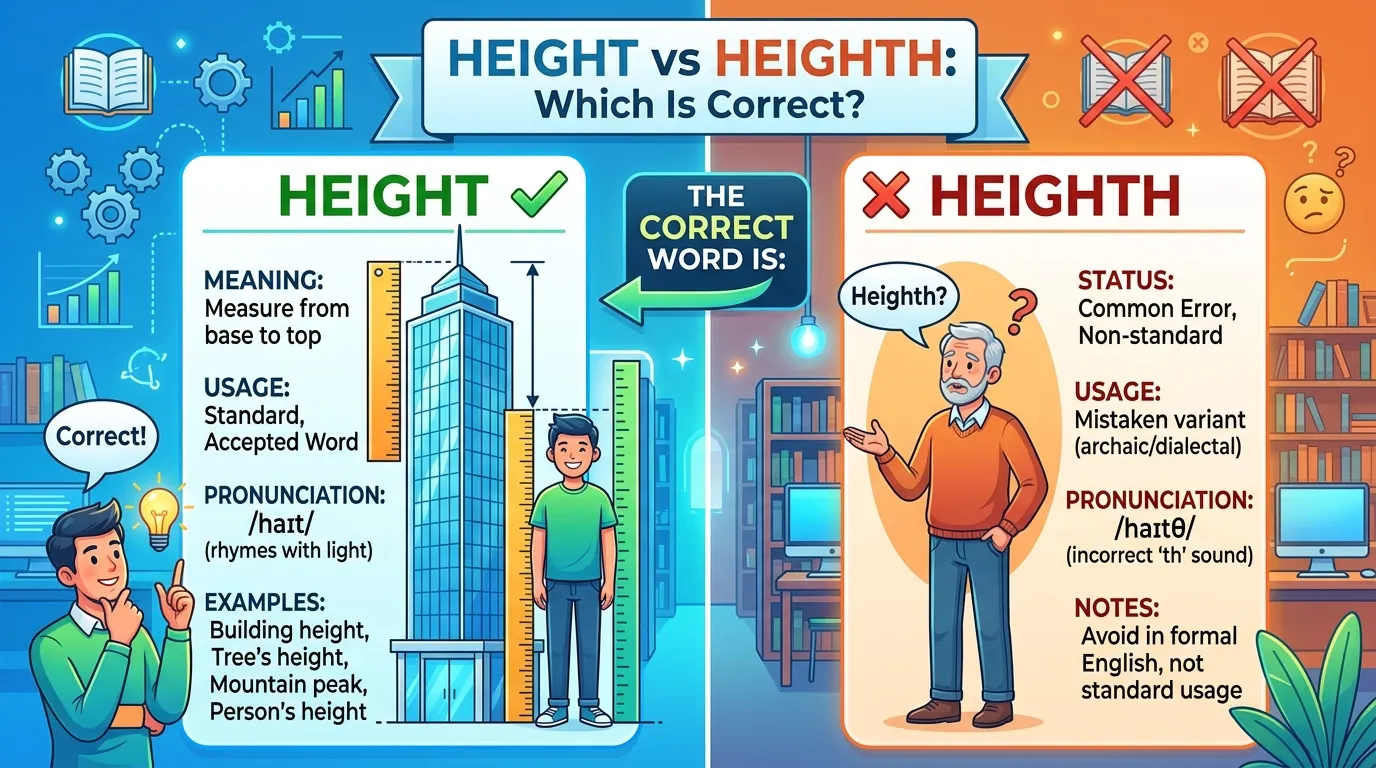
Height vs Heighth: Which Is Correct? Meaning, Usage, Pronunciation, and Examples

If you are wondering whether height or heighth is the correct spelling, the answer is simple: height is the standard English word. It is the form you should use in modern American English, British English, academic writing, business communication, journalism, and most other forms of formal or everyday writing.

Heighth is a nonstandard or dialectal variant that has appeared in English, and some dictionaries record it as a historical or regional form. You may hear or see it occasionally, but it is not the normal spelling used in standard written English.

For example:

  • Correct: The height of the building is 200 feet.
  • Standard: What is your height?
  • Nonstandard/dialectal: What is your heighth?

This guide explains the difference between height and heighth, including their meanings, pronunciation, grammar, history, regional use, common mistakes, synonyms, collocations, and examples. By the end, you will know exactly which form to choose and when.

Quick Answer: Height or Heighth?

Height is the correct standard spelling.

WordStandard English?MeaningRecommended use
heightYesHow tall or high something isUse everywhere
heighthGenerally nonstandard/dialectalSame basic meaning as heightAvoid in standard writing

The easiest rule to remember

Use height whenever you mean the measurement of how tall, high, or elevated something is.

The height of the mountain is impressive.

She measured the height of the wall.

What is the height of the basketball hoop?

Heighth may occur in regional speech, older usage, or informal writing that reflects pronunciation, but it should not normally replace height.

What Does Height Mean?

Height is a noun that refers to the measurement or extent of something from its bottom to its top.

It can describe people, animals, buildings, objects, mountains, trees, walls, waves, and many other things.

For example:

  • The height of the door is seven feet.
  • He is six feet in height.
  • The tree has reached an impressive height.
  • The airplane was flying at a great height.
  • We measured the height of the fence.

The word can also describe a high point, either literally or figuratively.

Literal meaning of height

The literal meaning concerns physical distance from the bottom to the top.

The height of the tower is 300 meters.

The table has a height of 30 inches.

The doctor recorded the child’s height.

Figurative meaning of height

Height can also describe the greatest or most intense point of something.

For example:

The company reached the height of its success.

She was at the height of her career.

The excitement reached its height during the final minutes.

In these examples, height does not refer to physical measurement. It means a peak, highest point, or greatest level.

What Does Heighth Mean?

Heighth is a variant spelling of height that has been used in some regional, dialectal, historical, and nonstandard forms of English.

It generally carries the same basic meaning as height.

For example, someone might say:

What is the heighth of that building?

In standard modern English, however, this should normally be written:

What is the height of that building?

The extra h in heighth may seem logical because speakers sometimes perceive a final consonant sound that encourages the spelling -th. However, standard English spelling does not use heighth for the ordinary noun.

Is heighth a real word?

It depends on what is meant by “real word.”

Heighth has existed as a recorded variant of height, so it is not simply a random string of letters. Some dictionaries and historical sources have recognized forms like it.

However, that does not mean it is the preferred spelling in contemporary standard English.

There is an important difference between a word being attested and a word being recommended for standard usage.

A regional or historical dictionary may record heighth, while a modern writer should still choose height.

Height vs Heighth: The Main Difference

The main difference is standardness, not meaning.

Both forms can refer to the vertical measurement or high point of something, but height is the established standard form.

Compare:

The height of the mountain is 8,000 feet.

The heighth of the mountain is 8,000 feet.

The first sentence is standard English. The second may be understood, but heighth looks nonstandard to most readers.

This distinction matters especially in professional and educational writing.

Height is preferred in:

  • Academic papers
  • School assignments
  • Business documents
  • News articles
  • Technical manuals
  • Websites
  • Resumes
  • Reports
  • Government documents
  • Medical records
  • Sports statistics
  • Product descriptions
  • Formal correspondence
  • Standard dictionaries

Heighth may appear in:

  • Regional speech
  • Dialect writing
  • Historical texts
  • Informal transcriptions of speech
  • Some nonstandard writing
  • Discussions of language variation

Why Do People Confuse Height and Heighth?

The confusion largely comes from pronunciation and spelling patterns.

Many English words ending in -th contain a clearly visible th sound:

  • length
  • width
  • depth
  • breadth
  • warmth
  • strength

Because of these words, some speakers may expect height to have a similar-looking form such as heighth.

The spelling of height is unusual because its pronunciation does not obviously match its spelling.

Height is pronounced /haɪt/

The standard pronunciation is approximately:

height = hyte

The final sound is a /t/ sound, not a normal final th sound.

This is one reason the spelling can seem strange to English learners.

Compare:

  • height → /haɪt/
  • eight → /eɪt/
  • weight → /weɪt/

The spelling pattern in height is historically connected to older forms of English rather than being a straightforward representation of modern pronunciation.

How Do You Pronounce Height?

In standard English, height is pronounced:

/haɪt/

It rhymes with:

  • bite
  • light
  • might
  • night
  • right
  • sight
  • tight
  • white

For example:

The height of the wall is ten feet.

The word sounds like hite, with one syllable.

How is heighth pronounced?

When heighth occurs in speech, pronunciation can vary by speaker and dialect. It may be pronounced with an additional consonant sound compared with standard height.

That variation is one reason the spelling is associated with dialectal speech rather than standard written English.

If you are learning or teaching standard English, the safest choice is:

height → /haɪt/

Is Height a Noun or an Adjective?

Height is a noun.

It refers to a measurement, level, or high point.

Examples:

The height of the building is 50 meters.

Her height makes her easy to spot in a crowd.

The mountain reaches an incredible height.

The adjective is usually high, not height.

Compare:

  • Noun: The height of the tower is impressive.
  • Adjective: The tower is high.

You can also use tall when describing something or someone with considerable vertical length.

He is very tall.

The height of the basketball player is impressive.

Height vs Tall vs High

These words are related but are not interchangeable in every situation.

WordTypical roleExample
heightNounWhat is the height of the tree?
tallAdjectiveThat tree is tall.
highAdjective/adverbThe plane is flying high.
heighthNonstandard variantAvoid in standard writing

A useful rule is:

Height names the measurement.
Tall describes something with considerable vertical size.
High describes something that is far above the ground or at an elevated level.

Examples:

The building has a height of 100 meters.

The building is tall.

The building rises high above the city.

Height in Measurements

One of the most common uses of height involves measurement.

You may measure height in:

  • Inches
  • Feet
  • Centimeters
  • Meters
  • Millimeters
  • Yards

Examples:

The height of the door is 80 inches.

The athlete’s height is 1.95 meters.

The fence has a height of six feet.

In American English, people commonly discuss a person’s height in feet and inches.

He is six feet two inches tall.

The more formal noun construction is:

His height is six feet two inches.

Both are grammatical, although the first sounds more natural in everyday conversation.

Common Collocations With Height

A collocation is a group of words that naturally occur together.

Learning common collocations can help you use height naturally.

Common height collocations

  • height measurement
  • height difference
  • height limit
  • height requirement
  • height restriction
  • average height
  • maximum height
  • minimum height
  • full height
  • total height
  • overall height
  • standing height
  • ceiling height
  • building height
  • tree height
  • wave height
  • mountain height
  • height adjustment
  • height increase
  • height chart

Examples:

The elevator has a maximum height limit.

The doctor recorded his standing height.

The bridge has a strict height restriction.

The product’s overall height is 12 inches.

Common Phrases and Expressions With Height

The word height appears in several common expressions.

At the height of

This means at the most intense or successful point of something.

The band was at the height of its popularity.

The storm reached the height of its intensity overnight.

At the height of summer

This refers to the middle or hottest part of summer.

We visited the coast at the height of summer.

Height of fashion

This expression refers to something considered extremely fashionable, although it can sound somewhat old-fashioned.

That style was once the height of fashion.

Height of success

This means the highest point of someone’s achievement or success.

She reached the height of her career.

From a height

This refers to something being viewed, dropped, or experienced from an elevated position.

The bird looked down from a great height.

Height in Sports

Height is especially important in sports where physical reach or body size can influence performance.

Examples include:

  • Basketball
  • Volleyball
  • High jump
  • Swimming
  • Boxing
  • Wrestling
  • Football
  • Soccer
  • Track and field

Examples:

The player’s height gives him an advantage near the basket.

The goalkeeper’s height helps him reach high shots.

The athlete cleared the bar at an impressive height.

Sports writing almost always uses height, not heighth.

Height and athletic measurements

Sports profiles commonly use expressions such as:

  • Player height
  • Listed height
  • Official height
  • Height advantage
  • Height difference
  • Height requirement

Example:

The two players have a significant height difference.

Height in Technical and Professional Writing

Height is the standard term in technical fields.

It may refer to dimensions, positioning, elevation, or measurement.

Construction

The wall must reach a minimum height of eight feet.

Engineering

The maximum operating height is 25 meters.

Aviation

The aircraft maintained a safe flight height.

Architecture

The building’s overall height was reduced during the redesign.

Manufacturing

Check the height of the component before installation.

Medicine

The patient’s height and weight were recorded.

In technical documentation, heighth should generally be avoided because readers expect the standard form height.

Height in Academic Writing

Academic writing strongly favors height.

Examples:

The study examined the relationship between body height and athletic performance.

Researchers measured the height of each participant.

The average height increased slightly across the sample.

Using heighth in an academic paper could make the writing appear careless or nonstandard unless you are specifically discussing dialect or historical language.

Better academic alternatives

Instead of:

The heighth of the structure was measured.

Write:

The height of the structure was measured.

Or:

Researchers measured the vertical height of the structure.

Height in Business Writing

Business communication also uses height.

Examples:

Please confirm the height of the display before production.

The product has a height of 24 inches.

The height restriction may affect transportation costs.

We need the exact height measurement before finalizing the design.

For proposals, specifications, emails, reports, and product documentation, height is the clear choice.

Height in Journalism and News Writing

Journalists use height because it is the standard noun.

Examples:

The storm produced waves reaching a height of 20 feet.

The suspect was described as approximately six feet in height.

The building has an estimated height of 500 feet.

A news publication would generally avoid heighth unless the word were relevant to a quotation, dialect, historical source, or language discussion.

Height in Casual Conversation

Even in casual speech, height is the normal form.

You might hear:

What’s your height?

But a more natural everyday question is:

How tall are you?

Similarly:

What’s the height of that tree?

is grammatical, while:

How tall is that tree?

is often more conversational.

This shows that choosing between height and tall is sometimes a matter of style rather than correctness.

Height vs Heighth in American English

In modern American English, height is overwhelmingly the preferred standard form.

If you are writing for an American audience, use height in virtually every ordinary situation.

This applies to:

  • School writing
  • Websites
  • Social media
  • Professional documents
  • Technical content
  • News
  • Business communication
  • Product descriptions
  • Medical writing
  • Sports writing

You might encounter heighth in regional speech or older material, but it is not the form to choose for standard American English.

Height vs Heighth in British English

British English also uses height as the standard form.

For example:

The height of the building is 50 metres.

The spelling difference between American and British English here is not height vs heighth.

Instead, other measurement terms may differ in style, but height remains the standard noun.

So if you are writing for either American or British readers, height is the safest choice.

Is Heighth a Misspelling?

In most modern standard-writing contexts, heighth would be treated as a nonstandard spelling or an incorrect choice.

However, calling every occurrence simply a “misspelling” can overlook the word’s historical and dialectal background.

Some speakers genuinely use or have used heighth as a variant.

Therefore, the most accurate practical description is:

Heighth is a nonstandard or dialectal variant of height, while height is the standard form.

This distinction is especially useful for editors, teachers, linguists, and writers who encounter the word in historical or regional material.

Why Height Is Spelled Without the Extra H

English spelling preserves many historical forms that do not perfectly match modern pronunciation.

Height developed from older forms associated with words meaning high or elevated. Over time, pronunciation changed significantly while the traditional spelling remained.

This is why height looks unusual compared with how it sounds.

The spelling is not meant to be read as though it were:

high-th

Instead, modern standard pronunciation is:

height → /haɪt/

English has many words whose spelling reflects earlier stages of the language.

Other examples include:

  • knight
  • though
  • daughter
  • weight
  • eight

The historical development of English helps explain these irregular-looking spellings.

Height, Weight, and Eight: A Useful Spelling Pattern

A useful way to remember height is to connect it with familiar words such as weight and eight.

Compare:

  • height → /haɪt/
  • weight → /weɪt/
  • eight → /eɪt/

Although the vowel sounds differ, these words share historical spelling patterns.

This can help English learners remember that height does not need an additional h before the final t.

Synonyms for Height

Depending on the context, several words can replace height.

For physical measurement

  • elevation
  • altitude
  • vertical measurement
  • stature
  • size

However, these words are not always exact substitutes.

For example, stature usually refers to a person’s physical size or height, while altitude often refers to elevation above sea level or another reference point.

For a highest point

  • peak
  • summit
  • pinnacle
  • high point
  • climax
  • maximum
  • apex

Examples:

The mountain reached its greatest height.

The mountain reached its peak.

These can be similar but may carry different meanings.

Antonyms and Contrasting Words

There is no single perfect antonym for height in every context.

Depending on meaning, contrasting concepts include:

  • depth
  • low point
  • bottom
  • base
  • shortness
  • low elevation

For physical dimensions, depth may contrast with height.

For levels or achievement, low point may contrast with height.

Example:

The company went from the height of success to a difficult low point.

Common Mistakes With Height

Mistake: Writing heighth in formal English

Incorrect or nonstandard:

The heighth of the building is 100 feet.

Better:

The height of the building is 100 feet.

Mistake: Pronouncing height like height-th

Standard pronunciation:

height → /haɪt/

Not:

high-th

Mistake: Using height as an adjective

Incorrect:

He is very height.

Correct:

He is very tall.

Or:

His height is impressive.

Mistake: Confusing height and high

Incorrect:

The height mountain is visible.

Correct:

The high mountain is visible.

Or:

The mountain has an impressive height.

Mistake: Confusing height and altitude

These words overlap but are not identical.

Height is a broad term for vertical measurement.

Altitude often describes elevation above a particular reference level, especially sea level.

For example:

The height of the building is 300 meters.

The airplane reached an altitude of 30,000 feet.

Awkward vs Natural Examples

Awkward or nonstandardNatural standard English
What is the heighth of the wall?What is the height of the wall?
His heighth is six feet.His height is six feet.
The heighth limit is five feet.The height limit is five feet.
She has a great heighth.She is very tall.
Measure the heighth carefully.Measure the height carefully.

The left-hand examples may still be understandable. The issue is that height is the expected standard form.

Formal vs Informal Ways to Talk About Height

Different contexts call for different expressions.

Formal

Please provide your exact height.

The structure has a total height of 40 meters.

Neutral

What is your height?

The height of the table is 30 inches.

Informal

How tall are you?

How tall is that building?

In everyday conversation, How tall…? is often more natural than What is the height…?

Both are correct.

Natural Examples of Height

Here are examples from different contexts:

People

Her height makes her easy to recognize in a crowd.

Buildings

The height of the skyscraper dominates the skyline.

Nature

The height of the waterfall is difficult to estimate from the ground.

Furniture

Check the height of the desk before buying it.

Vehicles

The vehicle cannot enter because of the parking garage’s height restriction.

Weather

The storm produced waves of unusual height.

Sports

The athlete’s height gives her an advantage in volleyball.

Career

He reached the height of his career in his early forties.

Emotion

At the height of the celebration, the entire crowd began singing.

A Simple Memory Trick for Height

Here is an easy way to remember the correct spelling:

Height ends in T, not T-H.

Think:

Height rhymes with eight.

You say:

height → h + eight sound

not:

high + th

Another useful reminder is:

How tall? → height.

If you are talking about how tall something is, the noun you need is height.

When Might Heighth Be Appropriate?

There are limited situations in which you might intentionally reproduce heighth.

For example, a linguist studying regional speech might write:

The speaker used the dialectal form heighth.

A historical writer might discuss:

Older variants of height included forms that differed from modern standard spelling.

A novelist might use nonstandard spelling to represent a character’s speech, although this should be done carefully.

In these cases, the unusual spelling is itself part of the subject.

For ordinary communication, however, there is no advantage to choosing heighth.

Should Bloggers and Content Writers Use Height or Heighth?

Bloggers and online writers should use height.

This is particularly important for:

  • SEO articles
  • Product descriptions
  • Educational websites
  • Health content
  • Sports blogs
  • Travel content
  • Real estate pages
  • Technical websites
  • News websites

For example:

Learn how to measure the height of a wall accurately.

is appropriate.

Using heighth may distract readers and can make otherwise professional content appear poorly edited.

If your target keyword contains heighth, you can discuss the spelling in the article, but your normal prose should still use height.

Height vs Heighth: SEO and Search Intent

People searching for height vs heighth are usually trying to answer one of several questions:

  • Is heighth a word?
  • Is height spelled with an extra h?
  • What is the correct spelling of height?
  • How do you pronounce height?
  • Why is height spelled strangely?
  • Is heighth correct in American English?
  • What is the difference between height and heighth?
  • Is heighth a real English word?
  • How do you use height in a sentence?

The practical answer remains consistent:

Height is the standard spelling. Heighth is a nonstandard or dialectal variant.

This is an important distinction because English contains many words that are historically attested but are not preferred in modern standard writing.

Quick Comparison: Height vs Heighth

FeatureHeightHeighth
Standard spellingYesNo, generally
Common todayVery commonUncommon
MeaningVertical measurement/high pointVariant of height
Part of speechNounNoun when used
Standard American EnglishYesAvoid
Standard British EnglishYesAvoid
Academic writingRecommendedAvoid
Business writingRecommendedAvoid
Technical writingRecommendedAvoid
Casual speechNormalRegional/nonstandard
Historical usageYesYes, as a variant
Pronunciation/haɪt/Varies by dialect
Best choiceHeightUsually avoid

Height vs Heighth: Which One Should You Use?

Choose height almost every time.

Use height when:

  • You are writing a school assignment.
  • You are writing professionally.
  • You are creating website content.
  • You are writing for an international audience.
  • You are writing technical instructions.
  • You are describing a person’s measurements.
  • You are discussing sports statistics.
  • You are describing buildings or objects.
  • You are writing a formal document.
  • You want standard American or British English.

Use heighth only when the specific context requires a historical, dialectal, or linguistic reference.

Frequently Asked Questions

Is height or heighth correct?

Height is the standard and recommended spelling. Heighth is a nonstandard or dialectal variant that has been recorded historically and regionally.

Is heighth a real word?

Yes, heighth has been used and recorded as a variant of height, particularly in historical or dialectal English. However, it is not the standard spelling for modern formal writing.

How do you spell height correctly?

The standard spelling is height: H-E-I-G-H-T.

Is height pronounced with a th sound?

No. In standard English, height is pronounced /haɪt/, rhyming with light, night, and right.

Why do people spell height as heighth?

The spelling heighth may arise from pronunciation, analogy with words ending in -th, regional speech patterns, or attempts to make the spelling seem more regular.

Is heighth acceptable in American English?

It can occur as a regional or nonstandard form, but height is the appropriate choice in standard American English.

Is heighth acceptable in British English?

British English also uses height as the standard spelling. Heighth is not the normal form in standard British writing.

What is the difference between height and high?

Height is a noun referring to vertical measurement or a high point. High is generally an adjective or adverb describing something elevated.

For example:

The building has a great height.

The building is high.

What is the adjective form of height?

There is no ordinary adjective formed directly from height. Common adjectives used in related contexts include high and tall.

For example:

The wall is high.

The man is tall.

What is the plural of height?

The plural is heights.

Examples:

The aircraft reached great heights.

The two buildings have different heights.

Can height have a figurative meaning?

Yes. Height can mean the highest point, greatest level, or peak of something.

For example:

She was at the height of her career.

Final Verdict: Height vs Heighth

When choosing between height and heighth, there is a clear practical winner: height.

Height is the standard noun used for the vertical measurement of a person, object, building, mountain, wave, or other thing. It can also refer figuratively to a peak or highest point, as in the height of success or at the height of summer.

Heighth, by contrast, is a nonstandard or dialectal variant. It has historical and regional uses, so it is not entirely meaningless or invented. However, it is not the form you should normally use in modern standard English.

For American English, British English, academic writing, business communication, journalism, technical writing, sports writing, blogging, and everyday standard usage, choose height.

The simplest rule is:

Use height. Avoid heighth unless you are specifically discussing dialect, historical usage, or a character’s nonstandard speech.

If you remember only one thing from this guide, remember that height is spelled H-E-I-G-H-T and pronounced /haɪt/. The unusual spelling is a feature of English history, not a reason to add another h.

Leave a Comment