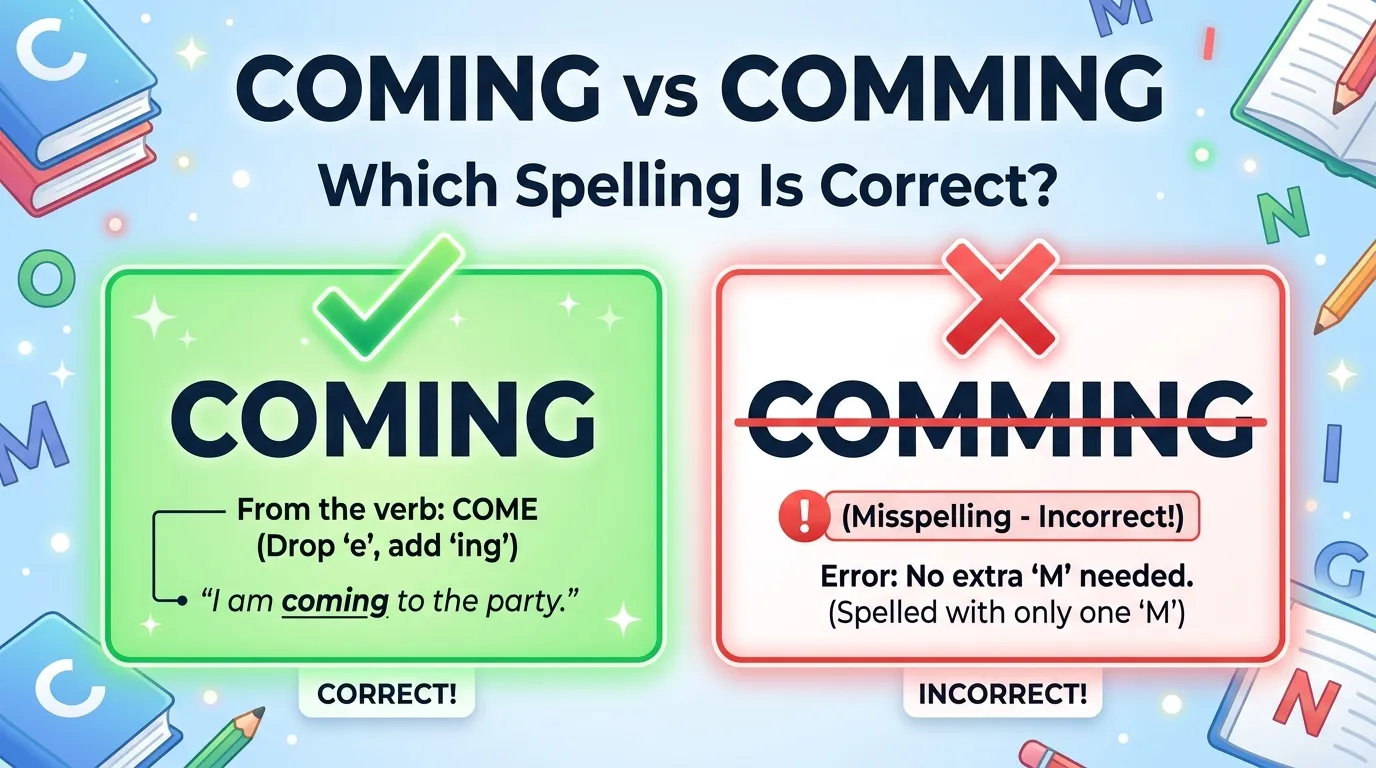
Coming vs Comming: Which Spelling Is Correct?

If you are wondering whether “coming” or “comming” is the correct spelling, the answer is simple: coming is correct, while comming is a misspelling in standard English.

The confusion usually happens because many English verbs double their final consonant before adding -ing. For example, run becomes running, sit becomes sitting, and stop becomes stopping. However, come does not follow that pattern. Its -ing form is coming, not comming.

This small spelling difference matters in school assignments, emails, resumes, business writing, websites, social media posts, and everyday communication.

In this guide, you will learn the difference between coming and comming, why the mistake happens, how to remember the correct spelling, how coming is used as a verb, adjective, and noun, and which related words and expressions are worth knowing.


Quick Answer: Coming or Comming?

Coming is the correct spelling.

Comming is incorrect in standard English.

SpellingCorrect?Example
coming✅ YesI am coming home.
comming❌ NoI am comming home.

The word coming is the present participle and -ing form of the verb come. It can describe movement toward a person or place, an approaching event, something happening soon, or a process of change. Standard dictionaries list coming as the correct form.

Correct:

She is coming to the office tomorrow.

Incorrect:

She is comming to the office tomorrow.

The easiest rule is:

come + ing = coming

Notice that the final e is removed before -ing is added:

come → coming

You do not double the m.


Coming vs Comming: The Main Difference

The difference is primarily one of spelling and grammatical correctness.

Coming

Coming is the standard English spelling.

It is commonly used as:

  • The present participle of come
  • Part of a progressive verb phrase
  • An adjective
  • A noun in certain expressions

Examples:

  • I am coming home.
  • They are coming to the party.
  • The coming week will be busy.
  • We are preparing for the coming election.
  • The coming of spring brought warmer weather.

Comming

Comming is not the standard spelling of the -ing form of come.

For normal English writing, do not use:

  • comming soon
  • comming home
  • comming tomorrow
  • comming back
  • comming to town
  • comming next week

Instead, write:

  • coming soon
  • coming home
  • coming tomorrow
  • coming back
  • coming to town
  • coming next week

Why Do People Spell “Coming” as “Comming”?

The mistake is understandable because English has many verbs that double a final consonant before adding -ing.

Consider these examples:

Base verb-ing form
runrunning
sitsitting
swimswimming
stopstopping
planplanning
getgetting
beginbeginning

Because learners see this pattern so often, they may assume:

come → comming

But English spelling does not work that way here.

The correct transformation is:

come → coming

The final e disappears, and the m remains single.


The Spelling Rule Behind “Coming”

The word come ends in a silent e.

When many verbs ending in silent e take -ing, the e is removed.

For example:

  • make → making
  • take → taking
  • write → writing
  • drive → driving
  • use → using
  • move → moving
  • come → coming

So:

come + ing → coming

Not:

come + ing → comming

And not:

comming

The important point is that the m is not doubled.


Why “Run” Becomes “Running” but “Come” Becomes “Coming”

This is one of the most common questions behind the coming vs comming spelling confusion.

Compare:

Run → running

The word run has a short vowel followed by a single final consonant. In its -ing form, the consonant is doubled:

run → running

Come → coming

The word come ends with a silent e, so the e is removed:

come → coming

The spelling patterns are therefore different.

VerbCorrect -ing formWhat happens?
runrunningFinal consonant doubles
sitsittingFinal consonant doubles
stopstoppingFinal consonant doubles
makemakingSilent e disappears
taketakingSilent e disappears
writewritingSilent e disappears
comecomingSilent e disappears

This is why comming should not be treated as the equivalent of running or sitting.


What Does “Coming” Mean?

Coming has several related meanings.

The most basic meaning is moving toward a person, place, or destination.

For example:

The train is coming.

Are you coming with us?

She is coming to my house.

The verb come can describe movement toward the speaker, toward the listener, or toward a place associated with the conversation. It can also mean arriving.

But coming has broader uses.

It can also refer to something that is:

  • Approaching
  • About to happen
  • Arriving
  • Developing
  • Becoming noticeable
  • Expected in the near future

For example:

The coming year may bring new opportunities.

Here, coming does not mean physically walking toward someone. It means the next or approaching year.


“Coming” as a Verb

The most common grammatical use of coming is as the present participle of come.

It appears in progressive forms such as:

  • am coming
  • is coming
  • are coming
  • was coming
  • were coming
  • will be coming
  • has been coming
  • have been coming

Examples

I am coming now.

She is coming home.

They are coming tomorrow.

We were coming down the road when it started raining.

He has been coming here for years.

More customers will be coming later.

The word remains spelled coming in every case.


“Coming” as an Adjective

Coming can also function as an adjective meaning approaching, upcoming, or happening soon.

For example:

We need to prepare for the coming winter.

The coming election will attract a lot of attention.

She is excited about the coming holiday.

The coming months will be important.

This meaning is especially common before nouns such as:

  • coming year
  • coming week
  • coming months
  • coming season
  • coming election
  • coming generation
  • coming changes
  • coming events
  • coming decade
  • coming challenge

Cambridge Dictionary defines this adjective use as referring to something that is happening soon or approaching in time.


“Coming” as a Noun

Coming can also be used as a noun, although this use is less common in everyday conversation.

Examples include:

the coming of spring

the coming of a new era

the coming of age

The noun can refer to arrival or the act of coming.

One familiar expression is:

Coming of age

Coming of age refers to the transition from childhood or youth into adulthood.

Example:

The novel is a coming-of-age story.

Another expression is:

Comings and goings

This refers to the movements or arrivals and departures of people.

Example:

There were constant comings and goings at the hotel.


Coming vs Comming Pronunciation

Both spellings may look as though they should sound different, but comming is not the standard spelling of this word.

The correct word coming is generally pronounced:

/ˈkʌmɪŋ/

It sounds approximately like:

KUM-ing

Examples:

  • coming
  • coming home
  • coming soon
  • coming back

The word come is pronounced approximately /kʌm/, and its -ing form is coming.

A useful way to remember the pronunciation is:

come → KUM
coming → KUM-ing

There is no need to add another m in the spelling.


Coming vs Comming in American English

In American English, coming is the standard spelling.

Use:

The new store is coming soon.

Not:

The new store is comming soon.

Use:

Are you coming with us?

Not:

Are you comming with us?

Use:

I am coming back tomorrow.

Not:

I am comming back tomorrow.

There is no standard American-English spelling variation that changes coming to comming.


Coming vs Comming in British English

British English also uses coming.

Examples:

She is coming to London next week.

The coming months will be difficult.

Are you coming with us?

Therefore, this is not a case where American and British English use different spellings.

American English:

coming

British English:

coming

Standard international English:

coming

Comming remains a misspelling.


Coming vs Comming in Academic Writing

Academic writing requires careful spelling and grammar, so use coming, never comming.

Incorrect:

The comming years will bring significant changes.

Correct:

The coming years will bring significant changes.

Incorrect:

Students should prepare for the comming examination.

Correct:

Students should prepare for the coming examination.

In formal academic writing, you can sometimes replace coming with more precise words such as:

  • upcoming
  • forthcoming
  • approaching
  • future
  • next

For example:

The upcoming examination will cover three major topics.

However, coming is perfectly grammatical and natural.


Coming vs Comming in Business Writing

Business communication also requires the correct spelling.

Natural:

We look forward to seeing you at the coming conference.

Our company will launch a new product in the coming months.

The coming quarter may present several challenges.

More formal alternatives:

  • upcoming quarter
  • forthcoming meeting
  • next fiscal year
  • approaching deadline
  • future projects

For example:

Please prepare the report before the upcoming meeting.

This may sound more specific than:

Please prepare the report before the coming meeting.

Both can be correct depending on context.


Coming vs Comming in Journalism

News writing frequently uses coming to describe events that are approaching.

Examples:

The coming election could reshape the political landscape.

Officials are preparing for the coming storm.

The coming weeks may determine the team’s future.

Journalists may also prefer upcoming, forthcoming, or next, depending on the style and meaning.

Compare:

The coming election
A natural phrase referring to an approaching election.

The upcoming election
Also natural and especially common in American English.

The next election
More direct when discussing the election that follows the current one.


Coming vs Comming in Sports

The word coming is common in sports writing.

Examples:

The team is coming off a major victory.

The coming season will be crucial.

He is coming back from an injury.

The players are coming into the tournament with confidence.

A new coach is coming to the club.

Common sports expressions include:

  • coming off a win
  • coming into the season
  • coming back
  • coming from behind
  • coming through
  • coming up
  • coming next

Example:

The team is coming off three straight wins.

Here, coming off means the team has just experienced those wins.


Coming vs Comming in Technical Writing

Technical writing should use coming when the word is needed.

Examples:

The update is coming next month.

The system will support the coming release.

Engineers are preparing for the coming deployment.

However, technical writers often benefit from more precise language.

Instead of:

A new feature is coming.

You might write:

A new feature will be released next month.

Instead of:

Changes are coming soon.

You might write:

The changes will be implemented in June.

The principle is simple: use coming when it communicates the meaning clearly, but choose a more precise expression when timing matters.


Coming vs Comming in Blogging and SEO

Bloggers often use coming in phrases such as:

  • coming soon
  • coming next
  • coming year
  • coming months
  • coming trends
  • coming changes
  • coming updates
  • coming attractions

Example:

Here are five SEO trends to watch in the coming year.

The phrase coming year is natural and widely understood.

However, avoid forcing the keyword coming into sentences simply for SEO purposes. Good content should prioritize clarity and natural language.


“Coming Soon” vs “Upcoming”

These expressions are related but not always interchangeable.

Coming soon

Usually means something will happen or become available in the near future.

The new website is coming soon.

A major update is coming soon.

Upcoming

Usually describes an event or thing that is scheduled or expected in the future.

We are preparing for an upcoming meeting.

The upcoming concert is sold out.

Both are useful, but they have slightly different patterns.

ExpressionTypical use
coming soonSomething will happen shortly
upcoming eventAn event that will happen in the future
coming yearThe approaching year
upcoming yearAlso possible, but less common in some contexts
next yearThe year immediately after this one

Coming vs Forthcoming

Forthcoming can be a synonym for coming when something is expected or approaching.

Coming:

We are preparing for the coming changes.

Forthcoming:

We are preparing for the forthcoming changes.

Forthcoming tends to sound more formal.

It can also mean that someone is willing to provide information:

The manager was forthcoming with details.

In that sentence, coming would not work in the same way.


Coming vs Upcoming

These words overlap strongly.

Coming

The coming months will be difficult.

Upcoming

The upcoming meeting will be important.

Upcoming is particularly common in American English for events, meetings, releases, holidays, and other scheduled things. Cambridge specifically lists upcoming as a mainly U.S. synonym for the adjective coming.

Examples:

  • upcoming event
  • upcoming movie
  • upcoming election
  • upcoming meeting
  • upcoming release
  • upcoming holiday
  • upcoming season

Coming vs Approaching

Approaching often emphasizes that something is getting closer.

The deadline is approaching.

Winter is approaching.

Coming can sound more general:

The coming winter may be cold.

Both are useful, but they often fit different grammatical structures.

Compare:

The deadline is approaching.

Natural.

The approaching deadline is causing stress.

Natural.

The coming deadline is causing stress.

Possible, but less natural.


Synonyms for Coming

Depending on the meaning, useful alternatives include:

  • approaching
  • upcoming
  • forthcoming
  • arriving
  • advancing
  • impending
  • next
  • future
  • oncoming
  • expected

Example:

The coming storm could be dangerous.

Possible alternatives:

The approaching storm could be dangerous.

The incoming storm could be dangerous.

The impending storm could be dangerous.

The best synonym depends on the exact context.


Antonyms of Coming

The opposite of coming depends on the meaning.

If coming means moving toward a place, possible opposites include:

  • going
  • leaving
  • departing
  • retreating

Example:

She is coming home.

Opposite:

She is leaving home.

If coming means approaching in time, possible contrasts include:

  • past
  • previous
  • former
  • gone
  • finished

Example:

the coming year

Contrast:

the previous year


Common Collocations With “Coming”

A collocation is a group of words that naturally appear together.

Common collocations with coming include:

Time

  • coming year
  • coming week
  • coming months
  • coming decade
  • coming years
  • coming season

Events

  • coming election
  • coming meeting
  • coming event
  • coming competition
  • coming conference

Movement

  • coming home
  • coming back
  • coming over
  • coming in
  • coming out
  • coming down
  • coming up

Development

  • coming changes
  • coming challenges
  • coming developments
  • coming opportunities

Learning these combinations can help English learners write more naturally.


Common Expressions With “Coming”

Here are several everyday expressions worth knowing.

Coming soon

Something will happen or become available shortly.

New episodes coming soon.

Coming back

Returning to a place, activity, or situation.

I am coming back tomorrow.

Coming home

Returning home.

What time are you coming home?

Coming up

Approaching or about to happen.

We have an important test coming up.

Coming along

Progressing or developing.

How is your project coming along?

Coming from

Originating from a place or source.

Where are you coming from?

Coming through

Successfully reaching or completing something.

She came through when we needed her most.

Coming of age

Reaching adulthood or maturity.

It is a coming-of-age story.


“Come” and “Coming”: Grammar Forms

Understanding the different forms of come can help prevent spelling mistakes.

FormWord
Base formcome
Third-person singularcomes
Past tensecame
Past participlecome
Present participlecoming

Examples:

I come here every day.

She comes here every day.

She came here yesterday.

She has come to help us.

She is coming tomorrow.

Notice that only the final form uses -ing:

come → coming

Not comming.


Common Mistakes With Coming

Mistake 1: Writing “comming”

Comming soon

Coming soon


Mistake 2: Keeping the final e

Comeing

Coming

The final e is removed.


Mistake 3: Adding an extra m

Comming

Coming

The m is not doubled.


Mistake 4: Confusing “coming” and “come”

❌ I am come tomorrow.

✅ I am coming tomorrow.

The progressive form requires coming.


Mistake 5: Confusing “coming” and “going”

These words describe movement from different perspectives.

Are you coming to my house?

This normally suggests movement toward the speaker or the relevant destination.

Are you going to the store?

This normally describes movement away from the speaker or toward another destination.

The distinction depends on perspective and context.


Awkward vs Natural Examples

Awkward/IncorrectNatural
I am comming home.I am coming home.
The movie is comming soon.The movie is coming soon.
Are you comming with us?Are you coming with us?
The comming year will be difficult.The coming year will be difficult.
She is comming tomorrow.She is coming tomorrow.
A new update is comming.A new update is coming.
We have a big event comming up.We have a big event coming up.

Memory Tricks for “Coming”

If you repeatedly write comming, try one of these memory tricks.

Trick 1: Remember “Come Loses E”

Think:

COME loses E → COMING

The word does not gain another m.


Trick 2: Say It in Two Steps

Start with:

COME

Remove E:

COM

Add ING:

COMING


Trick 3: Compare “Make”

You probably already know:

make → making

So remember:

come → coming

Both remove the silent e.


Trick 4: The One-M Rule

When spelling coming, remember:

One M is enough.

C-O-M-I-N-G


Is “Comming” Ever Correct?

For standard English, no. If you are writing an ordinary English sentence and mean the -ing form of come, use coming.

A sequence resembling comming might appear as part of an unusual proper name, username, brand name, historical spelling, typo, or another language, but that does not make it the standard English spelling of coming.

For normal English:

coming = correct

comming = incorrect


Word History and Etymology of “Coming”

The word coming has a long history in English.

The noun coming, meaning a drawing near or arrival, dates back to the late 13th century. By the mid-15th century, it was also used as a present-participle adjective meaning approaching in space or time. It developed from the verb come.

The verb come itself is much older. It goes back to Old English cuman, meaning to move toward or arrive, and is related to words for “come” in several Germanic languages. Its history extends even further to an ancient Indo-European root associated with going or coming.

This history helps explain why coming is an established English form rather than a modern spelling created by adding letters mechanically.


Literal and Figurative Uses of Coming

The literal meaning usually involves movement.

The children are coming toward us.

But coming is also widely used figuratively.

A coming change

The coming changes may affect everyone.

Here, nobody is physically moving. The change is approaching in time.

A coming opportunity

We should prepare for the coming opportunities.

The opportunities are expected in the future.

Coming to understand

I am coming to understand the problem.

Here, coming to understand means gradually reaching a state of understanding.

Coming to an end

The project is coming to an end.

This means the project is approaching completion.


Professional Recommendations by Writing Context

ContextRecommended usage
American Englishcoming
British Englishcoming
International Englishcoming
Academic writingcoming, or a more precise alternative
Business writingcoming, upcoming, forthcoming, or next
Journalismcoming, upcoming, approaching, depending on context
Technical writingcoming when accurate; prefer precise dates when possible
Sports writingcoming is very common
Bloggingcoming is natural
Casual messagescoming
Social mediacoming
School assignmentscoming
Formal reportscoming, upcoming, or forthcoming
SEO contentcoming when naturally relevant

Coming vs Comming: Final Comparison

FeatureComingComming
Standard English?✅ Yes❌ No
Correct spelling of come + -ing?✅ Yes❌ No
Used in American English?✅ Yes❌ No
Used in British English?✅ Yes❌ No
Present participle of come?✅ Yes❌ No
Can be an adjective?✅ Yes❌ No
Can be a noun?✅ Yes, in some uses❌ No
Pronunciation/ˈkʌmɪŋ/Not standard
ExampleShe is coming home.She is comming home. ❌

10 Correct Everyday Examples With “Coming”

  1. I am coming home after work.
  2. Are you coming to the party tonight?
  3. She is coming over this afternoon.
  4. The bus is coming now.
  5. We are coming back tomorrow.
  6. The coming week will be very busy.
  7. A new update is coming soon.
  8. The coming months will be important.
  9. Are you coming with us?
  10. The holidays are coming up quickly.

Each sentence uses coming, never comming.


When Should You Use “Coming”?

Use coming when you mean:

  • Moving toward someone
  • Moving toward a place
  • Arriving
  • Returning
  • Approaching
  • Happening soon
  • Developing or progressing
  • Reaching a particular state in certain expressions

Examples:

He is coming to the office.

Spring is coming.

The deadline is coming up.

She is coming back next week.

The coming year may be challenging.


When Should You Use “Upcoming” Instead?

Use upcoming when you want to clearly describe a future event, especially one that is scheduled or expected.

Examples:

our upcoming meeting

the upcoming election

an upcoming conference

the upcoming season

an upcoming product launch

However, coming remains completely correct:

our coming meeting

the coming election

the coming season

The choice often depends on style and context rather than grammar.


Frequently Asked Questions

1. Is it “coming” or “comming”?

Coming is correct. Comming is a misspelling in standard English.

The correct form of come + -ing is coming.


2. Why is “comming” wrong?

Because the verb come ends in a silent e. When it takes -ing, the final e is removed:

come → coming

The m is not doubled.


3. Is “coming” a real word?

Yes. Coming is the present participle of come and can also function as an adjective or noun in certain contexts.

Examples include:

She is coming home.

the coming year

the coming of spring


4. Is “comming” ever an acceptable English spelling?

Not as the standard -ing form of come. In normal English writing, use coming.


5. Is “coming soon” correct?

Yes. Coming soon is a common and natural English expression meaning that something will happen or become available in the near future.

Example:

New episodes are coming soon.


6. Is “coming” correct in American English?

Yes. Coming is the standard spelling in American English.

Comming is not an American spelling variant.


7. Is “coming” correct in British English?

Yes. British English also uses coming.

There is no standard British spelling change from coming to comming.


8. Why does “running” have two Ns but “coming” has one M?

Because the spelling rules are different.

run → running doubles the final consonant.

come → coming removes the silent e.

Therefore:

running ✅

coming ✅

comming ❌


9. What is the difference between “coming” and “upcoming”?

Both can describe something in the future.

Coming is broader:

the coming year

Upcoming is especially common for future events:

the upcoming meeting

They can overlap, but the best choice depends on the sentence.


10. What is an easy way to remember the spelling of “coming”?

Remember:

COME loses the E, then add ING.

COME → COM → COMING

Never add another M.


Conclusion: Coming vs Comming

When choosing between coming vs comming, there is no complicated spelling debate: coming is the correct standard English spelling, and comming is a misspelling.

The correct form comes from the verb come:

come → coming

The final silent e is removed before -ing is added, but the m is not doubled.

This is different from verbs such as run, sit, and stop, which double their final consonants:

  • run → running
  • sit → sitting
  • stop → stopping

By contrast:

  • come → coming
  • make → making
  • take → taking
  • write → writing

Coming can function as the present participle of come, an adjective meaning approaching or happening soon, and a noun in expressions such as the coming of spring and coming of age.

For American, British, academic, business, journalistic, technical, sports, blogging, and casual writing, the recommendation is the same:

Use “coming.” Do not use “comming” when you mean the -ing form of “come.”

If you are unsure, remember the simplest spelling trick:

COME loses E + ING = COMING.

That one rule will help you avoid one of the most common spelling mistakes involving the verb come.

Leave a Comment