If you have ever wondered about airplane vs aeroplane, you are not dealing with two different types of aircraft. Airplane and aeroplane have the same basic meaning: a powered aircraft with fixed wings that flies through the air.
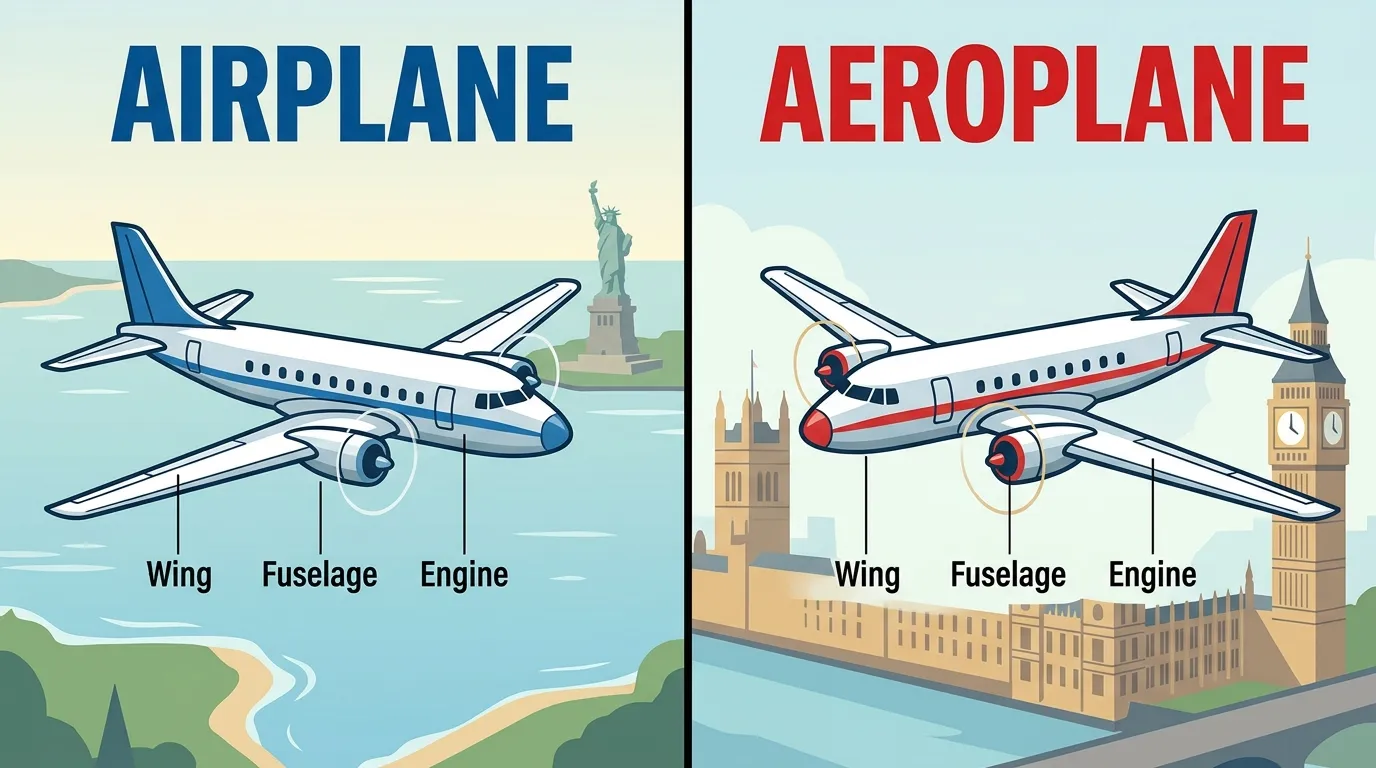
The main difference is regional spelling and usage. Airplane is the standard spelling in American English, while aeroplane is traditionally preferred in British English and is also common in several other varieties of English. Both spellings are correct, but your choice should depend mainly on the variety of English you are writing.
For example:
- American English: I booked an airplane ticket to Chicago.
- British English: We traveled by aeroplane to London.
This guide explains airplane vs aeroplane in detail, including their meanings, pronunciation, history, regional preferences, grammar, synonyms, common expressions, examples, formal and informal usage, and practical writing recommendations.
Quick Answer: Airplane vs Aeroplane
Airplane and aeroplane mean the same thing. The difference is primarily regional.
| Word | Main English Variety | Meaning | Example |
|---|---|---|---|
| airplane | American English | A powered fixed-wing aircraft | The airplane landed safely. |
| aeroplane | British English | A powered fixed-wing aircraft | The aeroplane landed safely. |
Which spelling should you use?
Use airplane when writing for an American English audience.
Use aeroplane when writing in British English or another variety that traditionally follows British spelling.
Neither spelling is inherently more correct. The important rule is consistency. If your article uses American English, use airplane. If you are writing in British English, aeroplane may be the better choice.
What Does Airplane Mean?

An airplane is a powered aircraft designed to fly through the atmosphere using wings and aerodynamic forces.
In everyday American English, airplane is the normal word for a fixed-wing aircraft.
Dictionary-style definition of airplane
Airplane (noun): A powered aircraft with fixed wings that is supported in flight by aerodynamic forces.
Example sentences
- The airplane took off at 7:30 a.m.
- We watched the airplane disappear into the clouds.
- Her airplane arrived earlier than expected.
- The pilot guided the airplane toward the runway.
- I always choose a window seat on an airplane.
In American English, airplane sounds completely natural in casual, professional, academic, journalistic, and technical writing.
What Does Aeroplane Mean?
Aeroplane has essentially the same meaning as airplane. It refers to a powered, fixed-wing aircraft capable of sustained flight.
The spelling aeroplane is especially associated with British English.
Dictionary-style definition of aeroplane
Aeroplane (noun): A powered fixed-wing aircraft designed to fly through the air.
Example sentences
- The aeroplane landed at Heathrow.
- We saw an aeroplane flying above the city.
- The aeroplane was delayed because of bad weather.
- She looked out of the window as the aeroplane took off.
- The pilot announced that the aeroplane would land shortly.
For British readers, aeroplane is a familiar and traditional term.
Are Airplane and Aeroplane Both Correct?
Yes. Both airplane and aeroplane are correct English spellings.
The difference is not mainly grammatical. It is a matter of regional language preference.
Think of them as similar to other American and British spelling differences:
- color / colour
- center / centre
- traveled / travelled
- theater / theatre
- airplane / aeroplane
The important point is that these differences do not normally change the underlying meaning.
Is “aeroplane” wrong in American English?
No. Americans can understand aeroplane, but it is not the normal modern American spelling. It may sound distinctly British or old-fashioned to some American readers.
Is “airplane” wrong in British English?
No. British speakers understand airplane, and the word appears in some contexts. However, aeroplane is the traditional British spelling and may sound more natural in general British usage.
Airplane vs Aeroplane: Key Differences
The easiest way to understand the distinction is to separate meaning from spelling preference.
| Feature | Airplane | Aeroplane |
|---|---|---|
| Meaning | Fixed-wing powered aircraft | Fixed-wing powered aircraft |
| American English | Very common | Uncommon |
| British English | Less traditional | Common/traditional |
| Pronunciation | Generally similar | Generally similar |
| Part of speech | Noun | Noun |
| Formal usage | Yes | Yes |
| Technical usage | Yes | Yes |
| Casual usage | Very common | Common in British contexts |
| Meaning difference | None | None |
So, if someone asks, “What is the difference between an airplane and an aeroplane?” the simplest answer is:
There is no meaningful difference in the aircraft being described. The difference is primarily regional spelling.
Why Do People Confuse Airplane and Aeroplane?
The confusion usually comes from exposure to different varieties of English.
Someone who learned American English may see aeroplane and wonder whether it is an outdated or incorrect spelling. Someone familiar with British English may see airplane and wonder whether it is an American variation.
Both assumptions miss the main point: English has multiple standard varieties.
The word itself combines ideas associated with air and plane, while the British spelling retains the form aero-, which is related to air and aviation.
International travel makes the difference even more noticeable. A person may read airplane on an American website, aeroplane in a British newspaper, and encounter both forms in international aviation contexts.
Airplane vs Aeroplane Pronunciation
The two words are generally pronounced similarly, although pronunciation can vary by accent.
A common pronunciation of airplane is approximately:
AIR-plane
A common pronunciation of aeroplane is approximately:
AIR-uh-plane
The exact pronunciation depends on the speaker’s regional accent.
Why does aeroplane have an extra syllable?
In many British pronunciations, aeroplane contains an additional vowel sound in the aero- portion.
This can make the words sound slightly different even though they refer to the same kind of aircraft.
Is Airplane a Noun or a Verb?
Airplane is primarily a noun.
It names an object or type of aircraft.
Examples:
- The airplane is on the runway.
- That airplane has four engines.
- I saw an airplane above the house.
It is not normally used as a standard verb in everyday English.
Grammatical role
Airplane: noun
Aeroplane: noun
Both can function as:
- singular nouns
- plural nouns
- subjects
- objects
- complements within sentences
Examples:
- Subject: The airplane landed.
- Object: We boarded the airplane.
- Plural: Several airplanes were waiting.
- Possessive: The airplane’s engine was inspected.
Plural Forms: Airplanes vs Aeroplanes
The plural forms follow normal English spelling patterns.
- Singular: airplane
- Plural: airplanes
And:
- Singular: aeroplane
- Plural: aeroplanes
Examples
American English:
Several airplanes were parked near the terminal.
British English:
Several aeroplanes were parked near the terminal.
Notice that the meaning remains the same.
Airplane vs Aeroplane in American English
If your target audience is primarily American, airplane should usually be your first choice.
This applies to:
- blog posts
- websites
- school assignments
- business writing
- news writing
- travel content
- technical explanations
- general conversation
- marketing copy
For example:
The airplane was delayed because of heavy rain.
This sounds natural to an American reader.
Using aeroplane is not necessarily incorrect, but it introduces a British spelling into an otherwise American-English sentence.
Best choice for American SEO content
If you are creating content specifically for the United States, use airplane naturally throughout the main article.
You can mention aeroplane when discussing the spelling difference, British English, or search intent.
For example:
In American English, airplane is the standard spelling, while British English commonly uses aeroplane.
That approach serves both readers and search intent without forcing the alternative spelling into every sentence.
Airplane vs Aeroplane in British English
In British English, aeroplane has traditionally been the preferred general term.
Examples:
- The aeroplane landed safely.
- We boarded the aeroplane at noon.
- The aeroplane was flying above the coastline.
However, modern British English also uses many aviation terms influenced by international and American usage. You may therefore encounter airplane in British contexts, especially in international material.
For traditional British prose, however, aeroplane remains a natural choice.
Airplane vs Aeroplane in International English
International English is more complicated because English is used across many countries and industries.
Writers may encounter both forms depending on:
- education system
- national spelling conventions
- media exposure
- aviation terminology
- audience
- publishing standards
- influence from American English
If you are writing for a worldwide audience, choose one spelling based on your editorial standard and stay consistent.
For example, an international website using American English can consistently use airplane. A publication following British English can consistently use aeroplane.
Airplane vs Aircraft: Are They the Same?
Not exactly.
Aircraft is a broader term.
An airplane is a type of aircraft, while aircraft can refer to different kinds of flying machines.
For example, aircraft may include:
- airplanes
- helicopters
- gliders
- other specialized flying vehicles
So:
An airplane is an aircraft.
But not every aircraft is an airplane.
Example
The airport handles many types of aircraft, including commercial airplanes and helicopters.
This sentence is more precise than using airplane as a general term for every flying machine.
Airplane vs Aeroplane vs Plane
Plane is the most common shortened everyday term.
In American English:
I need to catch my plane.
In British English:
I need to catch my plane.
Interestingly, plane is widely used across English varieties even though airplane and aeroplane differ regionally.
When should you use “plane”?
Use plane when the context is clear and you want a natural, conversational style.
Examples:
- The plane is boarding.
- Our plane was delayed.
- I left my bag on the plane.
- She is flying home tomorrow.
For technical or explanatory writing, airplane or aeroplane may provide greater precision.
Airplane vs Aircraft vs Plane: Comparison
| Term | Meaning | Typical Use |
|---|---|---|
| Airplane | Fixed-wing powered aircraft | American English |
| Aeroplane | Same as airplane | British English |
| Plane | Shorter everyday term | Casual/general |
| Aircraft | Broader category | Technical/formal |
Choosing the right word depends on the context.
Common Collocations With Airplane and Aeroplane
A collocation is a group of words that commonly appear together.
Common collocations with airplane
- airplane ticket
- airplane seat
- airplane window
- airplane pilot
- airplane mode
- airplane crash
- airplane cabin
- airplane engine
- airplane wing
- airplane flight
- airplane passenger
- commercial airplane
- private airplane
- passenger airplane
- military airplane
Common collocations with aeroplane
- aeroplane ticket
- aeroplane seat
- aeroplane window
- aeroplane pilot
- aeroplane engine
- aeroplane cabin
- commercial aeroplane
- passenger aeroplane
- aeroplane flight
- aeroplane wing
Some combinations are much more common in everyday speech than others.
For instance, airplane mode is a very familiar modern technology term in American English. In British English, people also commonly use the term airplane mode because it has become established as a technology label.
Common Expressions Related to Airplanes
English has many common phrases involving airplanes and flying.
“Board an airplane”
Meaning: enter an airplane before departure.
Passengers began to board the airplane at 6:15.
“Catch a plane”
Meaning: travel on a scheduled flight.
I need to catch a plane to Boston.
“Take off”
Meaning: when an aircraft leaves the ground.
The airplane took off on time.
“Land”
Meaning: when an aircraft comes down onto the ground.
The airplane landed safely.
“On the plane”
Meaning: physically inside an airplane.
I forgot to turn off my phone before getting on the plane.
“Plane ticket”
Meaning: a ticket for air travel.
She bought a plane ticket for her vacation.
Are There Figurative Meanings?
Airplane and aeroplane are normally literal nouns. They refer to aircraft.
However, words associated with flying can have figurative meanings.
For example:
- take off can mean to become successful quickly.
- land can mean to obtain something, such as a job.
- fly high can describe success or ambition.
- grounded can mean practical or sensible.
The figurative meaning usually belongs to the surrounding expression rather than to airplane or aeroplane themselves.
Example
Her new business really took off.
Here, took off does not mean that a business physically entered the sky. It means the business became successful quickly.
Synonyms for Airplane and Aeroplane
Depending on the context, possible alternatives include:
- plane
- aircraft
- passenger aircraft
- commercial aircraft
- jet
- airliner
- flying machine
However, these are not always exact synonyms.
Airplane vs jet
A jet usually refers to an aircraft powered by jet engines or, in casual use, a jet-powered airplane.
Therefore:
The jet landed.
is more specific than:
The airplane landed.
Airplane vs airliner
An airliner is generally a passenger aircraft designed for airline service.
Therefore, an airliner is a type of airplane, but not every airplane is an airliner.
Antonyms of Airplane
Strictly speaking, airplane has no direct antonym.
An antonym is a word with an opposite meaning. There is no single standard English word that means the exact opposite of airplane.
Depending on context, writers may contrast an airplane with:
- ground vehicle
- automobile
- train
- ship
- surface transport
These are contrasting categories, not true dictionary antonyms.
Airplane vs Aeroplane in Formal Writing
Both spellings can appear in formal writing.
The important consideration is your chosen variety of English.
American formal writing
Use:
The airplane industry has expanded rapidly.
British formal writing
Use:
The aeroplane industry has expanded rapidly.
However, aviation industry may be a more natural and professional phrase in many contexts.
Instead of:
The airplane industry has experienced major changes.
A professional writer might write:
The aviation industry has experienced major changes.
The second sentence is broader and often more precise.
Airplane vs Aeroplane in Academic Writing
Academic writing should follow the spelling conventions required by the institution, publication, or style guide.
If your paper follows American English, use airplane.
If it follows British English, use aeroplane when that is the preferred form.
Do not switch between the two without a reason.
Incorrectly inconsistent
The airplane took off before the aeroplane in the next gate departed.
This sounds as though the writer is describing two different types of aircraft.
Better
The airplane took off before the other airplane departed.
Or, in British English:
The aeroplane took off before the other aeroplane departed.
Airplane vs Aeroplane in Journalism
News organizations often follow their own style rules.
An American publication will generally favor airplane.
A British publication may favor aeroplane.
Journalists should prioritize the publication’s established editorial style rather than switching spellings based on personal preference.
Consistency helps readers recognize that the two forms are simply regional variants.
Airplane vs Aeroplane in Business Writing
For business writing, choose the form appropriate for your audience.
American business audience
Our executives traveled by airplane to the conference.
British business audience
Our executives traveled by aeroplane to the conference.
You could also use air travel, which works naturally in many professional contexts:
Our executives used air travel to attend the conference.
Airplane vs Aeroplane in Technical Writing
Technical writing requires precision.
If you are discussing aviation engineering, use terminology that matches the technical context.
For example:
The airplane’s wing generates lift during flight.
In British-oriented technical material:
The aeroplane’s wing generates lift during flight.
If the document belongs to an organization with a terminology standard, follow that standard.
The key issue is not choosing the “more correct” spelling. It is using the terminology consistently and accurately.
Airplane vs Aeroplane in Sports Writing
Sports writing about aviation events may use either spelling depending on the publication.
Examples include:
- airplane racing
- aeroplane racing
- aircraft competition
- air racing
- aerobatics
In many cases, air racing or aerobatics may be more natural than repeatedly using airplane or aeroplane.
Airplane vs Aeroplane in Blogging
Bloggers should usually match their audience.
If your readers are mainly American
Use airplane.
If your readers are mainly British
Use aeroplane.
If your blog has an international audience
Choose one consistent editorial style.
Do not repeatedly alternate between airplane and aeroplane just to target both keywords. That can make the writing feel unnatural.
A useful approach is to explain the distinction once:
In American English, the word is usually spelled airplane; in British English, it is traditionally spelled aeroplane.
Then continue naturally using the spelling that fits your primary audience.
Airplane vs Aeroplane Word History and Etymology
The difference becomes easier to understand when you look at the history of the words.
Aeroplane is connected to the older term aëroplane, formed from elements related to air and plane. The aero- element comes from a word associated with air or the atmosphere.
Airplane developed as an English form built more directly around the familiar word air.
Over time, American English increasingly favored airplane, while British English retained aeroplane as its traditional form.
This is a common pattern in English. Different regions often simplify, preserve, or modify spellings while continuing to use the same underlying word.
The result is not a difference in meaning but a difference in linguistic convention.
Airplane vs Aeroplane: Memory Trick
A simple memory trick can help.
Think “AIR” for American
AIR + PLANE = AIRPLANE
If you are writing American English, remember:
American → Airplane
Think “AERO” for British
AERO + PLANE = AEROPLANE
For British English:
British → Aeroplane
Another quick trick:
Airplane = American
Aeroplane = British
This is not an absolute rule for every speaker or publication, but it is a reliable general guide.
Common Mistakes With Airplane and Aeroplane
Mistake 1: Thinking they describe different aircraft
Incorrect assumption:
An airplane and an aeroplane are two different machines.
Correction:
Airplane and aeroplane normally describe the same type of aircraft.
Mistake 2: Calling aeroplane an incorrect spelling
Incorrect:
Aeroplane is spelled incorrectly.
Better:
Aeroplane is the traditional British spelling.
Mistake 3: Mixing regional styles without reason
Awkward:
The airplane arrived while another aeroplane was preparing to leave.
Better for American English:
The airplane arrived while another airplane was preparing to leave.
Better for British English:
The aeroplane arrived while another aeroplane was preparing to leave.
Mistake 4: Assuming airplane is informal
Airplane is not merely an informal word. It is the standard American English term and is perfectly appropriate in formal writing.
Mistake 5: Assuming aeroplane is outdated
In British English, aeroplane is not simply an old-fashioned word. It remains a recognized and established spelling.
Awkward vs Natural Examples
| Awkward | More Natural |
|---|---|
| The aeroplane flew to New York. | The airplane flew to New York. |
| The airplane flew to London. | The aeroplane flew to London. |
| I traveled on an aeroplane in the United States. | I traveled on an airplane in the United States. |
| The airplane’s aeroplane mode was on. | Airplane mode was on. |
The first three examples demonstrate audience-sensitive spelling. The final example shows that established expressions sometimes use a particular form regardless of the broader regional distinction.
Everyday Examples of Airplane
Here are natural American English examples:
- Where is your airplane boarding?
- The airplane is waiting at the gate.
- I left my headphones on the airplane.
- The airplane was delayed for two hours.
- She looked out of the airplane window.
- The airplane landed just before sunset.
- We booked an airplane for the private trip.
- His airplane ticket was expensive.
Everyday Examples of Aeroplane
Here are natural British English examples:
- The aeroplane is ready for boarding.
- We watched the aeroplane take off.
- The aeroplane was delayed.
- She sat near the front of the aeroplane.
- The aeroplane landed safely.
- He looked through the aeroplane window.
- Their aeroplane arrived at noon.
Formal vs Informal Alternatives
Different contexts may call for different terms.
| Context | Natural Term |
|---|---|
| Casual American conversation | plane |
| Casual British conversation | plane |
| American general writing | airplane |
| British general writing | aeroplane |
| Technical writing | aircraft / airplane / aeroplane |
| Airline industry | aircraft |
| Passenger travel | plane / flight |
| Professional discussion | aircraft |
| Academic writing | Follow the required style |
| International writing | Choose and maintain one variety |
For example, a traveler might say:
My plane leaves at eight.
A technical report might say:
The aircraft underwent a structural inspection.
Both are appropriate because the context is different.
Should You Use Airplane or Aeroplane for SEO?
If you are writing SEO content, search intent and audience matter more than forcing both spellings into every paragraph.
For an American audience, make airplane the primary term.
For a British audience, make aeroplane the primary term.
If your page specifically targets the comparison keyword “airplane vs aeroplane,” naturally include both terms in:
- the H1
- introduction
- comparison section
- relevant headings
- FAQ section
- examples
Do not repeat the keywords unnaturally.
A strong SEO sentence is:
Airplane and aeroplane are different regional spellings for the same type of aircraft.
That sentence directly answers the search query while sounding natural.
Which One Should You Use?
Use this simple guide:
Choose “airplane” if:
- You write American English.
- Your audience is primarily in the United States.
- Your publication uses American spelling.
- You are writing American travel content.
- Your school or employer follows American English.
Choose “aeroplane” if:
- You write traditional British English.
- Your audience is primarily British.
- Your publication uses British spelling.
- Your organization follows British English conventions.
Choose “plane” if:
- The context is casual.
- The meaning is already clear.
- You want a shorter, conversational expression.
Choose “aircraft” if:
- You need a broader technical term.
- You are discussing aviation professionally.
- You are referring to more than one type of flying vehicle.
Frequently Asked Questions About Airplane vs Aeroplane
1. Is airplane or aeroplane correct?
Both are correct. Airplane is the standard American English spelling, while aeroplane is traditionally preferred in British English and some other varieties.
2. What is the difference between airplane and aeroplane?
There is generally no difference in meaning. Both refer to a powered fixed-wing aircraft. The main difference is regional spelling.
3. Is aeroplane British or American?
Aeroplane is primarily associated with British English. American English generally uses airplane.
4. Is airplane American English?
Yes. Airplane is the standard and most common spelling in American English.
5. Is aeroplane an old-fashioned word?
Not necessarily. Although it can sound traditional to some American speakers, aeroplane remains a normal and established word in British English.
6. Can I use airplane in British English?
Yes. British readers will understand airplane, and the form appears in various contexts. However, aeroplane is the traditional British spelling.
7. Can I use aeroplane in American English?
Yes, but it may sound British or less familiar to an American audience. For standard American English, airplane is usually the better choice.
8. Which is better for American writing: airplane or aeroplane?
Use airplane. It is the standard American spelling and is the natural choice for American readers.
9. Is plane the same as airplane?
Usually, yes in everyday conversation. Plane is a shorter, more general everyday term, while airplane is more specific.
10. Should I use airplane or aeroplane in an international article?
Choose the spelling that matches your primary editorial style and audience. If you use American English, choose airplane. If you use British English, choose aeroplane. Most importantly, remain consistent.
Final Conclusion: Airplane vs Aeroplane
The difference between airplane vs aeroplane is simple once you separate meaning from regional spelling. Both words refer to the same basic type of powered, fixed-wing aircraft.
The biggest distinction is where the spelling is preferred.
- Airplane is the standard choice in American English.
- Aeroplane is the traditional choice in British English.
- Plane is a common shorter term in everyday speech.
- Aircraft is a broader and more technical term.
Neither airplane nor aeroplane is universally “more correct.” The best choice depends on your audience, publication style, educational system, and regional variety of English.
For American readers, use airplane consistently. For British readers, aeroplane is usually the natural choice. If you are writing for an international audience, select one English variety and maintain it throughout the content.
The most important lesson is this: airplane and aeroplane are regional spelling variants, not different kinds of aircraft. Once you know that, choosing the right word becomes straightforward.