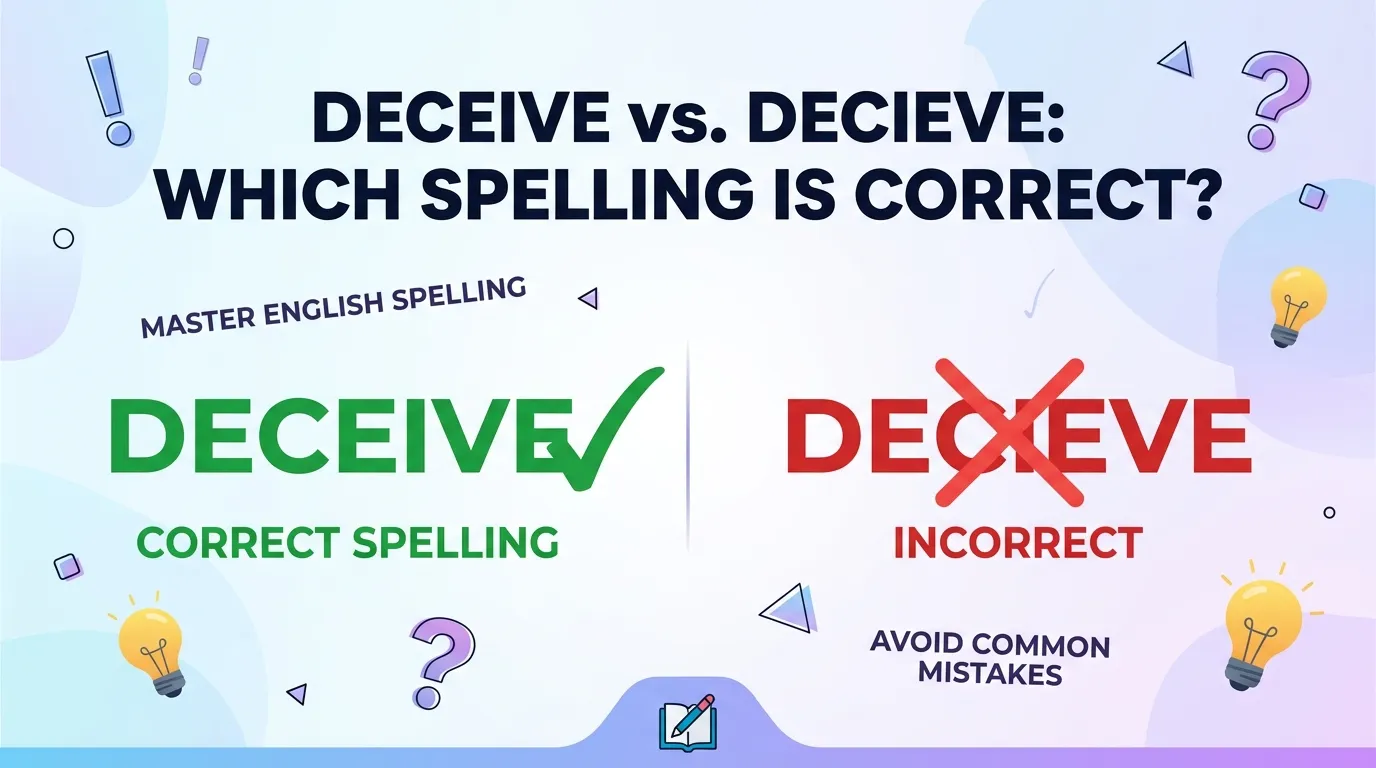
If you are wondering whether deceive or decieve is the correct spelling, the answer is simple: deceive is correct, while decieve is a misspelling.
The confusion happens because English has several words in which “ie” appears after a consonant, while words such as deceive use “ei.” Since deceive is pronounced with a long /ee/ sound, it is easy to write decieve by mistake.
In this guide, you will learn the difference between deceive and decieve, what deceive means, how to pronounce and use it, why the spelling causes confusion, common mistakes, synonyms and antonyms, word history, useful collocations, and practical examples for everyday, academic, business, professional, and formal writing.
Quick Answer: Deceive vs Decieve
Deceive is the correct English spelling.
Decieve is incorrect and should not be used in standard English.
| Word | Correct? | Meaning |
|---|---|---|
| deceive | ✅ Yes | To deliberately make someone believe something that is not true |
| decieve | ❌ No | Common misspelling of deceive |
Correct example
He tried to deceive his customers by giving them false information.
Incorrect example
He tried to decieve his customers by giving them false information.
The key spelling to remember is:
D-E-C-E-I-V-E → deceive
Not:
D-E-C-I-E-V-E → decieve
What Does Deceive Mean?
The verb deceive means to intentionally cause someone to believe something false, misleading, or untrue.
In simple terms, if someone deceives another person, they trick, mislead, or fool that person.
Dictionary-style definition
Deceive (verb): to deliberately cause someone to accept a false idea or belief, usually by lying, hiding information, or creating a misleading impression.
Examples
- The salesman tried to deceive the customer.
- She realized that he had deceived her.
- The advertisement was designed to deceive buyers.
- Do not deceive yourself about the risks.
- He deliberately deceived his friends.
The word can describe anything from a small misleading statement to serious dishonesty.
Why Is “Decieve” Wrong?
Decieve is simply a spelling error.
English spelling can be confusing because the letters i and e appear in different orders across many words.
For example:
- believe
- receive
- deceive
- achieve
- piece
- field
- friend
The familiar spelling rule often taught in school is:
“I before E, except after C…”
This rule helps explain why receive and deceive use ei after c.
However, English spelling has many exceptions, so the rule should not be treated as perfect.
The important point for this word is:
After the “c” in deceive, the letters are E-I:
dec + ei + ve
Therefore:
- deceive ✅
- decieve ❌
Deceive vs Decieve: The Key Difference
There is no difference in meaning between the two spellings because decieve is not a standard English word.
The real comparison is between:
- deceive — correct
- decieve — incorrect
Spelling
Deceive: D-E-C-E-I-V-E
Decieve: D-E-C-I-E-V-E
The third and fourth vowels are reversed in the misspelled version.
Meaning
Only deceive has a recognized standard meaning.
Grammar
Deceive is a verb.
Examples:
- They deceive people.
- They deceived people.
- They are deceiving people.
- They have deceived people.
Decieve has no standard grammatical role because it is a misspelling.
How Do You Pronounce Deceive?
Deceive is pronounced approximately:
dih-SEEV
The main stress falls on the second syllable.
Pronunciation
deceive: /dɪˈsiːv/
The final part sounds like “seev.”
It rhymes closely with words such as:
- receive
- believe
- achieve
- relieve
Example
He tried to deceive me.
The word sounds like:
dih-SEEV
The incorrect spelling decieve does not have a separate standard pronunciation. If someone says decieve, they generally mean the correctly spelled word deceive.
Why Do People Confuse Deceive and Decieve?
Several factors make this spelling error common.
1. The pronunciation does not reveal the spelling
When you hear deceive, you hear a long ee sound. That sound can be spelled in several ways in English.
Compare:
- see
- receive
- believe
- deceive
- field
- machine
The pronunciation alone does not tell you whether to write ie or ei.
2. The “I before E” rule causes confusion
Many English learners remember:
I before E, except after C.
Because deceive contains a c, the letters should be ei.
But people sometimes remember only the first half of the rule and write decieve.
3. Similar words use “ie”
Consider:
- believe
- piece
- chief
- field
- brief
Seeing these words can make decieve look visually believable, even though it is incorrect.
4. Typing quickly encourages spelling errors
Because deceive and decieve look almost identical, the error can easily survive a quick proofreading check.
This is particularly common in:
- emails
- social media posts
- school assignments
- online comments
- business documents
- blog posts
Deceive: Meaning and Different Uses
The meaning of deceive can change slightly depending on context.
1. To trick someone
This is one of the most common meanings.
The thief tried to deceive the police.
Here, deceive means to deliberately mislead someone.
2. To make someone believe something false
The company deceived customers about the product’s features.
The company caused customers to believe something that was not true.
3. To hide the truth
He deceived his parents about where he had been.
The person concealed the truth in order to create a false impression.
4. To mislead yourself
The expression deceive yourself means to refuse to accept the truth or to believe something because you want it to be true.
You are only deceiving yourself if you think the problem will disappear on its own.
This use is often figurative.
Is Deceive Always Intentional?
Usually, deceive suggests intention.
If someone accidentally gives you incorrect information, you would normally say they misinformed you rather than saying they deceived you.
Compare:
The employee accidentally gave me the wrong address.
This does not necessarily involve deception.
But:
The employee deliberately gave me the wrong address to deceive me.
Here, there is a clear intention to mislead.
This distinction matters in formal, legal, business, and professional writing.
Deceive vs Mislead vs Trick vs Lie
These words are related but are not always interchangeable.
| Word | Basic meaning | Typical implication |
|---|---|---|
| deceive | Cause someone to believe something false | Deliberate dishonesty or concealment |
| mislead | Give someone a wrong impression | May involve incomplete or indirect information |
| trick | Fool someone | Often more informal |
| lie | Say something knowingly untrue | Usually involves a false statement |
| dupe | Fool someone successfully | Informal and often stronger |
| cheat | Act dishonestly for an advantage | Often connected to rules or competition |
Example differences
Deceive:
The seller deceived the buyer about the condition of the car.
Mislead:
The advertisement may mislead customers about the product’s benefits.
Trick:
His friends tricked him into opening the empty box.
Lie:
He lied about where he had been.
Cheat:
The player cheated during the competition.
Synonyms for Deceive
Depending on the context, useful synonyms include:
- mislead
- trick
- fool
- dupe
- deceive
- delude
- hoodwink
- con
- cheat
- manipulate
- misrepresent
- disguise
- conceal
- misinform
Not all of these have exactly the same meaning or level of formality.
Formal alternatives
For professional or academic writing, consider:
- mislead
- misrepresent
- conceal
- provide false information
- create a false impression
For example:
The report misrepresented the available evidence.
This may sound more precise than:
The report tricked people.
Antonyms of Deceive
Common opposites include:
- tell the truth
- inform
- clarify
- reveal
- disclose
- explain
- be honest
- enlighten
- reassure
Examples
The company chose to disclose the information.
She was completely honest with her manager.
The witness clarified what had happened.
Word Forms Related to Deceive
Learning the word family can make the spelling easier to remember.
| Word | Part of speech | Example |
|---|---|---|
| deceive | verb | They deceive customers. |
| deceived | past tense/past participle | He was deceived. |
| deceiving | present participle | She is deceiving them. |
| deception | noun | The deception was discovered. |
| deceptive | adjective | The advertisement was deceptive. |
| deceptively | adverb | The task was deceptively difficult. |
| deceiver | noun | He was known as a skilled deceiver. |
Notice that the spelling changes slightly in the word family, but the deceive/decept- relationship remains clear.
Deceive vs Deception
These words are closely related but serve different grammatical purposes.
Deceive = verb
They tried to deceive the public.
Deception = noun
The investigation uncovered the deception.
Deceptive = adjective
The packaging was deceptive.
Deceiver = noun
The deceiver eventually admitted the truth.
Common Collocations With Deceive
A collocation is a group of words that commonly appear together.
Useful combinations include:
- deceive someone
- deceive customers
- deceive the public
- deceive the reader
- deceive yourself
- deliberately deceive
- attempt to deceive
- seek to deceive
- try to deceive
- deceive someone into doing something
- deceive someone about something
- deceive someone into believing something
Examples
The company attempted to deceive customers.
He deceived her into believing that everything was fine.
Don’t deceive yourself about the situation.
The evidence suggests that they deliberately deceived investors.
Common Expressions With Deceive
Deceive yourself
This means to believe something false because you do not want to face reality.
If you think the problem will solve itself, you are deceiving yourself.
Deceive someone into doing something
This means to trick someone so that they do something they otherwise might not have done.
The scammer deceived the victim into sending money.
Appearances can deceive
This expression means that things may not be what they seem.
The restaurant looked ordinary, but the food was excellent. Appearances can deceive.
Formal vs Informal Use
Deceive is a standard word suitable for almost every level of English.
It can appear in:
- everyday conversation
- academic writing
- journalism
- business writing
- legal discussions
- professional communication
- literature
- religious writing
- technical discussions
However, its tone can be somewhat serious.
Casual
He tried to trick me.
Neutral
He tried to mislead me.
More formal
He attempted to deceive me.
Choosing among these depends on context and tone.
Deceive in American English
In American English, deceive is standard and widely understood.
There is no American spelling variation such as decieve.
For American writing, use:
deceive
The same applies to:
- business emails
- school assignments
- news writing
- websites
- reports
- professional documents
Deceive in British English
British English also uses:
deceive
There is no standard British spelling decieve.
Therefore, this is one word where American and British English agree completely.
Correct in both varieties
The evidence suggests that he tried to deceive the public.
Incorrect in both varieties
The evidence suggests that he tried to decieve the public.
International English and Academic Writing
For international English, deceive is the safest and standard form.
In academic writing, however, you should consider whether deceive is the most precise word for your claim.
For example:
The advertisement deceived consumers.
This is a strong statement because it suggests intentional deception.
If the evidence only shows that the advertisement was unclear, a better sentence might be:
The advertisement may have misled consumers.
Academic writing benefits from choosing a word that matches the evidence.
Deceive in Business and Professional Writing
In business communication, deceive can carry a serious accusation.
Compare:
The supplier deceived us about the delivery date.
This strongly suggests intentional dishonesty.
A more cautious professional statement could be:
The supplier provided inaccurate information about the delivery date.
Or:
The information provided by the supplier was misleading.
Use deceive when the evidence supports the idea of intentional misleading behavior.
Deceive in Journalism
Journalists often need precise language when describing alleged wrongdoing.
Instead of automatically writing:
The company deceived customers.
A careful report might say:
Customers alleged that the company had deceived them.
Or:
Regulators accused the company of misleading consumers.
This distinction matters because deceive can imply deliberate misconduct.
Deceive in Sports
The word can also be used in sports.
For example:
The quarterback deceived the defense with a convincing fake.
The striker deceived the goalkeeper by shooting toward the opposite corner.
In sports writing, deceive can have a less negative meaning. It may simply describe using a fake, feint, or unexpected movement to fool an opponent.
Sports-related words
- fake
- feint
- disguise
- misdirect
- fool
- outwit
This shows why context matters.
Deceive in Technical and Professional Contexts
The word may appear when discussing:
- misleading interfaces
- deceptive advertising
- fraudulent information
- misleading statistics
- manipulated data
- security practices
- user behavior
- visual perception
For example:
A poorly designed graph can deceive readers even when the underlying data are accurate.
Here, the sentence focuses on the misleading effect of the presentation.
Literal and Figurative Uses
Literal use
A person deliberately gives another person false information.
The salesman deceived the customer about the product.
Figurative use
Something can create a misleading impression without literally speaking.
The simple design deceives the eye.
Or:
The small size of the building deceives visitors about how much space it contains.
In these cases, deceive means that appearances create an incorrect impression.
Is Deceive a Negative Word?
Usually, yes.
Deceive generally has a negative or critical tone because it suggests dishonesty, manipulation, or deliberate misleading.
However, context can soften the word.
In sports:
The player deceived the goalkeeper.
This may simply mean the player successfully used a fake.
In visual perception:
The shadows deceive the eye.
No person is necessarily behaving dishonestly.
So the word’s tone depends heavily on context.
Common Mistakes With Deceive
Mistake 1: Writing “decieve”
❌ Decieve
✅ Deceive
Correction
The company tried to deceive its customers.
Mistake 2: Confusing deceive with deception
❌ They tried to deception customers.
✅ They tried to deceive customers.
Or:
✅ Their deception was discovered.
Deceive is a verb, while deception is a noun.
Mistake 3: Using deceive when you mean “confuse”
These words are not identical.
The complicated instructions confused me.
This does not necessarily mean anyone intended to mislead you.
The instructions deceived me.
This suggests that the instructions caused a false belief, potentially through deliberate misleading information.
Mistake 4: Accusing someone without enough evidence
Because deceive often implies intention, be careful with it.
Instead of:
The company deceived everyone.
You might write:
The company’s advertisement may have misled consumers.
This is especially useful in professional, academic, and journalistic writing.
Awkward vs Natural Examples
Awkward
He did deceive to me.
Natural
He deceived me.
Awkward
She deceived me that the information was correct.
Natural
She deceived me into believing that the information was correct.
Awkward
They deceived about the price.
Natural
They deceived customers about the price.
Awkward
He made deception to his friend.
Natural
He deceived his friend.
Or:
He deceived his friend through a carefully planned deception.
Everyday Examples of Deceive
Here are natural examples you might encounter in ordinary English:
- Don’t try to deceive me.
- He deceived his friends about his plans.
- The advertisement was designed to deceive customers.
- She realized that she had been deceived.
- Don’t deceive yourself about the situation.
- The magician deceived the audience with a clever trick.
- His confident appearance deceived me.
- The fake website was created to deceive users.
- The player deceived the goalkeeper with a fake shot.
- The report may have misled readers rather than deliberately deceiving them.
Memory Trick: How to Remember Deceive
A simple memory trick is:
DECEIVE has “CEI”
Think:
C + EI = deceive
You can also connect it with receive:
- receive
- deceive
Both contain “ceive.”
Remember the ending
de + ceive
Not:
de + cieve
The word receive can help reinforce the pattern:
reCEIVE
deCEIVE
Words Commonly Confused With Deceive
Several words look or sound related.
Receive vs Deceive
Both end in -ceive.
I will receive the package tomorrow.
He tried to deceive the customer.
Perceive vs Deceive
Both use -ceive.
I perceive a problem.
They tried to deceive us.
Conceive vs Deceive
Again, both contain -ceive.
She could not conceive of a better plan.
He attempted to deceive them.
Learning these related words can make the spelling pattern easier to recognize.
The History and Etymology of Deceive
Deceive comes through French from Latin roots associated with taking, catching, or misleading someone.
The English word developed from forms related to Latin dēcipere, meaning roughly “to ensnare,” “to take in,” or “to deceive.”
Over time, the word developed into the modern English deceive, with the meaning of misleading someone or causing someone to accept something false.
This history also helps explain why the spelling contains the distinctive -ceive pattern found in related English words.
Deceive vs Decieve: A Practical Comparison
| Feature | Deceive | Decieve |
|---|---|---|
| Standard English word? | Yes | No |
| Correct spelling? | Yes | No |
| Part of speech | Verb | — |
| Meaning | To mislead or trick | — |
| Used in American English? | Yes | No |
| Used in British English? | Yes | No |
| Suitable for formal writing? | Yes | No |
| Suitable for academic writing? | Yes | No |
| Pronunciation | /dɪˈsiːv/ | Not standard |
| Word family | deception, deceptive, deceiver | — |
When Should You Use Deceive?
Use deceive when you mean that someone or something:
- deliberately misleads another person
- creates a false belief
- hides the truth
- tricks someone
- gives a misleading impression
- causes someone to misunderstand reality
Good examples
The company attempted to deceive consumers.
He deceived her into believing that the document was genuine.
The appearance of the building deceived visitors.
Don’t deceive yourself about your responsibilities.
When Should You Use Another Word?
Sometimes another word is more precise.
Use mislead when someone receives an incorrect impression.
The headline misled readers.
Use lie when someone knowingly makes a false statement.
He lied about his age.
Use trick in casual situations.
They tricked me into opening the box.
Use misrepresent when information is presented inaccurately, especially in formal contexts.
The report misrepresented the findings.
Use confuse when the problem is a lack of understanding rather than intentional deception.
The instructions confused the students.
SEO and Content Writing Tip: Deceive or Decieve?
If you are writing a blog post, website page, article, product description, or educational resource, always use deceive in your normal copy.
You may mention decieve when discussing the spelling mistake itself.
For example:
Many English learners search for “deceive vs decieve” because decieve is a common spelling error. The correct spelling is deceive.
This is useful when addressing search intent without repeatedly forcing the misspelled keyword into the article.
For professional content, never intentionally use decieve as though it were the correct word.
Quick Spelling Checklist
Before publishing or submitting your writing, remember:
- ✅ deceive
- ❌ decieve
- ✅ deceived
- ✅ deceiving
- ✅ deception
- ✅ deceptive
- ❌ decieved
- ❌ decieving
Pay particular attention to the ei sequence in deceive.
Frequently Asked Questions About Deceive vs Decieve
1. Is it “deceive” or “decieve”?
Deceive is correct. Decieve is a misspelling and should not be used in standard English.
2. What does deceive mean?
Deceive means to deliberately make someone believe something that is false or misleading. It can mean to trick, mislead, or fool someone.
3. Why is “decieve” incorrect?
The letters are in the wrong order. The correct spelling is deceive, with ei after the c.
4. How do you spell deceive correctly?
Spell it:
D-E-C-E-I-V-E
A useful way to remember it is de + ceive.
5. Is deceive a verb?
Yes. Deceive is a verb.
Example:
They tried to deceive the customer.
Its related noun is deception, and its adjective is deceptive.
6. Is “decieve” ever correct?
No. Decieve is not the standard spelling of an English word. When you mean “to mislead or trick,” use deceive.
7. What is the difference between deceive and mislead?
Both can describe causing someone to believe something incorrect. Deceive usually suggests intentional dishonesty, while mislead can describe creating a false impression without necessarily stating an outright lie.
8. What is the past tense of deceive?
The past tense is deceived.
Example:
She deceived him about the true cost.
The past participle is also deceived:
He had been deceived.
9. What is the noun form of deceive?
The main noun is deception.
Example:
The investigation uncovered a serious deception.
Another related noun is deceiver, meaning a person who deceives others.
10. Is deceive used in both American and British English?
Yes. Deceive is the standard spelling in both American and British English. There is no standard regional spelling decieve.
Conclusion: Deceive vs Decieve
The difference between deceive and decieve is straightforward: deceive is correct, and decieve is incorrect.
Use deceive when you mean to mislead, trick, fool, or cause someone to believe something that is not true. The correct spelling is:
D-E-C-E-I-V-E
The most important spelling pattern to remember is -ceive, as in:
- receive
- deceive
- perceive
- conceive
Although deceive is often associated with deliberate dishonesty, its exact tone depends on context. In business, academic, and journalistic writing, use it carefully because it can suggest intentional wrongdoing. When intention is uncertain, words such as mislead, misrepresent, or provide inaccurate information may be more precise.
For American English, British English, international English, academic writing, professional communication, blogging, and everyday conversation, the recommendation is the same:
Always write “deceive,” never “decieve.”
Once you remember the CEI pattern in deceive, this commonly confused spelling becomes much easier to get right.