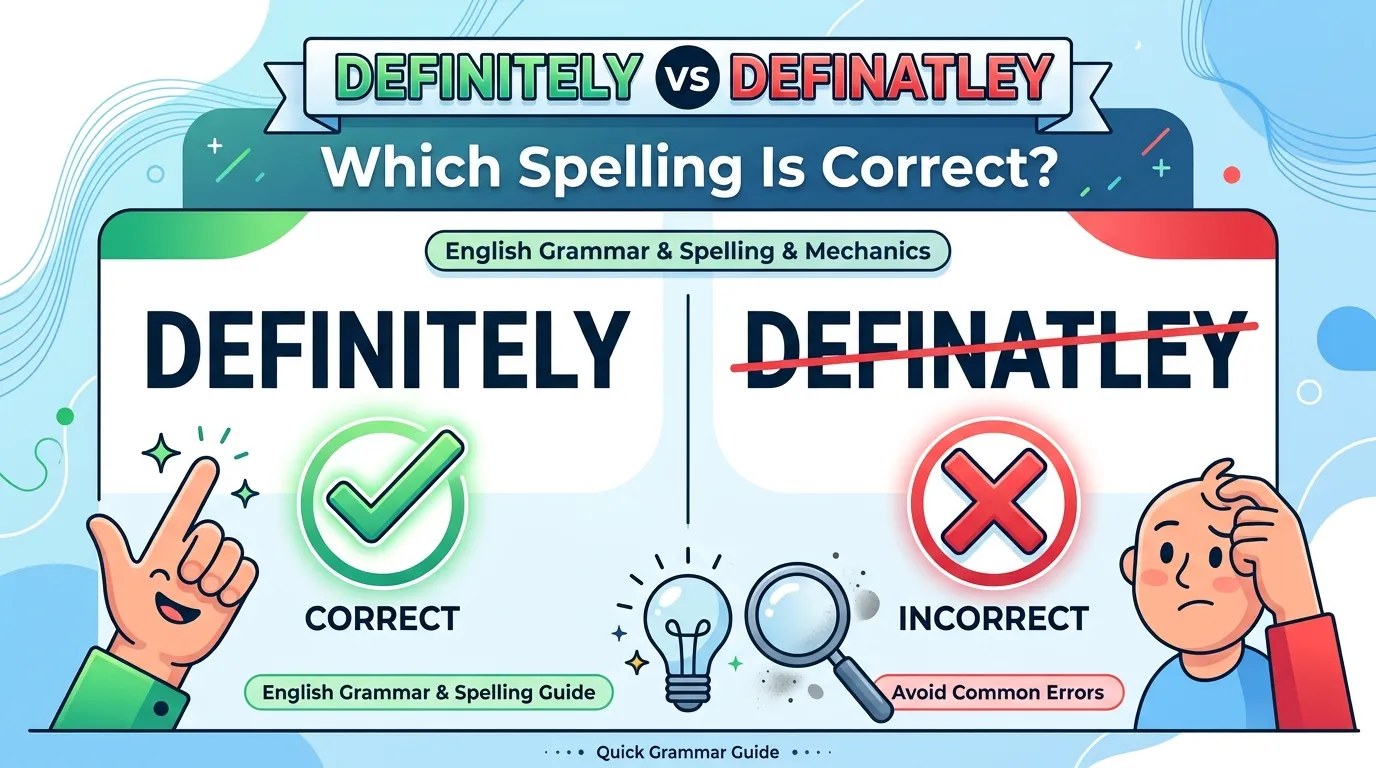
If you are wondering whether the correct spelling is definitely or definatley, the answer is simple: definitely is correct, while definatley is a misspelling.
The confusion is extremely common because definitely is not pronounced exactly the way it looks. The word also contains several letters that are easy to rearrange, especially the -ite- and -ately parts. As a result, many people write definatley, definately, or other incorrect variations when they mean definitely.
In this guide, you will learn the correct spelling, meaning, pronunciation, grammar, word history, common mistakes, synonyms, examples, memory tricks, and the best ways to use definitely in casual, academic, business, professional, and formal English.
Quick Answer: Definitely or Definatley?
Definitely is the correct spelling.
Definatley is incorrect and should not be used in standard English.
| Spelling | Correct? | Meaning |
|---|---|---|
| definitely | ✅ Yes | Without doubt; certainly |
| definatley | ❌ No | Misspelling of definitely |
| definately | ❌ No | Common misspelling of definitely |
| definitly | ❌ No | Common misspelling of definitely |
| definetely | ❌ No | Common misspelling of definitely |
Correct example
I will definitely call you tomorrow.
Incorrect example
I will definatley call you tomorrow.
The second sentence has the right idea, but the spelling is wrong.
What Does Definitely Mean?
Definitely is an adverb meaning without doubt, certainly, or in a way that is sure and clear.
It is commonly used when a person wants to express strong certainty.
For example:
- I will definitely be there.
- She definitely knows the answer.
- That was definitely the best part of the movie.
- We are definitely going to need more time.
- He definitely deserves another chance.
In simple terms:
Definitely = certainly = without doubt.
The word can also be used by itself as a short answer:
“Are you coming with us?”
“Definitely!”
Here, definitely means something like “certainly” or “yes, without a doubt.”
Is Definatley a Word?
No. Definatley is not the standard spelling of an English word.
It is a spelling error caused by rearranging letters in definitely.
If you type definatley into a word processor or spell checker, it will usually be flagged as an error. In standard American English, formal writing, academic writing, professional communication, journalism, and edited content, use definitely.
Correct
She definitely wants to join the team.
Incorrect
She definatley wants to join the team.
The meaning is understandable in the second sentence, but the spelling is incorrect.
Why Do People Confuse Definitely and Definatley?
The spelling problem is common because definitely does not have a very intuitive spelling.
There are several reasons people make this mistake.
1. The pronunciation can be misleading
In American English, definitely is commonly pronounced approximately:
DEF-uh-nit-lee
The middle vowel sounds can be reduced in normal speech. This makes it easy to forget exactly which letters belong in the written form.
2. People connect it to “definite”
The adjective is definite, spelled:
D-E-F-I-N-I-T-E
When forming the adverb, the spelling changes to:
definite + -ly → definitely
The word does not become definately.
3. The letters are easy to rearrange
The sequence near the middle of the word can be confusing:
definitely
People often accidentally write:
definately
The difference is small visually, but only definitely is correct.
4. English spelling is not always phonetic
English words are not always spelled exactly as they sound. Definitely is a good example.
The safest approach is to remember the written form rather than trying to spell the word entirely from pronunciation.
Definitely vs Definatley: The Key Difference
There is actually only one important difference:
Definitely is the correct spelling. Definatley is a spelling mistake.
This is not a case like affect vs effect, where both words are correct but have different meanings.
It is also not like color vs colour, where different regional spellings are accepted.
Instead:
- definitely = standard English word
- definatley = misspelling
Comparison
| Feature | Definitely | Definatley |
|---|---|---|
| Standard English | Yes | No |
| Correct spelling | Yes | No |
| Dictionary word | Yes | No |
| Used in formal writing | Yes | No |
| Used in academic writing | Yes | No |
| Used in business writing | Yes | No |
| Meaning | Without doubt | Intended to mean “definitely” |
| Recommended | ✅ Use it | ❌ Avoid it |
How to Spell Definitely Correctly
The correct spelling is:
D-E-F-I-N-I-T-E-L-Y
Break it into parts:
definite + ly
That gives you:
definitely
A useful visual pattern is:
DEFINITE + LY = DEFINITELY
Notice that definite already contains the letters -inite-.
Do not change the ending to -ately.
Correct
definitely
Incorrect
definately
A Simple Memory Trick for Definitely
One of the easiest ways to remember the spelling is:
Remember “finite”
The word definitely contains finite.
Look at it:
de + finite + ly
So:
de + finite + ly = definitely
This is a useful memory trick because finite is spelled f-i-n-i-t-e, and that helps you remember the middle of definitely.
Another trick is:
Definitely has “finite” inside it.
When you remember finite, you are much less likely to write definately.
Definitely Pronunciation
In American English, definitely is commonly pronounced approximately:
DEF-uh-nit-lee
A phonetic representation is:
/ˈdef.ə.nət.li/
British English commonly uses a pronunciation close to:
DEF-ih-nuht-lee
The exact vowel sounds can vary by accent and speaking style.
The important point is that pronunciation does not change the spelling.
You should write:
definitely
even when the middle sounds are reduced in everyday speech.
Is Definitely an Adjective or Adverb?
Definitely is an adverb.
It modifies a verb, adjective, another adverb, or sometimes an entire statement.
Example modifying a verb
I will definitely go.
Here, definitely tells us how certain the speaker is about going.
Example emphasizing an adjective
That is definitely unusual.
Example emphasizing another expression
She is definitely very talented.
Example as a short response
“Do you want to come?”
“Definitely.”
The adjective is definite, not definitely.
Compare
- definite = adjective
- definitely = adverb
- definiteness = noun
- definitive = adjective
- definitively = adverb
These words are related, but they do not all have exactly the same meaning or usage.
Definitely vs Definite
These words are related but have different grammatical roles.
Definite
Definite is an adjective meaning clear, certain, fixed, or specific.
Examples:
We need a definite answer.
She gave me a definite date.
There is no definite proof yet.
Definitely
Definitely is an adverb meaning certainly or without doubt.
Examples:
I will definitely be there.
She definitely knows him.
That is definitely true.
Quick comparison
| Word | Part of speech | Example |
|---|---|---|
| definite | Adjective | We need a definite answer. |
| definitely | Adverb | We definitely need an answer. |
Definitely vs Definitive
Another related word is definitive.
Definitive generally means authoritative, final, conclusive, or serving as the most reliable answer.
For example:
The study provides a definitive answer.
This is considered the definitive guide to the subject.
Definitely, however, means “without doubt.”
Compare:
She definitely won the competition.
versus:
This is the definitive account of what happened.
They are related, but they cannot always replace one another.
Definitely vs Definitively
These two words are both correct, but they have different uses.
Definitely
Means:
certainly; without doubt
I will definitely attend the meeting.
Definitively
Means:
in a final, conclusive, or authoritative way
The issue was definitively resolved by the court.
The distinction is subtle but useful.
Compare
She definitely knows the answer.
This means there is no doubt in the speaker’s mind.
The question was definitively answered.
This suggests the question was settled conclusively.
Common Misspellings of Definitely
Definitely is frequently misspelled.
Some common incorrect forms include:
- definatley
- definately
- definitly
- definetely
- definitelly
- definetly
- definatly
- definitley
The most common mistake is probably definately or definatley.
Correct form
definitely
Incorrect forms
definately
definatley
definitly
definetely
If you are unsure, remember:
finite → definitely
Common Mistakes With Definitely
Mistake 1: Writing Definatley
❌ I will definatley come.
✅ I will definitely come.
Mistake 2: Writing Definately
❌ She definately knows.
✅ She definitely knows.
This mistake is particularly common because definately looks like it might follow the pronunciation.
Mistake 3: Leaving Out the “i”
❌ I definitly agree.
✅ I definitely agree.
Remember the finite pattern.
Mistake 4: Using Definitive When You Mean Definitely
❌ I definitive agree.
✅ I definitely agree.
Definitive is an adjective. Definitely is an adverb.
Natural vs Awkward Examples
Knowing the correct spelling is only part of using the word well. Placement also matters.
Natural
I will definitely call you tonight.
Natural
She definitely made the right decision.
Natural
That is definitely a possibility.
Natural
We definitely need more information.
Natural
He definitely deserves the award.
Less natural
Definitely I will call you tonight.
This is understandable, but it sounds less natural in ordinary American English.
A more natural version is:
I will definitely call you tonight.
Where Should You Put Definitely in a Sentence?
The position of definitely can change depending on what you want to emphasize.
Before the main verb
I definitely agree with you.
She definitely knows the answer.
They definitely want to go.
After the verb “to be”
She is definitely ready.
That is definitely true.
He was definitely upset.
Before an adjective or adverb
It is definitely important.
She is definitely very talented.
At the beginning for emphasis
Definitely, we should consider that option.
This is possible, but in everyday American English, placing definitely closer to the verb often sounds more natural.
Definitely in Casual English
Definitely is very common in everyday conversation.
For example:
“Want to get pizza?”
“Definitely.”
It can express enthusiasm as well as certainty.
More examples
“Are you coming tonight?”
“Definitely.”
“Should we try the new restaurant?”
“Definitely!”
“Do you think he’ll win?”
“Definitely.”
In casual speech, the word can function almost like absolutely, sure, or of course, depending on context.
Definitely in Formal English
There is nothing inherently informal about definitely.
It can be used in professional and formal writing when expressing certainty.
For example:
The results definitely support the proposed conclusion.
The company definitely needs to improve its customer service process.
This approach is definitely worth considering.
However, in highly cautious academic writing, writers sometimes avoid strong certainty unless the evidence supports it.
For example, instead of:
This method definitely proves that the theory is correct.
A more careful academic sentence might be:
These findings strongly support the theory.
The issue here is not that definitely is informal. The issue is whether the level of certainty is justified.
Definitely in Academic Writing
Definitely is grammatically acceptable in academic writing, but use it thoughtfully.
Academic writing often values precision.
Strong claim
The evidence definitely proves the hypothesis.
More cautious claim
The evidence strongly supports the hypothesis.
The second sentence may be more appropriate if the evidence is persuasive but not absolute.
Useful alternatives include:
- clearly
- strongly
- certainly
- convincingly
- without doubt
- conclusively
- demonstrably
Choose the word that accurately reflects the evidence.
Definitely in Business Writing
In business communication, definitely can be useful when you need to communicate confidence.
Examples:
We will definitely meet the deadline.
This change will definitely improve the customer experience.
I will definitely follow up by Friday.
However, be careful when making promises.
If something is not fully certain, a more precise phrase may be better:
We expect to meet the deadline.
We are confident that the change will improve the customer experience.
I plan to follow up by Friday.
Good business writing is not only about sounding confident. It is also about being accurate.
Definitely in Journalism
Journalists often need to distinguish established facts from assumptions or opinions.
Definitely can appear in reporting, quotations, sports coverage, interviews, and commentary.
For example:
The team definitely improved after halftime.
That sentence is appropriate when the writer has evidence or is expressing an interpretation supported by observable performance.
In a direct quotation:
“We definitely played better in the second half,” the coach said.
Here, definitely reflects the speaker’s own wording.
Definitely in Sports Writing
The word is common in sports conversations and commentary.
Examples:
That was definitely the turning point of the game.
She is definitely one of the strongest players on the roster.
The team definitely looked more confident after halftime.
That was definitely a foul.
Sports writing often uses definitely to express strong judgment or certainty.
Definitely in Technical Writing
Technical writing usually favors precision over emotional emphasis.
You can use definitely when the certainty is genuinely supported:
The software definitely requires an internet connection during installation.
But when documenting a technical system, it may be clearer to state the specific condition:
The software requires an internet connection during installation.
The second sentence is more direct and objective.
So the question is not whether definitely is allowed. It is whether the word adds useful information.
Synonyms for Definitely
Depending on context, useful synonyms include:
- certainly
- surely
- undoubtedly
- unquestionably
- absolutely
- clearly
- positively
- assuredly
- without doubt
- without question
- for sure
- beyond doubt
These words are not perfect substitutes in every sentence.
Example
I will definitely go.
Possible alternatives:
I will certainly go.
I will absolutely go.
I will surely go.
I will go without a doubt.
The tone changes slightly with each choice.
Definitely vs Certainly
Definitely and certainly are close synonyms.
Both can express strong certainty.
I will definitely attend.
I will certainly attend.
Both are correct.
However, certainly can sometimes sound slightly more formal or measured, while definitely is especially common in everyday American speech.
Casual
“Are you coming?”
“Definitely!”
More formal
“Will you attend the meeting?”
“Certainly.”
Still, both words work in many situations.
Definitely vs Absolutely
Absolutely can express certainty, but it can also express strong agreement or enthusiasm.
“Do you agree?”
“Absolutely!”
Definitely can also work:
“Do you agree?”
“Definitely!”
The choice depends on tone.
Absolutely can sound stronger or more emphatic, while definitely often feels natural and direct.
Antonyms of Definitely
There is no single perfect opposite in every context, but words and phrases expressing uncertainty include:
- maybe
- perhaps
- possibly
- probably
- uncertainly
- doubtfully
- not necessarily
- potentially
Compare:
She will definitely come.
with:
She might come.
The first expresses certainty. The second expresses possibility.
Related Words
The word family around definitely includes several useful terms.
| Word | Part of speech | Basic meaning |
|---|---|---|
| definite | adjective | clear, certain, specific |
| definitely | adverb | without doubt |
| definiteness | noun | quality of being definite |
| define | verb | explain or establish meaning |
| definition | noun | explanation of meaning |
| definitive | adjective | final or authoritative |
| definitively | adverb | in a final or conclusive way |
These words share a historical connection, but their meanings and grammatical functions differ.
Word History and Etymology of Definitely
Definitely comes from definite, combined with the adverb-forming suffix -ly.
The older word definite is connected to Latin definitus, meaning something like “defined,” “bounded,” or “limited.” The Latin verb behind it is related to the idea of setting a boundary or determining something.
The adverb definitely has been used in English since the late 16th century. Its modern emphatic use developed later and became especially familiar in everyday speech.
This history helps explain why the word is connected to ideas such as:
- defined
- certain
- fixed
- clear
- determined
- specific
The spelling definitely reflects its connection to definite, rather than the common misspelling definately.
Definitely in American vs British English
There is no major spelling difference between American and British English for this word.
Both use:
definitely
The pronunciation can vary somewhat between American and British accents, but the spelling remains the same.
So:
- American English: definitely
- British English: definitely
- Canadian English: definitely
- Australian English: definitely
- International English: definitely
The incorrect spelling definatley is not a legitimate regional alternative.
Is “Definatley” Ever Correct in British English?
No.
British English does not use definatley as an accepted alternative spelling.
The correct spelling remains:
definitely
The same applies to American English and other major varieties of standard English.
Definitely in Blogging and Online Writing
Because definitely is common in conversational English, it works naturally in blogs, newsletters, reviews, social posts, and other online content.
For example:
These are definitely worth trying.
You should definitely read the full guide before making a decision.
This is definitely one of the easiest ways to improve your writing.
However, repeated use can make writing sound overly emphatic.
Instead of writing:
This is definitely the best product, definitely the easiest option, and definitely the smartest choice.
A cleaner version would be:
This is one of the easiest and most practical options.
Use definitely when it adds meaning, not simply for emphasis.
Common Collocations With Definitely
A collocation is a combination of words that commonly appear together.
Some natural combinations with definitely include:
- definitely agree
- definitely want
- definitely need
- definitely know
- definitely think
- definitely believe
- definitely worth
- definitely possible
- definitely true
- definitely better
- definitely important
- definitely not
- definitely the best
- definitely going to
- definitely worth considering
Examples
I definitely agree with your point.
This is definitely worth trying.
We definitely need more information.
She is definitely going to apply.
That is definitely not what I meant.
“Definitely Not” and “Definitely Yes”
Definitely can strengthen both positive and negative statements.
Definitely yes
Yes, I will definitely help.
Definitely not
No, I definitely won’t do that.
The phrase definitely not is especially common when someone wants to strongly reject an idea.
Examples:
I’m definitely not interested.
That’s definitely not the answer.
He is definitely not ready.
The meaning is strong and clear.
“Definitely Worth It”
One of the most common expressions is:
definitely worth it
It means something is strongly believed to justify the money, time, effort, or risk involved.
Examples:
The trip was definitely worth it.
If you have the time, the course is definitely worth it.
The extra effort is definitely worth it.
This phrase is especially common in reviews, recommendations, blogs, and everyday conversation.
“Definitely Going To”
Another common structure is:
definitely going to + verb
Examples:
I’m definitely going to try it.
She’s definitely going to succeed.
We’re definitely going to need another day.
It expresses a strong expectation or intention.
“Definitely the Best”
You will often see:
definitely the best
Examples:
This is definitely the best option for beginners.
That was definitely the best meal we had.
She is definitely one of the best players on the team.
Be careful with absolute claims in professional or promotional writing. If “best” cannot be objectively established, a more precise statement may be stronger.
For example:
This is definitely one of the most practical options for beginners.
Everyday Examples of Definitely
Here are natural examples from common situations.
At work
I’ll definitely send the report this afternoon.
At school
I definitely need to study for the test.
With friends
We should definitely hang out this weekend.
Shopping
I definitely prefer the first one.
Travel
I definitely want to visit that city someday.
Sports
That was definitely the turning point.
Food
I’d definitely order this again.
Technology
This feature is definitely useful.
Entertainment
That was definitely my favorite scene.
Personal opinion
I definitely think you should consider it.
Formal vs Informal Alternatives
The best synonym depends on the situation.
| Context | Natural choice |
|---|---|
| Casual conversation | definitely |
| Text message | definitely |
| Friendly email | definitely |
| General business writing | definitely / certainly |
| Academic writing | certainly / clearly / strongly |
| Legal or technical writing | precise factual wording |
| Journalism | definitely when justified |
| Formal speech | certainly / undoubtedly |
| Strong agreement | absolutely / definitely |
There is no rule saying you must replace definitely in formal writing. The key is to match your level of certainty to your evidence.
How to Avoid the Definitely Spelling Mistake
Use one of these methods.
Method 1: Remember “finite”
Think:
de + finite + ly
definitely
Method 2: Remember the base word
The adjective is:
definite
Add:
-ly
Result:
definitely
Method 3: Watch the “-nite-” sequence
The middle of the word contains:
nite
not:
nate
So:
definitely ✅
not:
definately ❌
Method 4: Save the correct form in your memory
If you frequently use the word in professional or academic writing, memorize the exact visual pattern:
definitely
After seeing it repeatedly, the correct spelling becomes much easier to recognize.
Definatley vs Definitely: Correct the Sentences
Here are some quick practice examples.
1
❌ I will definatley be there.
✅ I will definitely be there.
2
❌ She definately knows what happened.
✅ She definitely knows what happened.
3
❌ This is definitly important.
✅ This is definitely important.
4
❌ We are definetely ready.
✅ We are definitely ready.
5
❌ I definitelly agree.
✅ I definitely agree.
6
❌ That’s definatley not true.
✅ That’s definitely not true.
A Quick Editing Checklist
Before publishing or submitting your writing, check:
- Is the word spelled definitely?
- Did you accidentally write definatley?
- Did you accidentally write definately?
- Are you using definitely as an adverb?
- Does the sentence actually express certainty?
- Is the level of certainty appropriate for the evidence?
- Would certainly, clearly, or a more precise phrase communicate the idea better?
If the word appears in a professional document, it is worth checking carefully because spelling errors can distract readers from your message.
Frequently Asked Questions About Definitely vs Definatley
1. Is it definitely or definatley?
Definitely is correct. Definatley is a misspelling and should not be used in standard English.
2. Is “definatley” a real word?
No. Definatley is not the standard spelling of an English word. It is a common misspelling of definitely.
3. How do you spell definitely correctly?
The correct spelling is:
D-E-F-I-N-I-T-E-L-Y
A useful memory trick is to remember that definitely contains finite.
4. Why do people spell definitely as definately?
People often spell it definately because the pronunciation can make the middle vowels difficult to hear. The spelling is also easy to confuse because definite changes to definitely when the adverb ending -ly is added.
5. What does definitely mean?
Definitely means without doubt, certainly, or surely.
Example:
I will definitely call you tomorrow.
6. Is definitely formal or informal?
Definitely can be used in both formal and informal English. It is common in everyday conversation but is also grammatically acceptable in professional and academic writing when strong certainty is appropriate.
7. What is the difference between definitely and definitively?
Definitely means “without doubt” or “certainly.”
Definitively means “in a final, conclusive, or authoritative way.”
Example:
I definitely agree.
The issue was definitively resolved.
8. What is the difference between definite and definitely?
Definite is an adjective, while definitely is an adverb.
Example:
We need a definite answer.
We definitely need an answer.
9. Is “definately” accepted in American English?
No. American English uses definitely. Definately is considered a misspelling.
10. What is the easiest way to remember definitely?
Remember:
DEFINITE + LY = DEFINITELY
You can also remember that definitely contains the word finite:
de + finite + ly
Conclusion
When comparing definitely vs definatley, there is a clear winner: definitely.
Definitely is the correct standard English spelling and means without doubt, certainly, or surely. Definatley is simply a misspelling.
The easiest way to remember the correct form is to connect it to definite or finite:
definite + ly = definitely
The word works naturally in American English as well as British and other major varieties of English. It can appear in casual conversation, text messages, business communication, journalism, blogging, academic writing, and professional documents. The main consideration is not whether the word is formal enough, but whether the certainty it expresses is appropriate for the context.
If you are writing quickly, watch for common mistakes such as definatley, definately, definitly, and definetely. When in doubt, return to the simple spelling pattern:
DEFINITE → DEFINITELY
So, if you are choosing between the two spellings, use:
Definitely ✅
and avoid:
Definatley ❌
Once you remember the finite pattern, this spelling becomes much easier to get right every time.