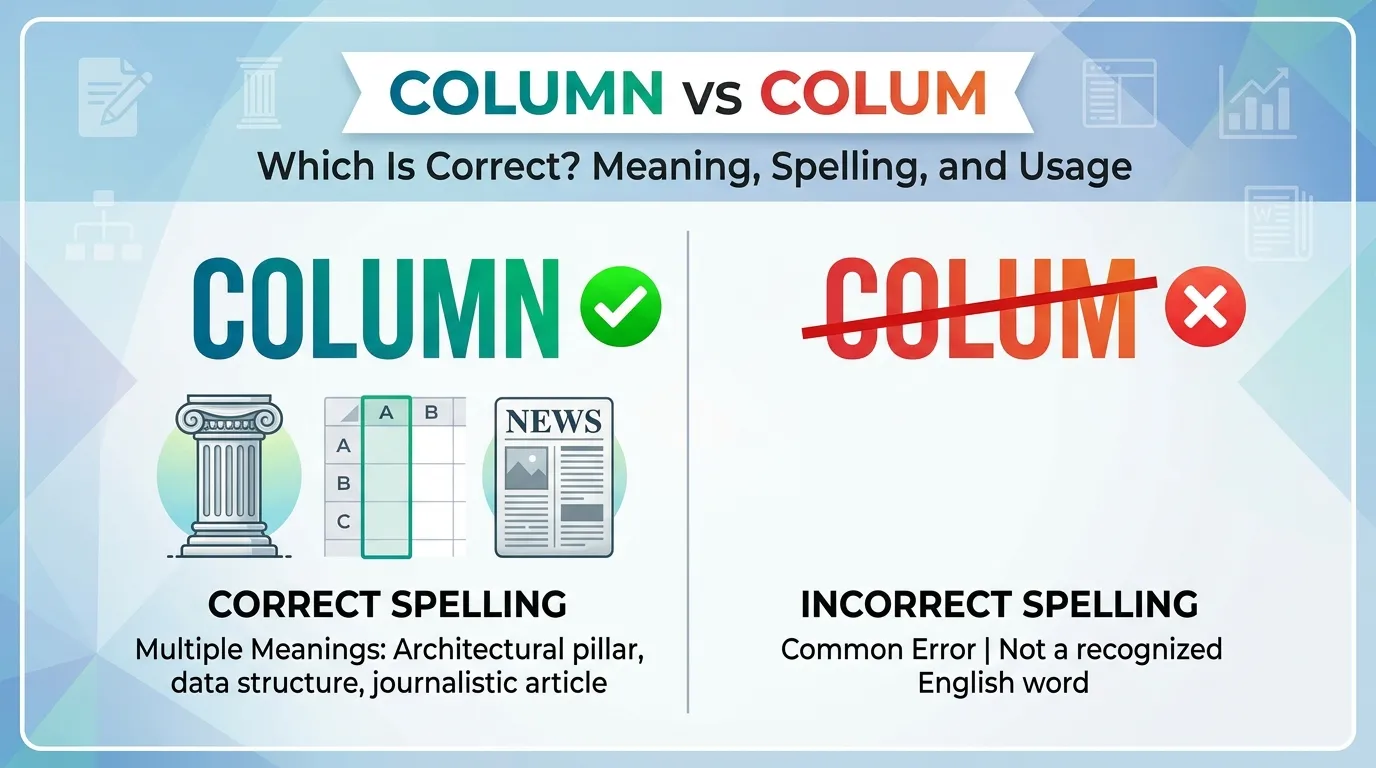
If you are wondering about column vs colum, the correct spelling for the common English word is column. The spelling colum is usually a misspelling when you mean a vertical section, supporting pillar, newspaper feature, or vertical set of numbers or data.
The confusion is easy to understand because column is pronounced without clearly sounding the final n. In American English, column is commonly pronounced roughly like KAH-lum, so it can sound almost exactly like “colum.” That makes it tempting to leave the n out when writing the word.
This guide explains the difference between column and colum, how to spell and pronounce column, what the word means in different contexts, why the mistake happens, and how to use it naturally in academic, business, technical, journalistic, sports, and everyday writing.
Quick Answer: Column vs Colum
Column is the correct spelling when you mean a vertical structure, vertical section of text, newspaper feature, spreadsheet field, or similar arrangement.
Colum is generally not the correct spelling for those meanings. In ordinary American English writing, use column.
| Word | Correct for the common meaning? | Main use |
|---|---|---|
| column | Yes | A pillar, vertical section, newspaper feature, data field, or vertical arrangement |
| colum | Usually no | Common misspelling of column |
| Colum | Yes in specific cases | A proper name, especially an Irish given name |
Examples
- Correct: Please add the figures in the second column.
- Incorrect: Please add the figures in the second colum.
- Correct: She writes a weekly newspaper column.
- Incorrect: She writes a weekly newspaper colum.
- Correct: The building has six stone columns.
- Incorrect: The building has six stone colums.
There is one important exception: Colum can be a proper name. For example, Colum is an Irish masculine given name. That is completely different from the common noun column.
What Does “Column” Mean?
The noun column has several related meanings. At its core, the word describes something arranged vertically or something that resembles a tall supporting pillar.
A dictionary-style definition would be:
Column: a vertical arrangement, upright support, or regularly appearing written feature, depending on context.
The word is commonly used in architecture, printing, journalism, mathematics, spreadsheets, databases, science, sports, and everyday descriptions.
1. Column as a Structural Support
In architecture, a column is a tall vertical structure that supports part of a building or serves as decoration.
For example:
- The entrance is supported by two marble columns.
- Ancient Greek temples often used large stone columns.
- The architect designed a row of decorative columns.
- A damaged column had to be repaired.
In this sense, column is closely related to words such as pillar, post, and support.
2. Column in Printing and Publishing
A column can also be a vertical section of text on a page.
For example:
- Read the information in the right-hand column.
- The article appears across three columns.
- The newspaper page has five narrow columns.
- Put the heading at the top of the first column.
This meaning is common in newspapers, magazines, textbooks, dictionaries, brochures, and other printed materials.
3. Column in Journalism
A column can mean a recurring piece of writing, usually written by the same person and often focused on a particular subject.
Examples include:
- sports column
- advice column
- opinion column
- political column
- business column
- fashion column
- humor column
- technology column
Example:
The journalist writes a weekly column about local politics.
This use is especially important because columnist comes from the same word.
A columnist is someone who regularly writes a column.
4. Column in Spreadsheets and Tables
In spreadsheets, a column is a vertical group of cells.
For example:
| Name | Age | City |
|---|---|---|
| Sarah | 28 | Chicago |
| David | 34 | Dallas |
| Maria | 31 | Boston |
Here, Name, Age, and City are columns.
The horizontal arrangement is called a row.
So:
- Column = vertical
- Row = horizontal
This distinction is essential in Excel, Google Sheets, databases, data analysis, and programming.
5. Column in Mathematics
In mathematics, numbers arranged vertically can form a column.
For example:
  25
+ 47
----
  72
The numbers may be described as being arranged in a column.
You may also hear phrases such as:
- column of numbers
- column of figures
- column addition
- first column
- second column
- right-hand column
Why Do People Confuse “Column” and “Colum”?
The main reason is pronunciation.
The spelling is:
c-o-l-u-m-n
But the final n is not pronounced as a separate sound in normal American English.
The word is commonly pronounced approximately:
KAH-lum
That means someone may hear:
“colum”
and naturally assume that is how the word is spelled.
This is a classic example of why English spelling cannot always be predicted from pronunciation.
The Silent “N”
The n in column is effectively silent in ordinary pronunciation.
Compare:
- column → “KAH-lum”
- autumn → “AW-tum”
- solemn → “SAH-lum”
- hymn → “him”
Because the final consonant is not clearly heard, writers sometimes omit it.
The correct spelling, however, remains:
column
Column vs Colum: Key Differences
The simplest way to remember the distinction is this:
Column is the standard English spelling. Colum is usually a spelling mistake when you mean column.
| Feature | Column | Colum |
|---|---|---|
| Standard English noun | Yes | No, for the usual meaning |
| Vertical arrangement | Yes | No |
| Architectural pillar | Yes | No |
| Newspaper article | Yes | No |
| Spreadsheet field | Yes | No |
| Data arrangement | Yes | No |
| Common spelling | Yes | No |
| Can be a personal name | No | Yes, as Colum |
| Final “n” pronounced separately? | No | Not applicable |
The Practical Rule
If you are talking about a spreadsheet, newspaper, building, table, page, database, numbers, or vertical arrangement, write:
column
Not:
colum
Is “Colum” Ever Correct?
Yes, but this requires an important distinction.
Colum can appear as a proper name. It is associated with Irish naming traditions and can refer to people whose given name is Colum.
For example:
Colum is a common enough personal name in Irish contexts.
Because proper names are spelled according to their established form, you should not “correct” someone’s name from Colum to Column.
There are also historical and non-English uses of forms resembling colum, but these are not reasons to use colum in ordinary modern American English when you mean the common noun.
So, if you write:
The table has four colums.
you almost certainly mean columns.
But if you write:
Colum spoke at the event.
you may be referring to a person’s name.
Column: Pronunciation and Spelling
How Do You Pronounce “Column”?
In American English, column is commonly pronounced approximately:
KAH-lum
The final n is not pronounced as a separate syllable.
It has two syllables:
col-umn
Not:
col-um-n
And not:
col-um-in
Common Pronunciation Mistake
A learner may try to pronounce every letter:
“COL-um-n”
That sounds unnatural in standard American English.
Instead, say:
“KAH-lum”
The exact vowel quality can vary by accent, but the important point is that the final n is not spoken as an independent sound.
Why Is “Column” Spelled With an N?
The spelling reflects the historical development of the word rather than its modern pronunciation.
Column entered English through forms related to French and ultimately comes from Latin columna, meaning a pillar or column.
Over time, English pronunciation changed, but the spelling retained the final n.
This is one reason English contains many words whose spelling preserves older forms or sounds that are no longer obvious in modern speech.
Other examples include:
- autumn
- solemn
- hymn
- damn
- condemn
So the silent n in column is not an error. It is part of the standard spelling.
Grammatical Role of “Column”
Column is primarily a countable noun.
That means you can use singular and plural forms.
Singular
The table has one column.
Plural
The table has six columns.
The plural is formed by adding -s:
column → columns
Not:
colum → colums
Common Grammatical Patterns
You will often see:
- a column
- the column
- this column
- that column
- each column
- several columns
- three columns
- a column of numbers
- a column of text
- a column of data
Common Meanings and Contexts of “Column”
The meaning of column depends on the context.
| Context | Meaning | Example |
|---|---|---|
| Architecture | Upright supporting structure | The column supports the roof. |
| Newspaper | Regular article | She writes a weekly column. |
| Printing | Vertical block of text | Read the second column. |
| Spreadsheet | Vertical set of cells | Enter the value in column B. |
| Database | Field of related data | The table contains a date column. |
| Mathematics | Vertical arrangement | Write the numbers in a column. |
| Military | Formation of people or vehicles | The soldiers moved in a column. |
| Nature | Tall vertical mass | A column of smoke rose into the sky. |
| Figurative | Something providing support | He became a column of strength for the team. |
Column vs Row
One of the most important related distinctions is column vs row.
A column runs vertically.
A row runs horizontally.
Imagine a spreadsheet:
| A | B | C |
|---|---|---|
| 1 | 2 | 3 |
| 4 | 5 | 6 |
| 7 | 8 | 9 |
The numbers under A form a column.
The numbers 1, 2, and 3 form a row.
Easy Memory Trick
Think:
Column = up and down
Row = side to side
This distinction is useful in:
- spreadsheets
- databases
- tables
- statistics
- data science
- accounting
- programming
- academic research
Column vs Pillar
The words column and pillar are often synonyms, but they are not always interchangeable.
A pillar is generally a vertical support.
A column can be a type of pillar, especially one with a recognizable architectural form.
Examples
The building has massive stone pillars.
The entrance is decorated with classical columns.
In everyday writing, pillar may sound broader and more general, while column is especially natural when discussing architecture or a vertical structure.
The figurative uses also differ slightly.
Pillar
She is a pillar of the community.
Column
The temple has six marble columns.
For figurative support, pillar is usually more natural.
Column vs Line
Another common comparison is column vs line.
A column normally refers to something arranged vertically.
A line can describe a sequence or arrangement in many directions.
Examples:
The students stood in a line.
The students moved in a column.
A column often suggests a longer, narrower vertical formation, while a line is a more general term for an ordered sequence.
Column vs Row in Data and Technology
In technical writing, getting column correct is especially important.
A database table may contain columns such as:
- customer_id
- first_name
- last_name
- date_created
For example:
| customer_id | first_name | |
|---|---|---|
| 101 | James | james@example.com |
| 102 | Olivia | olivia@example.com |
Each vertical field is a column.
Natural Technical Examples
- Add a new column to the database.
- Sort the data by the last-name column.
- The first column contains customer IDs.
- Delete the empty column.
- Rename the date column.
- The spreadsheet contains ten columns.
Incorrect
Add a new colum to the database.
Correct
Add a new column to the database.
This matters because technical documents depend heavily on exact terminology.
Column in Journalism and Media
The journalistic meaning of column has several useful related words.
Columnist
A columnist is a writer who regularly contributes a column.
Example:
The newspaper hired a new political columnist.
Opinion Column
An opinion column presents the writer’s views on a subject.
Advice Column
An advice column answers readers’ questions or offers guidance.
Sports Column
A sports column discusses sports news, analysis, opinions, or commentary.
Business Column
A business column may cover markets, companies, finance, management, or economic issues.
Common Collocations
- newspaper column
- magazine column
- weekly column
- regular column
- opinion column
- advice column
- sports column
- political column
- business column
- personal column
- guest column
- newspaper columnist
- syndicated column
Column in Sports
The word column also appears naturally in sports writing.
For example:
The team moved up in the win column.
The player has 25 goals in the scoring column.
Add another victory to the win column.
In sports statistics, columns organize information such as:
- wins
- losses
- points
- goals
- assists
- averages
- rankings
Example
| Team | Wins | Losses |
|---|---|---|
| Team A | 12 | 4 |
| Team B | 10 | 6 |
Here, Wins and Losses are columns.
Column in Academic Writing
In academic writing, column is common when discussing tables, figures, layouts, and data.
Examples:
The results are shown in the third column of Table 2.
Compare the values in the left-hand and right-hand columns.
The final column shows the percentage change.
In formal academic writing, column is always the appropriate spelling.
Avoid the nonstandard spelling colum, especially in:
- research papers
- essays
- dissertations
- laboratory reports
- presentations
- statistical reports
- educational materials
A spelling mistake in a technical term can make otherwise strong writing look careless.
Column in Business Writing
Business documents frequently use columns.
Examples include:
- financial tables
- invoices
- sales reports
- budgets
- performance dashboards
- schedules
- customer databases
- spreadsheets
Natural examples:
Please enter the total in the final column.
The sales column needs to be updated.
Compare this year’s figures with the previous column.
The report contains four data columns.
For professional communication, always use column.
Column in Casual Writing
Even in casual writing, the standard spelling does not change.
For example:
Which column should I put this in?
I accidentally deleted a column.
Look at the column on the left.
You do not need a formal alternative. Column is already the normal everyday word.
Formal vs Informal Usage
Unlike some word choices, column does not have a major formal/informal spelling variation.
| Situation | Best choice |
|---|---|
| Text message | column |
| column | |
| School assignment | column |
| Academic paper | column |
| Business report | column |
| Newspaper | column |
| Blog post | column |
| Technical manual | column |
| Sports article | column |
| Casual conversation | column |
The spelling remains column in all of these contexts.
American vs British English
There is no major American-versus-British spelling difference between column and colum.
Both American and British English use:
column
The pronunciation can differ slightly by accent, but the spelling remains the same.
For example, American English commonly uses a pronunciation close to:
KAH-lum
British English commonly uses a pronunciation closer to:
KOL-um
Regional accents can produce additional variation.
But neither American nor British standard English changes the spelling to colum for the common noun.
Common Mistakes With Column
Mistake 1: Writing “colum”
Incorrect:
The table has five colums.
Correct:
The table has five columns.
The final n belongs in the spelling.
Mistake 2: Writing “colum” Because It Sounds Right
Incorrect reasoning:
I don’t hear the n, so it must not be there.
English spelling does not always follow pronunciation.
Remember:
column → KAH-lum
The silent letter still belongs in the written form.
Mistake 3: Writing “colums” as the Plural
Incorrect:
The spreadsheet contains three colums.
Correct:
The spreadsheet contains three columns.
The correct singular and plural forms are:
column → columns
Mistake 4: Confusing Column With Row
Incorrect:
Put the information in the first row.
(when you mean the vertical section)
Correct:
Put the information in the first column.
Remember:
column = vertical
row = horizontal
Mistake 5: Assuming “Colum” Is Always Wrong
This is also too broad.
Colum can be correct when it is a person’s name.
For example:
Colum published a new book.
In this case, changing Colum to Column would change the person’s name.
Awkward vs Natural Examples
| Awkward or incorrect | Natural and correct |
|---|---|
| Put it in the second colum. | Put it in the second column. |
| The sheet has ten colums. | The sheet has ten columns. |
| Read the left colum. | Read the left column. |
| The article is three colums wide. | The article is three columns wide. |
| She writes a weekly colum. | She writes a weekly column. |
| The building has marble colums. | The building has marble columns. |
| Check the last colum for the total. | Check the last column for the total. |
Synonyms for “Column”
The best synonym depends on the meaning.
Architectural Meaning
- pillar
- post
- shaft
- support
- pier
- upright
Example:
The marble column supports the roof.
Possible alternative:
The marble pillar supports the roof.
Vertical Arrangement
- vertical section
- vertical block
- line
- row
- series
However, these words are not always exact substitutes.
Newspaper Meaning
- feature
- article
- piece
- commentary
Again, these can differ in meaning. A newspaper column is a particular type of recurring article, so article is broader.
Antonyms and Contrasting Terms
There is no single perfect antonym for column, because the word has several meanings.
Depending on context, contrasting terms may include:
- row
- horizontal section
- paragraph
- field
- pillar vs opening
- vertical vs horizontal
For spreadsheet terminology, row is the most important contrasting term.
Related Words
Several English words are connected to column.
Columnist
A person who writes a regular column.
The columnist discussed the election.
Columnar
An adjective meaning shaped like a column or arranged in columns.
The plant has a tall, columnar form.
Columned
Having or characterized by columns.
The building has a columned entrance.
Columns
The standard plural form of column.
The table contains six columns.
These related forms are useful in advanced writing, architecture, journalism, and technical descriptions.
Common Collocations With “Column”
A collocation is a combination of words that naturally occur together.
Useful column collocations include:
General
- first column
- second column
- last column
- left column
- right column
- center column
- narrow column
- wide column
Data
- data column
- database column
- spreadsheet column
- column heading
- column name
- column value
- column number
Journalism
- newspaper column
- opinion column
- sports column
- advice column
- weekly column
- regular column
- guest column
Architecture
- stone column
- marble column
- classical column
- decorative column
- supporting column
Learning these combinations can make your English sound more natural.
Common Phrases With “Column”
“In the same column”
This usually means something is placed in or categorized under the same vertical section.
Put both figures in the same column.
It can also be used figuratively to suggest that two people or things belong in the same category.
“Win column”
In sports, a team’s victories may be described as being in the win column.
The team added another game to the win column.
“Loss column”
The opposite statistical category is the loss column.
The club has moved into the loss column twice this season.
“Fifth column”
Fifth column is an established expression for a group within a larger organization or country that secretly supports an outside or opposing force.
The expression has a historical and political background and is still used figuratively.
Example:
The politician accused his opponents of acting as a fifth column.
Because this phrase can carry a strong political accusation, writers should use it carefully and accurately.
Memory Tricks for Spelling “Column”
If you regularly spell column as colum, use a simple memory trick.
Trick 1: Remember “LMN”
Look at the end of the word:
L → M → N
The letters are in alphabetical order.
co-L-M-N
You can think:
Column has L, M, and N at the end.
Trick 2: “You’re Not Done Yet”
Spell it:
C-O-L-U-M…
Then remember:
You’re not done yet—add N.
So:
COLUMN
Trick 3: Connect It With “Columns”
The plural makes the final n easier to remember:
column → columns
If you see the word frequently in the plural, the spelling becomes more familiar.
Trick 4: Visualize a Building
Imagine a tall building with a row of classical columns.
Picture the word:
COLUMN
The final N is part of the structure.
How to Choose the Correct Spelling Quickly
When you see column vs colum, ask:
Step 1: Am I talking about a vertical section or structure?
If yes, use:
column
Step 2: Am I talking about a newspaper feature?
Use:
column
Step 3: Am I talking about spreadsheet or database data?
Use:
column
Step 4: Am I talking about a vertical set of numbers?
Use:
column
Step 5: Is “Colum” someone’s established name?
If yes, preserve:
Colum
This simple process solves nearly every everyday usage question.
Real-World Examples
Architecture
The entrance is framed by four large stone columns.
Newspaper
She writes a weekly column about education.
Spreadsheet
The customer’s phone number belongs in the fourth column.
Database
The developer added a new column for account status.
Mathematics
Write the numbers in a vertical column before adding them.
Sports
The victory gave the team another entry in the win column.
Science
A tall column of smoke rose from the factory.
Military
The soldiers advanced in a long column.
Publishing
The article was formatted into two columns.
Casual conversation
Which column should I use?
In every common noun example above, column is the correct spelling.
Column vs Colum: Final Comparison
| Question | Answer |
|---|---|
| Which spelling is standard? | Column |
| Is “colum” a common spelling mistake? | Yes |
| Is the final N pronounced clearly? | No, not as a separate sound |
| Why is it confusing? | The spelling contains an N that is not clearly heard |
| Does American English use “column”? | Yes |
| Does British English use “column”? | Yes |
| Is “colum” ever correct? | Yes, especially as a proper name |
| What is the plural of column? | Columns |
| What is the related profession? | Columnist |
| What adjective means column-shaped? | Columnar |
| What is the spreadsheet opposite of a column? | Row |
| What is a close architectural synonym? | Pillar |
Recommendations by Writing Context
American English
Use column.
The data is in the second column.
British English
Use column.
Check the right-hand column.
International English
Use column for clarity and standard usage.
Academic Writing
Always use column when referring to tables, data, or page layout.
Journalism
Use column for recurring articles and vertical page sections.
Business Writing
Use column for reports, spreadsheets, financial tables, and databases.
Technical Writing
Use column consistently as the standard technical term.
Sports Writing
Use column in statistical and figurative expressions such as win column and loss column.
Blogging
Use column in articles about publishing, data, design, or writing.
Casual Writing
Use column. There is no need for a different informal spelling.
Frequently Asked Questions About Column vs Colum
1. Is “colum” the correct spelling of “column”?
Usually, no. Column is the correct spelling for the common English word referring to a vertical structure, section of text, newspaper feature, or vertical group of data. Colum is generally a misspelling in these contexts.
2. Why is “column” pronounced without the N?
The spelling preserves an older form of the word, while pronunciation changed over time. In modern American English, the final n is not pronounced as a separate sound, so column sounds roughly like “KAH-lum.”
3. Is “colum” a real word?
Colum can occur as a proper name and also appears in historical or specialized linguistic contexts. However, if you mean the ordinary English noun for a vertical structure or arrangement, the correct spelling is column.
4. What is the plural of column?
The plural is columns.
Example:
The spreadsheet contains eight columns.
Do not write colums when you mean the plural of column.
5. Is “column” American or British English?
Column is standard in both American and British English. The spelling does not change between the two major varieties of English.
6. What is the difference between a column and a row?
A column normally runs vertically, while a row runs horizontally. This distinction is especially important in spreadsheets, tables, databases, and data analysis.
7. How do you remember how to spell column?
Remember the final sequence L-M-N:
co-L-U-M-N
Another easy trick is to tell yourself:
“I hear colum, but I still need the N.”
8. Is “column” a noun?
Yes. Column is primarily a countable noun.
Examples:
This column is empty.
The building has six columns.
It can also appear in related forms such as columnist, columnar, and columned.
9. What is a newspaper column?
A newspaper column is a regularly published piece of writing, usually written by the same person and often focused on a particular topic, such as politics, sports, business, advice, or culture.
10. Is “column” the same as “pillar”?
They can be synonyms when referring to vertical architectural supports, but they are not always identical. Column can also mean a vertical section of text, data, or numbers, while pillar has a broader structural and figurative meaning.
Conclusion: Column vs Colum
When choosing between column vs colum, the answer is straightforward for ordinary English writing: column is the correct spelling.
Use column when referring to:
- an architectural support
- a vertical section of text
- a newspaper or magazine feature
- a spreadsheet field
- a database field
- a vertical arrangement of numbers
- a formation of people or vehicles
- something tall and narrow
- established expressions such as win column or fifth column
The confusion mainly comes from pronunciation. In American English, column is commonly pronounced roughly “KAH-lum,” so the final n is easy to miss when spelling the word.
The best memory aid is simple:
Column has the letters L, M, and N at the end.
Write:
column
not:
colum
And remember that Colum can still be correct when it is a person’s proper name. Context matters.
For American, British, academic, business, technical, journalistic, sports, blogging, and casual writing, consistency is easy: when you mean the common noun, choose column. If you are writing about spreadsheets or data, remember that a column is vertical and a row is horizontal.
Once you connect the silent n with the spelling, column vs colum becomes an easy distinction to remember.