The ethics seminar has been going for an hour, and the whiteboard is full. On the left, a drawing of a trolley, a fork in the track, and five figures on one branch, one figure on the other. On the right, a single word, underlined twice: DILEMMA. The professor turns to the class and asks, “Is this a dilemma?” A student in the back raises a hand and says, “It is a problem.” The professor shakes her head. “It is worse than a problem. A problem has a solution. A dilemma has two, and both of them hurt.” The student writes the word in a notebook and spells it dilema — with one M — because the word sounds like it has one M, and the double M feels like a luxury. The philosophy is right. The spelling is not.
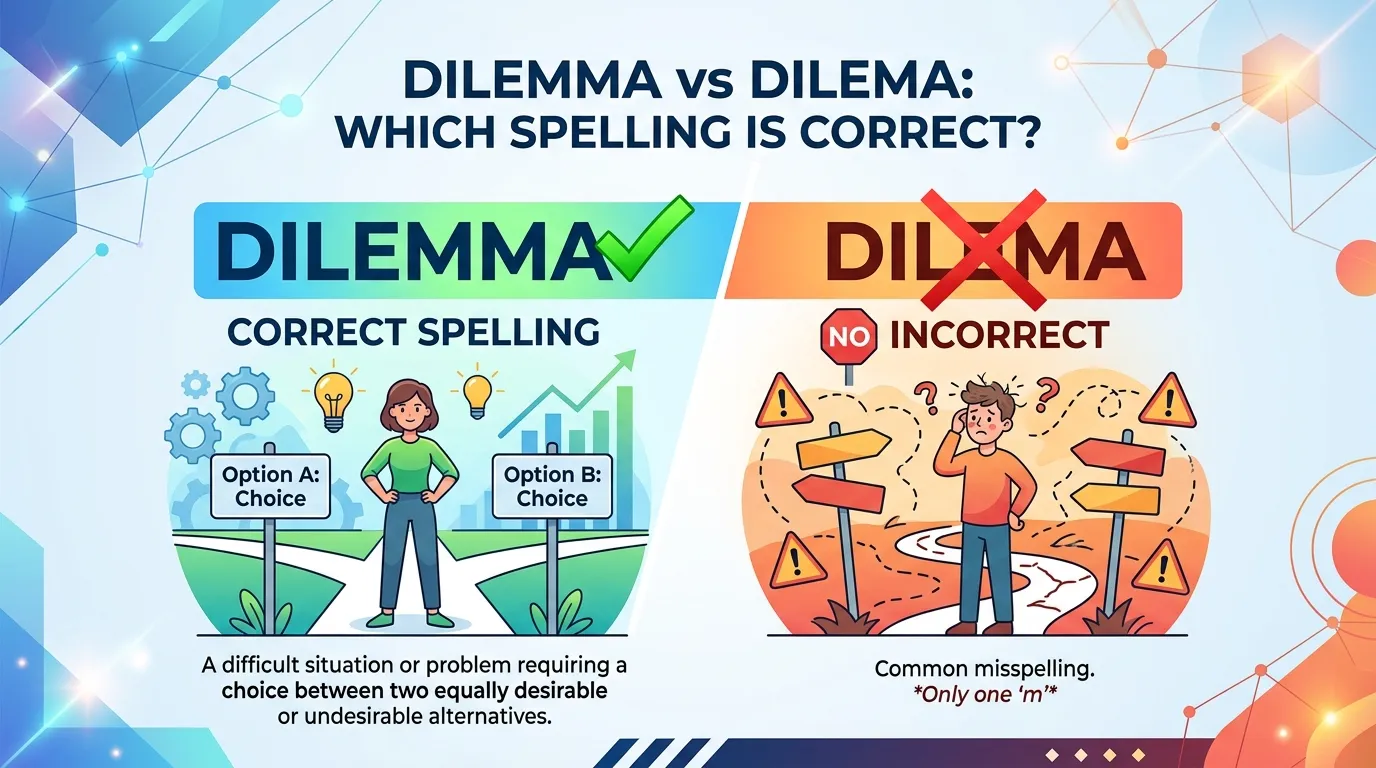
The correct spelling is dilemma. The misspelling dilema — with a single M — is one of the most common errors in English, and it happens because the pronunciation hides the doubling. The word is built from two Greek pieces, and the second piece brings its own M.
The Trolley Problem on the Whiteboard
Start with the trolley, because the trolley is the most famous dilemma in philosophy. A runaway trolley is heading toward five people tied to the track. You stand at a lever. If you pull it, the trolley switches to a side track, where one person is tied. If you do nothing, five die. If you pull, one dies — by your hand. There is no third option. There is no painless answer. That is what makes it a dilemma: not the difficulty, but the structure — two choices, both costly, no escape.
The trolley problem was devised by the philosopher Philippa Foot in 1967 and developed by Judith Jarvis Thomson. It is not a puzzle with a solution. It is a tool for exposing the difference between two moral intuitions: that killing is wrong, and that saving five lives is better than saving one. The dilemma forces the two intuitions to collide, and the collision is the point. A dilemma, in philosophy, is not a problem to be solved. It is a structure to be understood.
The word also lives outside philosophy, in the ordinary sense: any difficult choice between two undesirable options. “The dilemma of the small business owner: raise prices and lose customers, or keep prices and lose money.” “The dilemma of the doctor: tell the patient the truth and cause pain, or withhold it and break trust.” In every case, the word names a fork, not a wall. A wall has one obstacle. A fork has two paths, and the pain is in choosing.
Two Premises: The Greek Root
Here is the fact that fixes the spelling. Dilemma comes from the Greek dilemma — di- (two, twice) + lemma (a premise, an assumption, something taken). A dilemma is, literally, a “two-premise” argument — a form of reasoning in which you are offered two premises and both lead to conclusions you do not want. The classic form: “If you do A, B follows. If you do not do A, C follows. Both B and C are unacceptable. Therefore you are trapped.”
Look at the pieces: di- + lemma. The second piece, lemma, is spelled L-E-M-M-A, with a double M. The double M is part of the word, not an addition. When di- is attached, the double M stays: di- + lemma = dilemma. The misspelling dilema drops one of them, as if the prefix had eaten it. It did not. The prefix is di-, with one I. The stem is lemma, with two M’s. The whole word has one I in the prefix and two M’s in the stem.
The family confirms it. Lemma — the premise, the headword in a dictionary entry — keeps the double M. Trilemma — a dilemma with three options — keeps it too: T-R-I-L-E-M-M-A. Polylemma — a dilemma with many options — keeps it as well. The family is consistent. The single M is the stranger.
Dilemma vs Problem vs Quandary vs Predicament
Dilemma has close neighbors, and keeping them distinct sharpens a sentence. A problem is a difficulty that has, in principle, a solution — a puzzle, an obstacle, a question to be answered. A quandary is a state of perplexity, of not knowing what to do — the emphasis is on the confusion, not the structure. A predicament is a difficult, unpleasant, or embarrassing situation — the emphasis is on the situation, not the choice. A dilemma is a choice between two undesirable options — the emphasis is on the fork.
The choice among them is a matter of what you want to say. If the point is a difficulty with a solution, use problem. If the point is confusion, use quandary. If the point is an unpleasant situation, use predicament. If the point is a fork with two costly paths, use dilemma. The neighbors overlap, but they are not identical, and the sentence improves when the word matches the meaning.
There is a useful test: can you name the two options? If yes — “raise prices or lose money,” “pull the lever or do nothing” — the word is dilemma. If you cannot name two options, if the difficulty is a single obstacle or a general confusion, the word is problem or quandary. The test works because the dilemma is defined by its structure: two premises, two paths, two costs.
There is also a common misuse worth naming: dilemma used for any difficult problem. “The dilemma of finding a parking space” is not a dilemma — it is a problem, or an annoyance. The misuse is so common that dictionaries now list “a difficult situation” as an extended sense, but careful writers reserve dilemma for the fork. The word is stronger when it is used precisely.
The False Dilemma: When Two Choices Are a Trick
There is a logical fallacy named for this word, and it is one of the most important in argumentation: the false dilemma, also called the false dichotomy or the either/or fallacy. A false dilemma presents two options as if they were the only ones, when in fact there are more. “You are either with us or against us.” “Either we cut spending or the economy collapses.” “Either you support the policy or you do not care about the country.” In each case, the speaker has hidden the third, fourth, and fifth options, and the argument depends on the audience not noticing.
The false dilemma is a fallacy because the structure is dishonest. A genuine dilemma has two options because the situation really offers two. A false dilemma has two options because the speaker has concealed the rest. The distinction is the whole of the fallacy: the form is the same, the honesty is different. A writer who spots a false dilemma has spotted a manipulation, and naming it — “that is a false dilemma” — is one of the most useful moves in critical thinking.
The fallacy appears everywhere: in politics, in advertising, in family arguments, in sales pitches. “Buy now or miss out forever.” “Love it or leave it.” “My way or the highway.” The phrases are catchy precisely because they hide the alternatives. The dilemma, real or false, is one of the most powerful structures in rhetoric, and the word that names it deserves to be spelled correctly.
Dilemmas in Medicine, Business, and Everyday Life
In medicine, dilemmas are the daily work of ethics committees: the patient who refuses treatment, the family that disagrees about life support, the surgeon who must choose between two risky procedures. Medical ethics has a name for the field: bioethics, and its central tool is the dilemma — the case where two duties conflict, and no choice is clean. The word appears in every ethics textbook, and it is spelled with two M’s in all of them.
In business, dilemmas are the daily work of leadership: the layoff that saves the company and breaks the team, the product recall that costs millions and saves lives, the merger that creates jobs and destroys a culture. Business schools teach the dilemma as a case study — a situation with no right answer, only trade-offs. The word is the standard term, and the spelling is the standard spelling.
In everyday life, dilemmas are smaller but no less real: the friend who asks for an honest opinion about a terrible haircut, the job offer that pays more and means moving away, the secret that is not yours to tell and too important to keep. The word covers the whole spectrum, from the trolley to the haircut, because the structure is the same: two paths, two costs, no escape.
The Double-M Memory Hook
Here is the lock-in, and it is the Greek root doing its work. Dilemma is di- + lemma. Lemma has two M’s. The prefix does not eat one of them. When the word appears in your draft, look at the middle. If you see a single M — dilema — the stem has been robbed. Put the M back. Di-lem-ma. Two M’s, two premises, two paths — and the trolley, the professor, and the reader all know exactly what kind of problem this is.