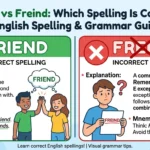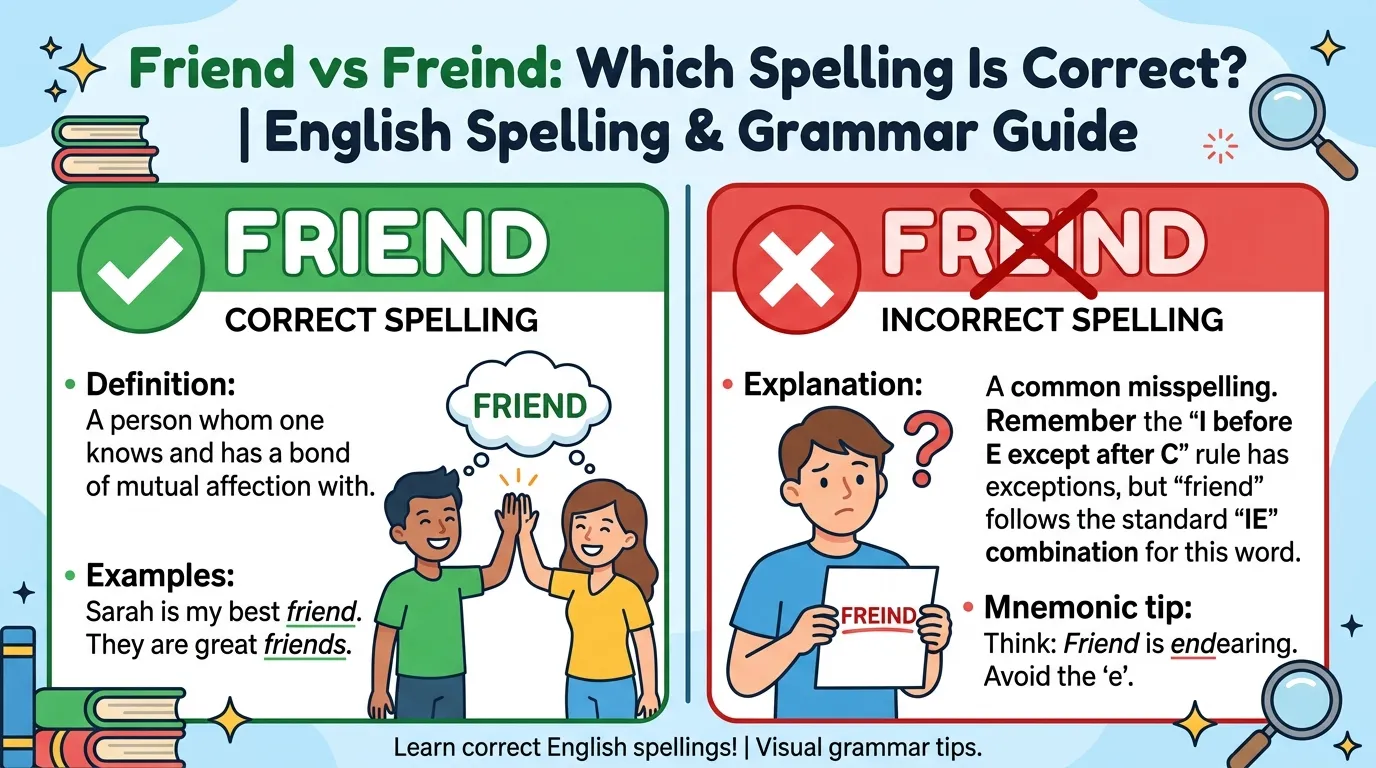
If you have ever typed friend and suddenly wondered whether freind might be correct, you are not alone. These two spellings look very similar, but there is an important difference: friend is the correct spelling, while freind is a common misspelling.
The confusion usually happens because the vowel order in friend does not follow the spelling pattern people expect. English contains many words where ei appears before ie, so writers sometimes reverse the letters and type freind.
This guide explains friend vs freind in clear, practical terms. You will learn the correct spelling, meaning, pronunciation, grammar, word history, common mistakes, synonyms, related expressions, formal and informal usage, and easy ways to remember the correct form.
Quick Answer: Friend or Freind?
Friend is the correct spelling.
Freind is incorrect in standard American English and standard British English.
| Spelling | Correct? | Meaning |
|---|---|---|
| friend | Yes | A person you know, like, trust, or have a relationship with |
| freind | No | A common spelling mistake for friend |
Correct examples
- She is my best friend.
- I met an old friend yesterday.
- He has been a close friend for years.
- I would like to friend you on the platform.
Incorrect example
- She is my best freind. ❌
The corrected sentence is:
- She is my best friend. ✅
If you are writing an email, essay, article, social media post, business message, school assignment, or professional document, use friend.
What Does Friend Mean?
The word friend usually refers to a person with whom you have a relationship based on affection, trust, companionship, or mutual respect.
Dictionary-style definition
Friend is a noun meaning a person whom someone knows and likes and with whom they share a relationship of mutual affection, trust, or support.
It can also function as a verb in modern English, especially in digital and social media contexts.
Examples as a noun
- Maria is my friend.
- My friend helped me move.
- He invited several friends to dinner.
- A good friend will listen when you need support.
Friend as a verb
In modern informal English, friend can also mean to add someone to a social networking service.
For example:
- I friended him on Facebook.
- She friended her new classmates.
- You can friend me on the app.
This verbal use is common in digital communication, although it is more informal than the traditional noun use.
What Does Freind Mean?
Freind has no standard English meaning.
It is generally a misspelling of friend.
You may see freind in:
- Text messages
- Social media comments
- Online forums
- Informal writing
- Typing mistakes
- Student writing
- Usernames or intentionally altered names
However, seeing the spelling frequently does not make it correct.
For standard English, always write friend.
Friend vs Freind: The Main Difference
The difference is simple:
Friend is correct. Freind is incorrect.
The letters are arranged differently.
Correct: f + r + i + e + n + d
Incorrect: f + r + e + i + n + d
The common error comes from reversing ie into ei.
| Feature | Friend | Freind |
|---|---|---|
| Standard spelling | Correct | Incorrect |
| Standard dictionary word | Yes | No |
| American English | Correct | Misspelling |
| British English | Correct | Misspelling |
| Academic writing | Use it | Avoid it |
| Business writing | Use it | Avoid it |
| Casual texting | Correct | Usually a typo |
| Pronunciation | /frend/ | Usually intended as /frend/ |
| Meaning | Person with whom you have a friendship | No standard meaning |
Why Do People Spell Friend as Freind?
The mistake is understandable because English spelling is not always predictable.
Many learners remember the phrase i before e, while others have learned words containing ei.
For example:
- receive
- ceiling
- perceive
- deceive
These words contain ei.
Meanwhile, other familiar words contain ie:
- piece
- field
- chief
- belief
- friend
Because both patterns occur in English, writers may hesitate when spelling friend.
The unusual vowel order
The word looks as though it might be spelled freind because the pronunciation does not clearly reveal which vowel comes first.
When spoken, friend sounds approximately like frend. The letters i and e do not each have a separate obvious sound.
That makes the spelling something you often need to remember rather than simply hear.
How Do You Pronounce Friend?
Friend is pronounced approximately like:
frend
Its pronunciation is represented in the International Phonetic Alphabet as /frɛnd/.
The word has one syllable.
Examples
- friend → frend
- friends → frendz
- friendly → FREND-lee
- friendship → FREND-ship
Interestingly, freind would generally be intended to represent the same pronunciation. The problem is not normally pronunciation. The problem is spelling.
Is Friend a Noun or a Verb?
Friend can be both a noun and a verb.
Friend as a noun
The most traditional use is as a noun.
A friend is someone with whom you have a personal relationship.
Example:
My friend lives nearby.
Here, friend is a noun.
Friend as a verb
In modern informal English, friend can also be a verb.
Example:
I friended my new coworker on social media.
Here, friended means added the person as a connection on a social platform.
The verb became especially common with the growth of social networking.
Related forms
- friend
- friends
- friendly
- friendship
- friendliness
- unfriendly
- friended
- friending
None of these forms are spelled with freind.
Friend vs Freind in American English
In American English, the standard spelling is friend.
Examples:
- My friend is visiting tomorrow.
- She became a close friend.
- I have known my friend since college.
- They are good friends.
Writing freind in an American English essay or professional document would normally be treated as a spelling error.
There is no American regional spelling in which freind is the accepted standard form.
Friend vs Freind in British English
The same rule applies to British English.
British writers use:
friend
They do not normally use freind as an alternative spelling.
For example:
She is one of my oldest friends.
The spelling does not change simply because the writer is using British English.
This makes friend a stable spelling across major varieties of standard English.
Is Freind Ever Correct?
In ordinary English writing, no.
There can be unusual situations where Freind appears as a surname, username, brand name, fictional name, or intentionally altered spelling. In those cases, it may be a proper name rather than the ordinary English word.
But if you mean a person you know and like, the standard word is:
friend
Do not use freind as a spelling variation.
The History and Etymology of Friend
The word friend has a long history in English.
It comes from Old English frēond, which was related to the idea of loving or being affectionate toward someone. It is connected historically with the Germanic family of words associated with love, friendship, and affection.
Over time, the spelling and pronunciation developed into the modern English word friend.
This history helps explain why modern spelling cannot always be predicted directly from pronunciation.
The modern spelling is established through centuries of English usage. Freind is not an alternative historical spelling that modern writers can freely choose. In contemporary standard English, it is simply considered an error when intended to mean friend.
Friend, Friendly, and Friendship: What Is the Difference?
These words are related but do not have exactly the same grammatical function.
| Word | Part of Speech | Meaning |
|---|---|---|
| friend | Noun / verb | A person you have a relationship with; or to add someone socially |
| friendly | Adjective | Kind, pleasant, or welcoming |
| friendship | Noun | The relationship between friends |
| friendliness | Noun | The quality of being friendly |
| unfriendly | Adjective | Not warm, kind, or welcoming |
Examples
Friend:
David is my friend.
Friendly:
David is very friendly.
Friendship:
Their friendship lasted for many years.
Friendliness:
Her friendliness made everyone feel welcome.
Unfriendly:
The receptionist seemed unfriendly.
Common Collocations With Friend
A collocation is a group of words that commonly appear together.
Knowing common collocations can make your English sound more natural.
Common expressions include:
- best friend
- close friend
- good friend
- old friend
- childhood friend
- family friend
- mutual friend
- dear friend
- trusted friend
- lifelong friend
- loyal friend
- true friend
- new friend
- male friend
- female friend
- Facebook friend
- online friend
Natural examples
Sarah is my best friend.
We ran into an old friend at the store.
He is a close friend of my family.
A mutual friend introduced us.
They have been lifelong friends.
Common Phrases and Expressions With Friend
The word friend appears in many common English expressions.
A friend in need is a friend indeed
This traditional expression means that someone who helps you during difficult times shows genuine friendship.
Make friends
To develop friendships with people.
It was easy for her to make friends at school.
Become friends
To start having a friendship.
We met at work and eventually became friends.
Stay friends
To remain friends after a change or disagreement.
They decided to stay friends after ending the relationship.
Best friends
People who share a particularly close friendship.
They have been best friends since childhood.
Friends and family
A common phrase referring to people close to you.
We invited friends and family to the celebration.
Friend vs Buddy vs Pal vs Acquaintance
These words are related, but they are not perfect substitutes.
| Word | Meaning | Typical Tone |
|---|---|---|
| friend | Someone with whom you have a friendship | Neutral |
| buddy | A friend or companion | Informal |
| pal | A friend | Informal, sometimes old-fashioned |
| acquaintance | Someone you know but are not close to | Formal or neutral |
| companion | Someone who spends time with you | Neutral to formal |
| colleague | Someone you work with | Professional |
Compare the meanings
John is my friend.
This suggests a personal relationship.
John is my buddy.
This sounds more casual.
John is an acquaintance.
This suggests you know John but are not especially close.
John is my colleague.
This focuses on the professional relationship.
Formal and Informal Alternatives to Friend
The best word depends on context.
Casual alternatives
- buddy
- pal
- mate
- bestie
- close friend
Mate is particularly common in British and Australian English, while buddy is especially common in American English.
More formal alternatives
- companion
- associate
- acquaintance
- colleague
- personal acquaintance
However, these words should not automatically replace friend.
For example, calling your best friend an acquaintance changes the meaning because an acquaintance is generally someone you know less closely.
Friend in Academic Writing
Friend is completely acceptable in academic writing when the topic requires it.
For example:
The study examined how friendships influence social development among adolescents.
There is no need to replace friend with an unnecessarily complicated word.
Good academic writing is not about avoiding simple words. It is about choosing precise words.
If your paper discusses friendships, relationships, social networks, or interpersonal communication, friend and friendship are natural choices.
Friend in Business Writing
In professional writing, friend is also correct, but context matters.
For example:
A longtime friend recommended the company.
That is perfectly natural.
However, in a formal business context, you may need a more precise relationship word.
Compare:
She is my friend.
with:
She is my colleague.
or:
She is a professional contact.
The correct choice depends on what relationship you actually mean.
Never use freind in business writing. A spelling error can make an otherwise professional message look careless.
Friend in Journalism
Journalists commonly use friend when describing personal relationships.
Examples:
Friends of the actor said he was recovering well.
The victim was remembered by friends and family.
A longtime friend described her as generous and hardworking.
The spelling remains friend in journalistic writing.
Friend in Sports
Sports writing frequently uses friend when athletes have personal relationships outside competition.
Examples:
The two players are close friends off the field.
The teammates became friends during their first season.
Despite being rivals, the athletes remain friends.
The word may also appear metaphorically.
For example:
The team found a friend in the home crowd.
Here, friend suggests support rather than literal friendship.
Friend in Technology and Social Media
Technology has expanded the use of friend.
On social networking platforms, users may:
- add a friend
- accept a friend request
- remove a friend
- unfriend someone
- make new online friends
- manage their friends list
The verb unfriend became especially associated with social media.
Example:
She decided to unfriend an account she no longer interacted with.
This is a modern digital use of the word.
Again, the base word is spelled friend, not freind.
Literal and Figurative Uses of Friend
The word friend can have both literal and figurative meanings.
Literal meaning
A person with whom you have a genuine personal relationship.
My friend lives across the street.
Figurative meaning
Something that helps, supports, or benefits someone can sometimes be described as a friend.
For example:
Exercise can be a friend to your health.
This is figurative language. Exercise is not literally a human friend.
The word can also be used rhetorically in phrases such as:
Nature is a friend to those who respect it.
Political and Historical Usage
In political and historical writing, friend can sometimes refer to an ally, supporter, or person with shared interests.
For example:
The two nations described each other as friends and partners.
This does not necessarily mean the leaders have a personal friendship. It can describe a diplomatic relationship.
In historical texts, friend may also have meanings connected with loyalty, alliance, support, or patronage.
The spelling remains unchanged.
Sports, Political, and Technical Meanings Do Not Change the Spelling
One useful rule is that specialized context does not turn freind into an accepted spelling.
Whether you are writing about:
- sports
- politics
- business
- technology
- education
- journalism
- social media
- history
- everyday life
the standard spelling is still:
friend
Common Mistakes With Friend
Here are some frequent errors and their corrections.
| Incorrect | Correct |
|---|---|
| freind | friend |
| freinds | friends |
| freindship | friendship |
| freindly | friendly |
| best freind | best friend |
| old freind | old friend |
| close freind | close friend |
| my freind | my friend |
Mistake: Freinds
A writer who accidentally changes friend to freind often makes the same mistake in the plural.
Incorrect:
I have many freinds.
Correct:
I have many friends.
Mistake: Freindship
Incorrect:
Their freindship lasted for decades.
Correct:
Their friendship lasted for decades.
The spelling friendship keeps the ie sequence from friend.
Awkward vs Natural Examples
Example one
Awkward:
My freind helped me with the project.
Natural:
My friend helped me with the project.
Example two
Incorrect:
She is my best freind.
Correct:
She is my best friend.
Example three
Incorrect:
We have been freinds since childhood.
Correct:
We have been friends since childhood.
Example four
Incorrect:
Our freindship is very important to us.
Correct:
Our friendship is very important to us.
Example five
Incorrect:
I met an old freind yesterday.
Correct:
I met an old friend yesterday.
How to Remember the Spelling of Friend
The easiest way to remember friend is to focus on the middle letters:
FRIEND
You can break it into:
FRI + END
Think of the word as:
FRIEND = FRI + END
The letters I and E appear in that order.
Another useful memory trick is:
A friend is someone who is there at the end of a difficult day.
This is not an etymological rule. It is simply a memory aid.
Another trick
Write this several times:
friend, friend, friend
Then connect it with familiar words:
- friend
- friends
- friendly
- friendship
Once you remember the base spelling, the related words become easier.
A Simple Test for Friend vs Freind
When you are unsure, ask:
Am I talking about someone I know and like?
If yes, use:
friend
For example:
He is my friend.
Never choose freind simply because it looks more natural to you.
Proofreading trick
Use your spell checker.
Most modern word processors and browsers will flag freind as a spelling mistake.
However, do not rely entirely on spell checking. Learning the correct spelling is useful because some digital systems may not catch every typo in every situation.
Friend vs Freind in Everyday Writing
Here are natural everyday examples:
- My friend is coming over tonight.
- I called my friend yesterday.
- She introduced me to her friends.
- We became friends in high school.
- He is one of my closest friends.
- I have an old friend who lives in Texas.
- My friendship with her means a lot to me.
- We have been friends for years.
- I made several new friends at college.
- My best friend gave me good advice.
All of these use friend or one of its correctly formed derivatives.
Recommended Usage by Writing Context
| Context | Recommended Form |
|---|---|
| American English | friend |
| British English | friend |
| International English | friend |
| Academic writing | friend |
| Business writing | friend when appropriate |
| Journalism | friend |
| Blogging | friend |
| Technical writing | friend when relevant |
| Sports writing | friend |
| Social media | friend |
| Texting | friend |
| Formal correspondence | friend when appropriate |
| School assignments | friend |
| Creative writing | friend |
| Standard English | friend |
There is no standard context where freind should replace friend.
Synonyms for Friend
Depending on the context, possible synonyms include:
- companion
- buddy
- pal
- mate
- ally
- confidant
- associate
- acquaintance
- bestie
- supporter
These words are not always interchangeable.
For example, an ally may support you without being your personal friend. An acquaintance is usually less close than a friend. A companion may describe someone who regularly spends time with you.
Use friend when you mean the general concept of a person with whom you share friendship.
Antonyms and Contrasting Words
There is no single perfect antonym for friend, but depending on the context, contrasting terms include:
- enemy
- opponent
- stranger
- rival
- adversary
The appropriate opposite depends on the sentence.
For example:
He was once my friend, but now he is my enemy.
In a sports context:
The team faced its biggest rival.
A stranger is not necessarily an enemy. Therefore, context matters.
Related Words You Should Know
Understanding the word family can strengthen your vocabulary.
Friendship
The relationship between friends.
Their friendship grew stronger over time.
Friendly
Kind, pleasant, or welcoming.
The staff were friendly.
Friendliness
The quality of being friendly.
Her friendliness made the conversation easy.
Unfriendly
Not warm, pleasant, or welcoming.
His response sounded unfriendly.
Unfriend
To remove someone from a social media friends list.
She decided to unfriend the account.
Befriend
To become a friend to someone or treat someone in a friendly way.
She befriended a new student at school.
Notice that befriend is not spelled befreind.
Is Friend a Commonly Misspelled Word?
Yes. Friend is a commonly confused spelling because of the unusual vowel order.
The problem is especially common among:
- English learners
- Young writers
- Fast typists
- People writing from memory
- People who rely heavily on pronunciation
The word is also easy to mistype because the letters ie occur in many different spelling patterns across English.
That does not make freind acceptable, but it explains why the error appears so often.
Friend vs Freind: What Should You Use?
The answer is straightforward.
Use friend when:
- Writing an essay
- Sending a professional email
- Publishing a blog
- Writing a school assignment
- Creating a business document
- Posting on social media
- Writing a news article
- Talking about a personal relationship
- Referring to a social media connection
- Using standard American or British English
Avoid freind when:
- Writing formally
- Publishing online
- Applying for a job
- Writing academic work
- Communicating with customers
- Creating professional content
- Editing an article
- Taking an English test
The only time you might preserve Freind is when it is intentionally used as a proper name, username, brand, title, or other special spelling.
Frequently Asked Questions About Friend vs Freind
Is friend or freind correct?
Friend is correct. Freind is a misspelling. Use friend in standard American English, British English, and other major forms of standard English.
Why do people spell friend as freind?
People often reverse the middle vowels because English has many words containing both ie and ei patterns. The pronunciation of friend also does not make its spelling obvious.
Is freind a word in the English dictionary?
Freind is not the standard spelling of the English word for a person with whom you have a friendship. It is generally treated as a misspelling of friend. A similar-looking form could appear as a proper name, but that is a different use.
How do you spell friend correctly?
The correct spelling is:
F R I E N D
A useful memory aid is FRI + END.
Is friend spelled the same in American and British English?
Yes. Friend is the standard spelling in both American and British English. There is no major regional spelling difference between the two varieties.
What is the plural of friend?
The plural is friends.
Example:
I have many friends.
The plural is not freinds.
What is the difference between friend and friendship?
Friend usually refers to a person, while friendship refers to the relationship.
Example:
Sarah is my friend.
Our friendship is important to me.
Can friend be a verb?
Yes. In informal modern English, friend can be used as a verb, especially in social media contexts.
Example:
I friended her yesterday.
Is friend a formal or informal word?
Friend is a neutral everyday English word. It can be used in casual, professional, academic, journalistic, and formal contexts when the meaning is appropriate.
What is the easiest way to remember friend vs freind?
Remember:
FRIEND = FRI + END
The correct middle sequence is IE, not EI.
Final Conclusion
When choosing between friend vs freind, there is no complicated spelling rule to memorize. The standard and correct spelling is friend.
Freind is a common misspelling, usually caused by reversing the letters i and e. It does not become correct in American English, British English, academic writing, business writing, journalism, sports writing, blogging, or social media.
Remember the correct spelling:
FRIEND
You can think of it as FRI + END to make it easier to recall.
The word friend can function as both a noun and, in modern informal usage, a verb. It also appears in related words such as friends, friendly, friendship, friendliness, unfriend, and befriend.
If you are writing for school, work, publishing, or everyday communication, choose friend every time you mean a person with whom you have a friendship. Once you remember the ie sequence, the friend vs freind confusion becomes much easier to avoid.