Beginning vs Beggining: Meaning, Spelling, and Examples

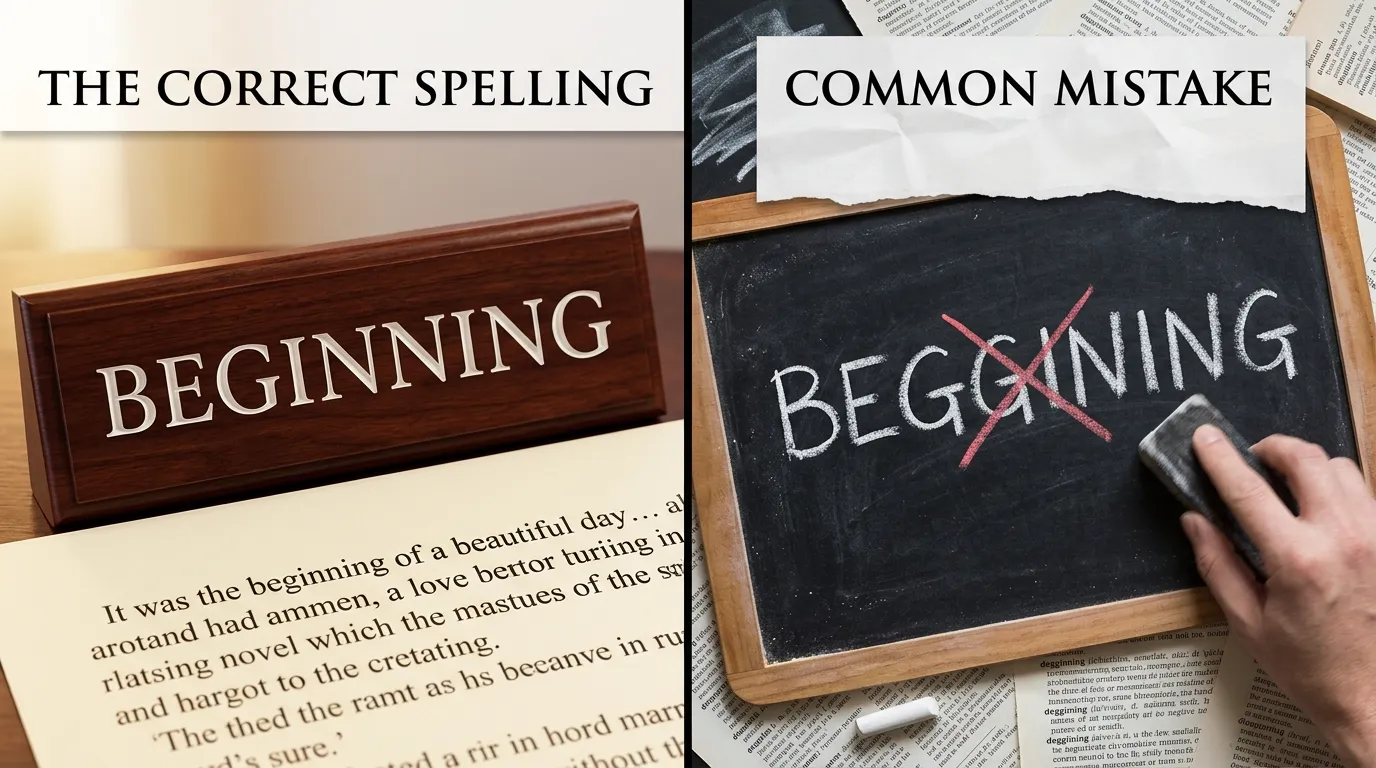
If you are wondering whether beginning or beggining is the correct spelling, the answer is simple: beginning is correct, while beggining is a misspelling.

The word beginning means the start or first part of something. It can function as a noun, as in the beginning of the story, or as a present participle of the verb begin, as in the meeting is beginning.

The confusion happens because the word begin contains a double consonant pattern in its past form, began, and many English spelling rules involve doubling the final consonant when adding endings. However, beginning follows a specific spelling pattern: begin + -ing = beginning. The final n is doubled, but the g is not.

In this guide, you will learn the difference between beginning and beggining, how to spell the word correctly, why the mistake is common, how to pronounce it, how it is used in different contexts, and how to remember the correct spelling.

Quick Answer: Beginning or Beggining?

Beginning is the correct spelling.

Beggining is incorrect in standard English.

SpellingCorrect?Example
beginning✅ YesThe beginning of the movie was exciting.
beggining❌ NoThe beggining of the movie was exciting.

The correct word is spelled:

B-E-G-I-N-N-I-N-G

A useful way to remember it is:

begin + ning = beginning

The word has one g and two n’s.

Correct

  • The beginning of the book was interesting.
  • We are beginning a new project.
  • At the beginning of the year, I made several goals.
  • The class is beginning now.

Incorrect

  • The beggining of the book was interesting.
  • We are beggining a new project.

The incorrect form beggining often appears because people expect the g to be doubled. In standard English, however, it is the n that is doubled.

What Does Beginning Mean?

What Does Beginning Mean?

Beginning refers to the start, first part, or initial stage of something.

As a noun, it identifies the point at which something starts.

For example:

  • The beginning of the movie was funny.
  • We missed the beginning of the meeting.
  • Every journey has a beginning.
  • The story has a surprising beginning.

The word can also describe an early stage of an activity or process:

  • She is at the beginning of her career.
  • The company is still in its beginning stages.
  • We are only at the beginning of the investigation.

Beginning can also be the present participle form of begin.

For example:

  • The concert is beginning.
  • It is beginning to rain.
  • The students are beginning their exams.
  • The team is beginning a new training program.

Why Is Beggining Incorrect?

Beggining is incorrect because English does not spell the present participle of begin by doubling the g.

The base verb is:

begin

When -ing is added, the spelling becomes:

begin + ing → beginning

The final consonant n is doubled:

begin → beginning

It does not become:

beggin → beggining

Therefore, beggining is a spelling error rather than an alternative English spelling.

Why Do People Confuse Beginning and Beggining?

There are several reasons this spelling mistake is common.

The Pronunciation Can Be Misleading

When people say beginning, the word sounds like it contains a strong consonant sequence in the middle. Depending on someone’s accent or speaking speed, it may be difficult to identify exactly which letter should be doubled.

The pronunciation does not clearly tell you that the written word contains nn.

English Has Many Doubling Rules

English spelling has rules that sometimes require a final consonant to be doubled before an ending is added.

For example:

  • run → running
  • sit → sitting
  • swim → swimming
  • stop → stopping

Because learners see many examples of consonant doubling, they may incorrectly assume that begin becomes something like beggin before -ing is added.

But the actual spelling pattern is:

begin → beginning

The Letters Are Close Together

The middle of beginning contains several letters:

b e g i n n i n g

When written quickly, the sequence g-i-n-n-i-n-g can be easy to misremember.

Typing Habits Reinforce the Error

Because beggining is a common typo, people sometimes see it online or type it repeatedly without realizing it is incorrect.

Spell-checkers usually identify it, but relying on automatic correction is not a substitute for learning the spelling.

Beginning vs Beggining: Key Difference

The main difference is straightforward:

Beginning is the standard English spelling.
Beggining is a misspelling.

There is no difference in meaning because beggining is not a standard English word.

FeatureBeginningBeggining
Standard spelling
MeaningStart or first stageNone as a standard word
Dictionary wordYesNo
Used in formal writingYesNo
Used in academic writingYesNo
Used in business writingYesNo
Correct for SEO contentYesNo
Common typoNoYes

How Do You Spell Beginning?

The correct spelling is:

Beginning

Break it into parts:

be + gin + ning

Or remember the letters:

B-E-G-I-N-N-I-N-G

There are:

  • 1 b
  • 1 e
  • 1 g
  • 2 i’s
  • 3 n’s
  • 1 final g

Another simple visual pattern is:

begin + ning

The most important detail is that n is doubled, not g.

Beginning Pronunciation

The standard pronunciation of beginning is approximately:

/bɪˈɡɪnɪŋ/

It sounds roughly like:

bih-GIN-ing

The main stress falls on the second syllable:

be-GIN-ning

Examples:

  • beginning of the year
  • beginning of the story
  • beginning to understand
  • beginning a new project

The pronunciation remains closely related to the verb begin:

begin → beginning

Is Beginning a Noun or a Verb?

Beginning can have more than one grammatical role.

Beginning as a Noun

As a noun, beginning means the start or first part of something.

Examples:

  • The beginning of the film was slow.
  • I remember the beginning of our friendship.
  • The beginning of the school year can be stressful.
  • We need to return to the beginning of the story.

Here, beginning names a thing or concept.

Beginning as a Present Participle

Beginning is also the present participle of begin.

Examples:

  • The meeting is beginning.
  • She is beginning her presentation.
  • They are beginning the next phase.
  • The rain is beginning to fall.

In these examples, beginning forms part of the verb phrase.

Beginning in a Gerund Construction

A present participle can also function as a gerund.

For example:

  • Beginning a new job can feel stressful.
  • Beginning with the basics is often helpful.
  • Beginning early gives us more time.

Here, beginning functions as a noun-like form.

Beginning vs Begin: What Is the Difference?

Begin is the base form of the verb.

Beginning is either the noun referring to a start or the -ing form of begin.

WordPart of SpeechExample
beginVerbWe will begin the meeting soon.
beginningNounThe beginning of the meeting was delayed.
beginningPresent participleThe meeting is beginning.
beganPast tenseThe meeting began at noon.
begunPast participleThe meeting has begun.

Understanding these forms can make the spelling easier to remember.

Why Does Begin Become Beginning?

The spelling change is connected to the way English forms -ing words.

The base verb is:

begin

Add -ing:

begin + ing

The result is:

beginning

The final n is doubled before the -ing ending.

Compare:

  • begin → beginning
  • run → running
  • sit → sitting
  • swim → swimming

This is why the correct spelling has nn.

The important point is that there is no reason to insert an extra g.

Beginning in American English

In American English, the spelling beginning is standard.

American writers should use it in:

  • school assignments
  • business emails
  • reports
  • websites
  • news articles
  • professional documents
  • resumes and cover letters
  • academic papers
  • social media posts
  • technical documentation

There is no American English variation that makes beggining correct.

Beginning in British English

British English also uses beginning.

Therefore, unlike pairs such as color/colour or organize/organise, there is no British-American spelling difference here.

Both American and British English use:

beginning

Not:

beggining

This makes the correct choice easy regardless of your target audience.

Is Beggining Ever Correct?

No. Beggining is not a standard English spelling.

You may occasionally encounter it in:

  • typos
  • informal online comments
  • social media posts
  • user-generated content
  • handwritten notes
  • drafts

Its appearance does not make it an accepted variant.

If you are writing something intended for publication or professional communication, always change beggining to beginning.

Common Phrases With Beginning

Beginning appears in many common English expressions.

At the Beginning

This means at the start of something.

  • We met at the beginning of the semester.
  • Please read the instructions at the beginning of the chapter.

In the Beginning

This can refer to an early period or the initial stage of something.

  • In the beginning, the project seemed difficult.
  • In the beginning, she did not understand the process.

The phrase also has strong religious and literary associations, especially through the opening of Genesis.

From the Beginning

This means from the start.

  • I knew the answer from the beginning.
  • She supported the project from the beginning.

At the Very Beginning

This emphasizes the earliest point.

  • The clue appears at the very beginning of the story.
  • We discussed the issue at the very beginning of the meeting.

A New Beginning

This phrase describes a fresh start.

  • Moving to a new city gave him a new beginning.
  • The company saw the merger as a new beginning.

Beginning to End

This means covering an entire process.

  • I read the book from beginning to end.
  • The documentary tells the story from beginning to end.

Common Collocations With Beginning

A collocation is a group of words that commonly appear together.

Common collocations with beginning include:

  • beginning of the year
  • beginning of the month
  • beginning of the week
  • beginning of the day
  • beginning of the story
  • beginning of the chapter
  • beginning of the process
  • beginning of the journey
  • beginning of the season
  • beginning of the meeting
  • beginning of the semester
  • beginning of the century
  • new beginning
  • humble beginning
  • fresh beginning
  • beginning stages
  • early beginning
  • beginning to understand

Examples

  • We moved here at the beginning of the year.
  • The company is still in the beginning stages.
  • Everyone deserves a fresh beginning.
  • He had a humble beginning but built a successful career.

Beginning vs Start

Beginning and start are often synonyms, but they are not always interchangeable in exactly the same way.

Start is generally more conversational and versatile.

Beginning can sound slightly more descriptive, formal, or literary depending on the context.

Compare:

  • The start of the movie was exciting.
  • The beginning of the movie was exciting.

Both are correct.

However:

  • Let’s start the meeting. sounds very natural.
  • Let’s beginning the meeting. is incorrect.

Why? Because beginning cannot replace the base verb begin in that sentence.

Correct:

  • Let’s begin the meeting.
  • Let’s start the meeting.

Incorrect:

  • Let’s beginning the meeting.
  • Let’s beginning the project.

Beginning vs Commencement

Commencement can also mean the beginning of something, but it is much more formal.

For example:

  • The beginning of construction was delayed.
  • The commencement of construction was delayed.

The second sentence sounds more formal and bureaucratic.

In everyday American English, beginning or start is usually more natural.

Interestingly, commencement can also mean a graduation ceremony in American English. Therefore, context matters.

Beginning vs Origin

These words are related but not identical.

Beginning usually refers to the point at which something starts.

Origin refers to where something comes from or the source from which it developed.

Compare:

  • The beginning of the meeting was at 9 a.m.
  • The origin of the tradition is unclear.

You would not normally replace one with the other.

Beginning vs Beginning’s

Beginning’s is the possessive form of the noun beginning.

For example:

  • The story’s beginning was confusing.
  • The beginning’s importance becomes clear later.

However, the second construction is less common and can often be rewritten more naturally.

Instead of:

  • The beginning’s meaning was unclear.

You might write:

  • The meaning of the beginning was unclear.

Beginning vs Beginnings

Beginnings is the plural form of beginning.

Examples:

  • The book explores the beginnings of modern science.
  • The company’s beginnings were modest.
  • We studied the beginnings of the movement.

The plural is especially common when discussing origins or early stages.

A common phrase is:

humble beginnings

Example:

  • The successful entrepreneur came from humble beginnings.

Synonyms for Beginning

Depending on context, synonyms for beginning include:

  • start
  • opening
  • outset
  • commencement
  • origin
  • inception
  • dawn
  • launch
  • introduction
  • onset
  • emergence
  • initiation

These words are not always interchangeable.

For example:

  • onset is common for unpleasant conditions or events: the onset of winter
  • inception is formal: the inception of the project
  • launch often describes a product, business, or event
  • opening can refer to the first part of a speech, story, or event
  • outset often appears in the phrase from the outset

Antonyms of Beginning

Common opposites include:

  • ending
  • end
  • conclusion
  • finish
  • completion
  • termination
  • closure
  • finale

For example:

  • beginning ↔ ending
  • start ↔ finish
  • opening ↔ closing
  • commencement ↔ conclusion

Beginning in Formal and Informal Writing

The word beginning works well in almost every register.

Academic Writing

  • The study examines the beginning of the industrial period.
  • At the beginning of the experiment, researchers recorded the initial conditions.

For highly technical contexts, onset, inception, or initiation may sometimes be more precise.

Business Writing

  • The new policy will take effect at the beginning of July.
  • We will begin the next phase after the review.

Journalistic Writing

  • At the beginning of the campaign, few expected such strong results.
  • The story’s beginning dates back several decades.

Technical Writing

Technical documents may use beginning for general audiences:

  • At the beginning of the process, the system checks the input.

For precise technical processes, terms such as initialization, startup, or initiation may be more appropriate depending on the field.

Casual Writing

  • I missed the beginning of the movie.
  • The beginning was pretty funny.
  • Let’s start over from the beginning.

Beginning in Sports

In sports writing, beginning is perfectly normal.

Examples:

  • The team had a strong beginning to the season.
  • The quarterback struggled at the beginning of the game.
  • The match had an exciting beginning.
  • The team scored early in the beginning of the second half.

However, sports writers may often prefer start:

  • The team had a strong start to the season.

Both are correct, but start is often more concise.

Beginning in Business and Professional Communication

The word is frequently used to describe stages of projects, careers, companies, and plans.

Examples:

  • The project is still in its beginning stages.
  • We need a clear plan before beginning the next phase.
  • The company had humble beginnings.
  • At the beginning of the quarter, sales were lower than expected.

For professional writing, avoid the misspelling beggining because spelling errors can reduce perceived credibility.

Beginning in Blogging and Online Content

For bloggers, content creators, and website owners, beginning is the correct spelling in headings, articles, metadata, captions, and body text.

Natural examples include:

  • Beginning Your Fitness Journey
  • How to Make a Strong Beginning
  • The Beginning of a New Chapter
  • What to Do at the Beginning of Your Career

If you are targeting the search phrase beginning vs beggining, it is useful to explain the spelling difference naturally rather than repeatedly inserting the exact phrase.

Search engines increasingly understand related concepts such as:

  • correct spelling of beginning
  • beginning spelling
  • is beggining a word
  • beginning definition
  • beginning meaning
  • how to spell beginning
  • beginning vs begin
  • beginning pronunciation
  • correct English spelling
  • common spelling mistakes
  • English spelling rules

Common Mistakes With Beginning

Mistake: Beggining

❌ The beggining of the book was slow.

✅ The beginning of the book was slow.

Mistake: Beggining

❌ We are beggining the project today.

✅ We are beginning the project today.

Mistake: Using Beginning Instead of Begin

❌ We will beginning the meeting at 10.

✅ We will begin the meeting at 10.

Mistake: Using Begin Instead of Beginning

❌ The meeting is begin now.

✅ The meeting is beginning now.

These errors show why knowing the spelling alone is not enough. You also need to understand the grammatical role of the word.

Awkward vs Natural Examples

Example 1

Awkward:

  • At the beggining, everyone was quiet.

Natural:

  • At the beginning, everyone was quiet.

Example 2

Incorrect:

  • We are beginning the meeting at noon.

This sentence is actually correct.

But if the intended meaning is a future scheduled action, this may sound more natural:

  • We will begin the meeting at noon.

Example 3

Incorrect:

  • The beggining of the article contains the main point.

Correct:

  • The beginning of the article contains the main point.

Example 4

Incorrect:

  • Let’s beginning with the first question.

Correct:

  • Let’s begin with the first question.

Or:

  • Let’s start with the first question.

Memory Tricks for Beginning

If you frequently spell beginning incorrectly, use one of these tricks.

Remember: Begin Has an N Before -ing

Think:

begin → beginning

The final consonant being doubled is n.

Remember the Double N

Picture the correct spelling:

beginNING

The middle contains NN.

Think of the Word Begin

Start with the correct base word:

BEGIN

Then add:

ING

The result is:

BEGINNING

Do not create a separate spelling such as beggin first.

Use the Phrase New Beginning

The familiar phrase new beginning can help reinforce the correct spelling.

  • new beginning
  • fresh beginning
  • new beginning

Each one uses nn, not gg.

How to Avoid the Beggining Spelling Error

A simple proofreading routine can help.

Before publishing or submitting your writing:

  1. Search the document for beggining.
  2. Replace it with beginning.
  3. Check whether the word is being used as a noun or verb form.
  4. Make sure you have not accidentally used beginning where begin is required.
  5. Read the sentence aloud to confirm the grammar.

If you write frequently, adding beggining to your personal list of commonly mistyped words can also help you catch the error faster.

Is Beginning a Difficult Word to Spell?

For many English learners, beginning is somewhat tricky because it contains repeated letters and several unstressed sounds.

The challenge is not the meaning. It is the spelling sequence:

b-e-g-i-n-n-i-n-g

The most common problem is replacing nn with gg.

Learning the base verb begin and its related forms together can make the pattern easier:

  • begin
  • begins
  • began
  • begun
  • beginning
  • beginner

Notice that beginning and beginner both preserve the spelling of begin while adding letters to it.

Related Words: Beginner, Began, Begun, Begin

Understanding related forms can strengthen your spelling.

Begin

Present/base form:

  • I will begin tomorrow.

Begins

Third-person singular:

  • The class begins at 9 a.m.

Began

Simple past:

  • The class began at 9 a.m.

Begun

Past participle:

  • The class has begun.

Beginning

Present participle or noun:

  • The class is beginning.
  • The beginning was difficult.

Beginner

A person who is new to an activity:

  • She is a beginner at tennis.

Word History and Etymology of Beginning

The word beginning comes from the verb begin, which has a long history in English and Germanic languages.

The English verb developed from older Germanic forms associated with starting or undertaking something. Over centuries, begin became the standard English verb meaning to start.

The noun beginning developed from the same verbal family.

This history helps explain why the spelling is built around begin, not a hypothetical form such as beggin.

The modern English forms are:

begin → beginning

rather than:

beggin → beggining

Is Beginning Used in Figurative Language?

Yes. Beginning is frequently used figuratively.

For example:

  • This conversation is the beginning of a new friendship.
  • Her recovery marked the beginning of a new chapter.
  • The decision was only the beginning of a much larger change.
  • The discovery could be the beginning of a major breakthrough.

The word does not have a separate spelling for figurative use. Whether you mean a literal beginning or a metaphorical new chapter, the spelling remains beginning.

Common Expressions With Beginning

Here are several useful expressions:

  • from the beginning
  • at the beginning
  • in the beginning
  • from the very beginning
  • at the very beginning
  • a new beginning
  • a fresh beginning
  • humble beginnings
  • beginning to end
  • beginning stages
  • beginning of the end
  • the beginning of a new chapter

Beginning of the End

This expression means that something has entered a stage that will eventually lead to its conclusion.

Example:

  • The loss was considered the beginning of the end for the defending champions.

It is often used figuratively in politics, sports, business, entertainment, and everyday conversation.

Beginning vs Beggining: Final Comparison

CategoryBeginningBeggining
Correct EnglishYesNo
MeaningStart or initial stageNo standard meaning
Pronunciation/bɪˈɡɪnɪŋ/Not a standard word
NounYesNo
Present participleYesNo
American EnglishStandardIncorrect
British EnglishStandardIncorrect
Academic writingAppropriateAvoid
Business writingAppropriateAvoid
Casual writingAppropriateOnly appears as a typo
Formal writingAppropriateIncorrect
SEO contentUseDo not use as the correct spelling

Frequently Asked Questions About Beginning vs Beggining

Is beginning or beggining correct?

Beginning is correct. Beggining is a misspelling. The correct word has one g and two n’s: beginning.

Why is beginning spelled with two n’s?

The word comes from begin + -ing, and the final n is doubled in the spelling: beginning. The g is not doubled.

Is beggining a real word?

No. Beggining is not a standard English word. It is a common misspelling of beginning.

How do you spell beginning?

The correct spelling is B-E-G-I-N-N-I-N-G. A useful memory trick is to remember begin + ning and focus on the double n.

What is the difference between begin and beginning?

Begin is the base form of the verb, while beginning can be a noun meaning the start or the present participle of begin.

Examples:

  • We will begin soon.
  • The meeting is beginning.
  • The beginning was interesting.

Is beginning spelled differently in British English?

No. Both American and British English use beginning. There is no standard British spelling beggining.

What is the plural of beginning?

The plural is beginnings.

For example:

  • The company had humble beginnings.
  • We studied the beginnings of the movement.

What is another word for beginning?

Depending on context, alternatives include start, opening, outset, commencement, origin, inception, launch, onset, and initiation. The best synonym depends on the sentence and level of formality.

What is the opposite of beginning?

Common opposites include ending, end, finish, conclusion, completion, and termination.

How can I remember the spelling of beginning?

Remember that begin becomes beginning with a doubled n, not a doubled g. Think: begin + ing = beginning.

Conclusion: Beginning Is the Correct Spelling

When choosing between beginning vs beggining, there is no real contest: beginning is the correct standard English spelling, while beggining is a misspelling.

The key spelling pattern is simple:

begin → beginning

The n is doubled, while the g remains single.

Beginning can work as a noun meaning the start of something, as in the beginning of the story. It can also be the -ing form of begin, as in the meeting is beginning.

The word is standard in American English, British English, academic writing, business communication, journalism, technical writing, blogging, and everyday conversation. There is no regional English variation that makes beggining correct.

If you are unsure, remember the double n:

B-E-G-I-N-N-I-N-G

Once you connect the word to its base form begin, the spelling becomes much easier to remember. When proofreading, replace every instance of beggining with beginning and check whether the surrounding sentence requires begin, began, begun, or beginning.

The best rule to keep is simple: one g, double n — beginning.

Leave a Comment