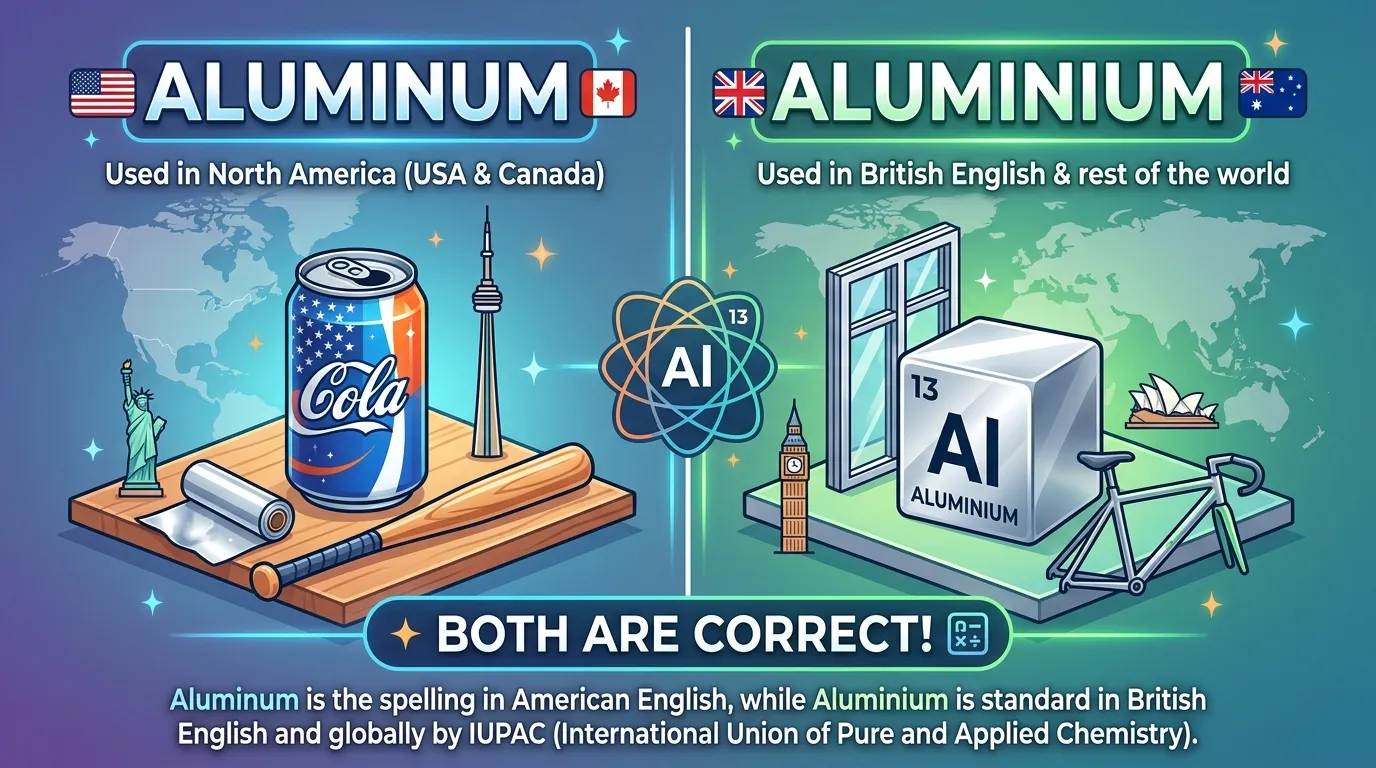
If you have ever wondered about aluminum vs aluminium, you are not looking at two different metals. Both spellings are correct. The difference is mainly regional: aluminum is the standard spelling in American English, while aluminium is the standard spelling in British English and in many other varieties of English around the world.
The word refers to the same chemical element, a lightweight metal with the chemical symbol Al and atomic number 13. The spelling changes depending on the English variety being used.
This distinction matters when you are writing for an American audience, following British English conventions, preparing technical documents, or publishing content for an international audience. Knowing which form to choose can make your writing look more natural and consistent.
In this guide, you will learn the difference between aluminum and aluminium, how each word is pronounced, where the spellings came from, which countries prefer each version, how the words are used in everyday and technical English, and how to avoid common spelling mistakes.
Quick Answer: Aluminum vs Aluminium
Aluminum and aluminium are two regional spellings for the same chemical element.
| Feature | Aluminum | Aluminium |
|---|---|---|
| Meaning | Same metal | Same metal |
| Chemical symbol | Al | Al |
| Atomic number | 13 | 13 |
| Main variety | American English | British English |
| Common in | United States | United Kingdom and many Commonwealth countries |
| Pronunciation | Usually 4 syllables | Usually 5 syllables |
| Scientific identity | Same element | Same element |
| Correct spelling? | Yes | Yes |
Which spelling should you use?
- Use aluminum for American English.
- Use aluminium for British English.
- Use aluminium when following a publication or institution that specifically uses British spelling.
- For international writing, choose one spelling based on your target audience and use it consistently.
There is no difference in the material itself. The difference is in English spelling and pronunciation.
What Does Aluminum or Aluminium Mean?
Aluminum or aluminium is a chemical element and metal represented by the symbol Al.
It is known for being:
- Lightweight
- Relatively strong
- Corrosion-resistant
- Malleable
- Ductile
- A good conductor of electricity and heat
- Widely used in manufacturing
Aluminum is found in many familiar products, including cans, foil, cookware, building materials, aircraft components, vehicles, electronics, and packaging.
A dictionary-style definition would be:
Aluminum/aluminium: A lightweight, silvery-white metallic chemical element with the symbol Al and atomic number 13.
The two spellings do not represent different definitions. If an American writer says aluminum, and a British writer says aluminium, they are talking about the same element.
Is Aluminum a Noun or an Adjective?
The word is primarily a noun.
For example:
- The can is made of aluminum.
- The aircraft contains several aluminium components.
It can also appear before another noun as a noun used attributively:
- aluminum foil
- aluminum frame
- aluminum can
- aluminium window
- aluminium alloy
- aluminium sheet
In phrases such as aluminum frame, the word describes the material used for the frame, but grammatically it remains a noun functioning before another noun.
Why Are There Two Spellings?
The difference comes from the history of the English word and the development of regional spelling conventions.
The element was discovered and identified in the early 19th century. English chemist Humphry Davy initially experimented with names including forms such as alumium and aluminum. The form aluminium later became established, particularly in British usage.
The American form aluminum became standard in the United States.
The difference also fits a broader pattern in scientific naming. Many chemical element names end in -ium, so aluminium fits that pattern neatly. The shorter American aluminum remained established in American English.
Over time, dictionaries, scientific institutions, manufacturers, schools, newspapers, and publishers reinforced the regional preferences.
As a result, both forms became standard English spellings.
Aluminum vs Aluminium: The Main Difference
The simplest way to understand the difference is to think of American English versus British English.
American English: Aluminum
In the United States, aluminum is the normal spelling.
Examples:
- aluminum foil
- aluminum siding
- aluminum cans
- aluminum alloy
- aluminum frame
- aluminum baseball bat
An American newspaper, textbook, website, or technical manual would normally use aluminum.
British English: Aluminium
In British English, aluminium is the standard spelling.
Examples:
- aluminium foil
- aluminium cans
- aluminium alloy
- aluminium frame
- aluminium sheet
- aluminium window
The spelling with -ium is also common in other English-speaking regions that generally follow British spelling traditions.
Where Is “Aluminum” Used?
Aluminum is strongly associated with American English.
It is the preferred form in the United States and is commonly seen in American:
- Schools
- Newspapers
- Technical manuals
- Product descriptions
- Business documents
- Engineering materials
- Government writing
- Websites
- Academic writing
For example:
The company manufactures lightweight aluminum frames.
The aircraft uses an aluminum alloy to reduce weight.
Place the food in an aluminum foil container.
These sentences sound natural to American English readers.
Where Is “Aluminium” Used?
Aluminium is the standard form in British English and is widely used in countries influenced by British English spelling.
It is commonly encountered in:
- The United Kingdom
- Australia
- New Zealand
- South Africa
- India
- Other regions where British spelling conventions are common
For example:
The company manufactures lightweight aluminium frames.
The aircraft uses an aluminium alloy.
The food was wrapped in aluminium foil.
These sentences are completely natural in British English.
Regional preferences can vary, however, especially in international scientific and commercial writing.
Aluminum vs Aluminium Pronunciation
The spelling difference is accompanied by a noticeable pronunciation difference.
How to Pronounce Aluminum
In American English, aluminum is commonly pronounced approximately:
uh-LOO-muh-num
It generally has four syllables:
a-lu-mi-num
The pronunciation corresponds to the shorter American spelling.
How to Pronounce Aluminium
In British English, aluminium is commonly pronounced approximately:
al-yoo-MIN-ee-um
It generally has five syllables:
a-lu-min-i-um
The extra -i- sound corresponds to the additional spelling found in aluminium.
Why Does the Pronunciation Differ?
The pronunciation follows the established regional forms of the word.
This is similar to other American and British differences in vocabulary and pronunciation. Neither pronunciation is inherently more correct. The appropriate form depends on the variety of English being spoken.
Is “Aluminum” or “Aluminium” More Correct?
Neither is universally more correct.
The correct choice depends on the English variety.
If you are writing in American English, use:
aluminum
If you are writing in British English, use:
aluminium
Calling one spelling “wrong” without considering regional English is misleading.
For example:
American English: The bridge uses an aluminum structure.
British English: The bridge uses an aluminium structure.
Both sentences are correct.
Aluminum vs Aluminium in Formal Writing
Both spellings are acceptable in formal writing when they match the appropriate regional standard.
American Formal Writing
Use aluminum in:
- Research papers written in American English
- American business reports
- U.S. technical documentation
- American news articles
- U.S. educational materials
Example:
The researchers tested the durability of an aluminum alloy under high temperatures.
British Formal Writing
Use aluminium in:
- British academic writing
- UK business documents
- British newspapers
- British technical publications
- Educational materials using British English
Example:
The researchers tested the durability of an aluminium alloy under high temperatures.
The key rule is consistency.
Aluminum vs Aluminium in Technical and Scientific Writing
The two spellings have exactly the same scientific meaning.
The chemical element is:
- Symbol: Al
- Atomic number: 13
- Element name: aluminum/aluminium
Scientific writing often requires strict consistency because terminology must be clear across an entire document.
If you start a technical report using aluminum, do not switch randomly to aluminium later unless there is a specific reason.
For example, this looks inconsistent in American English:
The product contains an aluminum frame and an aluminium panel.
A consistent version would be:
The product contains an aluminum frame and an aluminum panel.
For British English:
The product contains an aluminium frame and an aluminium panel.
Common Words and Collocations
A collocation is a group of words that commonly appear together.
Both spelling variants occur in many of the same phrases.
Common American English Collocations
- aluminum foil
- aluminum can
- aluminum alloy
- aluminum sheet
- aluminum frame
- aluminum siding
- aluminum pipe
- aluminum plate
- aluminum extrusion
- aluminum cookware
- aluminum door
- aluminum window
- aluminum ladder
- aluminum body
Common British English Collocations
- aluminium foil
- aluminium can
- aluminium alloy
- aluminium sheet
- aluminium frame
- aluminium siding
- aluminium pipe
- aluminium plate
- aluminium extrusion
- aluminium cookware
- aluminium door
- aluminium window
- aluminium ladder
- aluminium body
The difference is primarily the spelling of the element’s name.
Aluminum Foil vs Aluminium Foil
One of the most common examples is the phrase referring to thin metal used for wrapping and cooking.
American English
aluminum foil
Example:
Cover the dish with aluminum foil.
British English
aluminium foil
Example:
Cover the dish with aluminium foil.
Both expressions refer to the same product.
This is a useful example because people often notice the difference when reading recipes, packaging, or websites from different countries.
Aluminum Can vs Aluminium Can
The same regional spelling applies to cans.
American English:
He recycled an aluminum can.
British English:
He recycled an aluminium can.
The material is the same.
Aluminum Alloy vs Aluminium Alloy
An alloy is a material made by combining a metal with one or more other elements.
American technical writing:
The manufacturer selected an aluminum alloy for the component.
British technical writing:
The manufacturer selected an aluminium alloy for the component.
Again, the spelling changes, but the technical meaning does not.
Does “Aluminum” Have a Different Meaning From “Aluminium”?
No.
This is one of the most important points.
Aluminum and aluminium are not two different materials.
They are two English forms of the same element.
The difference is comparable to other regional spelling differences, although the pronunciation difference here is particularly noticeable.
There is no separate chemical substance called “aluminium” that is different from “aluminum.”
Are There Synonyms for Aluminum?
There are related terms, but they are not always exact synonyms.
Depending on context, you may encounter:
- Al
- aluminum metal
- aluminium metal
- aluminum alloy
- aluminium alloy
- lightweight metal
- nonferrous metal
However, Al is the chemical symbol, not a normal replacement for the word in ordinary prose.
For example:
The material contains Al.
is appropriate in a scientific context, but:
The car is made from Al.
may sound overly technical in everyday writing.
Is “Metal” a Synonym for Aluminum?
Not exactly.
Metal is a broad category that includes many substances, such as iron, copper, zinc, and aluminum.
Therefore:
Aluminum is a metal.
is correct, but:
Metal means aluminum.
is not correct.
Does Aluminum Have an Antonym?
There is no standard antonym for aluminum/aluminium.
An antonym is a word with an opposite meaning, such as:
- hot/cold
- large/small
- early/late
A chemical element does not normally have an opposite word.
You might contrast aluminum with another material, such as steel, iron, copper, plastic, or wood, depending on the context. These are comparisons, not true antonyms.
Related Words and Terms
Understanding related vocabulary can make technical and everyday writing easier.
Aluminum-Related Terms
- aluminum alloy
- aluminum oxide
- aluminum foil
- aluminum can
- aluminum sheet
- aluminum plate
- aluminum frame
- aluminum extrusion
- aluminum casting
- aluminum recycling
- aluminum production
- aluminum industry
In British English, the same terms generally use aluminium instead.
Chemical Terms
Some related chemical vocabulary includes:
- aluminum oxide
- aluminum hydroxide
- aluminum chloride
- aluminum sulfate
- aluminum compounds
British English generally spells these with aluminium:
- aluminium oxide
- aluminium hydroxide
- aluminium chloride
- aluminium sulfate
Is There a Figurative Meaning of Aluminum?
In ordinary modern English, aluminum/aluminium is mainly literal.
It refers to the chemical element or materials containing it.
Unlike words such as silver, which can have strong figurative meanings, aluminum does not have a widely established everyday figurative meaning.
For example:
She has nerves of steel.
Here, steel is used figuratively.
By contrast:
The building has an aluminum exterior.
is literal.
There is also no major slang meaning of aluminum or aluminium that replaces its standard dictionary meaning.
Political, Sports, and Slang Usage
The word does not have a special political meaning in standard English.
It can appear in politics or sports because aluminum is used in products and equipment, but that does not create a separate meaning.
For example:
The government announced new measures affecting aluminum production.
This is an economic or industrial use, not a special political definition.
Similarly:
The player used an aluminum bat.
is a sports-related use of the ordinary material name.
Common Mistakes With Aluminum and Aluminium
Mistake 1: Assuming One Spelling Is Always Wrong
Incorrect assumption:
“Aluminium is misspelled because American English uses aluminum.”
Why it is a problem: Aluminium is correct British English.
Better understanding:
Aluminum is standard American English, while aluminium is standard British English.
Mistake 2: Mixing Spellings in the Same Article
Inconsistent:
This aluminum frame is made from high-quality aluminium.
More consistent American English:
This aluminum frame is made from high-quality aluminum.
More consistent British English:
This aluminium frame is made from high-quality aluminium.
Mistake 3: Changing the Spelling When Quoting a Product Name
If a company, product, or organization uses a particular spelling as part of its official name or branding, do not automatically change it to match your preferred regional variety.
Names and official titles should generally be preserved.
Mistake 4: Thinking the Extra “I” Changes the Material
It does not.
The additional letters in aluminium do not indicate a different chemical composition.
Awkward vs Natural Examples
Example 1
Awkward for American English:
The house has an aluminium roof.
Natural American English:
The house has an aluminum roof.
Example 2
Awkward for British English:
The house has an aluminum roof.
Natural British English:
The house has an aluminium roof.
Neither sentence is globally wrong. The issue is regional consistency.
Example 3
Inconsistent:
The company sells aluminum cans and aluminium sheets.
Consistent American English:
The company sells aluminum cans and aluminum sheets.
Consistent British English:
The company sells aluminium cans and aluminium sheets.
American vs British English: Quick Comparison
| Expression | American English | British English |
|---|---|---|
| Element name | aluminum | aluminium |
| Foil | aluminum foil | aluminium foil |
| Can | aluminum can | aluminium can |
| Alloy | aluminum alloy | aluminium alloy |
| Sheet | aluminum sheet | aluminium sheet |
| Frame | aluminum frame | aluminium frame |
| Industry | aluminum industry | aluminium industry |
| Recycling | aluminum recycling | aluminium recycling |
Which Spelling Should Bloggers Use?
For bloggers, the best spelling depends on the audience.
If Your Audience Is Mostly American
Use aluminum.
This is especially important for websites targeting:
- U.S. readers
- American consumers
- American businesses
- U.S. students
- American home improvement searches
- American product searches
If Your Audience Is Mostly British
Use aluminium.
This applies to websites targeting:
- UK readers
- British consumers
- British businesses
- UK students
- British technical audiences
If Your Audience Is International
Choose a consistent editorial style.
If your website uses American English throughout, use aluminum. If it uses British English, use aluminium.
Do not switch between forms simply because searchers from different countries use different spellings.
Which Spelling Is Better for SEO?
Neither spelling is inherently better for SEO.
Search engines can understand that aluminum and aluminium refer to the same element. However, matching the spelling used by your target audience can improve relevance, readability, and user experience.
For example, a U.S.-focused page may naturally use:
- aluminum vs aluminium
- aluminum foil
- aluminum cans
- aluminum alloy
- aluminum frame
A UK-focused page may naturally use:
- aluminium vs aluminum
- aluminium foil
- aluminium cans
- aluminium alloy
- aluminium frame
The best SEO strategy is not to stuff both versions into every paragraph. Instead, write naturally and clearly for the audience you are targeting.
Academic Writing: Which Form Should You Use?
Follow the style guide or institution’s preferred English variety.
If your university requires American English, use aluminum.
If it requires British English, use aluminium.
If no specific style is required, choose a consistent variety and apply it throughout the paper.
For scientific writing, consistency is especially important because readers need to distinguish intentional terminology from accidental spelling changes.
Business and Professional Writing
Professional writers should consider their clients and readers.
American Business Audience
Use:
aluminum manufacturing
aluminum products
aluminum components
British Business Audience
Use:
aluminium manufacturing
aluminium products
aluminium components
For multinational companies, an established corporate style guide should take priority.
Journalistic Writing
News organizations typically follow their own editorial style.
An American publication will generally use aluminum, while a British publication will generally use aluminium.
If you are writing freelance articles, match the publication’s existing spelling conventions rather than switching between regional varieties.
Technical Writing
Technical writers should prioritize:
- Accuracy
- Audience expectations
- Established terminology
- Style-guide consistency
- Clear communication
The scientific concept remains the same regardless of spelling.
For an American technical manual:
Tighten the aluminum bracket before installation.
For a British technical manual:
Tighten the aluminium bracket before installation.
A Simple Memory Trick
If you are an American English writer, remember:
American = aluminum
It has the shorter ending.
If you are using British English, remember:
British = aluminium
It contains the extra i before the final -um.
Another simple trick is to associate aluminium with other element names that end in -ium, such as:
- sodium
- magnesium
- calcium
- titanium
- platinum
This can help you remember the British spelling, although element names do not all follow identical naming patterns.
Does “Aluminium” Mean the Same Thing in American English?
Yes, Americans who encounter aluminium will generally understand that it means aluminum.
It may simply look unusual or foreign because aluminum is the standard American spelling.
Likewise, British readers understand aluminum, even though aluminium is their standard form.
This is why the distinction is best described as a regional spelling variation, not a difference in meaning.
Does the Spelling Affect Chemical Properties?
No.
Spelling has no effect on chemistry.
Whether a document calls the element aluminum or aluminium, the chemical element has:
- Symbol Al
- Atomic number 13
- The same fundamental chemical identity
The difference exists in language, not in the material.
Aluminum vs Aluminium in Everyday Sentences
Here are more natural examples.
American English
- I wrapped the leftovers in aluminum foil.
- The truck has an aluminum frame.
- The company produces aluminum cans.
- We replaced the old window with an aluminum frame.
- The engineer selected an aluminum alloy.
- The recycling center accepts aluminum containers.
British English
- I wrapped the leftovers in aluminium foil.
- The truck has an aluminium frame.
- The company produces aluminium cans.
- We replaced the old window with an aluminium frame.
- The engineer selected an aluminium alloy.
- The recycling centre accepts aluminium containers.
Notice that other regional differences may appear too. For example, center is standard American English, while centre is standard British English. This is another reason to maintain a consistent variety throughout an article.
Formal vs Casual Usage
There is no major difference in formality between aluminum and aluminium.
Both are standard words.
Formal
The structure was constructed using a lightweight aluminum alloy.
Casual
The frame is made of aluminum.
The difference between the two examples comes from sentence style, not from the spelling of the metal.
You do not need to replace aluminum or aluminium with a more formal synonym.
What Is the Plural of Aluminum or Aluminium?
In ordinary English, the word is generally treated as a mass noun, so it usually does not need a plural form.
Natural:
The manufacturer produces aluminum.
The product contains aluminium.
When referring to different objects made from the material, use a countable noun such as:
- aluminum products
- aluminum parts
- aluminum sheets
- aluminum cans
- aluminium components
Rather than inventing a plural such as aluminums, use the appropriate noun for the objects or types being discussed.
Frequently Asked Questions
1. Is aluminum or aluminium correct?
Both are correct. Aluminum is the standard American English spelling, while aluminium is the standard British English spelling and is widely used in other varieties influenced by British English.
2. Is aluminium British or American?
Aluminium is primarily the British English form. It is also widely used in Australia, New Zealand, South Africa, India, and other regions where British spelling conventions are common.
3. Is aluminum American English?
Yes. Aluminum is the standard American English spelling of the element.
4. Why does America spell it aluminum?
The American spelling developed from the historical English forms of the element’s name and became established as aluminum in American English. British English standardized on aluminium.
5. Are aluminum and aluminium the same thing?
Yes. They are two spellings for the same chemical element, with the symbol Al and atomic number 13.
6. Which pronunciation is correct: aluminum or aluminium?
Both regional pronunciations are correct. American English commonly uses a four-syllable pronunciation similar to uh-LOO-muh-num, while British English commonly uses a five-syllable pronunciation similar to al-yoo-MIN-ee-um.
7. Should I use aluminum or aluminium in an American article?
Use aluminum if your article is written for an American audience. It is the standard American spelling and will sound natural to U.S. readers.
8. Should I use aluminium in British English?
Yes. Aluminium is the standard British English spelling.
9. Does aluminum have a different chemical meaning from aluminium?
No. The spelling difference has no effect on the chemical identity or properties of the element.
10. Which spelling is better for SEO?
Neither spelling is universally better. The best choice is the one that matches your target audience, regional English variety, and content style. Use related phrases naturally without forcing both spellings into every section.
Final Verdict
The answer to aluminum vs aluminium is straightforward: both spellings are correct, but they belong to different regional varieties of English.
Use aluminum when writing in American English. Use aluminium when writing in British English or another variety that follows the British spelling convention.
The two words have the same meaning, refer to the same chemical element, and describe the same material. The difference comes from the history and regional development of English spelling.
For most writers, the most important rule is consistency. If you choose American English, write aluminum throughout your article. If you choose British English, write aluminium throughout. The same principle should apply to related spelling choices across the rest of your content.
If you are writing for a U.S. audience, aluminum is the natural choice. If you are writing for a UK audience, aluminium is the natural choice. For international content, follow the English variety established by your publication, organization, or editorial style.
So, the next time you see aluminum vs aluminium, remember: different spelling, same element.