If you have ever stopped while writing a sentence and wondered, “Should I use who or whom?”, you are not alone. The difference between who vs whom is one of the most common grammar questions in English.
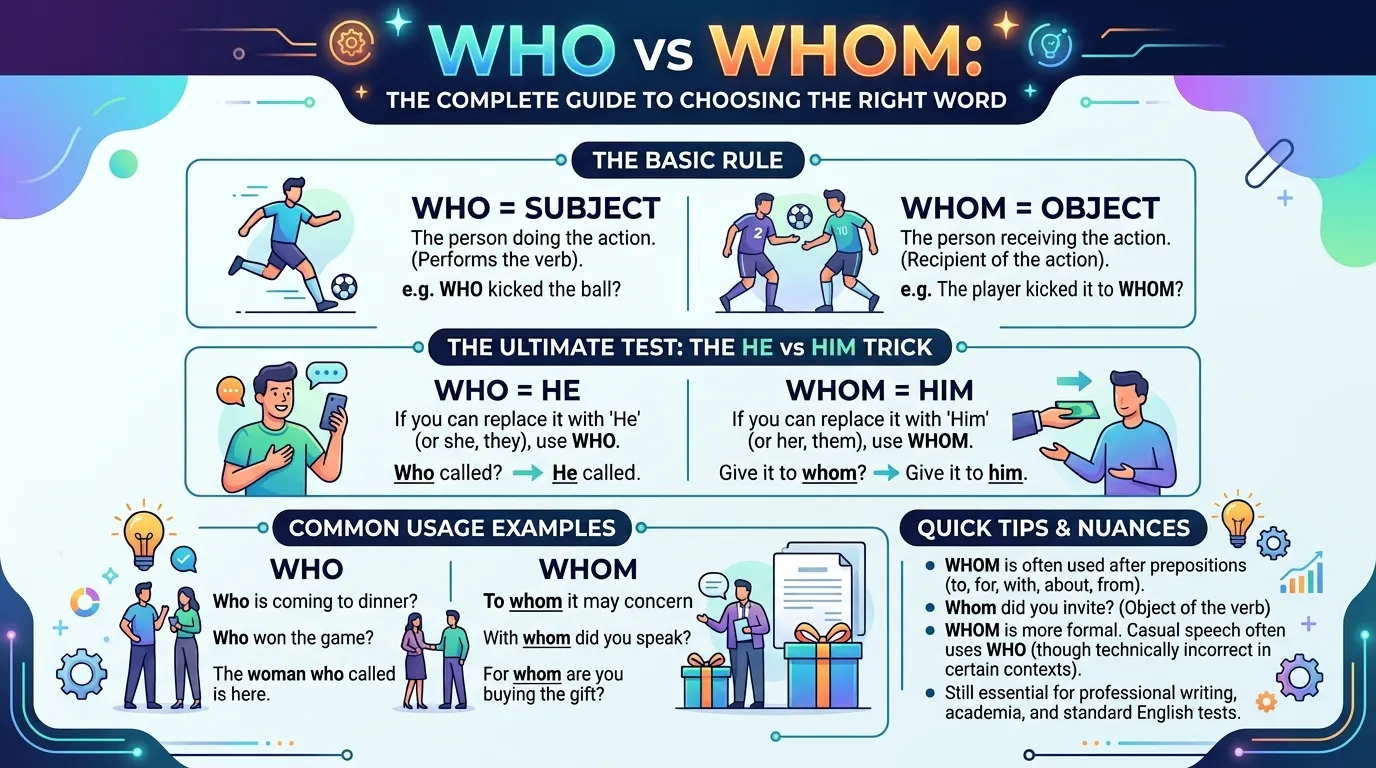
The basic rule is simple: who is normally used as a subject, while whom is used as an object. For example, “Who called you?” uses who because the person is doing the action. “Whom did you call?” uses whom because the person receives the action.
However, real-world English is more flexible than that simple rule suggests. In everyday American English, who is extremely common in places where traditional grammar would prescribe whom. In formal writing, academic English, professional communication, and after certain prepositions, whom still has an important role.
This guide explains who vs whom in plain English, including their meanings, grammatical roles, pronunciation, formality, examples, common mistakes, memory tricks, regional differences, and practical rules you can use in everyday writing.
Quick Answer: Who vs Whom
The easiest way to remember the difference is:
- Who = subject, the person doing the action.
- Whom = object, the person receiving the action.
- Use who for questions such as “Who called?”
- Use whom in formal constructions such as “To whom should I send this?”
- In casual American English, who often replaces whom, especially at the beginning of questions.
- After a preposition, whom is still preferred in formal English: “With whom did you speak?”
- If you can replace the word with he/she/they, use who.
- If you can replace it with him/her/them, use whom.
The fastest test
Ask yourself:
Would I answer with he/she/they or him/her/them?
Who → he/she/they
Who sent the email?
She sent the email.
Whom → him/her/them
Whom did you invite?
I invited him.
That simple substitution test solves most who vs whom questions.
What Does “Who” Mean?
Who is a pronoun used to refer to a person or people. It commonly introduces questions and relative clauses.
Dictionary-style definition of who
Who is an interrogative or relative pronoun referring to a person or people, especially when that person functions as the subject of a verb.
Examples:
- Who is coming to dinner?
- Who wrote this report?
- I know who made the decision.
- She is the person who helped me.
In these examples, who identifies the person performing or being associated with the action.
Who as a question word
When asking about a person, who is often the natural choice in everyday speech:
Who called you?
Who wants coffee?
Who broke the window?
Who is responsible for this project?
Notice that the person referred to by who is performing the action.
What Does “Whom” Mean?
Whom is also a pronoun referring to a person or people, but it traditionally functions as an object rather than a subject.
Dictionary-style definition of whom
Whom is an objective-form pronoun used for a person or people who receive an action or follow a preposition.
Examples:
- Whom did you invite?
- Whom are you calling?
- To whom should I speak?
- The person whom I hired starts Monday.
In modern English, whom is more formal than who and is much less common in casual conversation.
Who vs Whom: The Main Difference
The key difference is grammatical case.
| Word | Grammatical role | Basic idea | Example |
|---|---|---|---|
| Who | Subject | Does the action | Who called me? |
| Whom | Object | Receives the action | Whom did you call? |
Compare these two sentences:
Who interviewed the candidate?
The person did the interviewing, so who is the subject.
Whom did the manager interview?
The person was interviewed, so whom is the object.
The same person could be the answer to both questions, but their grammatical roles are different.
How to Know Whether to Use Who or Whom
The most useful technique is the he/him test.
Replace who or whom with:
- he or she
- they
or:
- him or her
- them
If he/she/they sounds correct, choose who.
If him/her/them sounds correct, choose whom.
Example: Who
Who is knocking?
Try:
He is knocking.
That works, so who is correct.
Example: Whom
Whom did you meet?
Try:
I met him.
That works, so whom is traditionally correct.
Another example
Who wants to go first?
Answer:
She wants to go first.
Therefore, use who.
Now:
Whom did you choose?
Answer:
I chose her.
Therefore, whom is grammatically appropriate.
Who vs Whom Examples
Here are some practical examples:
Use “who” when the person is doing the action
- Who opened the door?
- Who sent this message?
- Who made the cake?
- Who is leading the team?
- Who wants to join us?
- Who wrote the article?
- Who called during lunch?
Use “whom” when the person receives the action
- Whom did you invite?
- Whom did she contact?
- Whom are they hiring?
- Whom did the coach select?
- Whom did you meet yesterday?
- Whom should I ask?
- Whom did the company promote?
Why Do People Confuse Who and Whom?
The confusion exists because English has changed over time.
Older and more formal forms of English maintained clearer distinctions between subject and object pronouns. Modern spoken English has gradually simplified many of these distinctions.
Compare:
Who did you see?
with the more traditional:
Whom did you see?
Both are widely understood. The first is much more natural in ordinary conversation.
This creates a gap between traditional grammar rules and actual modern usage.
Many speakers know that whom sounds formal but are unsure exactly when to use it. Others may avoid it completely.
The result is a common question:
“Is whom still correct?”
Yes. Whom is still a correct English word. It is simply less common in informal modern English.
Is “Whom” Still Grammatically Correct?
Yes.
Whom is not an outdated or incorrect word. It remains useful in formal writing and in constructions where its object role is especially clear.
For example:
To whom it may concern
is a standard formal expression.
You may also see:
The candidate whom we selected accepted the position.
In casual conversation, many speakers would naturally say:
The candidate who we selected accepted the position.
The second version is common in contemporary English, particularly in American English.
When Should You Use Who?
Use who when the person is the subject of a clause or sentence.
Subject examples
Who made this decision?
Who is coming with us?
Who knows the answer?
Who lives next door?
Who wants another slice?
In each sentence, the person represented by who performs the action or occupies the subject position.
Who in relative clauses
Who is also commonly used for people in relative clauses:
She is the woman who helped me.
I met a teacher who speaks five languages.
He is the player who scored the winning goal.
Here, who functions as the subject of the following verb.
When Should You Use Whom?
Use whom when the person functions as an object.
Direct object
Whom did you invite?
The implied structure is:
You invited him.
Therefore, whom is the traditional grammatical choice.
Object of a preposition
With whom did you travel?
To whom should I send the letter?
From whom did you receive the information?
For whom was the gift purchased?
Because whom follows a preposition, it is particularly common in formal writing.
Who vs Whom After Prepositions
This is one of the clearest places to see the difference.
Formal
To whom should I address the letter?
With whom did you speak?
For whom are you working?
From whom did you hear this news?
Informal
Who should I address the letter to?
Who did you speak with?
Who are you working for?
Who did you hear this from?
The informal versions are extremely common in modern English.
Which version should you choose?
For everyday conversation, the natural version is usually better.
For formal letters, academic writing, legal documents, or highly polished professional communication, whom can be the better choice.
Who vs Whom in American English
American English has moved strongly toward who in everyday communication.
For example, most Americans would naturally say:
Who did you talk to?
rather than:
Whom did you talk to?
The second sentence is grammatically traditional but can sound formal or even stiff in casual conversation.
However, whom has not disappeared from American English.
It remains common in:
- Formal letters
- Legal language
- Academic writing
- Professional correspondence
- Official statements
- Fixed expressions
- Formal questions
- Certain carefully edited publications
The practical rule is not “never use whom.” Instead, consider context and tone.
Who vs Whom in British English
British English also distinguishes between who and whom, especially in formal writing.
However, everyday British English frequently uses who where traditional grammar would use whom.
For example:
Who did you speak to?
is natural in ordinary British conversation.
A more formal version would be:
Whom did you speak to?
or:
To whom did you speak?
So there is no simple rule that says British English always uses whom while American English does not.
Both varieties have experienced the same broad trend toward who in informal communication.
Who vs Whom in Formal Writing
Formal writing deserves special attention.
If you are writing a:
- Business letter
- Academic paper
- Formal report
- Legal document
- Official application
- Professional statement
you should understand how whom works.
For example:
The committee interviewed the applicants, several of whom had extensive experience.
Here, whom follows the preposition of and functions as its object.
Another example:
The consultant whom we hired has extensive experience.
Traditional grammar favors whom because the consultant is the object of hired.
Who vs Whom in Casual Writing
Casual writing usually favors who.
Text messages, social media posts, emails to friends, online comments, and casual blogs often use:
Who did you invite?
rather than:
Whom did you invite?
Using whom in a casual sentence is not necessarily wrong, but it may sound unusually formal.
Compare:
Who are you going with?
Natural and conversational
With whom are you going?
Grammatically formal and somewhat stiff
The best writing matches the audience.
Who vs Whom in Academic Writing
Academic writing generally benefits from grammatical precision, but that does not mean every sentence needs whom.
Consider:
The researcher interviewed participants who had completed the survey.
Here, who is correct because the participants completed the survey.
Now:
The researcher interviewed participants whom the university had selected.
Here, traditional grammar uses whom because the university selected the participants.
In academic writing, use the objective form when it improves grammatical clarity or when a preposition makes the object relationship obvious.
Who vs Whom in Business Writing
Professional writing should prioritize clarity over unnecessary formality.
Instead of:
Whom should I contact regarding this issue?
you could write:
Who should I contact about this issue?
The second version is common and natural.
For a highly formal letter, however:
To whom it may concern
remains perfectly appropriate.
Business writing recommendation
Use whom when:
- It follows a preposition in formal construction.
- It creates a polished professional tone.
- It is part of a fixed phrase.
- The object relationship is important.
Use who when:
- The sentence is conversational.
- The sentence is an ordinary question.
- Whom would make the sentence unnecessarily stiff.
Who vs Whom in Journalism
News writing tends to favor clear, natural language.
A journalist might write:
Who did the officials interview?
rather than:
Whom did the officials interview?
However, edited journalism may still use whom when the structure calls for it:
The official, whom investigators questioned Tuesday, declined to comment.
The choice depends on publication style, sentence structure, and desired tone.
Who vs Whom in Sports Writing
Sports language is generally direct and conversational.
Natural:
Who did the coach select?
Who will the team face next?
Who did the quarterback throw to?
Formal:
Whom did the coach select?
Whom will the team face next?
To whom did the quarterback throw?
Sports writing often favors who because readers expect quick, accessible language.
Who vs Whom in Blogging
Most blogs should favor natural modern usage.
For example:
Who should you invite to your wedding?
sounds more approachable than:
Whom should you invite to your wedding?
Unless your blog specifically discusses formal grammar, who will usually be the better choice in conversational content.
For SEO writing, readability and natural language matter. Avoid inserting whom merely because it seems more sophisticated.
Who vs Whom Pronunciation
The pronunciation difference is simple.
Who
Who is pronounced approximately:
/huː/
It sounds like “hoo.”
Example:
Who are you?
Whom
Whom is pronounced approximately:
/huːm/
It sounds like “hoom.”
The final m distinguishes it from who.
In rapid everyday speech, the difference can be less noticeable, which is another reason speakers often prefer who.
Who, Whom, Whose, and Who’s
These four words are easy to mix up.
| Word | Meaning/Function | Example |
|---|---|---|
| Who | Person as subject | Who called? |
| Whom | Person as object | Whom did you call? |
| Whose | Possession | Whose phone is this? |
| Who’s | Who is / who has | Who’s coming? |
Common mistake
Incorrect:
Who’s book is this?
Correct:
Whose book is this?
Why?
Who’s means who is or who has.
Whose indicates possession.
Who vs Whom in Relative Clauses
Relative clauses are another common source of confusion.
Who as subject
She is the employee who solved the problem.
The employee solved the problem.
Therefore:
who solved
Whom as object
She is the employee whom we hired.
We hired the employee.
Therefore:
whom we hired
The difference becomes easier when you identify who performed the verb.
Can “Who” Replace “Whom”?
In many modern contexts, yes.
For example:
Who did you invite?
is standard, natural English for most everyday situations.
Traditional grammar may recommend:
Whom did you invite?
But modern English commonly uses who in this position.
This is known as the weakening or loss of the traditional objective distinction in everyday usage.
That does not make whom useless. It simply means who is now much more versatile.
Common Mistakes With Who and Whom
Mistake: “Whom is coming?”
Incorrect because the person is the subject.
Correct:
Who is coming?
Mistake: “Who did you invite?”
This is common modern English and is not considered unacceptable in ordinary conversation.
Traditional formal version:
Whom did you invite?
Mistake: “To who should I send this?”
In formal English, use:
To whom should I send this?
In casual English:
Who should I send this to?
is natural.
Mistake: “The person whom called me”
Incorrect because the person performed the action.
Correct:
The person who called me.
Mistake: “The person who I called”
Traditional grammar prefers:
The person whom I called.
But:
The person who I called.
is very common in modern English.
An even more natural option is:
The person I called.
The relative pronoun can often be omitted entirely.
Awkward vs Natural Who and Whom Examples
| Awkward or overly formal | More natural |
|---|---|
| With whom are you going? | Who are you going with? |
| Whom should I ask? | Who should I ask? |
| To whom did you speak? | Who did you speak to? |
| Whom are you looking for? | Who are you looking for? |
| Whom did she invite? | Who did she invite? |
The formal versions are not necessarily wrong. They simply create a more formal tone.
Memory Trick for Who vs Whom
Remember this simple pair:
Who = he
Whom = him
Both end with the same general grammatical pattern:
he → who
him → whom
You can also remember:
Who does. Whom receives.
For example:
Who called?
The person does the calling.
Whom did you call?
The person receives the calling.
Who vs Whom: A Simple Decision Tree
When you’re unsure, follow these steps:
Step 1: Find the verb.
Step 2: Ask who is performing the action.
If the unknown person performs the action, use who.
Step 3: If someone else performs the action, ask who receives it.
If the unknown person receives the action, whom is traditionally correct.
Step 4: Apply the he/him test.
- He/she/they → who
- Him/her/them → whom
Step 5: Consider tone.
If the sentence is casual, who may sound more natural.
If it is highly formal, whom may be preferable.
Who vs Whom With Prepositions
Prepositions include words such as:
- to
- for
- with
- from
- by
- about
- among
Formal English commonly places whom after these words.
Examples:
To whom did you send the package?
With whom are you meeting?
From whom did you receive the letter?
For whom was the report prepared?
But everyday English often moves the preposition to the end:
Who did you send the package to?
Who are you meeting with?
Who did you receive the letter from?
Both patterns can be grammatically acceptable, but they differ in formality and style.
Fixed Expressions With Whom
Some expressions strongly favor whom.
To whom it may concern
This is a traditional formal opening used in letters and documents when the recipient is unknown.
With whom
With whom did you discuss the proposal?
Of whom
Several of whom were experienced professionals.
For whom
For whom was the decision made?
These expressions tend to preserve the traditional objective form.
Synonyms, Antonyms, and Related Words
Because who and whom are pronouns, they do not have direct synonyms in every context.
Depending on the sentence, related terms can include:
- person
- individual
- someone
- somebody
- anyone
- anybody
- they
- he
- she
- that person
Related pronouns
Who and whom are closely related to:
- whose
- whoever
- whomever
- which
- that
There are no true antonyms for who or whom because they identify people rather than describe an opposing quality or concept.
Whoever vs Whomever
The same subject-object distinction can apply to whoever and whomever, although the rules become more complicated.
Compare:
Give the award to whoever wins.
Here, whoever is the subject of wins.
Now:
Give the award to whomever you choose.
Here, whomever is traditionally the object of choose.
A useful strategy is to examine the word’s role inside its own clause, rather than simply looking at the preposition before it.
The History of Who and Whom
The distinction between who and whom comes from the older grammatical case system of English.
Historically, English had more pronounced distinctions between forms used as subjects and objects. The modern forms developed from older Germanic pronouns.
The basic relationship survived:
- who developed as the subject form.
- whom developed as the object form.
Over centuries, English lost many of its grammatical case endings. However, some distinctions survived in pronouns.
You can still see this pattern in:
I → me
he → him
she → her
they → them
Likewise:
who → whom
Modern English has gradually weakened the who/whom distinction in everyday speech, which explains why who now appears in many positions traditionally assigned to whom.
Is Whom Becoming Obsolete?
Whom is less common, but it is not obsolete.
It remains useful in formal contexts and is still recognized as a standard English word.
What has changed is its frequency.
Compare:
Who did you meet?
This sounds completely ordinary.
Whom did you meet?
This sounds more formal.
The difference is increasingly about style and register, not simply whether a sentence is understandable or acceptable.
Regional and International Usage
The general pattern is similar across major English varieties:
American English
Who is strongly preferred in ordinary conversation. Whom remains common in formal and fixed expressions.
British English
Both forms remain recognized, with who widely used in everyday speech and whom appearing more often in formal contexts.
International English
English learners and international organizations often favor who because it is simpler and more widely understood in ordinary communication.
For international audiences, clarity is usually more important than preserving a highly formal distinction.
How to Choose Who or Whom in Real Life
Use this practical guide.
For texting
Use who.
Who are you with?
For casual email
Usually use who.
Who should I contact?
For business email
Either can work depending on tone.
Who should I contact about the invoice?
is perfectly natural.
For formal letters
Whom can be appropriate.
To whom it may concern
For academic writing
Follow the grammatical role and maintain consistency.
For legal or official writing
Whom may appear frequently because formal legal language often preserves traditional constructions.
For blogs
Prefer natural modern English unless the subject is specifically grammar.
For social media
Who is usually the natural choice.
Common Search Questions About Who vs Whom
People often ask:
- Is it who or whom?
- What is the difference between who and whom?
- Is whom still correct?
- When should I use whom?
- Is “who did you call” grammatically correct?
- Is “whom did you call” formal?
- Can who replace whom?
- What is the who vs whom rule?
- How do I remember who and whom?
- Is whom outdated?
The answer to most of these questions comes back to one principle:
Who is traditionally the subject; whom is traditionally the object. Modern English often uses who in both roles, especially in informal speech.
Who vs Whom: Quick Comparison Table
| Feature | Who | Whom |
|---|---|---|
| Basic role | Subject | Object |
| Refers to | People | People |
| Formality | Neutral | More formal |
| Casual speech | Very common | Less common |
| Formal writing | Common | Common in specific structures |
| Pronunciation | “hoo” | “hoom” |
| Example | Who called? | Whom did you call? |
| Replacement test | He/she/they | Him/her/them |
| After preposition | Common informally | Preferred formally |
10 Practical Examples to Master the Difference
Example 1
Who called the office?
The caller performs the action.
Example 2
Whom did you call?
You perform the action; the other person receives it.
Example 3
Who wrote the book?
The person wrote the book.
Example 4
The author whom I interviewed was friendly.
I interviewed the author.
Example 5
The author who interviewed me was friendly.
The author interviewed me.
Notice how changing who to whom changes the grammatical role.
Example 6
Who is responsible?
The person is the subject.
Example 7
Whom should we hire?
The person is the object of hire.
Example 8
Who did you go with?
Very natural conversational English.
Example 9
With whom did you go?
More formal English.
Example 10
The students who completed the course received certificates.
The students completed the course, so who is correct.
FAQs About Who vs Whom
Is “who” or “whom” correct?
Both are correct words. Traditionally, who functions as a subject and whom functions as an object. Modern English frequently uses who in both positions, particularly in informal speech.
Is “whom” still used in English?
Yes. Whom remains standard English, especially in formal writing, after prepositions, and in expressions such as “to whom it may concern.”
Is “Who did you call?” grammatically correct?
Yes. It is standard and extremely common in modern English, especially in conversation and informal writing. Traditional grammar would use “Whom did you call?”
Should I say “who” or “whom” after a preposition?
In formal English, use whom:
To whom did you speak?
In informal English, who is common when the preposition moves to the end:
Who did you speak to?
What is the easiest way to remember who vs whom?
Use the he/him test. If he, she, or they fits, use who. If him, her, or them fits, use whom.
Is “whom” more formal than “who”?
Usually, yes. Whom often creates a more formal or traditional tone, while who is more natural in everyday communication.
Can I always use “who” instead of “whom”?
Not always if you are aiming for traditional formal grammar. In casual modern English, however, who has replaced whom in many common constructions.
Is “whom” outdated?
No. It is less common than it once was, but it remains a standard English pronoun and is useful in formal contexts.
Which is correct: “Who are you talking to?” or “Whom are you talking to?”
Both can be encountered. “Who are you talking to?” is much more natural in ordinary modern conversation. “Whom are you talking to?” is more formal, while “To whom are you talking?” is even more traditionally formal.
What is the difference between who, whom, whose, and who’s?
Who refers to a person as a subject. Whom refers to a person as an object. Whose shows possession. Who’s is a contraction meaning who is or who has.
Conclusion: Who vs Whom Made Simple
The traditional who vs whom rule is straightforward: who is used for the subject, while whom is used for the object.
Think:
Who = he/she/they
Whom = him/her/them
So:
Who called?
but:
Whom did you call?
The important modern-language point is that English usage has changed. In everyday American English and other varieties of modern English, who frequently replaces whom, particularly in questions and conversational sentences.
You do not need to force whom into every sentence to sound educated. In fact, using it where it feels unnatural can make casual writing sound stiff. At the same time, you should not assume that whom is wrong or obsolete. It remains valuable in formal writing, professional communication, academic prose, legal language, and expressions involving prepositions.
For everyday communication, choose the form that sounds natural and clear. For formal writing, apply the traditional grammatical distinction when appropriate.
The best rule to remember is simple:
Who does the action. Whom receives the action.
Once you learn that pattern—and use the he/him test—most who-versus-whom questions become much easier.