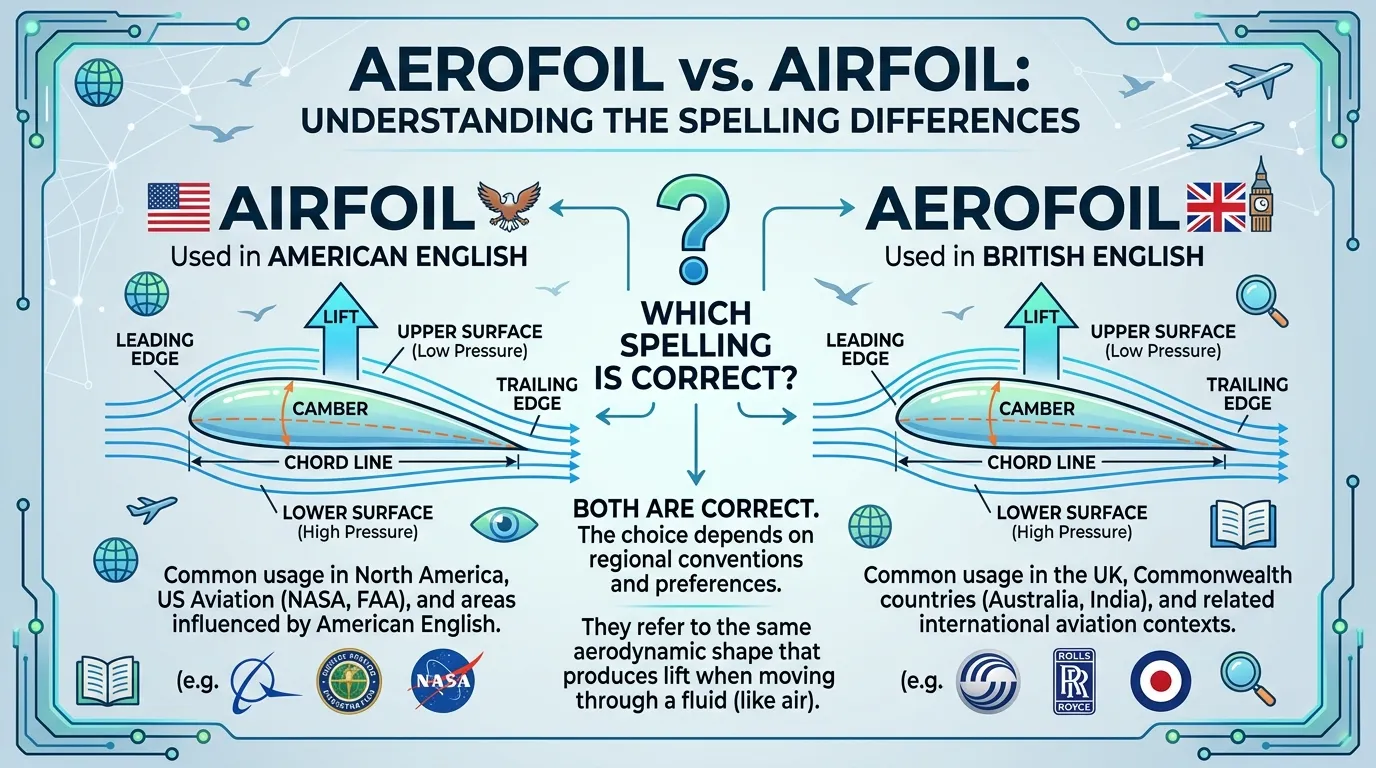
When comparing aerofoil vs airfoil, the most important answer is simple: they mean the same thing. Both words describe the shaped surface of an object that moves through air and is designed to produce a useful aerodynamic effect, especially lift.
The main difference is regional spelling and usage. Airfoil is the standard spelling in American English, while aerofoil is more common in British English and several other varieties of English.
You may see either spelling in aviation, aerospace engineering, physics, textbooks, technical manuals, and general writing. The choice usually depends on the variety of English being used.
This guide explains aerofoil vs airfoil, including their meanings, pronunciation, history, grammar, regional preferences, technical usage, examples, common mistakes, synonyms, and practical advice on which form to use.
Quick Answer: Aerofoil vs Airfoil
| Feature | Aerofoil | Airfoil |
|---|---|---|
| Meaning | A shaped surface designed to interact with airflow | A shaped surface designed to interact with airflow |
| Definition | Same as airfoil | Same as aerofoil |
| Standard American English | Less common | Preferred |
| Standard British English | Preferred | Also understood |
| Pronunciation | Usually “AIR-uh-foil” | Usually “AIR-foil” |
| Technical meaning | Same | Same |
| Grammar | Noun | Noun |
| Plural | Aerofoils | Airfoils |
| Best for U.S. writing | Usually avoid unless quoting a source | Use airfoil |
| Best for British writing | Use aerofoil | Acceptable but less typical |
In one sentence
Airfoil is the preferred American spelling, while aerofoil is the preferred British spelling; both refer to the same aerodynamic shape.
What Does Airfoil Mean?
An airfoil is a specially shaped surface that interacts with moving air to create aerodynamic forces.
The shape is designed to influence airflow. Depending on its purpose and operating conditions, an airfoil can generate:
- Lift
- Drag
- Thrust-related aerodynamic effects
- Pitching moments
- Controlled changes in airflow
The wings of an airplane contain airfoil-shaped sections. However, an airfoil is not necessarily an entire airplane wing.
For example:
The wing uses an airfoil designed to produce lift efficiently.
An airfoil can also appear in:
- Aircraft wings
- Propeller blades
- Helicopter rotor blades
- Turbines
- Compressors
- Wind turbines
- Aerodynamic research
- Model aircraft
- Racing equipment
The exact shape varies according to the intended application.
Simple definition
A dictionary-style definition would be:
Airfoil: A shaped surface designed to produce a particular aerodynamic effect as air flows around it.
In American English, airfoil is the usual spelling.
What Does Aerofoil Mean?
Aerofoil has essentially the same meaning as airfoil.
It refers to a streamlined or specially shaped surface that interacts with air to generate aerodynamic forces.
For example:
The aircraft’s wing has an efficient aerofoil design.
The word is particularly common in British English.
You may encounter aerofoil in British technical writing, aviation material, engineering publications, educational resources, and descriptions of aircraft.
In American English, however, most writers would use airfoil instead.
Aerofoil definition
Aerofoil: A shaped surface designed to produce useful aerodynamic forces as air passes over and around it.
So there is no major difference in the underlying engineering concept.
Aerofoil vs Airfoil: The Main Difference
The biggest difference is not meaning. It is regional usage.
Think of these words as similar to other British-American spelling pairs:
- colour / color
- honour / honor
- centre / center
- tyre / tire
- aluminium / aluminum
- aeroplane / airplane
- aerofoil / airfoil
In the same way that American writers generally use airplane, they generally use airfoil.
British writers may use aeroplane and aerofoil.
The easiest rule to remember
American English → airfoil
British English → aerofoil
Both forms are correct when used in the appropriate variety of English.
Is Aerofoil or Airfoil Correct?
Both are correct.
Neither spelling is inherently wrong.
The correct choice depends largely on the English variety and the publication’s style.
Use “airfoil” when:
- Writing for an American audience
- Following American English spelling
- Writing a U.S. technical document
- Creating an American engineering textbook
- Writing for an American aviation publication
- Optimizing content for searches using American terminology
Use “aerofoil” when:
- Writing in British English
- Following a British technical style guide
- Writing for a British audience
- Quoting or preserving British terminology
- Working with British engineering or aviation material
Important point
You generally should not switch randomly between the two spellings in the same article.
For example, an American technical article should normally use:
The airfoil produces lift as air flows over its upper and lower surfaces.
rather than switching between airfoil and aerofoil.
Consistency makes technical writing clearer and more professional.
Why Do People Confuse Aerofoil and Airfoil?
The confusion is understandable because the two words are almost identical in meaning and structure.
Both contain an idea related to air:
- airfoil
- aerofoil
The first part simply comes from different linguistic forms.
Air is the ordinary English word.
Aero- comes from a Greek-derived combining form associated with air or the atmosphere.
This means that the two terms developed as parallel ways of referring to an aerodynamic surface.
Another reason for confusion is international communication.
An engineer in the United States may write:
airfoil section
while an engineer in the United Kingdom may write:
aerofoil section
They can be discussing exactly the same aerodynamic concept.
Aerofoil vs Airfoil Pronunciation
The words are also similar in pronunciation.
Airfoil
A common American pronunciation is approximately:
AIR-foil
The two parts are pronounced clearly:
- air
- foil
Aerofoil
In British English, aerofoil is commonly pronounced approximately:
AIR-uh-foil
The middle sound reflects the aero- spelling.
Pronunciation can vary somewhat by speaker and regional accent, so there is no need to force an exact pronunciation in ordinary conversation.
Pronunciation memory trick
Think:
Air + foil = airfoil
and:
Aero + foil = aerofoil
The spelling gives you a useful clue to the pronunciation.
Aerofoil vs Airfoil: Meaning in Aviation
In aviation, both terms describe an aerodynamic profile used to control airflow and generate forces.
An airplane wing is not simply a flat board. Its cross-sectional shape has been carefully designed.
If you cut through a wing and examine its cross-section, you can study the shape of the airfoil or aerofoil.
This profile affects factors such as:
- Lift
- Drag
- Stall behavior
- Speed
- Stability
- Efficiency
- Pressure distribution
For example:
Engineers selected a high-lift airfoil for the aircraft wing.
A British publication might write:
Engineers selected a high-lift aerofoil for the aircraft wing.
The technical idea remains the same.
Is an Airfoil the Same as a Wing?
Not exactly.
This is an important technical distinction.
An airfoil is a cross-sectional aerodynamic shape, while a wing is a three-dimensional aircraft component.
A wing has:
- Span
- Chord
- Thickness
- Sweep
- Twist
- An airfoil or series of airfoil sections
Imagine slicing a wing from front to back. The resulting profile can resemble an airfoil.
So this statement is more precise:
A wing is a three-dimensional aerodynamic structure that may be designed using one or more airfoil sections.
Rather than:
A wing and an airfoil are exactly the same thing.
They are related, but they are not interchangeable in every technical context.
Airfoil vs Aerofoil in Engineering
In engineering, the difference is primarily linguistic rather than conceptual.
American engineering literature commonly uses terms such as:
- Airfoil geometry
- Airfoil section
- Airfoil thickness
- Airfoil camber
- Airfoil coordinates
- Airfoil performance
- Airfoil design
- Airfoil characteristics
British engineering literature may use:
- Aerofoil geometry
- Aerofoil section
- Aerofoil thickness
- Aerofoil camber
- Aerofoil coordinates
- Aerofoil performance
- Aerofoil design
- Aerofoil characteristics
The technical vocabulary surrounding the word remains almost identical.
Example
American:
The airfoil has a high camber that increases its lift at low speeds.
British:
The aerofoil has a high camber that increases its lift at low speeds.
Both sentences communicate essentially the same information.
Aerofoil vs Airfoil in American English
For American English, choose airfoil.
This is especially important if you are writing:
- U.S. educational content
- Engineering documentation
- Aviation articles
- American textbooks
- Technical blogs
- Scientific explanations for U.S. readers
- Search-optimized content targeting American users
Natural American examples
The aircraft uses a thin airfoil to reduce drag.
Researchers tested several airfoil designs in a wind tunnel.
The airfoil produces lift as air moves around its surface.
The propeller blade uses an airfoil-shaped cross-section.
Less natural for American technical writing
The aircraft uses a thin aerofoil to reduce drag.
This sentence is understandable, but airfoil is the more natural American choice.
Aerofoil vs Airfoil in British English
For British English, aerofoil is the traditional and widely recognized spelling.
Examples include:
The aircraft uses a highly efficient aerofoil.
Engineers tested the aerofoil in a wind tunnel.
The aerofoil shape influences the amount of lift generated.
That does not mean British readers will misunderstand airfoil. International scientific and engineering communication often exposes readers to both forms.
Still, if your goal is consistent British English, aerofoil is generally the better choice.
Aerofoil vs Airfoil in International English
International English requires a little more flexibility.
In global engineering, aviation, science, and aerospace communication, airfoil is extremely common because American technical English has substantial international influence.
However, aerofoil remains familiar in countries and institutions influenced by British English.
If you are writing for a global audience, choose one spelling and stay consistent.
A useful strategy
At the beginning of a document, you can clarify the terminology:
An airfoil (also spelled aerofoil in British English) is a shaped surface designed to interact with airflow.
After that, use one spelling consistently.
This approach prevents readers from thinking the two words describe different objects.
Grammatical Role of Aerofoil and Airfoil
Both aerofoil and airfoil are primarily countable nouns.
Singular
The airfoil is designed for low-speed flight.
The aerofoil is designed for low-speed flight.
Plural
The aircraft uses several airfoils.
The aircraft uses several aerofoils.
The spelling of the plural follows the normal plural pattern.
As a modifier
The words can also appear before other nouns.
Examples:
- airfoil design
- airfoil profile
- airfoil shape
- airfoil section
- airfoil geometry
- aerofoil design
- aerofoil profile
- aerofoil shape
- aerofoil section
- aerofoil geometry
These combinations are especially common in technical writing.
Dictionary-Style Comparison
| Term | Part of speech | Meaning | Main regional preference |
|---|---|---|---|
| Airfoil | Noun | Aerodynamic surface/profile | American English |
| Aerofoil | Noun | Aerodynamic surface/profile | British English |
| Airfoils | Plural noun | More than one airfoil | American English |
| Aerofoils | Plural noun | More than one aerofoil | British English |
Neither word functions as a normal verb in standard English.
For example, you would not normally write:
The engineer airfoiled the wing.
Instead, use:
The engineer designed the wing using a new airfoil.
Aerofoil vs Airfoil: Etymology and Word History
The difference becomes easier to understand when you look at the structure of the words.
Airfoil
Airfoil combines:
- air
- foil
Here, foil refers to a shaped surface or thin structure that interacts with a fluid.
The word belongs to the vocabulary of aerodynamics.
Aerofoil
Aerofoil combines:
- aero-
- foil
The combining form aero- comes from Greek aēr, meaning air, through scientific and technical vocabulary.
The same aero- element appears in words such as:
- aerodynamics
- aerospace
- aeronautics
- aerodynamic
- aeroplane
This explains why aerofoil fits naturally into British technical vocabulary.
The two forms therefore represent different linguistic traditions rather than two different aerodynamic objects.
Related Words and Semantic Terms
Understanding related vocabulary can help you use airfoil and aerofoil correctly.
Aerodynamics
The study of how air moves around objects and how that movement produces forces.
Lift
The aerodynamic force that acts approximately perpendicular to the airflow.
Drag
The aerodynamic resistance that acts opposite the object’s relative motion through the air.
Camber
The curvature of an airfoil’s mean line or overall profile.
Chord
The straight-line distance between an airfoil’s leading edge and trailing edge.
Leading edge
The front edge of an airfoil relative to the incoming airflow.
Trailing edge
The rear edge where the airflow leaves the airfoil.
Angle of attack
The angle between the airfoil’s reference chord line and the incoming airflow.
Stall
A condition in which an airfoil experiences a significant loss of lift because airflow separates from its surface, often after the angle of attack becomes too large.
These terms are closely connected to airfoil design and aerodynamic analysis.
Synonyms for Aerofoil and Airfoil
There is no perfect everyday synonym that can replace airfoil in every technical sentence.
Depending on context, related terms include:
- Aerodynamic profile
- Aerodynamic surface
- Wing profile
- Airfoil section
- Aerofoil section
- Streamlined profile
- Lift-producing surface
However, these terms are not always exact synonyms.
For example, aerodynamic surface is broader than airfoil.
A good technical writer should therefore use airfoil or aerofoil when referring specifically to the aerodynamic profile.
Antonyms of Airfoil and Aerofoil
There is no direct antonym for airfoil or aerofoil.
These words identify a type of aerodynamic shape rather than a quality with a natural opposite.
However, in a broader descriptive sense, you might contrast an aerodynamic profile with:
- Flat surface
- Blunt body
- Non-aerodynamic shape
- Poorly streamlined surface
These are contextual contrasts, not true dictionary antonyms.
Common Collocations With Airfoil
A collocation is a group of words that commonly appear together.
Common airfoil collocations include:
- airfoil design
- airfoil shape
- airfoil section
- airfoil geometry
- airfoil profile
- airfoil characteristics
- airfoil performance
- airfoil coordinates
- airfoil thickness
- airfoil camber
- airfoil lift
- airfoil drag
- airfoil analysis
- airfoil optimization
- airfoil testing
- airfoil model
Example
The researchers optimized the airfoil design to reduce drag.
British English may replace airfoil with aerofoil:
The researchers optimized the aerofoil design to reduce drag.
Common Collocations With Aerofoil
British technical writing may use:
- aerofoil design
- aerofoil section
- aerofoil profile
- aerofoil geometry
- aerofoil characteristics
- aerofoil performance
- aerofoil coordinates
- aerofoil thickness
- aerofoil camber
- aerofoil testing
Again, the meaning does not substantially change.
Common Mistakes With Aerofoil and Airfoil
Mistake 1: Assuming they describe different things
Incorrect assumption:
An airfoil is for airplanes, while an aerofoil is for something else.
Correction:
They generally refer to the same aerodynamic concept.
Mistake 2: Calling one spelling incorrect
Incorrect:
Aerofoil is misspelled.
Better:
Aerofoil is the British spelling, while airfoil is the standard American spelling.
Mistake 3: Mixing regional spellings unnecessarily
Awkward:
The aircraft’s aerofoil design was tested using three different airfoils.
This is not necessarily grammatically wrong, but unexplained switching can look inconsistent.
More consistent American English:
The aircraft’s airfoil design was tested using three different airfoils.
More consistent British English:
The aircraft’s aerofoil design was tested using three different aerofoils.
Mistake 4: Treating a wing and airfoil as identical
Awkward:
The engineer replaced the entire airfoil.
If you mean the aircraft’s wing, say:
The engineer replaced the entire wing.
Use airfoil when you specifically mean the aerodynamic profile or section.
Awkward vs Natural Examples
| Awkward or less suitable | Natural alternative |
|---|---|
| The plane has a good aerofoil. | The plane has an efficient airfoil. |
| Airfoil and aerofoil are different objects. | Airfoil and aerofoil are regional variants. |
| The wing is exactly the same as an airfoil. | The wing incorporates one or more airfoil sections. |
| This aerofoil is incorrect in American English. | Airfoil is the more common American form. |
| Engineers studied the airplane’s airfoil shape. | Engineers studied the aircraft’s airfoil profile. |
The best wording depends on both technical precision and regional style.
Formal vs Informal Usage
Both terms are technical nouns rather than slang.
There is no major formal-versus-informal distinction between them.
The distinction is primarily regional.
Technical/formal
The airfoil’s pressure distribution was evaluated under several flow conditions.
General audience
The wing has a special shape that helps the aircraft generate lift.
The second sentence may be easier for readers who are unfamiliar with aerodynamics.
Casual conversation
The wing uses a special airfoil shape.
In casual American English, airfoil is still the natural technical word when the technical concept needs to be named.
Aerofoil vs Airfoil in Academic Writing
For academic writing, use the spelling required by your institution, journal, professor, publisher, or style guide.
American academic writing
Prefer:
airfoil
British academic writing
Prefer:
aerofoil
International academic writing
Follow the publication’s house style.
The most important principle is consistency.
If a paper begins with airfoil, switching repeatedly to aerofoil without a reason can distract readers and make the document appear poorly edited.
Aerofoil vs Airfoil in Journalism
Journalists should generally follow the publication’s established style.
An American newspaper or website will normally prefer:
airfoil
A British publication may prefer:
aerofoil
For general readers, it can be useful to explain the technical word the first time it appears:
Engineers redesigned the aircraft’s airfoil, the curved profile that controls airflow around the wing.
This gives readers the meaning without requiring prior knowledge.
Aerofoil vs Airfoil in Business Writing
Business writing rarely needs to discuss the spelling difference unless the audience is international.
For a U.S. aerospace company:
Our new airfoil design improves aerodynamic efficiency.
For a British engineering company:
Our new aerofoil design improves aerodynamic efficiency.
If your business serves customers in multiple English-speaking countries, establish a style guide and use terminology consistently.
Aerofoil vs Airfoil in Sports
The terms can appear in sports involving aerodynamic equipment, including:
- Cycling
- Motorsports
- Sailing
- Skiing
- Competitive model aircraft
- High-speed racing
For example:
The racing bike uses an aerodynamic airfoil-shaped frame section.
In British writing:
The racing bike uses an aerodynamic aerofoil-shaped frame section.
However, don’t automatically call every aerodynamic object an airfoil. The term has a specific technical meaning.
Aerofoil vs Airfoil in Blogging and SEO
If you are writing for a U.S. audience, airfoil should usually be the primary keyword.
A natural SEO strategy might include related phrases such as:
- airfoil meaning
- what is an airfoil
- airfoil definition
- aerofoil vs airfoil
- airfoil vs aerofoil
- airfoil design
- airfoil shape
- airfoil in aviation
- airfoil in aerodynamics
- British spelling of airfoil
- American spelling of aerofoil
Avoid repeatedly inserting the exact keyword into every paragraph.
A stronger article answers related questions naturally.
For example, instead of repeating:
Aerofoil vs airfoil is a common question about aerofoil vs airfoil…
write:
The two terms describe the same aerodynamic concept. The important distinction is which variety of English you are using.
That is clearer for both readers and search engines.
How to Remember the Difference
Use this simple memory trick:
AIRFOIL = American English
Think:
Air + foil = American spelling
AEROFOIL = British English
Think:
Aero + foil = British technical spelling
You can also connect aerofoil with other British forms containing aero-, such as aeroplane.
One-line memory trick
Airfoil flies in American English; aerofoil flies in British English.
The underlying object is the same.
Which One Should You Use?
The best choice depends on your audience.
| Audience | Recommended spelling |
|---|---|
| United States | Airfoil |
| Canada | Airfoil is widely used |
| United Kingdom | Aerofoil |
| British technical writing | Aerofoil |
| U.S. engineering | Airfoil |
| International engineering | Follow house style |
| American academic writing | Airfoil |
| British academic writing | Aerofoil |
| American journalism | Airfoil |
| British journalism | Aerofoil |
| General global website | Choose one and stay consistent |
When in doubt for a general American audience, choose airfoil.
Aerofoil vs Airfoil: At a Glance
Here is the entire comparison in one table:
| Question | Answer |
|---|---|
| Do they mean the same thing? | Yes, generally. |
| Is airfoil correct? | Yes. |
| Is aerofoil correct? | Yes. |
| Which is American? | Airfoil |
| Which is British? | Aerofoil |
| Are they different technical objects? | No, not normally. |
| Can they be used interchangeably? | Usually, but regional style matters. |
| Should you mix them? | Preferably not. |
| Is aerofoil a misspelling of airfoil? | No. |
| Is airfoil a misspelling of aerofoil? | No. |
| Which should Americans use? | Airfoil |
| Which should British writers use? | Aerofoil |
Frequently Asked Questions
Is aerofoil the same as airfoil?
Yes. Aerofoil and airfoil generally refer to the same aerodynamic concept: a shaped surface or profile designed to interact with airflow and produce aerodynamic forces. The primary difference is regional spelling. Airfoil is preferred in American English, while aerofoil is common in British English.
Is airfoil American or British?
Airfoil is primarily the American English spelling. It is widely used in U.S. aviation, aerospace, engineering, science, and educational writing. British English traditionally uses aerofoil, although British readers and professionals generally understand airfoil.
Is aerofoil British English?
Yes. Aerofoil is the traditional British English spelling of the word. It is especially common in British technical, engineering, aviation, and educational contexts.
Which is correct: airfoil or aerofoil?
Both are correct. Neither is a simple spelling mistake. The preferred form depends on regional English. Use airfoil for American English and aerofoil for British English.
What is an airfoil used for?
An airfoil is used to control airflow and produce aerodynamic forces such as lift. Airfoil-shaped sections are commonly found in aircraft wings, propeller blades, helicopter rotors, wind turbines, and other aerodynamic equipment.
Is an airplane wing an airfoil?
Not exactly. A wing is a three-dimensional structure, while an airfoil describes an aerodynamic profile or cross-sectional shape. A wing can contain one or more airfoil sections along its span.
How do you pronounce airfoil?
In common American English, airfoil is pronounced approximately AIR-foil. The word has two clear parts: air and foil.
How do you pronounce aerofoil?
Aerofoil is commonly pronounced approximately AIR-uh-foil in British English, although pronunciation can vary between speakers and accents.
Should I use aerofoil or airfoil in an American article?
Use airfoil in an American English article. It is the more natural and standard choice for U.S. readers. If you are discussing British terminology, you can mention that aerofoil is the British variant.
Can I use airfoil and aerofoil in the same article?
Yes, but it is usually better to choose one spelling and remain consistent. You may mention both at the beginning when explaining the regional difference, then use the spelling appropriate for your target audience throughout the article.
Conclusion
The difference between aerofoil vs airfoil is much simpler than it may first appear.
Aerofoil and airfoil generally mean the same thing. Both describe an aerodynamic surface or profile designed to interact with moving air and produce useful aerodynamic effects.
The key distinction is regional English:
- Airfoil is the preferred form in American English.
- Aerofoil is the preferred form in British English.
- Both are recognized internationally.
- Neither spelling is inherently wrong.
- The two terms should not normally be treated as different technical objects.
- Consistency matters more than choosing one as universally “correct.”
If you are writing for readers in the United States, use airfoil. If you are following British English, aerofoil is the natural choice. In international or academic writing, follow the relevant publication or institutional style guide.
The simplest rule is worth remembering:
Airfoil = American English. Aerofoil = British English. Same basic aerodynamic concept.
Once you understand that distinction, aerofoil vs airfoil becomes a straightforward question of regional vocabulary rather than a difference in meaning.