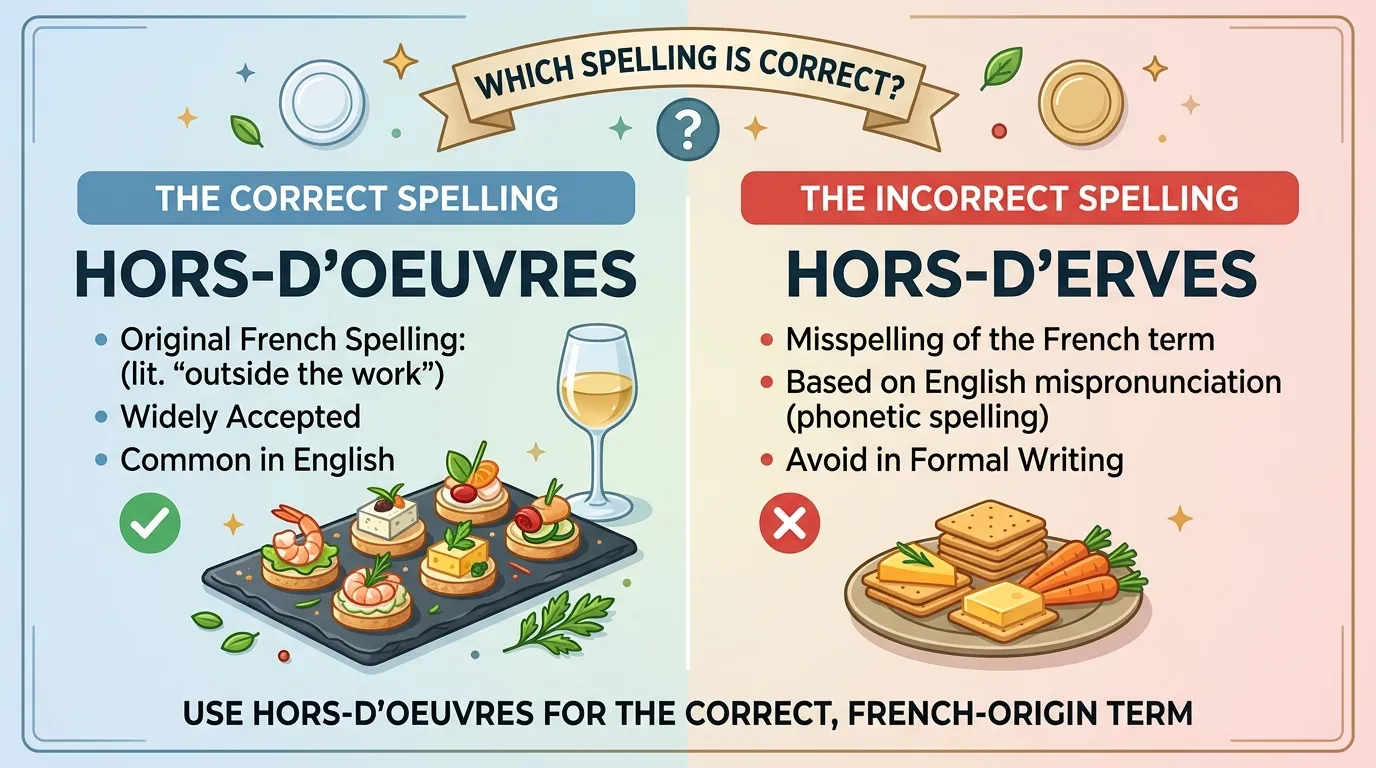
If you have ever wondered about hors d’oeuvres vs hors derves, the answer is simple: hors d’oeuvres is the correct spelling, while hors derves is a common misspelling. The word refers to small foods served before a meal or during a social gathering, such as cheese bites, stuffed mushrooms, mini sandwiches, or small pastries.
The confusion happens because the French word hors d’oeuvres does not look the way it sounds when English speakers pronounce it. The pronunciation is roughly “or-DERVZ”, which can make spellings such as hors derves, horse d’oeuvres, or hors devers seem reasonable.
In this guide, you will learn the difference between hors d’oeuvres and hors derves, the correct spelling, pronunciation, meaning, grammar, history, regional usage, common mistakes, and natural examples. You will also learn how to use the term confidently in menus, invitations, business writing, blogs, casual conversations, and everyday American English.
Quick Answer: Hors d’oeuvres vs Hors Derves
Hors d’oeuvres is the correct spelling.
Hors derves is incorrect and should generally be treated as a spelling mistake.
| Term | Correct? | Meaning |
|---|---|---|
| hors d’oeuvres | ✅ Yes | Small foods served before or apart from a main meal |
| hors d’oeuvre | ✅ Yes | Singular form of the word |
| hors derves | ❌ No | Common misspelling |
| horse d’oeuvres | ❌ No | Common humorous or phonetic misspelling |
| hors devers | ❌ No | Incorrect spelling |
| hors d’œuvres | ✅ Yes | Correct spelling using a typographic ligature |
The easiest rule to remember
If you mean small foods served before a meal or at a gathering, write:
hors d’oeuvres
Not:
hors derves
For example:
We served several hors d’oeuvres before dinner.
What Does Hors d’oeuvres Mean?
Hors d’oeuvres refers to small portions of food served before a meal or separately from the main meal.
Common examples include:
- Mini sandwiches
- Cheese and crackers
- Stuffed mushrooms
- Bruschetta
- Spring rolls
- Small pastries
- Deviled eggs
- Shrimp bites
- Meatballs
- Vegetable skewers
- Small tartlets
- Crostini
The word is especially common when discussing parties, receptions, weddings, dinners, cocktail events, restaurants, catering, and formal gatherings.
For example:
The wedding guests enjoyed several elegant hors d’oeuvres during the reception.
In everyday American English, you may also hear appetizers used for much the same purpose.
Hors d’oeuvre vs Hors d’oeuvres: What Is the Difference?
The difference is grammatical.
Hors d’oeuvre is singular.
Hors d’oeuvres is plural.
| Singular | Plural |
|---|---|
| hors d’oeuvre | hors d’oeuvres |
| one small dish | several small dishes |
| an hors d’oeuvre | some hors d’oeuvres |
Singular example
She prepared an elegant hors d’oeuvre for the dinner party.
Plural example
She prepared several hors d’oeuvres for the dinner party.
Notice that the plural form contains the final s.
The pronunciation can also change slightly because the final s is pronounced in the plural:
- hors d’oeuvre: roughly “or-DERV”
- hors d’oeuvres: roughly “or-DERVZ”
Why Do People Write “Hors Derves”?
The main reason is pronunciation.
English speakers often learn the word by hearing it rather than seeing it written. When someone hears “or-DERVZ,” the spelling hors derves may seem logical.
But English spelling does not always follow pronunciation, especially with words borrowed from French.
The correct spelling preserves the French form:
hors d’oeuvres
The incorrect version:
hors derves
is essentially an attempt to spell the pronunciation phonetically.
Why the spelling looks confusing
The word contains several features that are unusual in everyday English:
- French vocabulary
- An apostrophe
- A silent or weakly pronounced portion
- A plural ending that does not look like typical English spelling
- A pronunciation that differs significantly from its written form
This makes hors d’oeuvres a natural target for spelling mistakes.
What Is the Correct Pronunciation of Hors d’oeuvres?
In American English, hors d’oeuvres is commonly pronounced approximately:
or-DERVZ
The first part sounds like “or”, and the second part resembles “dervs.”
The singular is approximately:
or-DERV
You do not normally pronounce it as:
- horse-do-vers
- horse-dee-overs
- hors-do-ev-res
- hors-de-verse
Pronunciation memory trick
Think:
hors d’oeuvres → or-DERVZ
Then connect the pronunciation to the spelling:
OR-DERVZ = hors d’oeuvres
This can make the unusual spelling easier to remember.
What Does “Hors d’oeuvre” Literally Mean?
The expression comes from French.
Literally, hors d’oeuvre means something like “outside the work.”
The French components are:
- hors = outside
- d’ = contraction of de, meaning “of”
- oeuvre = work
Historically, the expression developed in connection with food served outside or apart from the principal part of a meal.
In modern English, however, you generally do not need to think about the literal French meaning when using the word.
Today, hors d’oeuvre primarily means a small dish served before or separately from the main meal.
Is “Hors Derves” Ever Correct?
No. Hors derves is not the standard English spelling of the food-related term.
If you are writing an article, menu, invitation, email, restaurant description, school assignment, business document, or professional communication, use:
hors d’oeuvres
There is no standard culinary meaning attached to hors derves.
You might occasionally see the misspelling online, in informal posts, or in user-generated content, but frequent online usage does not make it a standard spelling.
Hors d’oeuvres vs Appetizers
One of the most useful comparisons is between hors d’oeuvres and appetizers.
The terms overlap, but they are not always used in exactly the same situations.
| Hors d’oeuvres | Appetizers |
|---|---|
| Often associated with receptions and parties | Very common in restaurants |
| May be passed around by servers | Often ordered from a menu |
| Can be served before dinner | Usually served before the main course |
| Can be formal or elegant | Can be casual or formal |
| Often consists of small bite-sized portions | Can sometimes be larger portions |
For example:
The hotel offered complimentary hors d’oeuvres during the reception.
But:
We ordered three appetizers before our entrees.
In American English, appetizer is often the more natural everyday word when talking about a restaurant meal.
Are Hors d’oeuvres and Appetizers Synonyms?
They can function as near-synonyms in many contexts, but they are not perfect substitutes in every situation.
Other related words include:
- appetizers
- starters
- small bites
- finger foods
- canapés
- snacks
- refreshments
- savory bites
- nibbles
- amuse-bouches
The best choice depends on the setting.
For a wedding
hors d’oeuvres sounds natural:
Elegant hors d’oeuvres will be served during the reception.
For a restaurant
appetizers is often more natural:
Choose two appetizers from the menu.
For a casual party
snacks or finger foods may sound more relaxed:
We’ll have plenty of finger foods for everyone.
Hors d’oeuvres vs Canapés
These words are related but not identical.
A canapé is a particular type of small appetizer, often consisting of a base such as bread or a cracker topped with another ingredient.
Examples include:
- Toast topped with smoked salmon
- Crackers with cheese
- Small bread rounds with vegetables
- Crostini with spreads
Therefore, canapés can be hors d’oeuvres, but not every hors d’oeuvre is a canapé.
For example, a small meatball can be an hors d’oeuvre without being a canapé.
Is Hors d’oeuvres Singular or Plural?
Hors d’oeuvres is plural.
When referring to one item, use:
an hors d’oeuvre
When referring to multiple items, use:
hors d’oeuvres
Examples:
I tried an hors d’oeuvre before dinner.
We sampled several hors d’oeuvres.
A common mistake is treating hors d’oeuvres as singular.
Incorrect
This hors d’oeuvres is delicious.
Correct
This hors d’oeuvre is delicious.
Or:
These hors d’oeuvres are delicious.
Should You Say “An Hors d’oeuvre”?
Yes.
Although the spelling begins with h, the word is pronounced with a vowel sound at the beginning: approximately or-DERV.
Therefore, standard English uses an:
an hors d’oeuvre
Not:
a hors d’oeuvre
This follows the sound rather than the written letter.
Compare:
- an hour
- an honest person
- an hors d’oeuvre
The initial letter is not what determines the article. The sound does.
Common Mistakes With Hors d’oeuvres
Because the word is unfamiliar to many writers, several mistakes appear regularly.
1. Writing “hors derves”
Incorrect:
The restaurant served hors derves.
Correct:
The restaurant served hors d’oeuvres.
2. Writing “horse d’oeuvres”
Incorrect:
We prepared horse d’oeuvres for the party.
Correct:
We prepared hors d’oeuvres for the party.
This mistake is sometimes intentional as a joke because hors looks like the beginning of horse.
3. Using “hors d’oeuvres” as singular
Incorrect:
I ordered an hors d’oeuvres.
Correct:
I ordered an hors d’oeuvre.
4. Using “a” instead of “an”
Incorrect:
She brought a hors d’oeuvre.
Correct:
She brought an hors d’oeuvre.
5. Adding another plural ending
Because the word already contains a plural s, avoid forms such as:
hors d’oeuvreses
The standard plural is simply:
hors d’oeuvres
Natural vs Awkward Examples
Seeing the word in context makes the difference easier to understand.
Natural
The caterer prepared a selection of hors d’oeuvres.
Awkward
The caterer prepared a selection of hors derves.
The second sentence contains the common misspelling.
Natural
Guests enjoyed hors d’oeuvres while waiting for dinner.
Awkward
Guests enjoyed hors derves while waiting for dinner.
Natural
We served an hors d’oeuvre made with goat cheese.
Awkward
We served an hors d’oeuvres made with goat cheese.
The problem here is not spelling. It is number: an requires the singular form.
Hors d’oeuvres in Formal and Informal Writing
The term works well in both formal and informal contexts, but its tone can vary.
Formal
A selection of hors d’oeuvres will be available before the ceremony.
Business
Guests are invited to enjoy hors d’oeuvres and refreshments following the presentation.
Casual
We’ll have some hors d’oeuvres before dinner.
Very casual
We’ll have some snacks and small bites before dinner.
If your audience is unlikely to recognize the French term, appetizers, snacks, or small bites may be clearer.
Regional Differences: American vs British English
Hors d’oeuvres is understood in both American and British English.
However, food vocabulary can vary by region.
In American English, appetizer is especially common.
In British English, starter is often used when referring to the first course of a meal.
For example:
American English:
What appetizers are you ordering?
British English:
What starters are you having?
The term hors d’oeuvres remains available in both varieties, particularly in formal, restaurant, catering, and event contexts.
International English
In international writing, clarity should be the priority.
If your audience may not be familiar with the French expression, you can write:
Small appetizers, or hors d’oeuvres, will be served before dinner.
This gives readers the meaning immediately.
Dictionary-Style Definition
hors d’oeuvre (noun, singular)
Definition: A small portion of food served before a meal or separately from the main course.
Plural: hors d’oeuvres
Pronunciation: approximately or-DERV / or-DERVZ
Origin: French
Related terms: appetizer, starter, canapé, small bite, finger food
Example:
The restaurant offered an elegant hors d’oeuvre before the main course.
What Is the Word History of Hors d’oeuvres?
The expression comes directly from French hors d’oeuvre.
The literal elements refer to something being outside the work, which historically developed into a culinary expression for food positioned outside the main part of a meal.
English adopted the French term because French culinary vocabulary has had a strong influence on English-speaking food culture.
Other familiar culinary words borrowed from French include:
- cuisine
- chef
- entrée
- menu
- gourmet
- canapé
- soufflé
- buffet
Over time, hors d’oeuvre became established in English, while hors d’oeuvres became the familiar plural form.
Because the spelling remained close to French, the pronunciation and spelling do not match the expectations of many English speakers.
Is There a Figurative Meaning of Hors d’oeuvres?
The primary meaning is culinary.
However, hors d’oeuvre can occasionally be used figuratively to describe something that comes before something more important.
For example:
The opening presentation was merely an hors d’oeuvre for the main event.
Here, the word does not refer to literal food. It means a small introduction or preliminary experience before the main event.
This figurative use is relatively literary or playful rather than ordinary conversation.
Literal meaning
The guests enjoyed hors d’oeuvres before dinner.
Figurative meaning
The first victory was only an hors d’oeuvre before the championship match.
The second example uses food terminology metaphorically.
Can Hors d’oeuvres Be Used in Sports Writing?
Yes, although this is a figurative use rather than a technical sports term.
Sports writers sometimes describe an early event as an hors d’oeuvre for a larger competition.
For example:
The preseason game was an hors d’oeuvre for the highly anticipated regular-season matchup.
Here, the word suggests something small or preliminary before the main event.
It is not a standard sports statistic or technical term.
Can Hors d’oeuvres Be Used in Business Writing?
Yes.
The term is particularly appropriate for:
- Corporate receptions
- Networking events
- Award ceremonies
- Conferences
- Client dinners
- Product launches
- Business celebrations
Example:
Guests will enjoy hors d’oeuvres and refreshments following the keynote presentation.
For a highly general audience, however, light appetizers may be clearer.
Hors d’oeuvres in Academic Writing
Academic writing does not usually require the term unless the subject involves:
- Food
- Hospitality
- Culinary history
- French language
- Restaurant studies
- Cultural studies
- Event management
For example:
The study examines how French culinary vocabulary influenced American descriptions of hors d’oeuvres.
In an academic context, accuracy matters more than sounding sophisticated. Do not use hors d’oeuvres simply because it sounds formal.
Hors d’oeuvres in Journalism and Blogging
The word can work well in journalism and lifestyle writing, especially in stories about food, restaurants, weddings, parties, or events.
Example:
The evening began with sparkling drinks and a selection of seasonal hors d’oeuvres.
For blogs aimed at a broad audience, consider the reader’s familiarity with the term.
A clear first mention can help:
Guests were offered small appetizers, including several elegant hors d’oeuvres.
After that, you can simply use hors d’oeuvres.
Common Collocations With Hors d’oeuvres
A collocation is a group of words that commonly appear together.
Common combinations include:
- serve hors d’oeuvres
- prepare hors d’oeuvres
- offer hors d’oeuvres
- pass hors d’oeuvres
- elegant hors d’oeuvres
- light hors d’oeuvres
- hot hors d’oeuvres
- cold hors d’oeuvres
- delicious hors d’oeuvres
- assorted hors d’oeuvres
- selection of hors d’oeuvres
- tray of hors d’oeuvres
- platter of hors d’oeuvres
- hors d’oeuvres reception
- hors d’oeuvres menu
Example sentences
The hotel will serve hors d’oeuvres before the ceremony.
The caterer prepared a selection of hors d’oeuvres.
We ordered several light hors d’oeuvres for the reception.
The menu includes both hot and cold hors d’oeuvres.
These combinations sound natural in American English.
Related Words and Near-Synonyms
Depending on context, you can replace hors d’oeuvres with:
Appetizers
Best for general American restaurant language.
We ordered two appetizers.
Starters
Common in British English and some international contexts.
The restaurant offers several starters.
Small bites
Modern and conversational.
The event will feature small bites and drinks.
Finger foods
Informal and practical.
We need easy finger foods for the party.
Canapés
More specific and often associated with formal events.
Servers passed canapés during the reception.
Snacks
Very broad and casual.
We’ll have snacks available throughout the afternoon.
Is There an Antonym for Hors d’oeuvres?
There is no exact antonym for hors d’oeuvres.
However, in the context of a meal, contrasting terms include:
- main course
- entrée
- main dish
- principal course
These are not true dictionary antonyms. They simply describe a different part of a meal.
For example:
Guests enjoyed hors d’oeuvres before the main course.
The two terms contrast naturally in that sentence.
Memory Tricks for Remembering the Correct Spelling
The spelling can be difficult, so use a simple memory system.
Memory trick 1: Think French
Remember that the word comes from French:
hors d’oeuvre
Then add s for the plural:
hors d’oeuvres
Memory trick 2: Remember the sound
Think:
or-DERVZ
When you hear or-dervz, do not automatically spell it hors derves.
Memory trick 3: Connect it to “work”
The French word oeuvre is associated with “work.”
So:
hors + d’oeuvre → hors d’oeuvre
Memory trick 4: Avoid “horse”
If you are writing about food, remember:
hors d’oeuvres ≠ horse d’oeuvres
The latter may be funny in a joke, but it is not the standard food term.
How to Choose the Best Word in Different Situations
| Situation | Best choice |
|---|---|
| Formal wedding invitation | hors d’oeuvres |
| Fancy reception | hors d’oeuvres |
| Restaurant menu | appetizers |
| British restaurant | starters |
| Casual party | snacks or finger foods |
| Catering brochure | hors d’oeuvres |
| General-audience blog | appetizers or hors d’oeuvres |
| Culinary article | hors d’oeuvres |
| Business reception | hors d’oeuvres |
| Very informal conversation | snacks or small bites |
The most important rule is not to choose the fanciest word. Choose the word your readers will understand naturally.
Should You Capitalize Hors d’oeuvres?
Normally, hors d’oeuvres is lowercase when it appears in ordinary sentences.
For example:
We served hors d’oeuvres at the reception.
Capitalize it when it appears at the beginning of a sentence or when capitalization is required by a particular title or heading style.
In a menu or event title, capitalization may depend on the design or editorial style being used.
Consistency matters more than arbitrary capitalization.
Should You Use an Apostrophe?
Yes.
The standard spelling includes the apostrophe:
hors d’oeuvres
You may also see:
hors d’œuvres
The second form uses a typographic curly apostrophe and ligature-style œ.
In ordinary digital writing, hors d’oeuvres is perfectly acceptable and widely recognizable.
The important thing is to avoid changing the word into a phonetic spelling such as hors derves.
Formal vs Informal Alternatives
If you want a more formal tone, use:
- hors d’oeuvres
- canapés
- reception appetizers
- assorted appetizers
For a more casual tone, use:
- snacks
- small bites
- finger foods
- party food
- appetizers
Compare:
Formal:
A selection of elegant hors d’oeuvres will be served.
Neutral:
Appetizers will be served before dinner.
Casual:
We’ll have plenty of snacks and small bites.
All three can be correct. The best choice depends on your audience and setting.
Real-World Examples of Correct Usage
Here are examples across different contexts.
At a wedding
Guests enjoyed hors d’oeuvres during the cocktail hour.
At a business event
Light hors d’oeuvres will be available after the presentation.
At a restaurant
The chef created a seasonal selection of hors d’oeuvres.
At a family gathering
We prepared several easy hors d’oeuvres for the party.
In a blog post
These simple hors d’oeuvres are perfect for holiday entertaining.
In a menu
Hors d’oeuvres
Stuffed mushrooms, bruschetta, cheese bites, and vegetable skewers
In casual conversation
What kind of hors d’oeuvres are you serving?
Hors Derves vs Hors d’oeuvres: Final Comparison
| Feature | Hors d’oeuvres | Hors derves |
|---|---|---|
| Standard spelling | ✅ Yes | ❌ No |
| Food-related meaning | ✅ Yes | ❌ No |
| Dictionary-standard form | ✅ Yes | ❌ No |
| Used in professional writing | ✅ Yes | ❌ No |
| Used on menus | ✅ Yes | ❌ No |
| Common online spelling | Yes | Sometimes as a mistake |
| Pronunciation-based spelling | No | Yes |
| Recommended for formal writing | ✅ Yes | ❌ No |
The distinction is straightforward: hors d’oeuvres is the correct word; hors derves is a misspelling.
Frequently Asked Questions
1. Is it hors d’oeuvres or hors derves?
The correct spelling is hors d’oeuvres. Hors derves is a common misspelling based on the way the word sounds when pronounced.
2. What is the correct spelling of hors d’oeuvres?
The standard spelling is hors d’oeuvres. The singular form is hors d’oeuvre.
3. How do you pronounce hors d’oeuvres?
In American English, hors d’oeuvres is commonly pronounced approximately “or-DERVZ.” The singular is approximately “or-DERV.”
4. Is hors d’oeuvre singular or plural?
Hors d’oeuvre is singular, while hors d’oeuvres is plural.
For example:
She served an hors d’oeuvre.
She served several hors d’oeuvres.
5. Is “hors derves” a word?
No. Hors derves is not the standard spelling of the culinary term. It is generally a phonetic misspelling of hors d’oeuvres.
6. What is another word for hors d’oeuvres?
Depending on the situation, alternatives include appetizers, starters, small bites, finger foods, snacks, and canapés. These words are related but may not be exact substitutes in every context.
7. Do you say “an hors d’oeuvre”?
Yes. The correct phrase is an hors d’oeuvre because the word begins with a vowel sound when pronounced in English.
8. Is hors d’oeuvres the same as appetizers?
They often refer to similar foods, but they are not always identical in usage. Appetizer is especially common in American restaurants, while hors d’oeuvres is often associated with receptions, parties, catering, and formal events.
9. Is hors d’oeuvres a French word?
Yes. Hors d’oeuvre is a French expression. It literally relates to the idea of something being “outside the work” and developed into a culinary term for food served outside the main part of a meal.
10. What is the easiest way to remember hors d’oeuvres?
Remember the pronunciation “or-DERVZ” but keep the French spelling: hors d’oeuvres. Do not try to spell the pronunciation as hors derves.
Conclusion
When comparing hors d’oeuvres vs hors derves, there is a clear winner: hors d’oeuvres is the correct standard spelling, while hors derves is a misspelling.
The word hors d’oeuvre is singular, and hors d’oeuvres is plural. It refers to small foods served before a meal or separately from the main course. In American English, it often appears in contexts such as weddings, receptions, catered events, parties, restaurants, and business gatherings.
The unusual spelling is easy to understand once you remember that the word comes from French and is pronounced roughly “or-DERVZ.” Because the pronunciation does not closely resemble the spelling, forms such as hors derves and horse d’oeuvres are common mistakes.
For everyday American restaurant conversations, appetizers may be simpler. In formal event, catering, culinary, and reception contexts, hors d’oeuvres is a natural and polished choice. British English also uses the term, although starters is often preferred when discussing the first course of a meal.
The main rule is simple:
Write “hors d’oeuvres” when you mean small foods served before or apart from a meal. Never use “hors derves” as the standard spelling.
Once you remember the difference between the singular hors d’oeuvre and plural hors d’oeuvres, this tricky French-derived word becomes much easier to use correctly.