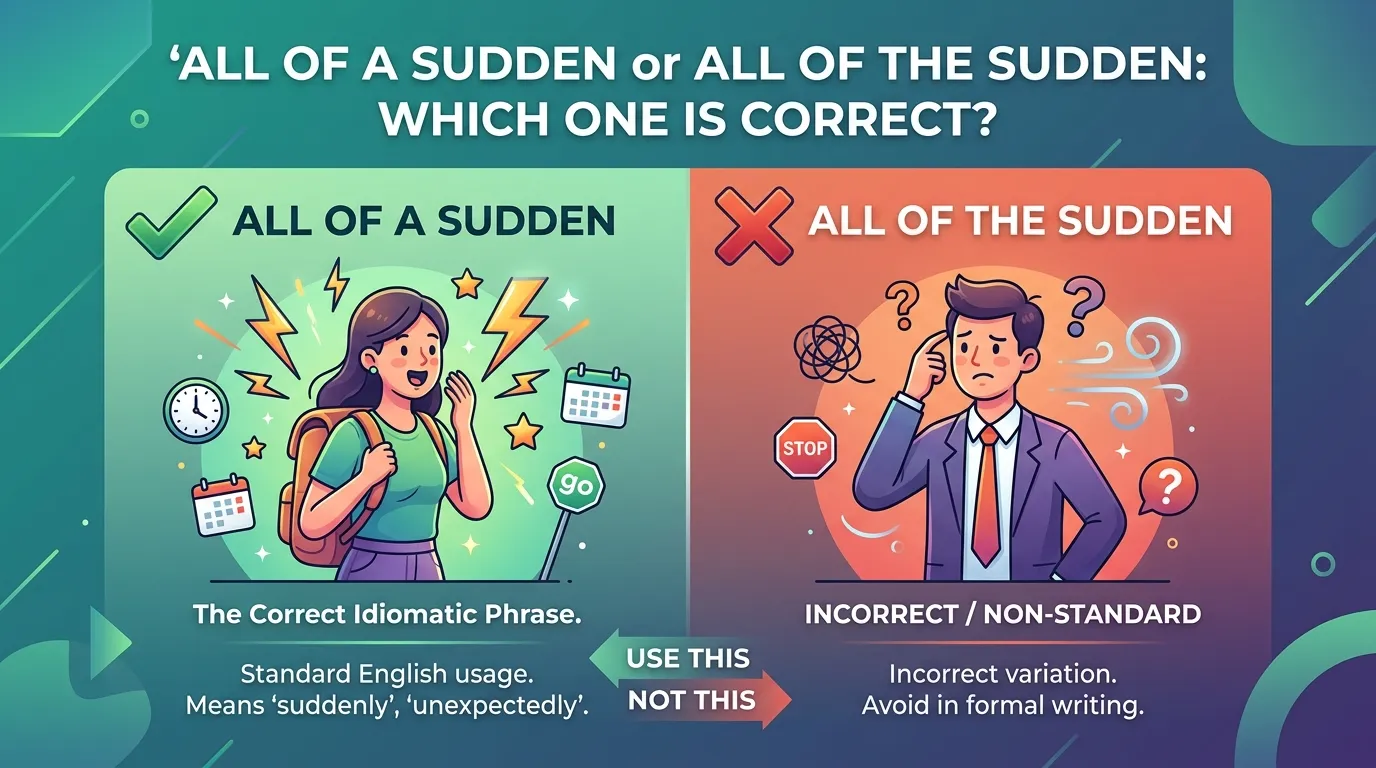
Have you ever wondered whether you should write all of the sudden or all of a sudden? The short answer is simple: all of a sudden is the correct English expression, while all of the sudden is considered incorrect in standard English. Even though many native speakers accidentally say or write all of the sudden, dictionaries, grammar guides, teachers, editors, and style manuals all recommend using all of a sudden.
People often confuse these expressions because both a and the are common articles in English. Since we naturally say phrases like all of the people or all of the time, many learners assume all of the sudden follows the same pattern. However, this expression is an idiom, meaning its wording has been fixed for hundreds of years. You cannot replace one word with another without making it grammatically incorrect.
The good news is that there is no difference between American and British English on this point. Whether you’re writing in the US or the UK, all of a sudden is the accepted form. In this guide, you’ll learn the All of the Sudden or All of a Sudden grammar difference, pronunciation, history, examples, synonyms, common mistakes, and easy memory tricks.
Quick Answer
| ✔ Correct | ✘ Incorrect |
|---|---|
| All of a sudden | All of the sudden |
Meaning
All of a sudden means:
- Suddenly
- Unexpectedly
- Without warning
- Happening very quickly
Example:
All of a sudden, the lights went out.
What Does “All of a Sudden” Mean?
All of a sudden is an idiomatic adverbial phrase that describes something happening unexpectedly or instantly.
It tells readers or listeners that an event occurred without any warning.
Examples:
- All of a sudden, it started raining.
- She was laughing, and all of a sudden she began crying.
- My phone stopped working all of a sudden.
What Part of Speech Is It?
All of a sudden functions as an adverbial phrase.
It modifies an entire sentence or a verb by describing how or when something happened.
Example:
All of a sudden, the meeting ended.
It modifies the action ended.
Why Is “All of a Sudden” Correct?
This expression has been part of English for centuries.
The phrase became fixed as:
all + of + a + sudden
Because it is an idiom, changing a to the breaks the traditional expression.
English contains many idioms whose wording never changes.
Examples:
- in a hurry
- once in a while
- all of a sudden
These expressions cannot be rewritten word for word.
American English Examples
Here are examples commonly used in the United States.
- All of a sudden, the traffic stopped.
- The baby began crying all of a sudden.
- My computer restarted all of a sudden.
- All of a sudden, everyone stood up.
- She felt sick all of a sudden.
- The market dropped all of a sudden.
- The lights flickered all of a sudden.
- Our internet stopped working all of a sudden.
- He disappeared all of a sudden.
- The dog barked all of a sudden.
British English Examples
British English uses exactly the same phrase.
- All of a sudden, it began to snow.
- The train stopped all of a sudden.
- Everyone became quiet all of a sudden.
- All of a sudden, the phone rang.
- She remembered the answer all of a sudden.
- The children started laughing all of a sudden.
- My neighbour appeared all of a sudden.
- All of a sudden, the wind became stronger.
- The kettle switched off all of a sudden.
- We lost electricity all of a sudden.
Why “All of the Sudden” Is Incorrect
Although many people say it in casual speech, all of the sudden is not accepted in standard English.
The phrase is an idiom, and idioms cannot usually be changed.
Incorrect
- All of the sudden it started raining.
- She cried all of the sudden.
- The lights went out all of the sudden.
Correct
- All of a sudden it started raining.
- She cried all of a sudden.
- The lights went out all of a sudden.
Comparison Table
| Feature | All of a Sudden | All of the Sudden |
|---|---|---|
| Grammar | Correct | Incorrect |
| Meaning | Unexpectedly | Intended to mean unexpectedly |
| Dictionary Status | Accepted | Not accepted in standard English |
| Formal Writing | Yes | No |
| Academic Writing | Yes | No |
| Newspapers | Yes | Rarely, only as an error |
| American English | Standard | Considered incorrect |
| British English | Standard | Considered incorrect |
| IELTS/TOEFL | Correct | Incorrect |
Pronunciation Guide
| Phrase | IPA (US) | IPA (UK) |
|---|---|---|
| All of a sudden | /ɔːl əv ə ˈsʌdən/ | /ɔːl əv ə ˈsʌdən/ |
| All of the sudden | /ɔːl əv ðə ˈsʌdən/ | /ɔːl əv ðə ˈsʌdən/ |
Why Are They Confused?
People confuse them because:
- “the” is more common in everyday speech.
- Both sound similar during fast conversations.
- Speakers often copy what they hear.
- Some regional dialects occasionally use the incorrect form informally.
- Learners assume both are acceptable.
Word Origins and Etymology
The phrase all of a sudden dates back to the 17th century.
The noun sudden once referred to a sudden occurrence or event.
Over time, English speakers fixed the expression as:
all of a sudden
Eventually, the noun sudden disappeared from normal everyday usage except inside this idiom.
That is why replacing a with the does not match the historical expression.
Grammar Rule Explained
The phrase is an idiomatic prepositional expression.
Structure:
all + of + a + sudden
It works as a complete unit.
Example:
All of a sudden, the meeting ended.
It is not built by normal grammar rules where articles can be swapped.
Think of it like:
- by and large
- once and for all
- in a nutshell
Changing words inside these idioms makes them incorrect.
Related Expressions
Similar expressions include:
| Expression | Meaning |
|---|---|
| Suddenly | Immediately |
| Out of nowhere | Unexpectedly |
| Without warning | No advance notice |
| In an instant | Very quickly |
| Abruptly | Suddenly |
| Unexpectedly | Without expectation |
| At once | Immediately |
Synonyms
| Synonym | American English | British English | Formality |
|---|---|---|---|
| Suddenly | Very common | Very common | Neutral |
| Unexpectedly | Common | Common | Formal |
| Abruptly | Common | Common | Formal |
| Out of nowhere | Common | Common | Informal |
| In an instant | Common | Common | Neutral |
| Without warning | Common | Common | Neutral |
| Immediately | Common | Common | Neutral |
Which Synonyms Are Preferred?
American and British English both commonly use:
- suddenly
- unexpectedly
- abruptly
In informal speech, both varieties often use:
- out of nowhere
Real-Life Examples
Emails
All of a sudden, our email server stopped working.
Office
All of a sudden, the projector turned off during the presentation.
Banking
All of a sudden, the payment disappeared from my account.
Invoice
All of a sudden, the invoice status changed to Paid.
School
All of a sudden, the fire alarm rang.
Social Media
My post went viral all of a sudden.
Rent Payment
All of a sudden, my rent reminder appeared twice.
Everyday Conversation
We were talking when all of a sudden the door opened.
Common Mistakes
Using “the”
❌ All of the sudden
✔ All of a sudden
Forgetting the phrase is an idiom
Treat it as one complete expression.
Writing “all of sudden”
Incorrect.
Correct:
All of a sudden
Writing “all a sudden”
The word of cannot be removed.
Confusing it with “suddenly”
Both work, but the sentence structure changes.
Example:
Suddenly, the phone rang.
All of a sudden, the phone rang.
Using it too often
Avoid repeating it many times in one paragraph.
Using it in very formal scientific writing
Sometimes unexpectedly or abruptly sounds more professional.
All of a Sudden vs Suddenly
| All of a Sudden | Suddenly |
|---|---|
| Idiom | Single adverb |
| Slightly conversational | Works everywhere |
| Four-word phrase | One word |
| Natural storytelling | More concise |
Examples:
All of a sudden, the baby smiled.
Suddenly, the baby smiled.
Both are correct.
Memory Tricks
- Remember: A comes before sudden.
- Think of it as one fixed expression.
- Never replace a with the.
- Picture a lightning bolt appearing all of a sudden.
- Read books—you’ll almost always see all of a sudden, never all of the sudden.
Frequently Asked Questions
Is all of the sudden correct?
No. Standard English uses all of a sudden.
What does all of a sudden mean?
It means unexpectedly or without warning.
Is all of a sudden formal?
Yes. It works in both formal and informal writing.
Can I say suddenly instead?
Yes. Both are correct.
Which dictionaries accept all of a sudden?
Major dictionaries such as Merriam-Webster, Cambridge, Oxford, and Collins recognize all of a sudden.
Is there a UK vs US difference?
No. Both American and British English use all of a sudden.
Is all of the sudden ever acceptable?
Some people say it in casual speech, but it is widely considered a grammatical error in edited writing.
How do you pronounce all of a sudden?
US and UK pronunciation are both approximately:
/ɔːl əv ə ˈsʌdən/
Is all of a sudden an idiom?
Yes. It is a fixed English idiom.
People Also Ask
Is all of the sudden a grammar mistake?
Yes. Standard grammar recommends all of a sudden instead.
Why do people say all of the sudden?
People often substitute the because it sounds natural in many English phrases, but this idiom has a fixed form.
Can I use all of a sudden in academic writing?
Yes. It is grammatically correct, though words like unexpectedly or abruptly may sound more formal depending on the context.
Is suddenly better than all of a sudden?
Neither is universally better. Suddenly is shorter and often preferred in formal writing, while all of a sudden adds a conversational, storytelling tone.
Is all of a sudden old-fashioned?
No. It has historical origins, but it remains common and natural in modern English.
Can I start a sentence with all of a sudden?
Yes. Starting a sentence with All of a sudden, is perfectly correct and very common.
Does all of a sudden always describe something unexpected?
Yes. The phrase implies a quick or surprising change, often without warning.
Are there regional dialects that use all of the sudden?
Some regional speakers may say all of the sudden in casual conversation, but it is not accepted in standard edited English.
Conclusion
If you’ve been wondering whether to write all of the sudden or all of a sudden, the answer is clear. All of a sudden is the only correct form in standard English. It is a long-established idiom that means unexpectedly, without warning, or very quickly. Although all of the sudden is sometimes heard in informal speech, it is considered incorrect in both American and British English and should be avoided in school assignments, business writing, emails, articles, and professional communication.
By understanding its grammar, history, pronunciation, and proper usage, you’ll write with greater confidence and accuracy. When in doubt, remember that idioms are fixed expressions—you can’t swap words freely. If you want a shorter alternative, suddenly is an excellent synonym. Mastering this small but important grammar point will help you sound more natural and polished in every kind of English writing.