The librarian at the reading-room desk had two regulars who confused her every week. One was a student who always asked for “a quite room to study in.” The other was a professor who always described a new book as “quiet interesting.” The librarian, who had been correcting students for thirty years, never corrected either of them, because she understood the confusion. The two words look almost identical, they sound almost identical, and they have nothing to do with each other. One is about silence. The other is about degree. And a single letter — the e that sits in the middle of one and not the other — is all that separates them.
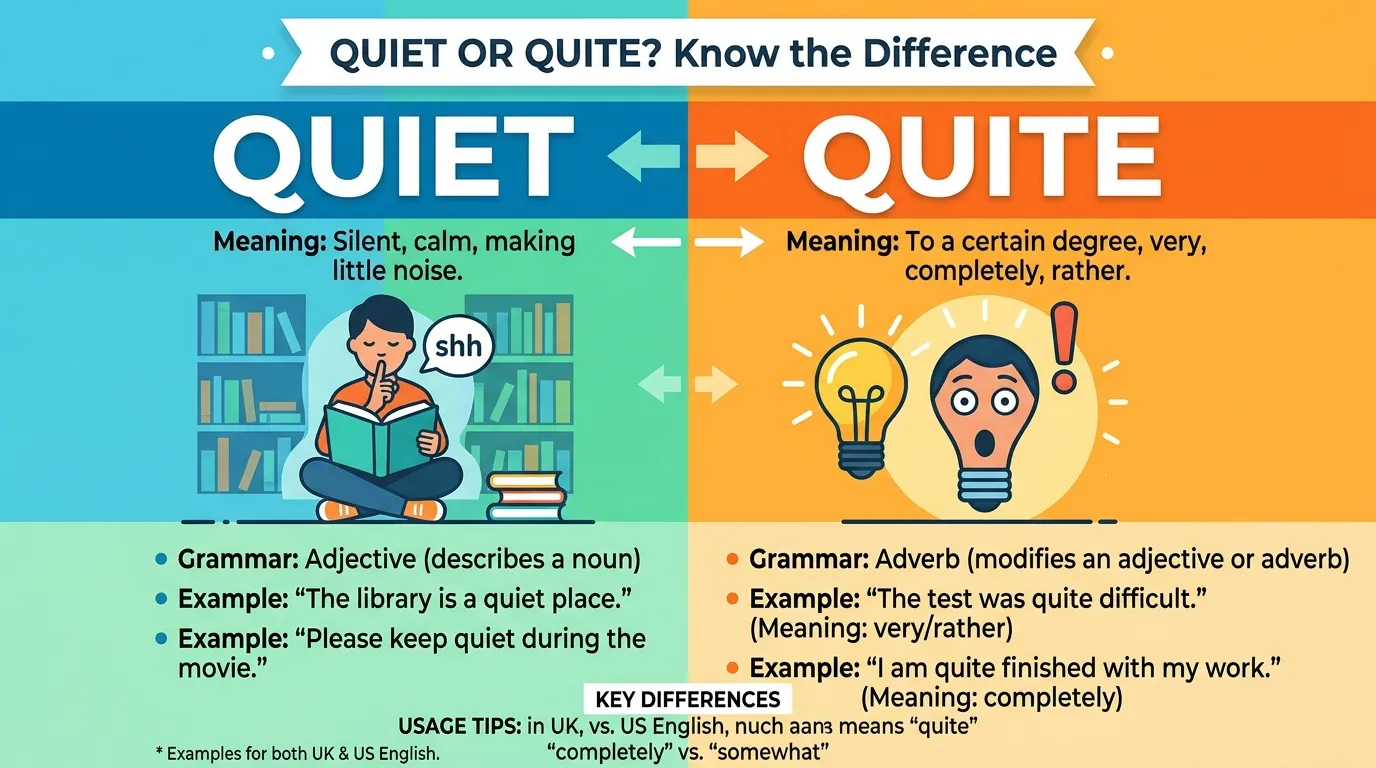
Quiet means silent, calm, or free from noise. Quite means very, completely, or to a considerable degree. They are different words, with different meanings, different grammar, and different jobs in a sentence. Confusing them changes the meaning entirely: “a quite room” is not a silent room, and “quiet interesting” is not a degree of interest. The confusion is easy, the fix is simple, and the distinction is worth mastering, because both words appear constantly in everyday writing.
Shh in the Reading Room
Start with the library, because it is the word quiet‘s natural habitat. A library is quiet. A reading room is quiet. A study corner is quiet. The word describes the absence of noise, and the library’s famous sign — “Please be quiet” — is the word in its purest form: a request for silence. The student who asked for “a quite room” wanted a silent room, and the librarian gave her one, because the meaning was obvious from context. But the spelling was wrong, and on an exam, in an essay, or in a job application, the wrong spelling would be marked.
The professor’s error was the mirror image. He meant to say the book was “quite interesting” — very interesting, considerably interesting — and he wrote “quiet interesting,” which is not a phrase at all. Quiet cannot modify interesting. It is an adjective, and adjectives do not modify other adjectives. The sentence was nonsense, and the librarian, who knew the professor’s meaning, let it pass. But the sentence was wrong, and the wrongness was grammatical, not just spelling.
The library holds both words in a single room, and the room is the perfect place to keep them straight. The room is quiet. The book is quite interesting. The room’s silence is quiet. The book’s interest is quite — very, considerably, to a high degree. Silence and degree, side by side, in the same building, never overlapping.
Quiet: The Silence Word
Quiet is a versatile word with three jobs. As an adjective, it means silent, calm, or free from noise: “a quiet street,” “a quiet voice,” “a quiet evening.” As a noun, it means silence itself: “the quiet of the library,” “the quiet after the storm,” “a moment of quiet.” As a verb, it means to make silent: “Please quiet the children,” “He quieted the crowd,” “The medicine quieted her cough.” In British English, the verb is often quieten — “Please quieten down” — while in American English, quiet does the job alone.
The adjective has a family: quietly (the adverb), quietness (the noun for the quality), quietly again in phrases like “quietly confident,” “quietly pleased,” “quietly furious” — the adverb doing the work of understatement. A quietly confident person is confident without showing off. A quietly pleased person is pleased without making a fuss. The adverb softens the adjective it modifies, the way a quiet voice softens a room.
Quiet also appears in fixed phrases. Keep quiet means to stay silent or to keep a secret: “Keep quiet about the surprise party.” Quiet down means to become quieter: “Quiet down, please.” On the quiet means secretly: “They got married on the quiet.” A quiet word means a private conversation: “Can I have a quiet word?” In every phrase, the word is about silence, secrecy, or calm. It never means degree.
The pronunciation is KWY-et, two syllables, with the stress on the first. The qu sounds like kw, the i is short, and the et is a separate, unstressed syllable. Say it slowly: KWY-et. Two beats. The two syllables are the word’s fingerprint, and they distinguish it from quite in speech, even when the spelling confuses the eye.
Quite: The Booster Word
Quite is a simpler word with one job: it is an adverb that boosts the word it modifies. It means very, completely, or to a considerable degree, depending on context. “Quite good” means very good. “Quite finished” means completely finished. “Quite a story” means a remarkable story. “Quite a few” means a considerable number. The word always comes before the word it boosts, and it never stands alone. You cannot say “The room is quite” and stop. The sentence needs a word after quite to boost.
The word’s meaning shifts with the adjective it modifies, and the shift is worth understanding. With gradable adjectives — adjectives that have degrees, like good, interesting, big, cold — quite means “very” or “to a considerable degree”: “quite good” (very good), “quite interesting” (very interesting). With non-gradable adjectives — adjectives that are absolute, like finished, dead, empty, perfect — quite means “completely”: “quite finished” (completely finished), “quite dead” (completely dead). The same word, two meanings, decided by the adjective that follows it.
Quite also has a regional twist that confuses even fluent speakers. In American English, quite usually means “very”: “quite good” is very good. In British English, quite often means “fairly” or “somewhat”: “quite good” is fairly good — good, but not very good. The difference is one of degree, and it has caused real misunderstandings: an American who hears a Briton say “quite good” thinks the Briton is enthusiastic, while the Briton meant only moderate approval. The British understatement — “quite nice,” “quite pleasant,” “quite interesting” — is a cultural habit as much as a linguistic one, and it is the source of the famous British talent for damning with faint praise.
The pronunciation is KWAHYT, one syllable, rhyming with white, night, and right. One beat. The single syllable is the word’s fingerprint, and it distinguishes it from quiet in speech. KWY-et (two beats) versus KWAHYT (one beat). The ear can tell them apart. The eye, faced with two words that differ by one letter, often cannot.
The One-Letter Gap
Here is the spelling mechanics, and it is the part that explains the error. Quiet is spelled Q-U-I-E-T. Quite is spelled Q-U-I-T-E. The difference is the position of the e: in quiet, the e sits before the t, making the word two syllables. In quite, the e sits after the t, making the word one syllable with a long i. The e moves from the middle to the end, and the word changes its meaning, its grammar, and its pronunciation.
The error happens because the eye sees the same letters — q, u, i, t, e — and the hand, writing quickly, puts the e in the wrong place. The two words are anagrams of each other, differing only in the order of the last two letters. Anagrams are rare in English, and they are treacherous: the letters are the same, the order is everything, and the eye slides over the difference. The same trap catches though / through, form / from, and casual / causal — pairs where a small rearrangement changes everything.
The fix is to attach the spelling to the meaning. Quiet has the e in the middle, and the middle is where the silence is — the word’s second syllable, -et, is the quiet part, the soft landing after the stressed qui-. Quite has the e at the end, and the end is where the boost is — the silent e that makes the i long, the way a booster makes the adjective stronger. The e in the middle means silence. The e at the end means degree. The position of the letter is the meaning.
Quite, Fairly, or Very?
Quite‘s neighbours are worth a look, because choosing between them is a real writing skill. Very is the straightforward booster: “very good” means extremely good, with no ambiguity. Fairly is the moderate booster: “fairly good” means reasonably good, not outstanding. Rather is the British cousin of quite: “rather good” means considerably good, with a hint of surprise. Pretty is the informal cousin: “pretty good” means quite good, in casual speech. Quite sits between fairly and very in British English, and beside very in American English. The choice between them is a matter of how strong you want the boost to be — and, in British English, how much understatement you want to keep.
Quiet‘s neighbours are a different set. Silent means making no sound at all: “a silent room.” Calm means peaceful and free from disturbance: “a calm evening.” Peaceful means tranquil and undisturbed: “a peaceful garden.” Still means motionless and silent: “a still night.” Quiet is the general word that covers all of them — a quiet room can be silent, calm, peaceful, or still — and the choice between them is a matter of precision. If the point is the absence of sound, use silent. If the point is the absence of disturbance, use calm or peaceful. If the point is the general quality, use quiet.
The two sets never overlap. Quite boosts; quiet silences. No sentence needs both words for the same job, and no sentence can swap them without changing its meaning. “A quite room” is a room that is very something — but the sentence never says what. “A quiet interesting” is a phrase that never gets off the ground. The words are neighbours on the page and strangers in meaning.
Hearing the Difference
Back in the library, the student found her quiet room, and the professor’s book was quite interesting, and the librarian, who had heard both errors a hundred times, said nothing. She knew what they meant. But the written language does not have her patience. On the page, the two words must be distinguished by spelling alone, and the spelling alone is the e — in the middle for silence, at the end for degree.
The check is two questions. First, the meaning question: does the sentence need silence or degree? If it needs silence — a room, a voice, an evening, a moment — the word is quiet, with the e in the middle. If it needs degree — very, completely, considerably — the word is quite, with the e at the end. Second, the sound question: say the word aloud. Two beats (KWY-et) means quiet. One beat (KWAHYT) means quite. The ear knows the difference, even when the eye forgets. Trust it.