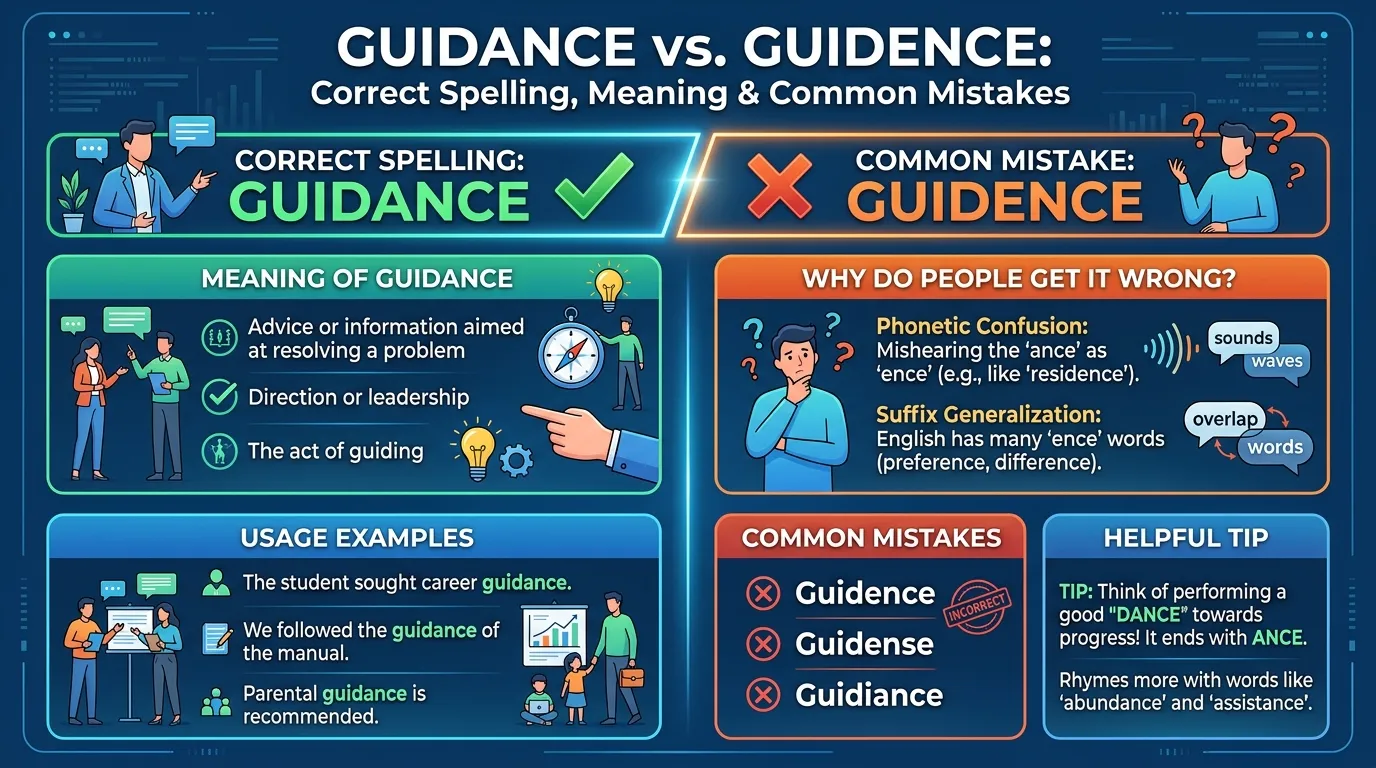
If you are unsure whether the correct spelling is guidance or guidence, the answer is simple: guidance is the correct spelling in standard English. Guidence is a common misspelling and should not be used in formal, academic, professional, or everyday writing.
The confusion usually happens because of the pronunciation of guidance and the spelling of related words such as guide, guided, and guiding. The word comes from guide, but its noun form changes the ending to -ance, not -ence.
In this guide, you will learn the difference between guidance vs guidence, what guidance means, how to pronounce it, why guidence is incorrect, and how to remember the correct spelling. You will also see examples in business, education, writing, technology, sports, journalism, and everyday conversation.
Quick Answer: Guidance or Guidence?
Guidance is the correct spelling.
Guidence is incorrect and should be treated as a spelling mistake.
| Word | Correct? | Meaning |
|---|---|---|
| Guidance | ✅ Yes | Advice, direction, help, or recommendations |
| Guidence | ❌ No | Common misspelling of guidance |
Correct example
The teacher provided helpful guidance before the exam.
Incorrect example
The teacher provided helpful guidence before the exam.
The correct spelling is always guidance when you mean advice, direction, instruction, or help.
What Does Guidance Mean?
Guidance is a noun meaning advice, direction, instruction, or help given to someone who needs assistance in making a decision or taking action.
For example:
I asked my manager for guidance on the new project.
Here, guidance means advice or direction.
Another example is:
Parents often provide guidance to their children.
In this sentence, guidance refers to the advice and support parents give as children grow and make decisions.
Guidance can be practical, professional, educational, personal, or general.
Dictionary-style definition
Guidance
Noun: Advice, direction, instruction, or assistance intended to help someone make a decision or complete a task.
Simple meaning
You can think of guidance as:
“Helpful direction that shows someone what to do.”
For example:
- A teacher gives students guidance.
- A coach gives athletes guidance.
- A manager gives employees guidance.
- A counselor gives clients guidance.
- A parent gives children guidance.
- A manual provides guidance to users.
Why Is “Guidence” Incorrect?
Guidence is incorrect because standard English spells this noun guidance, with -ance at the end.
The correct word is derived from guide:
guide → guidance
Not:
guide → guidence
The spelling guidence may look reasonable because English has many words ending in -ence, such as:
- difference
- confidence
- patience
- intelligence
- independence
However, spelling patterns in English are not always predictable. You cannot automatically change every related noun to -ence.
The established spelling is guidance.
Guidance vs Guidence: The Key Difference
There is really only one meaningful distinction:
- Guidance = correct English word
- Guidence = incorrect spelling
This is not a case where two words have different meanings.
They are not like:
- advice vs advise
- affect vs effect
- practice vs practise
- principal vs principle
Instead, guidence is simply a misspelling of guidance.
Side-by-side comparison
| Feature | Guidance | Guidence |
|---|---|---|
| Standard English | Yes | No |
| Correct spelling | Yes | No |
| Part of speech | Noun | Not a standard English word |
| Meaning | Advice or direction | — |
| Used in formal writing | Yes | No |
| Used in academic writing | Yes | No |
| Used in business writing | Yes | No |
| Used in casual writing | Yes | No |
How Do You Spell Guidance?
The correct spelling is:
G-U-I-D-A-N-C-E
Break it down
guid + ance = guidance
The easiest spelling pattern to remember is the ending:
-ance
So write:
guidance
not:
guidence
How Do You Pronounce Guidance?
Guidance is generally pronounced approximately like:
GY-dन्स or GUY-dns
In ordinary American speech, the middle vowel can be reduced, making the word sound somewhat like “guy-dns.”
The pronunciation can contribute to spelling confusion because the spoken form does not clearly reveal every letter.
Pronunciation example
The counselor offered guidance.
When spoken naturally, guidance may sound shorter than it looks when written.
This is one reason people sometimes write guidence even though that spelling is incorrect.
Why Do People Confuse Guidance and Guidence?
Several factors can cause this spelling mistake.
1. The pronunciation is not fully transparent
English spelling does not always match pronunciation letter for letter.
When people hear guidance, they may not clearly hear the vowel represented by a.
2. English has many “-ence” words
Writers are familiar with words such as:
- experience
- evidence
- confidence
- presence
- reference
- difference
As a result, guidence may visually seem familiar.
3. The word “guide” creates uncertainty
The base word is guide, but its related noun is guidance.
The spelling relationship is:
- guide
- guided
- guiding
- guidance
The a in guidance needs to be remembered.
4. Fast typing causes spelling errors
People often type words based on how they sound. Autocorrect and spell-check tools can catch some errors, but not every writing environment provides immediate correction.
Guidance: Part of Speech
Guidance is a noun.
It refers to something given or received rather than an action performed directly.
Examples
She gave me useful guidance.
We need professional guidance.
His guidance helped the team succeed.
The school offers career guidance.
In each example, guidance names the advice or direction being provided.
Guidance vs Guide
Although guidance and guide are related, they are not interchangeable.
Guide can be a noun or a verb.
Guidance is a noun.
Guide as a noun
Our tour guide showed us the museum.
Here, a guide is a person or resource that helps someone understand or navigate something.
Guide as a verb
The instructions will guide you through the process.
Here, guide means to direct or help someone.
Guidance as a noun
The instructions provide guidance during the process.
Here, guidance refers to the advice or direction itself.
Easy distinction
Guide = the person, thing, or action that directs.
Guidance = the advice or direction provided.
Guidance vs Advice
These words are closely related, but they are not always identical.
Advice usually refers to an opinion or recommendation about what someone should do.
Guidance can be broader and may include advice, instruction, direction, support, or recommendations.
Compare:
My friend gave me advice about choosing a college.
My academic advisor provided guidance throughout my college application.
The first focuses on a recommendation. The second suggests continuing direction and support.
Guidance vs Direction
Direction can mean specific instructions about what to do or where to go.
Guidance often has a broader and more supportive meaning.
For example:
The supervisor gave me directions for completing the form.
This suggests specific instructions.
The supervisor gave me guidance on handling the project.
This suggests broader advice and support.
Guidance vs Instruction
Instruction often tells someone exactly how to perform a task.
Guidance may be less direct.
For example:
The manual provides instructions for installing the software.
The consultant provided guidance on choosing the right software.
The first explains how to do something. The second helps someone make a decision.
Common Collocations With Guidance
A collocation is a combination of words that commonly appear together.
Guidance is frequently used with words such as:
- helpful guidance
- professional guidance
- expert guidance
- practical guidance
- clear guidance
- additional guidance
- useful guidance
- valuable guidance
- career guidance
- financial guidance
- legal guidance
- technical guidance
- educational guidance
- spiritual guidance
- parental guidance
- medical guidance
- personal guidance
- guidance and support
- advice and guidance
- guidance counselor
- guidance system
- guidance document
Example sentences
Students need clear guidance when choosing courses.
The company provided technical guidance to its employees.
She sought professional guidance before making the decision.
Parents can offer guidance without controlling every choice.
Common Phrases With Guidance
Some natural expressions include:
“Seek guidance”
This means to ask for advice or direction.
You should seek guidance before making a major decision.
“Provide guidance”
This means to give advice or direction.
The manager provided guidance to the new employee.
“Offer guidance”
This means to make help or advice available.
The organization offers guidance to new members.
“Under the guidance of”
This means someone is working or learning with the help or direction of another person.
The students worked under the guidance of an experienced teacher.
“For guidance”
This means something is offered as a source of direction or advice.
Use the checklist for guidance when preparing your application.
Formal vs Informal Use of Guidance
Guidance works well in both formal and informal English.
Formal examples
Employees should seek guidance from the appropriate department.
The report provides guidance for future research.
Applicants should follow the official guidance before submitting their forms.
Informal examples
I could use some guidance here.
Can you give me some guidance?
Thanks for the guidance.
The word itself is neutral. The surrounding vocabulary determines how formal the sentence sounds.
Guidance in Academic Writing
Guidance is common in academic and educational contexts.
Examples include:
- academic guidance
- career guidance
- research guidance
- writing guidance
- study guidance
- guidance for students
Examples
Students can seek academic guidance from their advisors.
The professor offered guidance on improving the research paper.
The handbook provides guidance for new students.
In academic writing, guidance is often preferable to vague phrases such as “help” when the meaning specifically involves advice or direction.
Guidance in Business Writing
The word is also common in professional communication.
For example:
Please contact your supervisor if you require further guidance.
The policy provides guidance for handling customer complaints.
Managers should provide clear guidance to their teams.
In business writing, guidance can sound more professional and precise than simply saying help.
Compare:
We need help with the process.
and:
We need guidance on the process.
The second sentence suggests that you need direction or expertise rather than someone simply doing the work for you.
Guidance in Technical Writing
Technical documents frequently use guidance when they offer recommendations or general direction.
Examples:
This document provides guidance for system administrators.
The manufacturer issued guidance on safe equipment operation.
The software includes guidance for configuring advanced settings.
However, when a document gives exact procedures, instructions may be more precise.
Guidance in Sports
In sports, guidance can refer to coaching, strategic advice, or direction.
Examples:
The young player improved under the guidance of an experienced coach.
The team benefited from the coach’s guidance.
The captain provided guidance to younger players.
The word can describe both technical coaching and broader leadership.
Guidance in Journalism
Journalists may use guidance when discussing recommendations, policies, or official advice.
Examples:
Officials issued new guidance for businesses.
The organization published guidance for schools.
New guidance recommends additional safety measures.
The term is especially common when an authority provides recommendations without creating a strict law or command.
Guidance in Technology and AI
In technology, guidance can refer to recommendations, documentation, instructions, or principles that help users operate a system.
Examples:
The platform provides guidance for developers.
Users can find guidance on configuring their accounts.
The documentation offers guidance for troubleshooting common problems.
In technical contexts, the exact meaning depends on the surrounding sentence.
Guidance in Everyday Conversation
You do not need formal language to use guidance naturally.
For example:
I need some guidance.
Can you give me a little guidance?
Thanks for your guidance.
I really appreciate your guidance.
She gave me some good guidance.
These expressions are natural in ordinary American English.
Is “Guidence” Ever Correct?
In standard modern English, guidence is not the correct spelling of the noun guidance.
If you see guidence in a message, article, document, assignment, or social media post, it is normally a spelling error.
Incorrect
Thank you for your guidence.
Correct
Thank you for your guidance.
Incorrect
I need some guidence with this project.
Correct
I need some guidance with this project.
Common Mistakes With Guidance
Here are several mistakes worth avoiding.
Mistake 1: Writing “guidence”
❌ We appreciate your guidence.
✅ We appreciate your guidance.
Mistake 2: Confusing guidance with guide
❌ I need a guidance.
✅ I need guidance.
In many situations, guidance is uncountable, so we normally do not say a guidance.
You can say:
I need some guidance.
Or:
I need a piece of guidance.
However, the second version is less common in everyday American English.
Mistake 3: Using “guidances”
❌ The website contains several guidances.
✅ The website contains several pieces of guidance.
More naturally:
The website provides several guidelines.
Depending on the intended meaning, guidelines may be the better word.
Guidance vs Guidelines
These terms are related but different.
Guidance is advice or direction in a broad sense.
Guidelines are specific recommendations or principles that explain how something should generally be done.
Compare:
The manager provided guidance on the project.
The manager provided guidelines for submitting the project.
The first is broader. The second suggests a defined set of recommendations.
Guidance vs Help
The words are also different in meaning.
Help is a broad term for assistance.
Guidance specifically suggests direction, advice, or recommendations.
Compare:
I need help with my homework.
This could mean you need someone to explain something, complete part of the work, or solve a problem with you.
I need guidance on choosing my research topic.
This clearly suggests that you want advice or direction.
Synonyms for Guidance
Depending on the context, useful synonyms include:
- advice
- direction
- instruction
- assistance
- counsel
- support
- leadership
- coaching
- mentoring
- recommendation
- supervision
- orientation
- consultation
- help
These words are not perfect substitutes in every sentence.
For example, mentoring usually suggests ongoing personal or professional development, while instruction usually focuses on teaching someone how to do something.
Antonyms of Guidance
There is no single perfect antonym for guidance, but depending on context, contrasting concepts include:
- confusion
- misdirection
- uncertainty
- neglect
- independence
- disorientation
The best opposite depends on the intended meaning.
For example:
The guidance helped eliminate uncertainty.
Here, uncertainty functions as a natural contrast.
Related Words
Words related to guidance include:
- guide
- guided
- guiding
- guider
- guidance
- guideline
- guidebook
- guiding principle
- guidance counselor
Word family example
The teacher guided the students.
The teacher served as their guide.
The teacher provided guidance.
The students followed the guidelines.
These words are related but have different grammatical roles and meanings.
Word History and Etymology of Guidance
The word guidance developed from the verb guide, which ultimately has roots connected to words meaning to direct, lead, or show the way.
The noun-forming suffix -ance is used in many English words to describe an action, process, state, or result.
Examples include:
- assistance
- attendance
- importance
- performance
- resistance
- guidance
The historical development of the word helps explain why guidance is spelled with -ance rather than -ence.
English spelling reflects historical development as well as pronunciation, so spelling cannot always be predicted simply by sound.
American vs British English: Is the Spelling Different?
No significant spelling difference exists between standard American and British English for this word.
Both use:
guidance
Not:
guidence
So whether you are writing for:
- an American audience
- a British audience
- an Australian audience
- a Canadian audience
- an international audience
the standard spelling is guidance.
Is Guidance Formal or Casual?
Guidance is neutral in tone.
It can appear in casual conversation, professional writing, academic papers, government communication, journalism, and technical documentation.
For example:
Casual:
I could use some guidance.
Professional:
Please seek guidance from your supervisor.
Academic:
The study provides guidance for future researchers.
Technical:
Refer to the documentation for configuration guidance.
The word itself does not sound unusually formal.
Awkward vs Natural Examples
Example 1
Awkward:
My teacher gave me a guidance.
Natural:
My teacher gave me guidance.
Example 2
Awkward:
I need your guidence.
Natural:
I need your guidance.
Example 3
Awkward:
She gave me many guidances.
Natural:
She gave me a lot of guidance.
Example 4
Less precise:
The document gives help about the process.
More natural:
The document provides guidance on the process.
Example 5
Less natural:
He guided me some guidance.
Natural:
He gave me some guidance.
Or:
He guided me through the process.
Memory Tricks for Spelling Guidance
If you often confuse guidance and guidence, try one of these memory tricks.
Trick 1: Remember “guide + ance”
Think:
GUIDE + ANCE = GUIDANCE
The word guide points directly toward the correct spelling.
Trick 2: “A” for Advice
Both advice and guidance involve helping someone know what to do.
Remember:
Guidance = A for Advice
The A can remind you to use -ance, not -ence.
Trick 3: Say “guide” first
When spelling the word, mentally say:
guide → guidance
This makes the connection easier to remember.
Trick 4: Reject “guidence”
If you see:
guidence
ask yourself:
“Where did the A go?”
Then correct it to:
guidance
How to Choose the Right Word in Your Writing
Use guidance when you mean:
- advice
- direction
- recommendations
- professional support
- instruction at a general level
- coaching
- assistance with decision-making
Use guidelines when you mean a defined set of recommendations.
Use instructions when you mean specific steps for completing a task.
Use advice when you mean recommendations or opinions about what someone should do.
Use help when you mean assistance in a broad sense.
Use mentoring when you mean longer-term personal or professional development.
Quick Editing Checklist
Before publishing or submitting your writing, check the following:
- Is the word spelled guidance?
- Did you accidentally write guidence?
- Are you using guidance as a noun?
- Does the sentence mean advice, direction, or support?
- Would advice, instructions, or guidelines be more precise?
- If you are using a possessive form, did you write guidance correctly?
Correct forms
- guidance
- guidance from
- guidance on
- guidance about
- guidance for
- guidance provided by
- professional guidance
- expert guidance
- seek guidance
- provide guidance
- offer guidance
Frequently Asked Questions
1. Is it guidance or guidence?
Guidance is the correct spelling. Guidence is a misspelling and should not be used in standard English.
2. What does guidance mean?
Guidance means advice, direction, instruction, or support that helps someone make a decision or take action.
3. Why do people spell guidance as guidence?
The mistake usually happens because of pronunciation, the similarity to words ending in -ence, and confusion about the relationship between guide and guidance.
4. Is guidance a noun?
Yes. Guidance is a noun. It names advice, direction, or support that someone provides to another person.
5. Is guidance spelled the same in American and British English?
Yes. The standard spelling is guidance in both American and British English.
6. Can I say “a guidance”?
Usually, no. Guidance is generally uncountable in standard everyday English. Say some guidance, helpful guidance, or simply guidance.
7. What is the difference between guidance and advice?
Advice usually means a recommendation about what someone should do. Guidance is broader and can include advice, direction, support, instruction, or recommendations.
8. What is the difference between guidance and guidelines?
Guidance is general advice or direction. Guidelines are usually specific principles or recommendations that explain how something should generally be done.
9. Is “guidence” a real English word?
Not as the standard spelling of the noun meaning advice or direction. In ordinary English writing, guidence is considered a misspelling of guidance.
10. What is an easy way to remember the spelling of guidance?
Remember:
guide + ance = guidance
You can also connect the A in guidance with advice, since both words relate to giving helpful direction.
Conclusion: Guidance Is the Correct Spelling
When comparing guidance vs guidence, there is a clear winner: guidance is the correct standard English spelling, while guidence is a common misspelling.
The word guidance is a noun meaning advice, direction, instruction, or support. It is widely used in everyday conversation as well as academic, business, technical, educational, sports, and journalistic writing.
The spelling becomes easier to remember when you connect it to the word guide:
guide → guidance
Remember the A before N:
G-U-I-D-A-N-C-E
If you are writing an email, school assignment, business document, article, report, or social media post, always use guidance when you mean advice or direction.
The simplest rule is:
Guidance is correct. Guidence is incorrect.
Once you remember the -ance ending, this common spelling confusion becomes much easier to avoid.