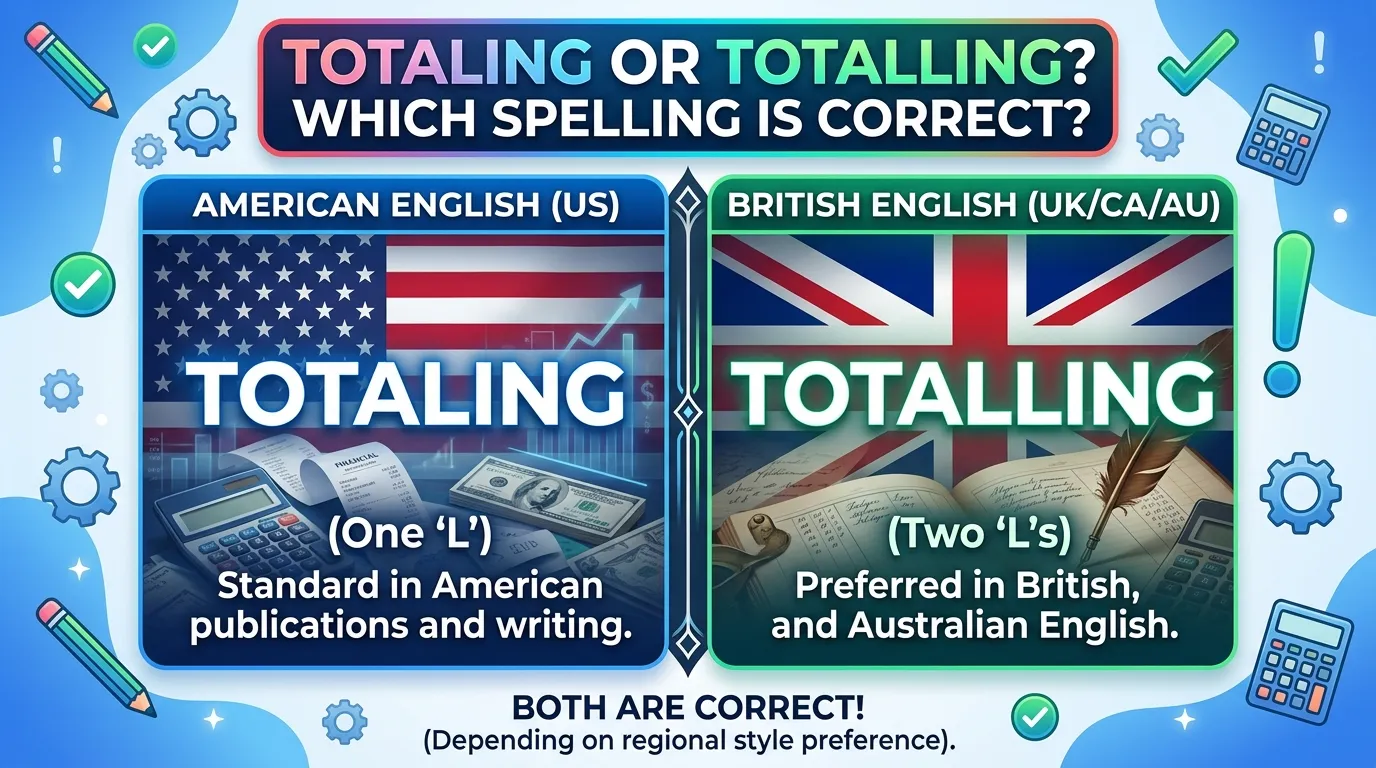
Have you ever wondered whether you should write totaling or totalling? You’re not alone. Many English learners, students, professionals, and even native speakers search for the difference between Totaling or Totalling because both spellings appear in books, websites, and official documents. The good news is that both spellings are correct, but the right choice depends on whether you’re using American English or British English.
The confusion happens because American and British English follow different spelling rules for verbs ending in a vowel followed by a consonant before adding -ing. If you’re writing for a US audience, you’ll usually see totaling. If you’re writing for readers in the UK, Australia, New Zealand, or many other Commonwealth countries, you’ll usually see totalling.
In this guide, you’ll learn the Totaling or Totalling meaning, grammar rules, pronunciation, origins, examples, synonyms, common mistakes, memory tricks, and much more. By the end, you’ll know exactly which spelling to use in every situation.
Quick Answer
✅ American English: Totaling
✅ British English: Totalling
❌ Neither spelling is universally incorrect.
✔ Use totaling when writing in US English.
✔ Use totalling when writing in UK English.
What Does Totaling or Totalling Mean?
Both totaling and totalling are the present participle and gerund forms of the verb total.
They mean:
- Adding numbers together
- Reaching a final amount
- Coming to a complete sum
- Equaling a specific value
Grammatical Role
The word can function as:
- Present participle
- Gerund
- Part of a continuous verb tense
Examples:
- We are totaling the expenses.
- She spent the afternoon totalling the receipts.
Why Are There Two Spellings?
The difference comes from spelling conventions.
American English Rule
American English usually does not double the final consonant when the last syllable is unstressed.
Example:
- travel → traveling
- cancel → canceling
- total → totaling
British English Rule
British English often doubles the final L before adding -ing.
Example:
- travel → travelling
- cancel → cancelling
- total → totalling
This is why both spellings exist.
Quick Comparison Table
| Feature | Totaling | Totalling |
|---|---|---|
| Meaning | Adding to a total | Adding to a total |
| Grammar | Present participle | Present participle |
| US English | Preferred | Rare |
| UK English | Less common | Preferred |
| Dictionaries | Merriam-Webster | Oxford, Cambridge |
| Pronunciation | Same | Same |
| Formal Writing | Yes | Yes |
| Informal Writing | Yes | Yes |
Pronunciation Guide (IPA)
Both words are pronounced exactly the same.
| Word | IPA (US) | IPA (UK) |
|---|---|---|
| Totaling | /ˈtoʊtəlɪŋ/ | /ˈtəʊtəlɪŋ/ |
| Totalling | /ˈtoʊtəlɪŋ/ | /ˈtəʊtəlɪŋ/ |
Notice that the spelling changes, but the pronunciation does not.
Why Are Totaling and Totalling Commonly Confused?
People become confused because:
- Both spellings are correct.
- Search engines show both versions.
- Different countries teach different spelling rules.
- International companies use both.
- Spellcheck changes words depending on language settings.
If your device is set to US English, it may flag totalling.
If it’s set to UK English, it may flag totaling.
Grammar Rule Behind the Correct Usage
The key rule involves doubling the final consonant.
In American English:
If the final syllable is not stressed, don’t double the consonant.
Example:
- total → totaling
In British English:
Words ending in L often double the L before adding endings.
Example:
- total → totalling
This same rule appears in:
- traveling / travelling
- canceled / cancelled
- fueling / fuelling
- signaling / signalling
Parts of Speech
Verb
- They are totaling the sales.
Present Participle
- The manager is totaling the invoices.
Gerund
- Totalling expenses takes time.
American English Examples
Here are ten Totaling examples in American English.
- We are totaling the sales report.
- The expenses are totaling over $5,000.
- She is totaling today’s receipts.
- They’re totaling the budget.
- The damages are totaling nearly $2 million.
- We spent an hour totaling invoices.
- He’s totaling every payment.
- The costs are totaling more than expected.
- We’re totaling last month’s profits.
- The accountant finished totaling the numbers.
British English Examples
Here are ten Totalling examples in British English.
- She is totalling the receipts.
- The repairs are totalling £2,000.
- We’re totalling today’s expenses.
- He’s totalling every invoice.
- The bill is totalling over £300.
- They spent hours totalling accounts.
- The losses are totalling millions of pounds.
- We are totalling all school fees.
- She’s totalling the rent payments.
- The office is totalling quarterly expenses.
American English vs British English Examples
American English
- The invoice is totaling $450.
- We’re totaling today’s income.
- She’s totaling all customer orders.
- The project is totaling six months.
- They’re totaling payroll records.
British English
- The invoice is totalling £450.
- We’re totalling today’s income.
- She’s totalling customer orders.
- The project is totalling six months.
- They’re totalling payroll records.
Why Some People Think One Spelling Is Wrong
Many people assume one version is incorrect because:
- They learned only American English.
- Their spellchecker flags the other spelling.
- Online dictionaries differ.
- Schools teach regional spelling rules.
In reality, both spellings are accepted.
Incorrect and Correct Examples
Incorrect (US Style)
❌ We are totalling the expenses.
Correct
✅ We are totaling the expenses.
Incorrect (UK Style)
❌ We are totaling the expenses.
Correct
✅ We are totalling the expenses.
Word Origins and Etymology
The word total comes from the Medieval Latin word totalis, meaning entire or whole.
It entered English through French during the 16th century.
Later, English speakers created the verb to total, meaning:
- calculate the sum
- add everything together
As English developed differently in Britain and America, spelling rules also changed.
American English simplified many spellings.
British English kept the traditional practice of doubling the letter L.
Totaling or Totalling Synonyms
| Synonym | American English | British English | Best Use |
|---|---|---|---|
| Adding | Yes | Yes | General |
| Summing | Yes | Yes | Mathematics |
| Calculating | Yes | Yes | Formal |
| Counting | Yes | Yes | Informal |
| Computing | Yes | Yes | Technical |
| Equaling | Yes | Yes | Totals |
| Accumulating | Yes | Yes | Finance |
| Combining | Yes | Yes | General |
Preferred Synonyms
American English often prefers:
- calculating
- adding
- totaling
British English commonly uses:
- calculating
- totalling
- adding
Real-Life Usage Examples
Emails
We are totaling all travel expenses before reimbursement.
We are totalling all travel expenses before reimbursement.
Banking
The deposits are totaling $12,000.
The deposits are totalling £12,000.
Office
She’s totaling the quarterly budget.
He’s totalling the expense reports.
Schools
Students are totaling their math scores.
Pupils are totalling examination marks.
Invoices
The invoice is totaling $980.
The invoice is totalling £980.
Rent Payments
We’re totaling rent collected this month.
We’re totalling monthly rent payments.
Social Media
Our fundraiser is totaling over 10,000 likes.
The campaign is totalling thousands of shares.
Everyday Conversation
I’m just totaling everything now.
She’s totalling the shopping bill.
Common Mistakes
Using UK spelling in US documents
❌ totalling
✅ totaling
Using US spelling in UK reports
❌ totaling
✅ totalling
Mixing spellings in one article
Choose one style and stay consistent.
Assuming one spelling is incorrect
Both are correct.
Ignoring audience location
Always write for your readers.
Trusting spellcheck blindly
Spellcheck follows your language settings.
Confusing spelling with pronunciation
Both words sound exactly the same.
Related Words
| American | British |
|---|---|
| totaling | totalling |
| totaled | totalled |
| traveler | traveller |
| traveling | travelling |
| canceled | cancelled |
| canceling | cancelling |
| fueling | fuelling |
These pairs follow similar spelling rules.
Five Memory Tricks
1. Think About Your Audience
US readers → totaling
UK readers → totalling
2. Remember the Double L Rule
British English loves double L.
3. Link It with Traveling
traveling → totaling
travelling → totalling
4. Check Your Keyboard Language
US keyboard = totaling
UK keyboard = totalling
5. Stay Consistent
Pick one spelling style and use it throughout your document.
Frequently Asked Questions
Is totaling or totalling correct?
Both are correct. American English prefers totaling, while British English prefers totalling.
What is the meaning of totaling?
It means adding numbers together or reaching a final amount.
What is the meaning of totalling?
It has exactly the same meaning as totaling.
Which spelling do dictionaries recommend?
American dictionaries such as Merriam-Webster usually list totaling.
British dictionaries such as Oxford and Cambridge generally prefer totalling.
Is totaling formal?
Yes. It is suitable for business, education, accounting, banking, and official writing.
Is totalling formal?
Yes. It is equally formal in British English.
Is there a pronunciation difference?
No.
Only the spelling changes.
Which spelling should ESL learners use?
Choose the spelling that matches the English variety you are studying.
Is totaling used in accounting?
Yes.
Accountants frequently use the word when adding expenses, invoices, and financial records.
People Also Ask
Is totaling a real word?
Yes. It is the standard American English spelling.
Is totalling accepted?
Yes. It is the preferred British English spelling.
Why does British English use two Ls?
British spelling usually doubles L before adding -ing and -ed.
Can I use both spellings in one document?
No. Choose one spelling style and remain consistent.
Which spelling is better for international writing?
Follow the style guide required by your audience, employer, publisher, or school.
Conclusion
The debate over Totaling or Totalling is not about right versus wrong—it is about US English versus UK English. If you write for an American audience, use totaling. If your readers are in the United Kingdom or other regions that follow British English conventions, use totalling. Both words share the same pronunciation, meaning, and grammatical role. The only difference is the spelling convention adopted by each variety of English.
When in doubt, think about your audience, check your style guide, and stay consistent throughout your writing. Whether you’re preparing invoices, balancing accounts, writing emails, creating reports, or completing school assignments, using the correct regional spelling will make your writing look polished and professional. With the grammar rules, pronunciation tips, examples, comparison tables, and memory tricks in this guide, you can confidently choose the right form every time.