Have you ever stopped while writing and wondered whether you should use everyday or every day? You are not alone. This is one of the most common grammar questions in English. Many native speakers, students, professionals, and English learners confuse these two forms because they look almost identical. However, they have different meanings and different grammar rules.
The good news is that the difference between everyday or every day is actually very simple once you understand it. One form describes something ordinary, while the other talks about something happening daily. Knowing when to use each one will make your writing clearer and more professional.
In both American English and British English, the grammar rule is the same. There is no major difference between the UK and US in how these expressions are used. The only differences you might notice are in the examples and vocabulary surrounding them.
This complete guide explains the everyday or every day meaning, grammar difference, pronunciation, examples, common mistakes, memory tricks, and real-life usage so you can confidently choose the correct form every time.
Quick Answer
| Form | Correct? | Meaning |
|---|---|---|
| ✅ Everyday | Correct | An adjective meaning ordinary, common, or typical. |
| ✅ Every day | Correct | An adverbial phrase meaning each day or daily. |
| ❌ Use everyday when you mean daily | Incorrect | Wrong because everyday cannot replace every day. |
| ❌ Use every day before a noun | Incorrect | Wrong because every day cannot describe a noun directly. |
Simple Rule
- Everyday = ordinary
- Every day = each day
What Does Everyday Mean?
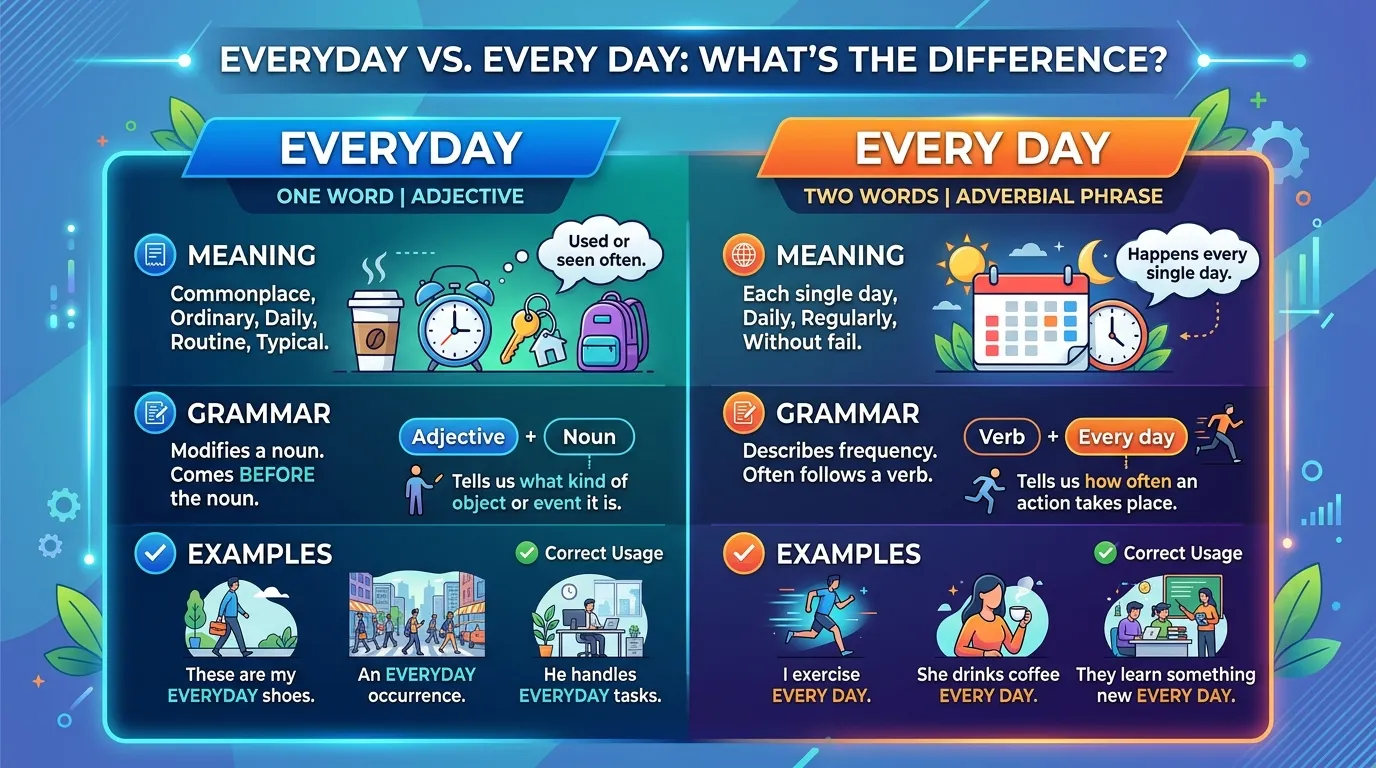
Everyday is an adjective.
It describes something that is normal, common, or used regularly. It comes before a noun.
Grammar Role
- Part of speech: Adjective
- Function: Describes a noun
- Meaning: Ordinary, typical, routine
Examples in American English
- She wears everyday clothes to work.
- These are my everyday shoes.
- Coffee is an everyday habit for millions of Americans.
- This laptop is perfect for everyday use.
- We discussed everyday problems.
- His watch is suitable for everyday wear.
- They sell affordable everyday products.
- Good communication is an everyday skill.
- This is an everyday occurrence.
- The backpack is made for everyday life.
Examples in British English
- These are my everyday trainers.
- She carries an everyday handbag.
- Tea is part of everyday British life.
- He prefers everyday clothing.
- The shop sells everyday essentials.
- The newspaper covers everyday issues.
- They discussed everyday concerns.
- It’s suitable for everyday driving.
- This is an everyday situation.
- We need practical solutions for everyday living.
What Does Every Day Mean?
Every day is a two-word phrase.
It means each day or daily.
It tells us when something happens rather than describing a noun.
Grammar Role
- Part of speech: Adverbial phrase
- Meaning: Daily or each day
- Function: Modifies verbs
American English Examples
- I exercise every day.
- She calls her parents every day.
- They check their emails every day.
- We drink coffee every day.
- The bus arrives every day at eight.
- He studies English every day.
- I read the news every day.
- She walks to work every day.
- We practice piano every day.
- They open the store every day.
British English Examples
- I walk to the station every day.
- She drinks tea every day.
- We use the Underground every day.
- The post arrives every day.
- He cycles to university every day.
- They visit the market every day.
- Children learn something new every day.
- She reads the paper every day.
- We cook dinner every day.
- The office is open every day.
Why Is “Everyday” Often Confused with “Every Day”?
People confuse them because they sound exactly the same.
However, they have different grammar jobs.
| Everyday | Every Day |
|---|---|
| One word | Two words |
| Adjective | Adverbial phrase |
| Means ordinary | Means each day |
| Describes nouns | Describes actions |
Easy Test
Replace it with ordinary.
If it works, use everyday.
Example:
- Everyday clothes
- Ordinary clothes ✅
Replace it with each day.
If it works, use every day.
Example:
- I study every day.
- I study each day. ✅
Everyday vs Every Day Comparison Table
| Feature | Everyday | Every Day |
|---|---|---|
| Meaning | Ordinary | Each day |
| Grammar | Adjective | Adverbial phrase |
| Number of words | One | Two |
| Describes | Nouns | Verbs |
| Example | Everyday shoes | I walk every day |
| Formal writing | Yes | Yes |
| Informal writing | Yes | Yes |
| UK English | Same | Same |
| US English | Same | Same |
Pronunciation Guide
| Word | IPA (US) | IPA (UK) |
|---|---|---|
| Everyday | /ˈevri.deɪ/ | /ˈev.ri.deɪ/ |
| Every day | /ˈevri deɪ/ | /ˈev.ri deɪ/ |
Why They Sound the Same
Although one is written as one word and the other as two words, they are pronounced almost identically. That is why many people make spelling mistakes while writing.
Word Origins and Etymology
Everyday
The adjective everyday developed by combining every and day into one compound word. English often joins frequently used words together to create adjectives.
Examples include:
- everyday
- lifelong
- worldwide
Its meaning gradually changed to describe something ordinary or routine.
Every Day
The phrase every day has existed for centuries.
It simply combines:
- every
- day
Together they mean each individual day.
The phrase has always expressed frequency rather than description.
Grammar Rule Explained Simply
Remember this basic grammar rule.
Everyday
- Adjective
- Comes before nouns
Examples:
- everyday routine
- everyday problems
- everyday clothing
Every Day
- Time expression
- Answers the question When?
Examples:
- I study every day.
- She exercises every day.
Incorrect Usage and Corrections
Incorrect
❌ I go jogging everyday.
Correct
✅ I go jogging every day.
Incorrect
❌ I bought every day shoes.
Correct
✅ I bought everyday shoes.
Incorrect
❌ She practices piano everyday after school.
Correct
✅ She practices piano every day after school.
Incorrect
❌ We discussed every day problems.
Correct
✅ We discussed everyday problems.
Synonyms
Synonyms for Everyday
| Synonym | American English | British English |
|---|---|---|
| Ordinary | Very common | Very common |
| Common | Very common | Very common |
| Typical | Very common | Very common |
| Routine | Common | Common |
| Regular | Common | Common |
| Standard | Common | Common |
| Normal | Very common | Very common |
Synonyms for Every Day
| Synonym | Usage |
|---|---|
| Daily | Very common |
| Each day | Formal and informal |
| Every single day | Emphasis |
| On a daily basis | Formal |
| Day after day | Continuous repetition |
Seven Common Mistakes
Confusing one word with two words
Wrong:
- I exercise everyday.
Correct:
- I exercise every day.
Using every day before a noun
Wrong:
- Every day clothes
Correct:
- Everyday clothes
Thinking pronunciation changes spelling
The pronunciation is almost identical, but the grammar changes the spelling.
Assuming UK English is different
The grammar rule is exactly the same.
Using everyday after verbs
Wrong:
- She studies everyday.
Correct:
- She studies every day.
Forgetting the adjective rule
Adjectives describe nouns.
Remember:
- everyday backpack
Ignoring the “ordinary” test
If ordinary fits, use everyday.
Real-Life Examples
Emails
- Please complete the report every day.
- Use your everyday email account.
Office
- This software supports everyday tasks.
- Employees attend meetings every day.
Banking
- Check your account every day.
- These are everyday banking services.
Invoices
- Process invoices every day.
- The software manages everyday accounting.
School
- Students read every day.
- Homework is an everyday responsibility.
Social Media
- She posts every day.
- They share everyday moments online.
Rent Payments
- Check your payment portal every day.
- Budgeting is an everyday habit.
Everyday Conversations
- I walk my dog every day.
- These are my everyday glasses.
Everyday vs Daily
Many learners ask whether daily and every day are the same.
| Everyday | Every Day | Daily |
|---|---|---|
| Ordinary | Each day | Each day |
| Adjective | Phrase | Adjective or adverb |
| Everyday clothes | I exercise every day | Daily exercise |
Five Memory Tricks
Think “ordinary”
If you can replace it with ordinary, choose everyday.
Think “each day”
If you can replace it with each day, choose every day.
Count the words
One word equals adjective.
Two words equal time.
Look for the noun
If a noun follows, everyday is often correct.
Ask “When?”
If the phrase answers when, use every day.
Frequently Asked Questions
Is everyday one word or two?
Both are correct, but they have different meanings.
What does everyday mean?
It means ordinary, common, or typical.
What does every day mean?
It means each day or daily.
Is everyday an adjective?
Yes. It describes nouns.
Is every day an adverb?
It is an adverbial phrase that describes when something happens.
Which form is used in American English?
Both forms are used with the same grammar rules.
Which form is used in British English?
British English follows exactly the same rule.
Which dictionaries recognize both?
Major dictionaries, including Oxford, Cambridge, Merriam-Webster, and Collins, recognize both forms with their separate meanings.
Is every day formal?
Yes. It is correct in both formal and informal writing.
Can everyday replace daily?
Not always.
- Everyday means ordinary.
- Daily means each day.
People Also Ask
Is it everyday life or every day life?
The correct phrase is everyday life because everyday describes the noun life.
Is it every day or everyday at work?
If you mean something happens daily, write every day.
How do I remember the difference?
Use the ordinary test and the each day test.
Can everyday be used after a verb?
Usually no. Use every day after verbs when talking about frequency.
Is everyday informal?
No. It is perfectly acceptable in formal and professional writing.
Conclusion
Understanding the difference between everyday and every day is easier than it first appears. The key is to remember that everyday is an adjective meaning ordinary, typical, or common, while every day is a two-word phrase meaning each day or daily. This grammar rule is the same in both American English and British English, making it a reliable guideline wherever you write.
Whenever you are unsure, use the simple memory tests from this guide. If you can replace the word with ordinary, choose everyday. If you can replace it with each day, choose every day. With regular practice and real-life examples, this common grammar confusion will quickly become a thing of the past. Whether you are writing emails, school assignments, business reports, or social media posts, using the correct form will make your English more accurate, natural, and professional.