The oral-history interview had been going for an hour when the archivist asked the question she always asked. “When did it begin?” she said. The old man smiled. “It began the day the factory closed,” he said. “And once it had begun, there was no stopping it.” The archivist nodded and made a note — not about the factory, but about the verbs. In two sentences, the man had used both forms of begin correctly, and he had done it without thinking. Began stood alone, marking a moment in the past. Begun leaned on its helper, had, marking something completed before another past moment. The difference between began and begun is one of the most commonly confused pairs in English, and it is also one of the simplest — once you see that one of them can stand alone and the other cannot.
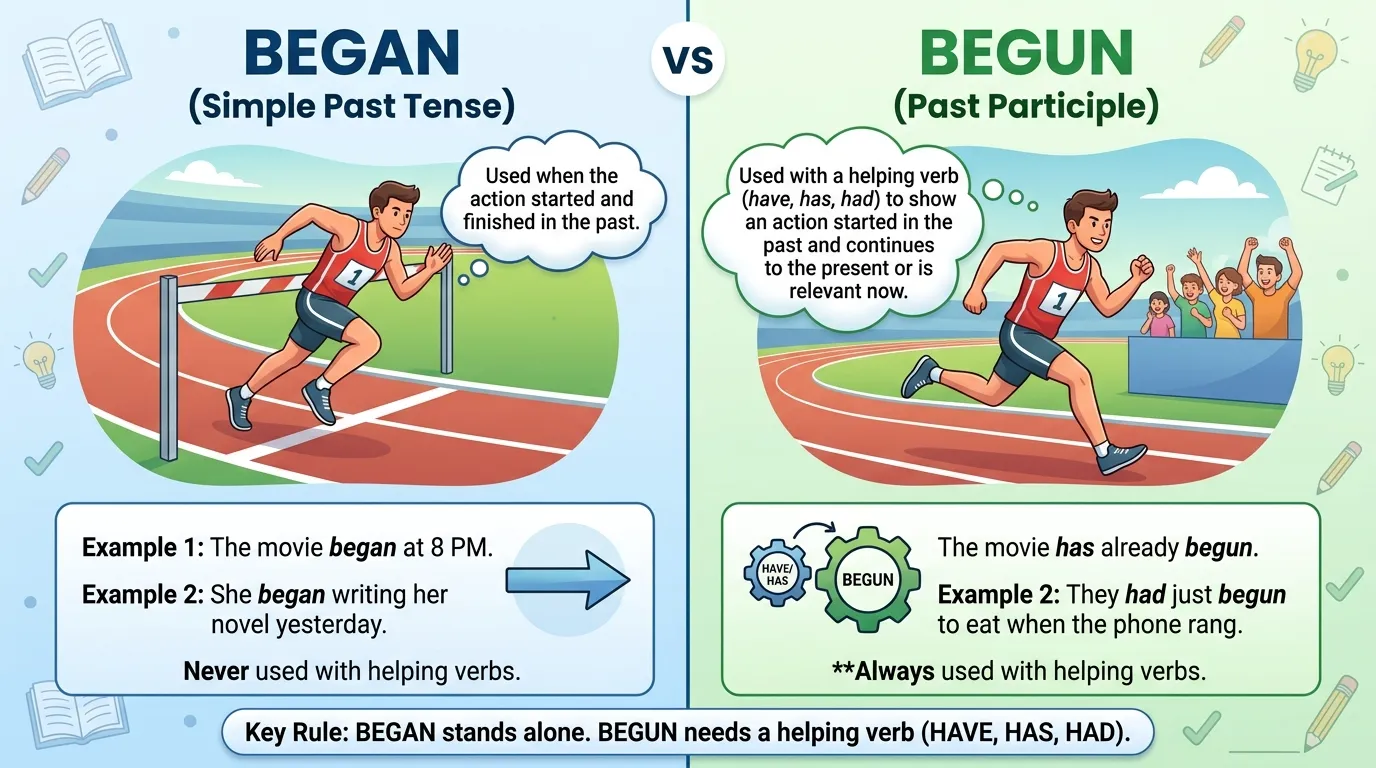
The rule: began is the simple past tense of begin. It stands alone. Begun is the past participle of begin. It never stands alone — it always appears with a helping verb: has, have, had, is, was, will have, or a similar helper. “It began yesterday.” “It has begun.” “It had begun before noon.” Swap them — “It begun yesterday,” “It has began” — and the sentence breaks. The two forms look like twins. They are not. One is independent. The other needs company.
The First Question on the Tape
The archivist’s question — “When did it begin?” — contains the base form, begin, because the helper did carries the past tense. “When did it begin?” “It began in 1974.” The question uses begin; the answer uses began. This is the ordinary pattern of English questions and answers: the question puts the tense on the helper, and the answer puts the tense on the verb. The man’s answer was correct because it followed the pattern: a finished moment in the past, named with the simple past.
The interview format matters, because oral history is where this pair lives most vividly. People telling their own stories use the past tenses constantly, and they use them correctly by ear, without thinking about grammar. “We began the march at dawn.” “The trouble had begun weeks earlier.” “She began to cry.” “It had not yet begun.” The ear knows the difference even when the mind does not. The writer’s problem is the opposite: on the page, without the rhythm of speech to guide them, the two forms look interchangeable, and the writer reaches for the wrong one.
Began Stands Alone
Began is the simple past. It describes an action that started and happened at a specific time in the past, and it needs no helper. “The meeting began at nine.” “She began her career in 1998.” “The rain began after midnight.” “They began building the house in June.” In each sentence, began is the only verb, it carries the past tense by itself, and the sentence is complete.
The simple past is the tense of the timeline. It puts events in order: first this, then that. “The factory closed. The strike began. The town changed.” Three events, three simple pasts, one sequence. Began belongs to this timeline mode. When you are narrating — telling what happened, in order — began is the form you want. It is the workhorse of stories, histories, biographies, and news reports, because stories are told in sequence, and sequence is the simple past’s job.
There is a common error to avoid with began: doubling the past tense. “Did you began?” is wrong — the helper did already carries the past, so the verb returns to its base form: “Did you begin?” Similarly, “It didn’t began” is wrong; “It didn’t begin” is right. The rule is that a sentence carries its past tense once. If the helper has it, the verb does not. If the verb has it — began — there is no helper. This is the same rule that governs every irregular verb: “Did you go?” not “Did you went?” “She didn’t see” not “She didn’t saw.” Began is not special here. It follows the universal pattern.
Begun Needs a Helper
Begun is the past participle. It cannot stand alone as the main verb of a sentence. It must appear with a helping verb, and the helper determines the tense. With has or have, it forms the present perfect: “It has begun.” “They have begun the project.” With had, it forms the past perfect: “It had begun before we arrived.” “She had begun to worry.” With will have, it forms the future perfect: “By June, they will have begun construction.” With is or was, it can form a passive: “The work was begun in 1998” — formal, slightly old-fashioned, but correct.
The perfect tenses do a different job from the simple past. They do not put events in a sequence. They connect a past event to another time: the present perfect connects it to now (“It has begun” — it is underway), the past perfect connects it to a later past moment (“It had begun before we arrived” — it was already underway when we got there), the future perfect connects it to a future moment (“It will have begun by June”). Begun belongs to this connecting mode. When you are relating a past event to another time, begun with its helper is the form you want.
The most common error with begun is using it without a helper: “It begun yesterday.” “The meeting begun at nine.” “She begun her career in 1998.” All wrong. The fix is to add the helper or switch to began: “It had begun yesterday” or “It began yesterday.” The second error is using began with a helper: “It has began.” “They have began the project.” “It had began before noon.” All wrong. The fix is to swap in begun: “It has begun.” The two errors are mirror images, and they come from the same confusion: treating the two forms as interchangeable. They are not. One needs a helper. The other forbids one.
The Tape Rewound: Common Errors
Listen to the interview tape again, this time for the mistakes that even fluent speakers make. The first is the double past: “I had began to worry.” Wrong — had plus begun. The second is the bare participle: “The trouble begun before anyone noticed.” Wrong — begun with no helper, or began alone. The third is the question form: “Has the meeting began?” Wrong — has plus begun: “Has the meeting begun?” The fourth is the negative: “It hasn’t began yet.” Wrong — “It hasn’t begun yet.” Every one of these errors follows the same pattern: the helper and the verb disagree about who carries the tense.
There is also a subtler error that appears in writing but rarely in speech: using began where the perfect is needed for meaning. “The project began before we arrived” is grammatically correct, but it says something slightly different from “The project had begun before we arrived.” The first puts the project’s beginning in the same timeline as our arrival — a sequence. The second puts the beginning before our arrival, with the emphasis on the project’s already-underway state when we got there. Both are correct sentences. The choice is about meaning, not grammar, and it is the kind of choice that separates careful writers from careless ones.
Begin, Began, Begun — The Full Set
The verb’s full set is short, and it is worth memorizing as a set: begin, begins, began, begun, beginning. Base: begin. Third-person singular present: begins — “She begins work at eight.” Simple past: began — “She began work at eight yesterday.” Past participle: begun — “She has begun work.” Present participle: beginning — “She is beginning work now.” Five forms, one pattern, no exceptions.
Begin belongs to a family of verbs that follow the same i-a-u vowel pattern: sing, sang, sung; swim, swam, swum; ring, rang, rung; drink, drank, drunk; sink, sank, sunk; spring, sprang, sprung; stink, stank, stunk. The pattern is old — it goes back to the Germanic strong verbs — and it is one of the most reliable in English. If you know sing, sang, sung, you know begin, began, begun. The vowel moves from i to a to u, and the pattern holds across the whole family. The family is also a memory tool: when you are unsure about begun, think of sung. You would never write “I have sang.” You would write “I have sung.” The same ear that knows sung knows begun.
Start vs Begin
Begin has a near-synonym, start, and the two are interchangeable in most sentences — “Let’s begin” and “Let’s start” mean the same thing. But start is regular: start, started, started. It has no began/begun split, and that regularity is why some writers prefer it. There is no error in preferring start. But begin carries a slightly more formal register, and it appears in fixed phrases where start sounds wrong: “to begin with,” “the beginning of the end,” “charity begins at home,” “a new beginning.” In those phrases, begin is not interchangeable. It is the phrase itself.
There is also a difference in nuance. Start suggests setting something in motion — starting an engine, starting a race. Begin suggests entering a process — beginning a book, beginning a career, beginning a conversation. The difference is small, and most sentences tolerate either. But in the interview’s language — “When did it begin?” — begin is the natural choice, because the question is about a process entering a life, not a machine being switched on. The verb’s irregularity is part of its character. It is an old word, and it behaves like one.
The Helper Test
Back to the archivist’s tape. The old man said two sentences: “It began the day the factory closed.” “Once it had begun, there was no stopping it.” The first has no helper, so the verb stands alone: began. The second has the helper had, so the verb takes its participle form: begun. The test is that simple. Look at your sentence. Is there a helping verb — has, have, had, is, was, will have — before the verb? If yes, write begun. If no, write began. The helper test never fails, because it is not a trick. It is the grammar, stated as a question, and the old man on the tape answered it correctly without ever having heard of it.