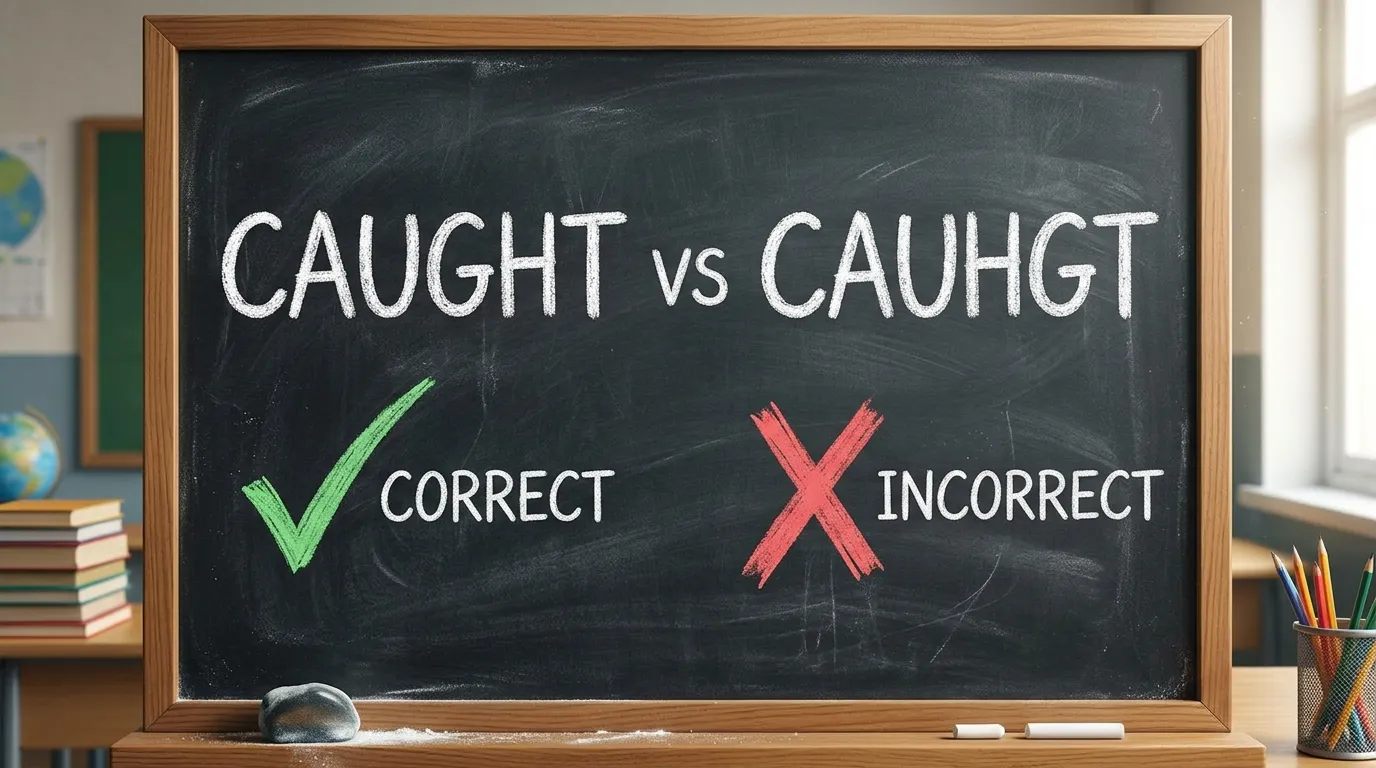
Have you ever typed “cauhgt” instead of “caught” and wondered which spelling is correct? You are not alone. The two forms look surprisingly similar, especially when typing quickly, but there is an important difference: caught is the correct English word, while cauhgt is a misspelling.
The word caught is the past tense and past participle of catch. It can mean successfully grabbing something, stopping someone, being discovered, experiencing something unexpectedly, or becoming affected by a condition or situation.
In this guide, you will learn the difference between caught vs cauhgt, why this spelling mistake happens, how to pronounce caught, how to use it correctly, common expressions, examples, synonyms, word history, regional usage, and easy ways to remember the correct spelling.
Quick Answer: Caught vs Cauhgt
Caught is correct. Cauhgt is incorrect.
| Spelling | Correct? | Meaning |
|---|---|---|
| caught | ✅ Yes | Past tense and past participle of catch |
| cauhgt | ❌ No | Common misspelling of caught |
Correct examples
- I caught the ball.
- She caught the bus.
- The police caught the thief.
- He was caught cheating.
- We caught a cold.
- I caught the last train home.
Incorrect example
- I cauhgt the ball. ❌
The correct sentence is:
- I caught the ball. ✅
The key point is simple: always spell the word C-A-U-G-H-T: caught.
What Does “Caught” Mean?
Caught is the past tense and past participle of the irregular verb catch.
The basic forms are:
- Present: catch
- Past: caught
- Past participle: caught
- -ing form: catching
For example:
I catch the ball every afternoon.
becomes:
I caught the ball yesterday.
And:
I have caught the ball many times.
Unlike regular verbs such as walk → walked, the verb catch changes its form completely in the past tense.
Dictionary-style definition of “caught”
Caught can mean:
- Successfully grabbed or stopped something
- She caught the ball.
- Captured or arrested someone
- The police caught the suspect.
- Discovered someone doing something
- He was caught cheating.
- Reached or boarded something
- We caught the early train.
- Became affected by an illness
- She caught a cold.
- Experienced or encountered something
- We caught a glimpse of the mountain.
- Understood or heard something
- Sorry, I didn’t catch what you said.
- Became trapped or stuck
- My sleeve caught on the door.
Because caught has many meanings, it is an extremely common word in everyday English.
Is “Cauhgt” a Word?
No. Cauhgt is not a standard English word.
It is usually a typing or spelling error caused by rearranging the letters in caught.
The correct spelling is:
C-A-U-G-H-T
The incorrect spelling is:
C-A-U-H-G-T
Notice the position of G and H.
Correct
caught
Incorrect
cauhgt
The letters GH appear in the correct spelling before T, while cauhgt incorrectly places the H before the G.
You may occasionally see cauhgt in:
- Text messages
- Social media posts
- Online comments
- Informal chats
- Fast typing
- User-generated content
However, seeing a misspelling online does not make it an accepted spelling.
For school, work, business, academic writing, journalism, blogging, or professional communication, use caught.
Why Do People Confuse “Caught” and “Cauhgt”?
The confusion usually comes from the unusual spelling of caught.
English spelling can be difficult because letters do not always appear in the order that speakers expect.
The sequence -aught can be especially confusing.
For example:
- caught
- taught
- bought
- thought
When typing caught quickly, someone may accidentally switch the g and h, producing:
cauhgt
This is a common type of transposition error, where two letters are accidentally reversed.
The visual problem
When you look at these two words quickly:
caught
cauhgt
they can appear almost identical.
But only one is standard English:
caught
Caught vs Cauhgt: The Key Difference
The main difference is correctness, not meaning.
| Feature | Caught | Cauhgt |
|---|---|---|
| Standard English word | Yes | No |
| Correct spelling | Yes | No |
| Past tense of catch | Yes | No |
| Past participle of catch | Yes | No |
| Used in formal writing | Yes | No |
| Used in academic writing | Yes | No |
| Used in professional writing | Yes | No |
| Acceptable in standard American English | Yes | No |
| Acceptable in standard British English | Yes | No |
There is no separate meaning attached to cauhgt.
If you intend to write the past tense of catch, the correct word is always caught.
How to Pronounce “Caught”
In American English, caught is commonly pronounced approximately like:
/kɔːt/
For many American speakers, it sounds similar to “cot,” although pronunciation varies by regional accent.
The word has one syllable:
caught
It rhymes with words such as:
- bought
- fought
- taught
- thought
Depending on the speaker’s accent, caught may have a slightly different vowel sound.
Example
I caught the ball.
The pronunciation does not change because the word is used as a past tense or past participle.
Is “Caught” Formal or Informal?
Caught is neutral.
It works in virtually every variety of English and in both casual and formal contexts.
Casual
I caught the bus.
Professional
The security system caught the unauthorized access attempt.
Academic
The researcher was caught by an unexpected limitation in the experimental design.
Journalistic
Police caught the suspect after a brief search.
Business
We caught the error before the report was published.
You do not need to replace caught with a more formal word simply because you are writing professionally.
However, depending on the context, alternatives such as detected, captured, identified, or intercepted may be more precise.
Grammatical Role of “Caught”
Caught has two primary grammatical roles.
1. Past Tense
It describes an action that happened in the past.
I caught the train yesterday.
She caught the ball.
They caught the thief.
2. Past Participle
It is also used with helping verbs such as have, has, had, and in passive constructions.
Present perfect
I have caught the mistake.
Past perfect
She had caught the ball before I arrived.
Passive voice
The thief was caught by the police.
So, caught is both the simple past form and the past participle of catch.
Caught in Different Contexts
One reason caught is so useful is that its meaning changes depending on context.
Caught a Ball
This means successfully grabbed a moving ball.
Maria caught the ball with one hand.
He caught the football before it hit the ground.
Caught a Bus or Train
Here, caught means successfully reached and boarded public transportation.
I caught the 8 a.m. bus.
We barely caught the train.
The expression is especially common in American and British English.
Caught Someone
This can mean captured or arrested someone.
The police caught the suspect.
It can also mean discovering someone doing something wrong.
She caught her son taking cookies from the kitchen.
Caught Cheating
This means someone was discovered while cheating.
The student was caught cheating on the exam.
This is a common passive construction.
Caught a Cold
Here, caught means became infected with an illness.
I caught a cold last week.
Although people often say caught a cold, they may also say:
I got a cold.
Both are natural.
Caught a Glimpse
This means briefly saw something.
I caught a glimpse of the sunset through the trees.
Caught Your Attention
This means something attracted your attention.
Her unusual painting caught my attention.
Caught Fire
This means something began burning.
The old building caught fire during the night.
Caught in the Rain
This means someone unexpectedly experienced rain while outside.
We got caught in the rain on our way home.
Common Collocations With “Caught”
A collocation is a group of words that naturally appear together.
Here are some common combinations with caught:
- caught a ball
- caught a bus
- caught a train
- caught a flight
- caught a cold
- caught the flu
- caught fire
- caught attention
- caught sight of
- caught a glimpse of
- caught someone lying
- caught someone cheating
- caught in traffic
- caught in the rain
- caught off guard
- caught red-handed
- caught between
- caught up in
- caught by surprise
- caught in a trap
Learning these combinations can make your English sound more natural.
Common Phrases and Idioms With “Caught”
Caught Red-Handed
This means someone was discovered while doing something wrong.
The thief was caught red-handed.
Caught Off Guard
This means someone was surprised and unprepared.
The unexpected question caught me off guard.
Caught by Surprise
This means something happened unexpectedly.
The sudden announcement caught everyone by surprise.
Caught Between Two Choices
This describes being stuck between two options.
I’m caught between two job offers.
Caught Up In Something
This can mean becoming deeply involved in something.
She became caught up in the excitement.
It can also mean becoming involved in an unpleasant situation.
He was caught up in the investigation.
Caught in the Act
This means discovered while doing something wrong.
He was caught in the act of stealing.
Caught Someone’s Eye
This means something attracted someone’s attention.
The bright advertisement caught my eye.
Caught vs Catched: Another Common Mistake
People sometimes assume that because catch is a verb, its past tense should be catched.
That is incorrect.
The correct forms are:
catch → caught → caught
Not:
catch → catched ❌
For example:
I caught the ball. ✅
Not:
I catched the ball. ❌
This is an example of an irregular verb.
Caught vs Catch: What’s the Difference?
Catch is the present form.
Caught is the past form and past participle.
| Present | Past |
|---|---|
| I catch the ball. | I caught the ball. |
| She catches the bus. | She caught the bus. |
| They catch fish. | They caught fish. |
| We catch mistakes. | We caught several mistakes. |
Present example
I usually catch the train at seven.
Past example
I caught the train at seven yesterday.
The time of the action usually tells you which form you need.
Caught vs Caught Up
These expressions are related but have different meanings.
Caught
I caught the ball.
This describes capturing or grabbing something.
Caught up
I caught up with my work.
This can mean reaching the same level as someone or completing delayed work.
Another example:
She got caught up in the story.
Here, caught up in means deeply involved or absorbed.
Caught vs Got: Are They Interchangeable?
Not always.
Sometimes got and caught can express similar ideas, but their meanings are not identical.
Illness
I caught a cold.
I got a cold.
Both can be natural.
Transportation
I caught the bus.
You generally would not replace this directly with:
I got the bus.
In American English, I took the bus or I got on the bus may be more natural depending on the intended meaning.
Discovering someone
The teacher caught him cheating.
You cannot simply say:
The teacher got him cheating.
The meaning changes.
Therefore, choose caught when the context specifically involves the verb catch.
Synonyms for “Caught”
The best synonym depends on the meaning.
When “caught” means captured
Possible alternatives include:
- captured
- seized
- arrested
- apprehended
- trapped
- detained
Example:
The police caught the suspect.
More formal:
The police apprehended the suspect.
When “caught” means noticed
Possible alternatives include:
- noticed
- detected
- discovered
- observed
- identified
Example:
She caught the mistake.
Alternative:
She detected the mistake.
When “caught” means grabbed
Possible alternatives include:
- grabbed
- seized
- snatched
- grasped
Example:
He caught the falling glass.
Alternative:
He grabbed the falling glass.
When “caught” means experienced
Depending on context:
- encountered
- experienced
- noticed
- witnessed
Antonyms of “Caught”
There is no single opposite for every meaning of caught.
Depending on the context, possible opposites include:
- missed
- released
- escaped
- avoided
- overlooked
- ignored
- lost
Examples:
I caught the bus.
Opposite:
I missed the bus.
The police caught the suspect.
Opposite:
The suspect escaped.
She caught the mistake.
Opposite:
She overlooked the mistake.
Word History and Etymology of “Caught”
The word caught comes from the verb catch, which has a long history in English.
Catch entered English through Anglo-French influence and developed from earlier forms related to the idea of grabbing, capturing, or seizing.
Over time, its meaning expanded considerably.
Today, catch and caught can describe physical actions as well as abstract experiences.
For example:
- catch a ball
- catch a person
- catch a bus
- catch a disease
- catch someone’s attention
- catch a glimpse
- catch a mistake
- catch someone lying
This broad development is one reason catch has become such a productive verb in modern English.
Is “Caught” Used Differently in American and British English?
The spelling caught is standard in both American and British English.
There is no major regional spelling difference between:
American English: caught
and:
British English: caught
The main differences may involve pronunciation, accent, or preferred expressions.
For example, American speakers may commonly say:
I caught the bus.
British speakers also use:
I caught the bus.
So you do not need a different spelling when switching between American and British English.
Caught in Sports
The word caught is extremely common in sports.
Baseball
The center fielder caught the ball.
Football
The receiver caught the pass.
Cricket
The batsman was caught behind.
Basketball
He caught the pass near the basket.
Tennis
She caught the ball before it bounced twice.
In sports writing, caught is completely natural and often appears in headlines, game reports, and commentary.
Caught in Business and Professional Writing
In professional writing, caught is useful when the context is clear.
Natural
The accounting team caught the error before the report was sent.
More formal
The accounting team detected the error before the report was issued.
Neither is automatically better. The second version is simply more formal and precise.
Another example
Casual:
We caught a problem with the software.
Professional:
We identified an issue with the software.
Choose based on the tone and audience rather than assuming that caught is too informal.
Caught in Academic Writing
Academic writing often prefers precise vocabulary.
Instead of:
The researchers caught a problem in the data.
you might write:
The researchers identified an error in the data.
However, caught is still appropriate when it is part of a normal expression.
For example:
The study caught the attention of researchers in several fields.
The important rule is precision, not avoiding common words.
Caught in Journalism
Journalists use caught frequently because it is short, familiar, and direct.
Examples include:
Suspect caught after overnight search
Player caught in dramatic final moment
Officials caught off guard by sudden change
Camera caught the incident
In headlines, the word can make writing concise and accessible.
Caught in Technical Writing
In technical contexts, caught may describe detection.
For example:
The monitoring system caught the error.
However, technical documentation often uses more specific verbs:
- detected
- identified
- intercepted
- recorded
- flagged
- captured
For example:
The monitoring system detected the error.
This may be more precise than:
The monitoring system caught the error.
Both can be grammatically correct, but technical writing often benefits from specificity.
Common Mistakes With “Caught”
Mistake 1: Writing “cauhgt”
❌ I cauhgt the ball.
✅ I caught the ball.
Mistake 2: Writing “catched”
❌ She catched the train.
✅ She caught the train.
Mistake 3: Using “catch” for a completed past action
❌ Yesterday, I catch the bus.
✅ Yesterday, I caught the bus.
Mistake 4: Confusing “caught” and “cot”
These words can sound similar for some speakers.
Caught is the past form of catch.
Cot is a noun referring to a small bed.
I caught the ball.
The baby slept in a cot.
They are completely different words.
Awkward vs Natural Examples
Transportation
Awkward:
I caught on the bus.
Natural:
I caught the bus.
Or:
I got on the bus.
Discovering a mistake
Awkward:
My manager caught about the mistake.
Natural:
My manager caught the mistake.
Or:
My manager noticed the mistake.
Getting sick
Natural:
I caught a cold.
Also natural:
I got a cold.
But:
I caught cold. ❌
The article a is normally needed in the expression catch a cold.
Seeing something briefly
Natural:
I caught a glimpse of him.
Not:
I caught a look of him. ❌
You could instead say:
I got a quick look at him.
Easy Memory Tricks for “Caught”
If you often write cauhgt, use a simple memory trick.
Trick 1: Remember “GH” stays together
Think:
CAU + GHT
The letters G and H belong together.
So:
CAUGHT ✅
not:
CAUHGT ❌
Trick 2: Connect it with “taught”
The words caught and taught have similar spelling patterns:
caught
taught
If you remember taught, you can use it to help remember caught.
Trick 3: Think “catch → caught”
Memorize the complete verb pair:
catch → caught
Instead of trying to build the spelling letter by letter each time.
How to Remember the Correct Spelling When Typing
If you frequently make the caught/cauhgt typo, slow down for just a moment when typing the word.
Break it visually into:
CAU + GHT
Then write:
CAUGHT
You can also remember:
G comes before H in caught.
That single rule can prevent the most common spelling error.
Correct “Caught” Examples for Everyday English
Here are practical examples you can use in daily conversation.
At home
I caught the glass before it fell.
At school
The teacher caught him using his phone.
At work
We caught the mistake before the client saw it.
While traveling
I caught the last train home.
In sports
She caught the ball perfectly.
During bad weather
We got caught in the rain.
During conversation
Sorry, I didn’t catch that.
When watching something
I caught the final few minutes of the movie.
When noticing something
Did you catch that detail?
During an emergency
The firefighters caught the fire before it spread.
Formal and Informal Alternatives to “Caught”
The best alternative depends on context.
| Meaning | Common | More Formal/Precise |
|---|---|---|
| Caught a mistake | caught | detected, identified |
| Caught a suspect | caught | apprehended |
| Caught someone cheating | caught | discovered |
| Caught a disease | caught | contracted |
| Caught a glimpse | caught | briefly observed |
| Caught attention | caught | attracted |
| Caught a ball | caught | intercepted, secured |
| Caught fire | caught fire | ignited |
You should not replace caught automatically. A synonym is useful only when it preserves the intended meaning.
Should You Use “Caught” in Professional Writing?
Yes.
Caught is perfectly acceptable in professional English.
However, professional writers should consider whether a more precise word communicates the idea better.
For example:
The team caught the error.
is clear and natural.
But:
The team identified the accounting discrepancy.
is more specific in a financial report.
The choice depends on audience, context, and purpose.
Is “Cauhgt” Ever Acceptable?
No—not in standard English.
It may appear as:
- A typo
- A spelling mistake
- A keyboard error
- An informal online error
- A user-generated mistake
But it should not be intentionally used in standard writing.
This applies to:
- American English
- British English
- Canadian English
- Australian English
- Academic English
- Professional English
- International English
Use caught.
Caught vs Cauhgt: Final Comparison
| Question | Caught | Cauhgt |
|---|---|---|
| Is it a real standard English word? | Yes | No |
| Is the spelling correct? | Yes | No |
| Is it the past tense of catch? | Yes | No |
| Can it be a past participle? | Yes | No |
| Can it appear in formal writing? | Yes | No |
| Can it appear in casual writing? | Yes | Only as an error |
| Is it used in American English? | Yes | No |
| Is it used in British English? | Yes | No |
| Should you use it in school writing? | Yes | No |
| Should you use it in business writing? | Yes | No |
Frequently Asked Questions About Caught vs Cauhgt
1. Is “caught” or “cauhgt” correct?
Caught is correct. Cauhgt is a misspelling and is not a standard English word.
2. Why do people spell “caught” as “cauhgt”?
People often accidentally reverse the G and H when typing quickly. The unusual spelling pattern of caught can also make the word easy to mistype.
3. What is the past tense of “catch”?
The past tense of catch is caught.
I catch the ball.
I caught the ball.
4. What is the past participle of “catch”?
The past participle is also caught.
I have caught the ball.
She had caught the train.
5. Is “cauhgt” a word?
No. Cauhgt is a spelling error, not a standard English word.
6. How do you pronounce “caught”?
In many varieties of American English, caught is pronounced approximately /kɔːt/. The exact vowel can vary by accent.
7. Is “caught” used in American English?
Yes. Caught is a standard and very common word in American English.
8. Is “caught” British English too?
Yes. Caught is also standard in British English. The spelling is the same, although pronunciation may vary between accents.
9. Is “catched” correct?
No. The standard past tense and past participle are caught, not catched.
She caught the ball. ✅
She catched the ball. ❌
10. What is an easy way to remember “caught”?
Remember that G comes before H:
CAUGHT
You can also connect it with taught, which has a similar spelling pattern.
Conclusion: Caught vs Cauhgt
When comparing caught vs cauhgt, the answer is straightforward: caught is the correct spelling, and cauhgt is a misspelling.
Caught is the past tense and past participle of catch. It can describe grabbing a ball, reaching a bus, capturing someone, discovering wrongdoing, becoming sick, noticing something, attracting attention, or encountering a situation.
The most important spelling point is the order of the letters:
C-A-U-G-H-T
not:
C-A-U-H-G-T
The word caught is standard in American and British English and works in casual, professional, academic, journalistic, business, sports, and everyday writing. Its meaning depends on context, but its spelling does not change.
If you are unsure while typing, remember the simple pattern CAU + GHT. And when choosing between caught and cauhgt, always choose caught.
Correct: I caught the bus.
Incorrect: I cauhgt the bus.
Once you remember that G comes before H, this common spelling mistake becomes much easier to avoid.