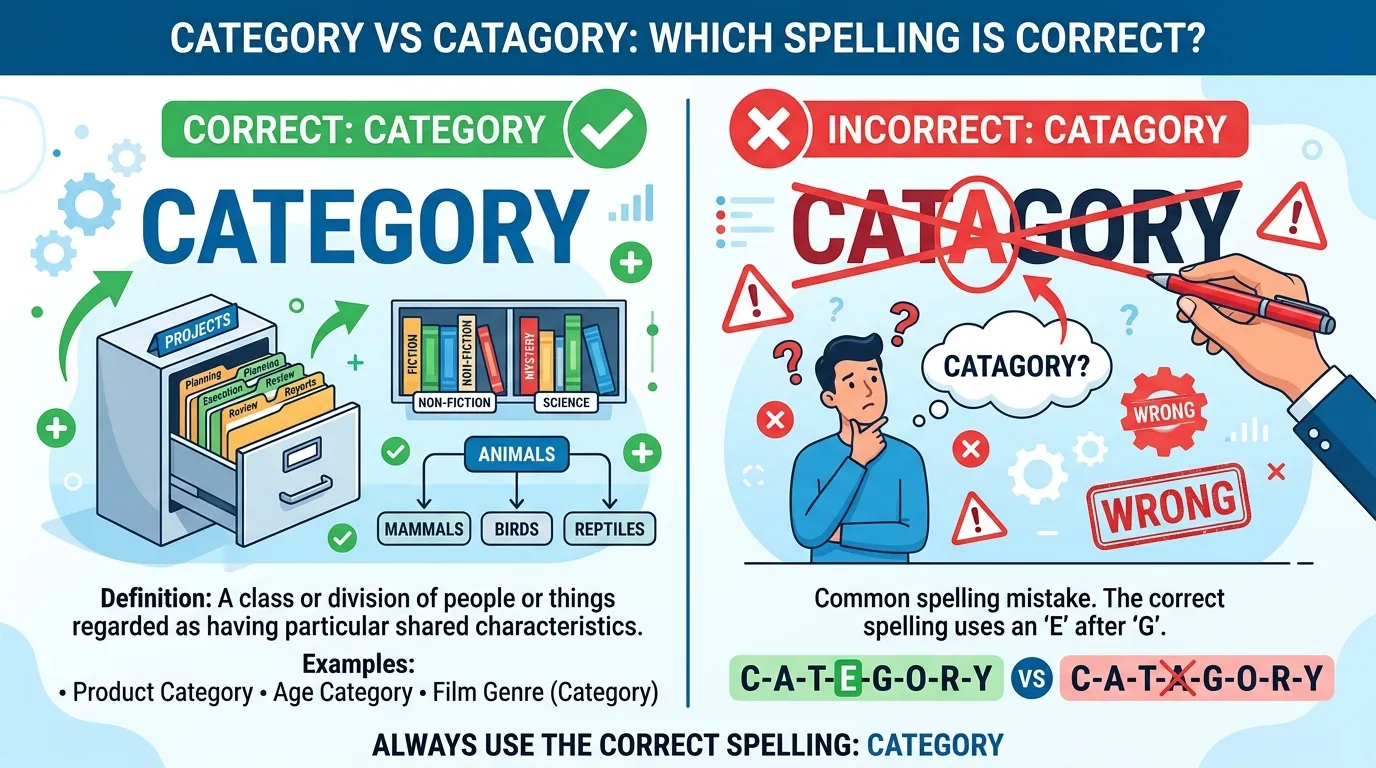
The bequest arrived in twenty-seven crates. A collector had died and left the museum everything: pottery, textiles, coins, manuscripts, weapons, jewellery, tools, and a box labelled, in the collector’s own hand, “miscellaneous.” The curator’s job was to sort it all — to put every object into its category, the group it belonged to, so the museum could catalogue it, store it, and eventually display it. On the third day, working through the coins, she found a note the collector had left inside a crate lid: “Sort by catagory.” The advice was sound. The spelling was not. The correct spelling is category — c-a-t-e-g-o-r-y — with an E in the second syllable, not an A. Catagory is a misspelling. The error is a single vowel swapped by the ear, and the museum’s catalogue is exactly the kind of place where it cannot survive.
Category is a word that organises the world. It puts things into groups, classes, and kinds, and it appears in every field that sorts anything — libraries, shops, science, law, sport, data. It is also a word whose spelling is betrayed by its own pronunciation, and the betrayal is worth understanding.
The Storeroom
Start in the storeroom, because the storeroom is where categories are born. The curator stands among the crates with a clipboard and a set of decisions. The pottery goes in one category: ceramics. The textiles go in another: fabrics. The coins go in a third: numismatics. The manuscripts go in a fourth: documents. Each category is a shelf, a drawer, a database field, a label. Without categories, the bequest is twenty-seven crates of stuff. With categories, it is a collection.
The decisions are not always easy. A ceremonial sword is a weapon and a work of art. A manuscript is a document and a treasure. A coin is currency and a historical record. The curator must choose a primary category and note the secondary ones, and the choosing is the intellectual work of the museum. A category is not a box that nature provides. It is a box that humans build, and the building is a judgment.
The plural matters too. One category, many categories — the Y changes to IES, the way it does in library/libraries, country/countries, family/families. The plural is not categorys. The rule is the standard one for words ending in consonant + Y, and it holds through the whole family.
The storeroom also shows the word’s reach. The museum’s categories are formal: ceramics, textiles, numismatics. A shop’s categories are commercial: clothing, electronics, furniture, books. A library’s categories are intellectual: fiction, biography, history, science. A streaming service’s categories are algorithmic: drama, comedy, documentary, thriller. The word is the same in all of them. The sorting is the same act. Only the shelves differ.
Why the Ear Writes Catagory
Say category aloud: KAT-uh-gor-ee. Four syllables. The second syllable is a schwa — the neutral uh sound that lives in unstressed syllables across English. The schwa is the most common vowel sound in the language, and it is the least informative, because it tells the ear nothing about which letter produced it. The uh in the second syllable of category could be spelled with any vowel. The spelling chose E. The ear, hearing uh, guesses A.
The guess is strengthened by a true pattern. English has a large family of words with -a- in the second syllable: catalogue, catapult, catastrophe, category‘s near-neighbour catacomb. A writer who knows those words can easily reason that category must share their A. It does not. The A words and the E word are different families, and the resemblance is a coincidence of the first syllable.
There is also the pull of the related words. Categorize, categorical, categorization — the whole family carries the same E, and the whole family is pronounced with the same schwa. A writer who misspells the root will misspell the family, and a writer who learns the root will spell the family correctly. The error propagates. So does the correction.
There is a third force: the word’s length. Category is eight letters and four syllables, long enough that the eye skims it and the hand types it on autopilot. Autopilot spells by sound, and sound says A. The misspelling is a hurry error wearing an ear error’s clothing.
From Accusation to Aristotle
Here is the history that fixes the spelling for good. Category comes from the Greek katēgoria, built from kata-, meaning “against” or “down,” and agora, meaning “the marketplace” or “the assembly” — the public square where Athenians gathered to debate, to trade, and to accuse one another. A katēgoria was, literally, a statement made against someone in the assembly: an accusation, a charge, a claim laid down in public.
The philosopher Aristotle took the word and gave it its modern job. In his treatise Categories, he listed ten fundamental kinds into which everything that exists could be sorted: substance, quantity, quality, relation, place, time, position, state, action, and affection. The categories were the most basic classes of being, the boxes into which reality itself could be sorted. The word moved from the courtroom to the cosmos, from accusation to classification, and it kept its spelling the whole way.
The Greek root explains the E. The second syllable of katēgoria carries an E — the ē in katē- — and English kept it when it borrowed the word through Latin categoria. The A that the ear wants to insert has no history behind it. It is an invention of the schwa, and the schwa is not a reliable witness.
The history also explains a cousin worth knowing: categorical. A categorical statement is one that is absolute, without qualification: “a categorical denial,” “a categorical refusal.” The sense comes from Aristotle’s categories — a statement that places something firmly in a category, with no hedging. A categorical denial does not say “probably not.” It says “no,” and it puts the no in a box labelled NO. The word’s philosophical past is still alive in its modern use.
Categories in the Wild
The word’s uses are worth surveying, because they show how one act — sorting — appears in every field.
In science, categories are the backbone of classification. Biologists sort life into kingdom, phylum, class, order, family, genus, species — a hierarchy of categories, each one nested inside the one above it. A lion belongs to the category Panthera leo, the category Felidae, the category Mammalia, and so on up the ladder. The categories are not arbitrary. They record real relationships, and getting them right is the work of the science.
In commerce, categories are the backbone of the catalogue. A shop sorts its products into categories so customers can find them. The categories are a map of the store, and a bad map loses sales. Online shops add a second layer: recommendation engines that suggest products from categories the customer has browsed. The category is both a shelf and a signal.
In law, categories decide outcomes. A crime falls into a category — felony or misdemeanour, civil or criminal — and the category decides the procedure, the penalty, and the court. A worker falls into a category — employee or contractor — and the category decides their rights. The law is, in large part, a system of categories with consequences attached.
In sport, categories create fairness. Weight classes in boxing, age groups in youth leagues, disability classifications in Paralympic events — all are categories designed to make competition fair by grouping like with like. A category in sport is not just a label. It is a promise that the contest will be between equals.
In data, categories are the backbone of analysis. A dataset is sorted into categorical variables — gender, region, product type — and numerical variables — age, income, temperature. The distinction decides which statistical tools apply. A data scientist who miscategorises a variable will produce a wrong analysis, and the wrongness will be invisible until someone checks the categories.
Category, Class, Type, Kind: Four Sorters
Category has close neighbours, and keeping them distinct sharpens a sentence.
Class is the most formal neighbour. A class is a category defined by shared properties, often in a hierarchy. “Social class,” “a class of drugs,” “first class.” The word carries a sense of rank and system.
Type is the most casual neighbour. A type is a category defined by a typical example. “What type of car is it?” “A new type of battery.” The word is looser than category, more conversational, less systematic.
Kind is the oldest neighbour, from the Old English gecynd, meaning nature or birth. “What kind of person is she?” “A kind of bird.” The word is warm and informal, and it carries a sense of nature rather than system.
Category sits between them: more systematic than type or kind, less hierarchical than class. A category is a group defined by a shared characteristic, used for sorting. When you want the systematic word, pick category. When you want the casual word, pick type or kind. When you want the hierarchical word, pick class. The choice is a matter of register, and the register is the message.
There is also the verb family. Categorize (American) or categorise (British) means to place something in a category: “The specimens were categorized by species.” Categorization is the act or result. Categorical is the adjective of absoluteness. All of them keep the E, because the E belongs to the root, and the root belongs to Aristotle.
The Lock-In
The memory hook is the Greek root. Katēgoria — kat- + ē + goria. The E is the second letter of the root, the vowel of the accusation made in the assembly. Think of the marketplace — the agora — where the accusation was spoken, and remember that the word for the accusation carries an E where the ear hears uh.
There is a second hook, and it is built for the eye. The word category contains the word cate-, the beginning of catechism and cater — words that also begin with C-A-T-E. The E is not an anomaly. It is part of a small family of C-A-T-E words, and the family is a reminder that the second syllable is E, not A.
And one final check for the keyboard: when the word appears in your draft, look at the second syllable. If you see -te-, with an E, the spelling is right. If you see -ta-, with an A, the ear has overwritten the root, and the word is wrong. The curator in the storeroom would not file a coin under the wrong category. The writer should not file the word under the wrong vowel. Spell it with the E, and the collection will be in order.










