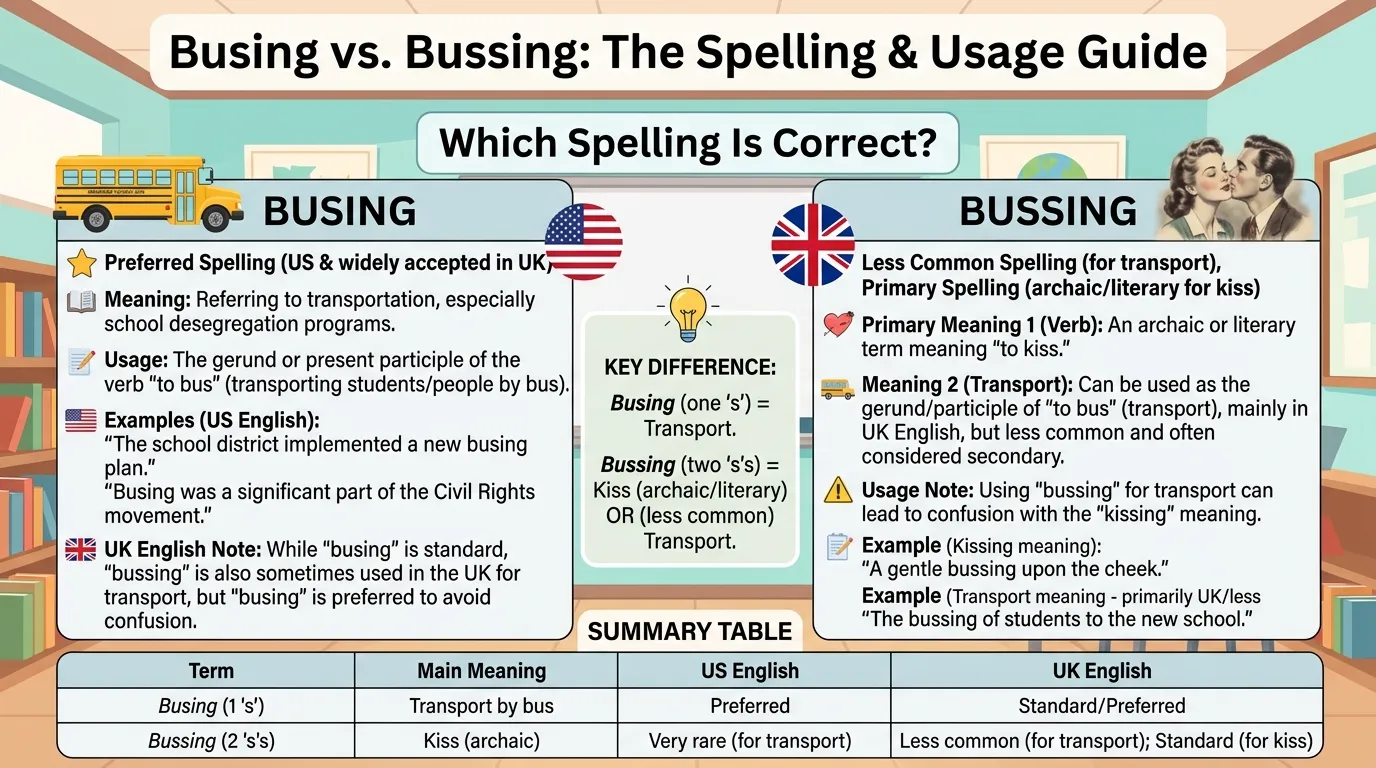
If you have ever wondered whether busing or bussing is the correct spelling, you are not alone. Many English learners, students, writers, and even native speakers get confused because busing and bussing both appear in books, newspapers, dictionaries, and online articles. The confusion becomes even greater because the answer depends on the meaning of the word and, sometimes, on the style guide being followed.
The good news is that both busing and bussing are correct in modern English, but they are not always used in the same way. In American English, busing is usually the preferred spelling when talking about transporting people by bus, especially students. However, bussing is often preferred when referring to clearing tables in a restaurant. Some dictionaries also accept bussing as an alternative spelling of the transportation verb.
Understanding the difference between busing or bussing helps you write more accurately, avoid common grammar mistakes, and communicate clearly in both American and British English. This guide explains the meanings, grammar rules, pronunciation, history, examples, synonyms, and practical usage so you can confidently choose the correct spelling every time.
Quick Answer
| Form | Status | Best Use |
|---|---|---|
| ✅ Busing | Correct | Transporting people by bus (preferred in US English) |
| ✅ Bussing | Correct | Clearing restaurant tables; also accepted for transportation in some dictionaries |
| ❌ Using one spelling for every meaning | Incorrect | Choose the spelling that matches the context and style guide |
Simple Rule
- ✅ Busing = taking people somewhere by bus.
- ✅ Bussing = clearing dishes from restaurant tables.
- ⚠️ Some dictionaries accept bussing for transportation too, but busing is more common.
What Does Busing Mean?
Busing is the present participle and gerund of the verb bus, meaning:
- To transport people by bus
- To travel by bus
- To move students from one school to another by bus
Grammar Role
- Verb
- Present participle
- Gerund
Examples:
- We are busing students across the city.
- The district supports busing for educational access.
- They are busing workers to the factory.
American English Examples
- The school is busing students to the new campus.
- They started busing children earlier this year.
- The company is busing employees from downtown.
- We are busing visitors to the conference center.
- The city spends millions on busing programs.
British English Examples
Although less common, British English also uses busing.
- The council is busing children to another school.
- They began busing passengers during the rail strike.
- We are busing guests to the venue.
- The charity is busing volunteers around London.
- They discussed busing workers between offices.
What Does Bussing Mean?
Bussing has two accepted meanings.
Meaning One
In restaurants, bussing means:
- Clearing tables
- Removing plates
- Taking away glasses
- Cleaning dining areas
Example:
The waiter spent the afternoon bussing tables.
Meaning Two
Some dictionaries also accept bussing as another spelling of busing for transportation, although it is less preferred in modern American style guides.
Why Do People Think One Form Is Wrong?
Many people believe only busing is correct because schools and newspapers often use it for transportation.
Others believe bussing is correct because English usually doubles the final consonant before adding -ing.
Both beliefs contain some truth.
Today:
- Transportation → busing is preferred.
- Restaurant work → bussing is preferred.
Incorrect and Correct Examples
| Incorrect | Correct |
|---|---|
| He is bussing students to school. (less preferred) | He is busing students to school. |
| She spent the evening busing tables. | She spent the evening bussing tables. |
| The waiter was busing dishes. | The waiter was bussing dishes. |
| The school announced a bussing program. (less common) | The school announced a busing program. |
Busing vs Bussing Comparison Table
| Feature | Busing | Bussing |
|---|---|---|
| Main meaning | Transport by bus | Clear restaurant tables |
| Part of speech | Verb | Verb |
| Transportation | Preferred | Accepted by some dictionaries |
| Restaurant use | Rare | Preferred |
| American English | More common | Restaurant meaning preferred |
| British English | Used | Also accepted |
| Formal writing | Preferred for transport | Preferred for restaurant work |
Pronunciation Guide
| Word | IPA (US) | IPA (UK) |
|---|---|---|
| Busing | /ˈbjuː.zɪŋ/ | /ˈbjuː.sɪŋ/ |
| Bussing | /ˈbʌs.ɪŋ/ or /ˈbjuː.zɪŋ/ | /ˈbʌs.ɪŋ/ |
Although the spellings differ, pronunciation often depends on the meaning and regional accent.
Why Are They Commonly Confused?
People confuse these spellings because:
- Both come from the word bus.
- Different dictionaries list different preferred spellings.
- Restaurant workers traditionally use bussing tables.
- Education articles usually write busing students.
- English spelling rules are not always consistent.
Word Origin and Etymology
The noun bus comes from omnibus, a Latin word meaning for everyone.
During the 1800s, omnibus became bus, referring to public transportation.
Later, English created the verb to bus, meaning:
- travel by bus
- transport by bus
When English speakers added -ing, two spellings developed.
- Busing became popular in transportation.
- Bussing remained common in restaurant work because doubling the consonant matched traditional English spelling patterns.
Today, dictionaries recognize both spellings depending on context.
Synonyms
| Word | American English | British English |
|---|---|---|
| Transporting | Very common | Very common |
| Carrying | Common | Common |
| Conveying | Formal | Formal |
| Driving | Common | Common |
| Shuttling | Very common | Common |
| Delivering | Common | Common |
| Moving | Common | Common |
Preferred Synonyms
Transportation
- transporting
- shuttling
- carrying
Restaurant
- clearing tables
- cleaning tables
- removing dishes
Grammar Rule
The verb is bus.
Verb forms:
| Form | Example |
|---|---|
| Base | bus |
| Present | buses |
| Past | bused or bussed (dictionary dependent) |
| Present participle | busing or bussing |
Beginner Rule
If you mean transport by bus, write busing.
If you mean clear restaurant tables, write bussing.
Busing vs Related Words
| Word | Meaning |
|---|---|
| Bus | Vehicle |
| Busing | Transporting by bus |
| Bussing | Clearing restaurant tables |
| Shuttle | Repeated transport |
| Transit | Public transportation |
| Commuting | Regular travel to work or school |
Common Mistakes
Using bussing for school transportation
❌ The district is bussing students.
✅ The district is busing students.
Using busing for restaurant work
❌ She was busing tables.
✅ She was bussing tables.
Thinking one spelling is always wrong
Both spellings are accepted in modern English.
Ignoring context
Always ask:
Is this about transportation or restaurants?
Following social media instead of dictionaries
Many online posts use inconsistent spelling.
Forgetting audience
Formal school writing prefers busing.
Restaurant writing often prefers bussing.
Mixing spellings in one article
Stay consistent throughout your writing.
Real-Life Examples
Emails
Our company will be busing employees to the conference.
Office
The office is busing staff between buildings.
Banking
The bank is busing customers from the parking area during renovations.
Invoice
The invoice includes busing charges for conference attendees.
School
The district increased busing services this semester.
Restaurant
Jake spent two hours bussing tables.
Social Media
We’re busing fans to the stadium today.
Rent Payments
The apartment complex is busing residents to temporary parking.
Everyday Conversation
We’re busing everyone to the wedding.
Ten American English Sentences
- The school is busing students every morning.
- They began busing workers yesterday.
- We are busing visitors downtown.
- The city supports busing programs.
- The company is busing employees.
- She enjoys bussing tables on weekends.
- The restaurant needs someone for bussing duties.
- He finished bussing every table.
- They hired two people for bussing.
- Busing saves transportation costs.
Ten British English Sentences
- The council is busing children to school.
- We are busing passengers today.
- They discussed busing during the meeting.
- The charity is busing volunteers.
- We began busing guests after lunch.
- She works bussing tables at a café.
- He enjoys bussing after school.
- They were bussing dishes quickly.
- The hotel needs more staff for bussing.
- Busing services were expanded last year.
Memory Tricks
Think of School Buses
School transportation = busing
Think of Restaurant Buses
Restaurant tables = bussing
One S for the Bus
One s reminds many writers of the transportation spelling.
Two Ss for Serving
Serving tables uses bussing.
Remember the Context
Transportation → busing
Restaurant → bussing
Frequently Asked Questions
Is busing or bussing correct?
Both are correct, but they have different preferred uses.
Which spelling do dictionaries prefer?
Most modern dictionaries prefer busing for transportation and bussing for restaurant work.
Is bussing students wrong?
Not completely. Some dictionaries allow it, but busing students is more common in formal American English.
What does bussing mean?
It usually means clearing dishes from restaurant tables.
What does busing mean?
Transporting people by bus.
Which spelling is used in British English?
British English accepts both, depending on context.
Is bussing formal?
Yes, especially in restaurant and hospitality writing.
Is busing a real word?
Yes. It is widely used in education, transportation, and government documents.
How do you pronounce busing?
American IPA: /ˈbjuː.zɪŋ/
British IPA: /ˈbjuː.sɪŋ/
People Also Ask
Is busing an American spelling?
Yes. It is the preferred American spelling when talking about transportation by bus.
Why do restaurants use bussing?
The hospitality industry traditionally uses bussing to describe clearing and resetting tables.
Can I use bussing in school writing?
You can, but busing is generally the preferred choice in educational and formal American writing.
Which spelling should ESL learners remember?
Remember busing for transportation and bussing for restaurant work. This simple rule will be correct in most situations.
Conclusion
Choosing between busing or bussing is easier once you understand the context. Both spellings are recognized in modern English, but they serve different purposes. Busing is the standard choice when talking about transporting people by bus, especially in schools, workplaces, and public transportation. Bussing, on the other hand, is the preferred spelling in the restaurant industry, where it means clearing tables and removing dishes. While some dictionaries also allow bussing for transportation, most American style guides recommend busing in that context.
By learning the grammar difference, pronunciation, history, and real-life usage, you can avoid common mistakes and write with greater confidence. Whether you are preparing an email, writing an essay, creating business documents, or improving your English skills, remembering the context is the easiest way to choose the correct spelling. When in doubt, think school buses = busing and restaurant tables = bussing. This simple memory trick will help you use these words accurately in both American and British English.