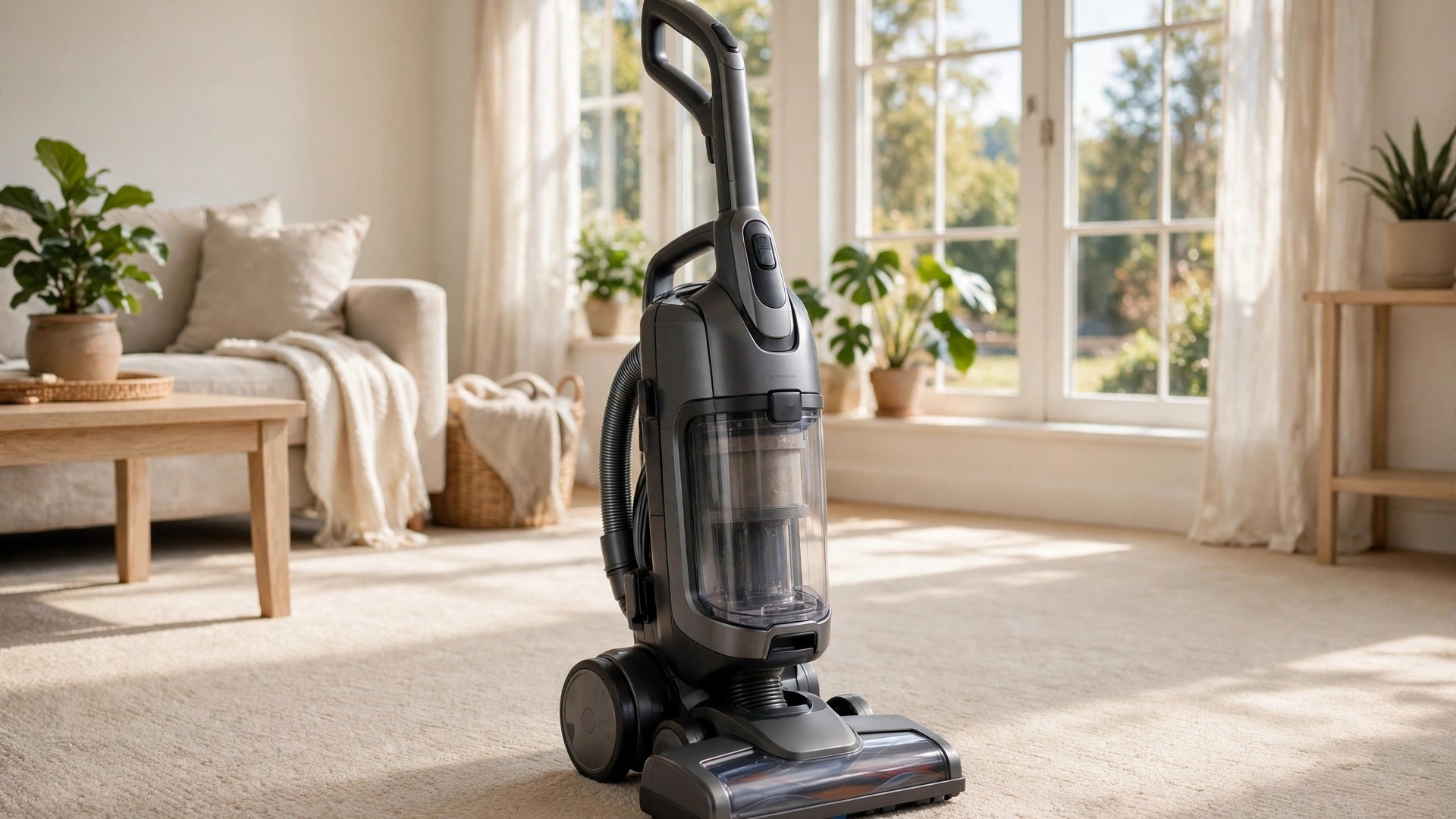
There is a place, not far in cosmic terms, where there is almost nothing at all. No air. No sound. No weather. The space between the stars is so empty that physicists call it a near-perfect vacuum — a region with almost no matter in it. It is one of the most extreme things in the universe, and it shares its name with the machine in your hall closet.
That double life is part of what makes the word interesting. Vacuum names both an emptiness and an appliance, both a condition of physics and a Saturday chore. And its spelling is one of the most consistently fumbled in English. The error is almost always the same: a doubled C that does not belong, producing vaccum. The real spelling has one C and two U’s — a combination that looks wrong to the eye and is exactly right.
Nothing, Perfected
A vacuum, in the scientific sense, is a space entirely or nearly empty of matter. Sound cannot travel through it, because sound needs a medium — air, water, metal — to carry its vibrations. Light passes through it easily, which is why sunlight reaches Earth across 150 million kilometers of near-vacuum. A “partial vacuum” is a space where most, but not all, of the air has been removed: the inside of an old light bulb, a sealed food package, a laboratory chamber.
The word comes from the Latin vacuus, meaning empty or free. That Latin root is the key to the spelling, and it is worth pausing on: vacuus has one C and two Us. English kept the shape of the Latin word almost exactly. The spelling is not a puzzle the language invented to torment students. It is an inheritance, passed down with its letters intact.

From Outer Space to Your Carpet
The same word does three jobs in everyday English. As a noun, it names the empty space — “Sound cannot travel through a vacuum” — and the cleaning appliance — “The vacuum is in the hall closet.” As a verb, it names the act of cleaning with that appliance: “Please vacuum the living room before the guests arrive.” As the first element of compounds, it describes anything related to that emptiness or that machine: vacuum-sealed, vacuum-packed, vacuum tube, vacuum flask.
The appliance sense has its own history. The first powered vacuum cleaners appeared in the early 1900s, and they worked — as they still do — by creating a partial vacuum inside the machine. The pressure difference pulls air, and the air carries dust with it. The machine is named for the physics it uses, which is why the cosmic void and the household chore share a word. In British English, the appliance is often called a hoover, after the Hoover brand, and “to hoover” means to vacuum. In American English, that usage is rare.
The verb form follows the standard pattern: vacuum, vacuums, vacuumed, vacuuming. “She vacuums the whole house every Saturday.” “We vacuumed the car seats.” No spelling changes, no surprises — the verb keeps the noun’s letters exactly.
Why the Spelling Looks Wrong
The misspelling vaccum is so persistent because two separate instincts push writers toward it. The first is the short-vowel instinct. In English, a short vowel sound is often followed by a doubled consonant — accuse, accumulate, accept, accommodate. The first syllable of vacuum sounds like “vak,” a short, sharp sound, so the hand wants to double the C to match. The instinct is real, and in this word it is wrong.
The second instinct is suspicion of the double U. English words rarely contain two U’s in a row, so the spelling looks like a typo even when it is correct. Writers feel that something must be off, and they “fix” it by adding a C instead — moving the extra letter to the wrong place and producing vaccum. The result looks believable, follows a genuine English pattern, and is not a standard spelling.
Other wrong versions show the same unease in different forms. Vacume drops a U. Vacuume adds a silent E by analogy with words like costume or volume. Vaccuum doubles both letters. Every wrong version is a different negotiation with the same discomfort: a word whose letters do not match what the ear expects. The correct version — one C, two U’s — is the one to memorize whole.

The Figurative Vacuum
Beyond physics and housework, vacuum does heavy work as a metaphor. A power vacuum is a situation where leadership or authority is missing and competing forces rush to fill it: “The sudden resignation created a power vacuum in the department.” The phrase works because the physics is built in — nature abhors a vacuum, and so do organizations. Empty spaces get filled, whether by air or by ambition.
In a vacuum means isolated from real-world conditions or context: “This plan sounds good, but it was designed in a vacuum.” And the old saying “nature abhors a vacuum” has traveled far from physics into everyday speech: if there is a gap — in leadership, in a market, in a conversation — something or someone will step in to fill it. The metaphor is so natural that most people who use it never think about the physics at all. The word has become a way of talking about absence itself.
The Vacuum in the Lab
The vacuum did not stay a philosopher’s curiosity. In the 1600s, Evangelista Torricelli built the first barometer by filling a glass tube with mercury, sealing one end, and inverting it into a dish. The mercury fell, leaving an empty space at the top of the tube — a vacuum, the first one deliberately created by human hands. That empty space did more than demonstrate physics. It showed that air has weight: the atmosphere pressing on the dish held the mercury column up. The barometer, the instrument that still forecasts weather today, was born from a tube of nothing.
From that experiment grew the vacuum pump, the vacuum chamber, and a whole branch of technology. Scientists learned to remove air from chambers to study how materials behave without it. Food companies learned to seal products in vacuum packaging, removing the air that lets bacteria and mold grow — the same principle behind the vacuum-sealed coffee that stays fresh for months. Engineers built thermos flasks — Dewar flasks — with a vacuum between two walls, so heat cannot travel across the gap by conduction or convection. Your coffee stays hot because a vacuum is doing the insulating.
Every one of these inventions leans on the same fact: a vacuum is not just “nothing.” It is the absence of the medium through which heat, sound, and decay travel. Remove the medium and you remove the travel. That is why the word appears in laboratories, kitchens, factories, and space stations alike. It names a condition that engineers can build, cooks can exploit, and physicists can measure — all with the same six letters, one C, two U’s.
Locking It In
The memory hook for this word is visual. Look at the middle of the word: vacUUm. Two U’s, side by side — like the two tubes of a vacuum cleaner, or like a pair of eyes staring back at you. One C, two U’s. If you remember nothing else, remember that.
A second hook plays on the appliance itself: a vacuum cleaner sucks up everything extra — including the extra C. It sucks so hard that only one C is left. Silly, but silly is what memory likes. Between the two hooks, the spelling has two independent anchors, and either one is enough to hold it.
The word is a reminder that English spelling is often history, not sound. The double U came from Latin. The single C came from Latin. The pronunciation drifted; the letters stayed. Spell the history, not the sound: vacuum, one C, two U’s, every time.


And if the spelling ever wobbles, return to the Latin. Vacuus — empty, free — gave English the word with its letters already set: one C, two U’s. The centuries since have changed how the word sounds, how it is used, and what it names, from the void between stars to the machine in the closet. The letters never changed. That is the quiet promise of words with deep roots: spell the history, and the present takes care of itself. One C, two U’s, and the vacuum holds.
One more use deserves a mention, because it shows how far the word has traveled from the laboratory. In everyday speech, a vacuum can describe any absence that feels conspicuous: a silence in a conversation, a gap in a story, a missing person at a table. “Her absence left a vacuum in the office.” The physics is gone, but the shape remains — an emptiness that pulls attention toward itself, the way a physical vacuum pulls air. It is the word’s oldest job, done in its newest setting: naming the nothing that everyone notices.










