Principal vs Principle: What’s the Difference? Meaning, Examples, and Easy Ways to Remember

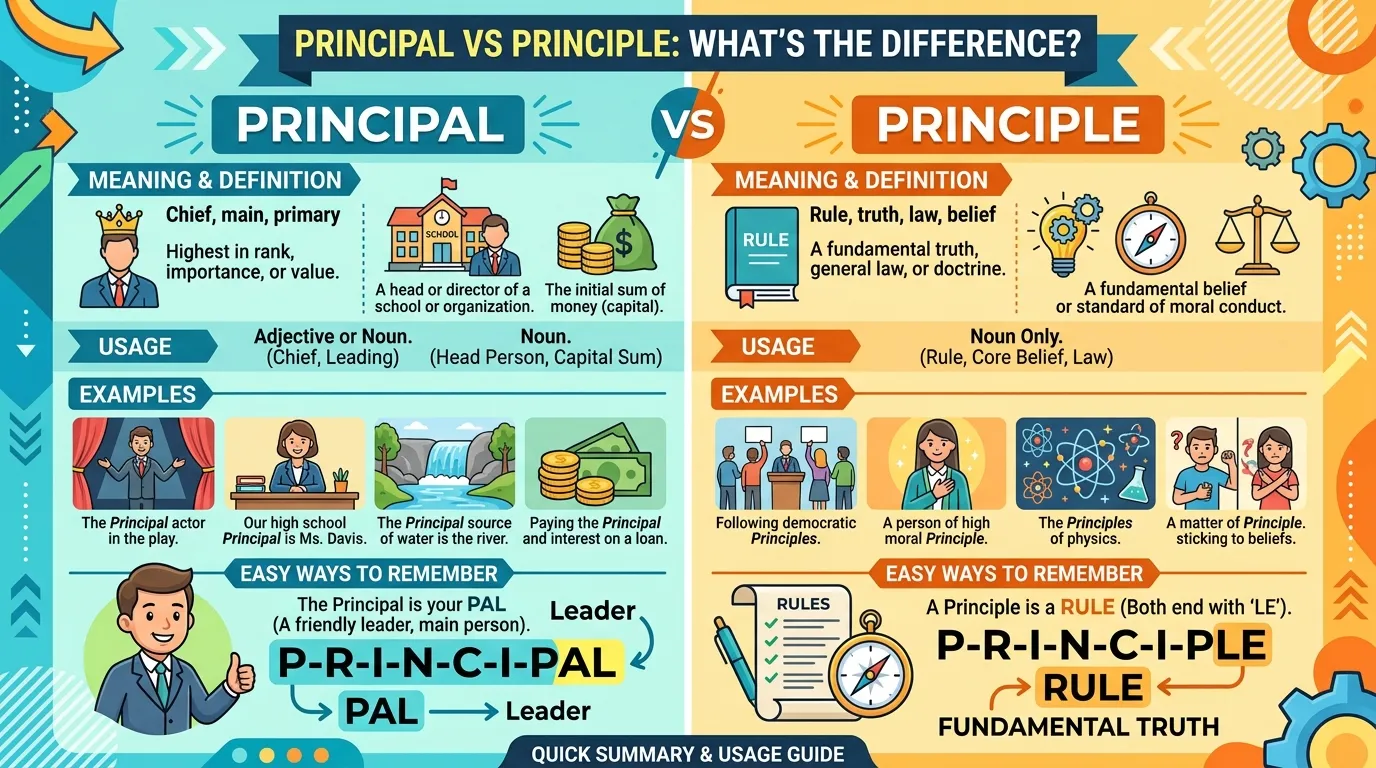
If you have ever paused over principal vs principle, you are not alone. These two words sound almost identical, but they have different meanings and grammatical roles. One usually refers to a person, position, or something most important, while the other refers to a rule, belief, or guiding standard.

The good news is that the difference is easy to understand once you connect each word with its most common meaning.

Principal can mean the head of a school, the main or most important person or thing, or the original amount of money involved in a loan or investment. Principle means a basic rule, belief, moral standard, or general truth that guides behavior or explains how something works.

For example:

  • The principal called a meeting with the teachers.
  • She refuses to compromise her principles.
  • The principal reason for the delay was bad weather.
  • You must repay both the interest and the principal on the loan.

In this guide, you will learn the difference between principal and principle, their definitions, pronunciation, word histories, grammatical uses, common expressions, memory tricks, mistakes to avoid, and examples from everyday, academic, business, financial, professional, and formal writing.

Quick Answer: Principal vs Principle

The simplest distinction is:

WordMain MeaningExample
PrincipalA person in charge; the main or most important thing; the original amount of moneyThe school principal spoke to the parents.
PrincipleA rule, belief, moral standard, or basic truthHonesty is an important principle.

Easy memory trick

Think:

Principal = person or primary

The principal of a school is a person, and principal can also mean the primary or most important thing.

Principle = rule

A principle is a rule, belief, or standard that guides someone or something.

So, if you mean the head of a school, use principal.

If you mean a moral rule or belief, use principle.


What Does Principal Mean?

Principal is a versatile word with several meanings. It can function as a noun or an adjective.

As an adjective, principal means main, primary, or most important.

The principal objective of the project is to improve customer service.

Here, principal means the main objective.

As a noun, principal can refer to several things.

Principal as a school leader

In American English, a principal is the person who manages or leads a school.

The principal welcomed the new students.

The school principal announced the schedule change.

This is one of the most common uses of the word.

Principal as the main person or organization

In business, law, and professional contexts, a principal can refer to a person or organization that has a leading role or gives authority to another person.

The agent acted on behalf of the principal.

The exact legal meaning can vary depending on the context, but the general idea involves the person or entity represented by an agent.

Principal as the original amount of money

In finance, principal means the original amount of money borrowed, invested, or owed, before interest or other charges.

For example, suppose you borrow $10,000. The principal is $10,000.

If interest is added, the amount you eventually pay may be higher than the principal.

She made an extra payment to reduce the principal on her mortgage.

Principal as the most important thing

Principal can also mean the main or most important part.

The principal concern is employee safety.

Cost was the principal reason for choosing the new supplier.

Here, principal means main or primary.


What Does Principle Mean?

Principle is a noun.

It generally means a basic rule, belief, standard, or truth that influences behavior, decisions, or understanding.

For example:

Honesty is one of his strongest principles.

This means honesty is an important belief or moral standard that guides him.

A principle does not always have to be moral.

Moral principles

Moral principles are beliefs about what is right and wrong.

Examples include:

  • honesty
  • fairness
  • responsibility
  • respect
  • integrity
  • compassion

You might say:

She refused to lie because it went against her principles.

General rules or standards

Principles can also be practical rules.

The company operates according to several basic principles.

These principles might include customer service, transparency, safety, or efficiency.

Scientific or technical principles

In science and technology, a principle can mean a fundamental rule that explains how something works.

The device operates according to the principles of physics.

In this sense, principle does not mean a personal belief. It means a foundational concept or rule.


Principal vs Principle: The Key Difference

The biggest difference is simple:

Principal generally describes something that is primary, important, or connected with a person in authority or money.

Principle describes a rule, belief, standard, or fundamental truth.

Compare these sentences:

The principal reason for the decision was cost.

The decision was based on the principle of fairness.

In the first sentence, principal means “main.”

In the second, principle means “guiding belief or standard.”

Side-by-side comparison

FeaturePrincipalPrinciple
Part of speechNoun and adjectiveNoun
School leaderYesNo
Main or primaryYesNo
Original loan amountYesNo
Moral ruleNoYes
Guiding beliefNoYes
Scientific ruleNoYes
Sounds similarYesYes
Common spelling mistakeYesYes

Why Do People Confuse Principal and Principle?

The main reason is pronunciation.

In most varieties of standard American English, principal and principle are pronounced the same way: approximately PRIN-suh-puhl.

Because they are homophones, listeners cannot tell which spelling is intended from sound alone.

This creates problems in writing.

For example, someone might know that “principal” and “principle” sound alike but not remember which spelling belongs to which meaning.

The confusion becomes especially common in phrases such as:

  • principal reason
  • moral principle
  • school principal
  • principal amount
  • basic principle

The solution is not to rely on pronunciation. Instead, identify the meaning first.


How to Remember Principal vs Principle

Here are several useful memory tricks.

1. Principal has “pal”

A common memory trick is:

The principal is your pal.

This is especially useful for remembering that a school leader is a principal.

The principal is my pal.

It is not a grammatical rule, but it can help you remember the spelling.

2. Principal = primary

Both words begin with pri, but think of:

principal = primary

If something is the main or most important thing, principal is usually the correct choice.

The principal reason = the primary reason.

3. Principle = rule

Think:

Principle = a rule or belief.

If you could replace the word with rule, belief, standard, or guideline, you probably need principle.

Honesty is an important principle.

Honesty is an important rule or standard.


Principal as an Adjective

One important grammatical difference is that principal can be an adjective.

It means main, primary, or most important.

Examples:

The principal issue remains unresolved.

Safety is the principal concern.

The principal goal is to reduce waste.

She was the principal speaker at the conference.

Notice that principle cannot be used this way.

Incorrect:

Safety is the principle concern.

Correct:

Safety is the principal concern.


Principal as a Noun

Principal can also be a noun.

Common noun meanings include:

  1. A school leader
  2. A person with a leading or authoritative role
  3. The original amount of money borrowed or invested
  4. A main participant or person

Examples:

The principal met with the students.

The investor wants to protect the principal.

The agent contacted the principal.

This variety is one reason principal appears frequently in professional writing.


Principle as a Noun

Principle is a noun and usually refers to an idea, rule, belief, or standard.

Examples:

The principle of fairness matters to the organization.

Newton’s laws are based on scientific principles.

He follows the principle that everyone deserves respect.

The engineer explained the operating principle of the machine.

Unlike principal, principle does not normally describe a person.


Principal vs Principle in School Contexts

This is one of the easiest contexts.

The person who leads a school is the:

principal

The rules or values that guide behavior are:

principles

For example:

The principal spoke during the school assembly.

The school teaches students important principles of respect and responsibility.

Never write:

The school principle spoke to the students.

That spelling changes the meaning and is incorrect when referring to a school administrator.


Principal vs Principle in Finance

The distinction is also important in financial writing.

Principal refers to the original amount of a loan or investment.

Principle refers to a rule or concept.

For example:

She paid $5,000 toward the principal of her loan.

But:

The investment strategy follows the principle of diversification.

These words can appear in the same article or conversation, but they mean entirely different things.

Principal and interest

A common financial phrase is:

principal and interest

If you borrow money, the principal is the amount originally borrowed. Interest is the additional amount charged for borrowing that money.

Example:

The monthly payment covers both principal and interest.


Principal vs Principle in Business

Business writing uses both words frequently.

Principal in business

Principal may mean the main person, company, or party involved.

The principal authorized the representative to negotiate the contract.

It can also mean most important.

The principal objective is to increase customer retention.

Principle in business

Principle refers to a standard or belief.

Transparency is a core business principle.

The company operates on the principle that customers deserve clear information.

Common business collocations

Principal:

  • principal investor
  • principal owner
  • principal office
  • principal reason
  • principal objective
  • principal amount
  • principal party

Principle:

  • guiding principle
  • basic principle
  • core principle
  • moral principle
  • fundamental principle
  • operating principle
  • ethical principle

Principal vs Principle in Academic Writing

Both words are common in academic writing, but they serve different functions.

Use principal when discussing the main or primary element.

The principal finding of the study was unexpected.

Use principle when discussing a foundational rule, theory, or concept.

The research is based on the principle of controlled observation.

Academic writers should be especially careful because confusing the two words can make otherwise polished writing appear careless.


Principal vs Principle in Formal Writing

Both words are perfectly acceptable in formal English when used correctly.

Principal is appropriate when referring to:

  • a primary factor
  • a school leader
  • a financial amount
  • a main party
  • a chief objective

Principle is appropriate when referring to:

  • ethical standards
  • beliefs
  • rules
  • theories
  • fundamental concepts
  • guiding ideas

Neither word is inherently more formal than the other.


Principal vs Principle in Casual Writing

The distinction remains the same in informal communication.

I need to talk to the principal tomorrow.

I don’t want to compromise my principles.

Casual writing does not change the spelling rules.

The only difference is that informal writing may contain shorter or simpler expressions.


Pronunciation of Principal and Principle

In standard American English, both words are generally pronounced:

PRIN-suh-puhl

Because they are homophones, they sound alike despite having different spellings and meanings.

Why pronunciation does not solve the problem

If someone says:

“The principal reason…”

You cannot determine the spelling from sound alone.

You need to understand the sentence.

If the meaning is main, the spelling is principal.

If the meaning is rule or belief, the spelling is principle.


Principal vs Principle: Dictionary-Style Definitions

Principal

Principal
Noun

A person or thing that has a leading, primary, or authoritative role; also, the original amount of money borrowed or invested.

Adjective

Most important, main, or primary.

Principle

Principle
Noun

A fundamental rule, belief, standard, or truth that guides behavior, decisions, or understanding.


Word History and Etymology

The two words are related historically, which helps explain why they look and sound so similar.

Principal comes through Old French and Latin roots associated with being first, chief, or foremost. Its connection with the idea of something being primary explains meanings such as “main,” “chief,” and “school leader.”

Principle also comes from Latin, ultimately connected with an idea of a beginning, foundation, or fundamental basis. Over time, its meaning developed toward a foundational rule, belief, or standard.

Their shared historical background contributes to their similar appearance, but modern English assigns them different meanings and grammatical functions.


Synonyms for Principal

Depending on the meaning, synonyms for principal include:

When principal means “main”

  • primary
  • chief
  • main
  • leading
  • central
  • foremost
  • major
  • most important

Example:

The principal cause was equipment failure.

Possible alternatives:

The main cause was equipment failure.

The primary cause was equipment failure.

When principal means a school leader

Possible alternatives include:

  • school administrator
  • headteacher in some regional contexts
  • school leader

However, these terms are not always exact equivalents.

When principal means money

Financial alternatives may include:

  • original amount
  • principal balance
  • capital amount

The exact replacement depends on the financial context.


Synonyms for Principle

Depending on context, synonyms for principle include:

  • rule
  • standard
  • belief
  • value
  • guideline
  • doctrine
  • concept
  • foundation
  • ideal
  • tenet

For example:

Honesty is a core principle.

Could become:

Honesty is a core value.

However, synonyms are not always interchangeable in every context.


Antonyms of Principal

When principal means “main,” possible opposites include:

  • minor
  • secondary
  • subordinate
  • lesser
  • unimportant

Example:

The principal issue

could contrast with:

A secondary issue


Antonyms of Principle

There is no single universal antonym for principle because the meaning changes by context.

Depending on usage, possible contrasts include:

  • exception
  • disorder
  • inconsistency
  • lawlessness
  • practice that violates a standard

For moral principles, a contrasting concept might be unethical behavior.

For scientific principles, the opposite may depend on the specific concept being discussed.


Common Collocations With Principal

Collocations are words that frequently appear together.

Some common combinations with principal include:

  • school principal
  • principal reason
  • principal concern
  • principal objective
  • principal amount
  • principal balance
  • principal investigator
  • principal office
  • principal source
  • principal character
  • principal investor
  • principal party

Examples:

The principal investigator reviewed the results.

The principal concern was safety.

The borrower paid down the principal balance.


Common Collocations With Principle

Common combinations with principle include:

  • basic principle
  • core principle
  • guiding principle
  • moral principle
  • ethical principle
  • fundamental principle
  • scientific principle
  • operating principle
  • legal principle
  • general principle
  • first principle
  • principle of fairness

Examples:

Fairness is a guiding principle of the organization.

The machine works according to a basic scientific principle.


Common Expressions With Principal

Some useful expressions include:

Principal amount

The original amount of money borrowed or invested.

The lender calculated interest based on the principal amount.

Principal balance

The amount of the original debt that remains unpaid.

Making extra payments can reduce the principal balance.

Principal reason

The main reason.

The principal reason for leaving was the long commute.

School principal

The person who leads a school.

The school principal addressed the parents.


Common Expressions With Principle

In principle

This means according to a general idea or rule.

In principle, I agree with the proposal.

On principle

This means because of a moral or personal belief.

She refused the offer on principle.

As a matter of principle

This means because someone considers an action or belief fundamentally important.

As a matter of principle, he avoids misleading customers.

First principles

This refers to fundamental ideas or basic assumptions.

The engineers went back to first principles to solve the problem.


Common Mistakes With Principal and Principle

Mistake 1: “The school principle”

Incorrect:

The school principle spoke at the assembly.

Correct:

The school principal spoke at the assembly.

Mistake 2: “A moral principal”

Incorrect:

Honesty is an important moral principal.

Correct:

Honesty is an important moral principle.

Mistake 3: “The principle reason”

Incorrect:

The principle reason was cost.

Correct:

The principal reason was cost.

Mistake 4: “Pay the principle”

Incorrect:

I want to pay down the principle on my mortgage.

Correct:

I want to pay down the principal on my mortgage.

Mistake 5: “Follow your principals”

Incorrect:

Always follow your principals.

Correct:

Always follow your principles.

The plural form principles means multiple rules, beliefs, or standards.


Awkward vs Natural Examples

Awkward or IncorrectNatural and Correct
The school principle called me.The school principal called me.
She has strong moral principals.She has strong moral principles.
The principle reason is unclear.The principal reason is unclear.
We reduced the principle on the loan.We reduced the principal on the loan.
This violates our company principals.This violates our company principles.

Everyday Examples of Principal

Here are natural examples you might encounter in daily life:

The principal sent an email to all parents.

Time was the principal concern.

The bank explained how the principal would be calculated.

The principal speaker arrived early.

The principal goal is to keep everyone safe.


Everyday Examples of Principle

She believes in the principle of treating people fairly.

That decision goes against my principles.

The principle sounds simple, but applying it can be difficult.

The teacher explained the basic principle behind the experiment.

They built the policy around a few core principles.


Formal vs Informal Alternatives

Sometimes you may want to avoid repetition or choose a more specific word.

Instead of principal meaning “main”

Formal:

The principal objective of the study is…

Other choices:

The primary objective of the study is…

The central objective of the study is…

The main objective of the study is…

Instead of principle meaning “rule”

Formal:

The policy is based on the principle of fairness.

Alternatives:

The policy is based on the standard of fairness.

The policy follows a fairness guideline.

The best option depends on the exact context.


Regional Variations: American vs British English

The spelling distinction between principal and principle remains important in both American and British English.

However, some related terms can differ by region.

For example, principal is widely used in American English for the head of a school. In British English, headteacher is commonly used for a school leader.

This does not mean principal is wrong in British English. It means educational terminology varies by region and institution.

The meanings of principal as “main” and principle as “rule or belief” remain broadly consistent across major varieties of English.


Principal vs Principle in Journalism

Journalists need precision because a spelling mistake can change the meaning of a sentence.

Compare:

The principal reason for the resignation was financial pressure.

with:

The resignation violated a long-standing principle.

The first sentence identifies a main reason.

The second refers to a guiding standard or belief.

News writing should use the most direct term possible, especially in headlines and short reports.


Principal vs Principle in Technical Writing

Technical writing frequently uses principle when discussing how systems work.

Examples include:

  • operating principle
  • engineering principle
  • scientific principle
  • design principle
  • mechanical principle

Example:

The device operates on the principle of pressure differences.

Principal may appear when referring to the primary component, investigator, or objective.

The principal component was replaced during testing.

The context determines the correct word.


Principal vs Principle in Sports Writing

Sports writing can use both words.

Principal can describe a main player, main reason, or primary objective.

Defense was the principal focus of the team’s training session.

Principle can describe a team’s values or philosophy.

The coach believes in the principle of disciplined teamwork.

In sports journalism, the distinction is exactly the same as in general English.


Principal vs Principle in Blogging and Content Writing

Bloggers and content creators should pay attention to this pair because both words often appear in educational, financial, business, and lifestyle content.

For SEO content, accuracy matters more than trying to force one spelling into every context.

For example:

Learn how to reduce the principal on your mortgage.

is correct for a financial article.

But:

Learn the principles of responsible borrowing.

is correct when discussing general rules or beliefs.

Never replace one with the other simply because a keyword tool suggests a particular spelling. Search intent and grammatical accuracy should come first.


How to Choose the Correct Word in Seconds

When you are unsure, ask yourself these questions.

Question 1: Am I talking about a school leader?

Use principal.

The principal announced the new policy.

Question 2: Do I mean main or primary?

Use principal.

The principal cause was human error.

Question 3: Am I talking about money originally borrowed or invested?

Use principal.

The principal is still outstanding.

Question 4: Am I talking about a rule, belief, value, or standard?

Use principle.

The decision violates an important principle.

Question 5: Am I talking about a scientific or general rule?

Use principle.

The system operates according to a basic principle.


A Simple Principal vs Principle Cheat Sheet

Remember these five combinations:

School → principal

Main → principal

Money → principal

Rule → principle

Belief → principle

You can also remember:

Principal = primary

Principle = principle/rule

Once these associations become familiar, the spelling becomes much easier.


Principal vs Principle: Practice Quiz

Choose the correct word in each sentence.

  1. The school ___ met with the parents.
  2. Honesty is an important ___.
  3. The ___ reason for the change was cost.
  4. She made an extra payment toward the loan ___.
  5. The company follows the ___ of transparency.
  6. Safety was the ___ concern.
  7. The machine operates according to a scientific ___.
  8. The ___ announced the school’s new schedule.

Answers

  1. principal
  2. principle
  3. principal
  4. principal
  5. principle
  6. principal
  7. principle
  8. principal

The key is to focus on meaning rather than pronunciation.


Frequently Asked Questions

Is it principal or principle for a school leader?

Use principal for a school leader.

The principal spoke to the students.

Principle is incorrect in this context.

Is it principal or principle for a moral belief?

Use principle.

Respect is an important moral principle.

A principle can be a moral rule, belief, or standard that guides behavior.

Is it principal or principle for the main reason?

Use principal.

The principal reason for the delay was bad weather.

Here, principal means main or primary.

Is loan principal spelled principal or principle?

It is spelled principal.

The principal is the original amount of money borrowed, invested, or still owed, depending on the financial context.

Are principal and principle pronounced the same?

Yes. In standard American English, they are generally homophones, meaning they have the same pronunciation but different meanings and spellings.

What is an easy trick for remembering principal vs principle?

Think principal = primary. A principal can be the main person or thing.

For principle, think rule or belief.

Another common memory aid is: “The principal is your pal.”

Can principal be an adjective?

Yes. Principal can be an adjective meaning main, primary, or most important.

The principal objective is to improve safety.

Principle is normally used as a noun.

Can principle be plural?

Yes. The plural is principles.

The organization follows several ethical principles.

The plural principals can also exist, but it refers to multiple principals, such as several school leaders or people in authoritative roles.

Is principal more formal than principle?

No. Neither word is inherently more formal. They have different meanings and should be selected based on context.

Why are principal and principle so easy to confuse?

They have similar spellings and are generally pronounced the same way. Their meanings, however, are different. The best way to avoid confusion is to identify whether you mean main/person/money or rule/belief/standard.


Conclusion

The difference between principal vs principle becomes much easier when you focus on meaning.

Use principal when you mean:

  • a school leader
  • the main or primary thing
  • a leading person or party
  • the original amount of money in a loan or investment

Use principle when you mean:

  • a rule
  • a belief
  • a moral standard
  • a value
  • a general truth
  • a scientific or foundational concept

The fastest memory trick is:

Principal = primary.

Principle = rule or belief.

If you are writing about a school administrator, loan balance, main reason, or primary objective, principal is likely the correct choice. If you are describing an ethical standard, guiding belief, scientific rule, or fundamental concept, choose principle.

Because the two words are pronounced alike in American English, proofreading should focus on meaning and context, not sound. Once you connect each spelling with its core meaning, this commonly confused word pair becomes much easier to use accurately in everyday conversation, academic writing, business communication, journalism, technical writing, and professional content.

Leave a Comment