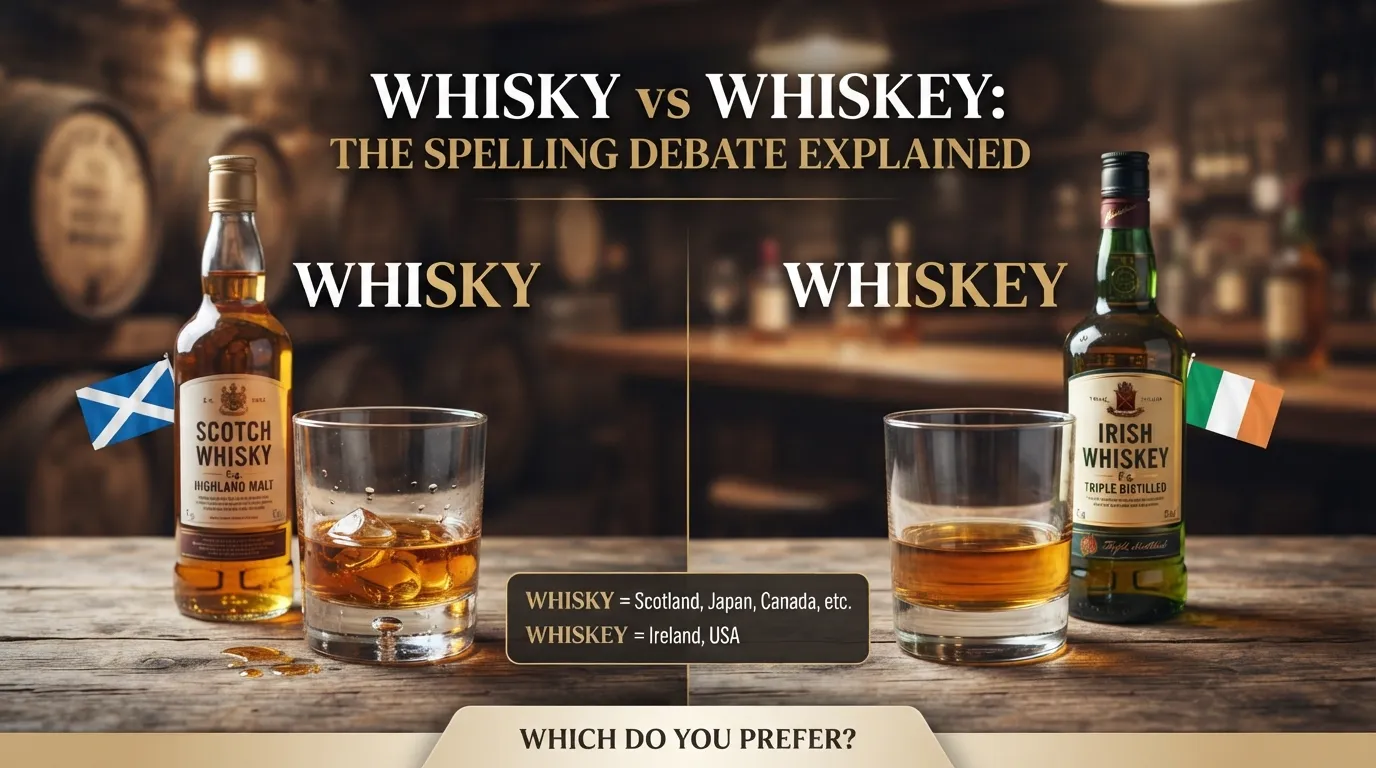
Order the same drink in three cities and watch the menu change. In Edinburgh, the bartender slides over a glass labeled Scotch whisky — no E. In Dublin, the menu says Irish whiskey — with an E. In Louisville, Kentucky, the bourbon on the shelf reads whiskey too. Same golden liquid, same family of spirit, three different spellings staring back at you. Nothing is wrong in any of the three bars. The spelling is not a typo. It is a passport stamp, and it tells you where the drink comes from.
Both words name the same thing: a distilled spirit made from fermented grain — barley, corn, rye, wheat — then aged in wooden barrels until it takes on color and character. The difference between whisky and whiskey is not the drink. It is geography, history, and a nineteenth-century marketing decision that never went away.
Three Bars, One Drink
Start in Edinburgh. The pub is old, the fire is real, and the shelf behind the bar holds a row of single malts from Islay, Speyside, and the Highlands. Every bottle says whisky. In Scotland, the word has been spelled without an E for centuries, and the Scots are not about to change it. A Scotch whisky, by law and by pride, is whisky. Write whiskey on a bottle of Scotch and you have made two mistakes at once: you have misspelled the word and insulted the tradition.
Fly to Dublin. The pub is just as old, the fire just as real, and the shelf holds Jameson, Redbreast, and Powers. Every bottle says whiskey, with the E. In Ireland, the E is not decoration. It is the national spelling, and the Irish take it as seriously as the Scots take theirs. Irish whiskey is a protected category with its own rules, and the E is part of the identity.
Land in Louisville. The bourbon trail runs through Kentucky like a river, and every distillery — Jim Beam, Maker’s Mark, Woodford Reserve — pours American whiskey, spelled with an E, following the Irish convention that crossed the Atlantic with immigrants. Except, of course, for the bottles that don’t. Maker’s Mark, famously, spells it whisky on its label, a deliberate throwback we will come back to. The rule has exceptions, and the exceptions have stories.

So the first lesson is simple: neither spelling is wrong. Whisky and whiskey are both correct, and the choice between them is a matter of origin. The second lesson is that the choice is not random. There is a pattern, and once you see it, you can spell the word correctly in almost any context without looking it up.
The E Rule: A Country Test
Here is the rule of thumb that bartenders, writers, and spirit lovers have used for generations. Look at the name of the country that made the drink. If the country’s name contains the letter E, the drink is whiskey, with an E. If it does not, the drink is whisky, without one.
- Ireland — has an E — whiskey.
- America (the United States) — has an E — whiskey.
- Scotland — no E — whisky.
- Japan — no E — whisky.
- Canada — no E — whisky.
The mnemonic is neat, memorable, and — like most mnemonics — a simplification that holds up surprisingly well. Japan is the interesting case: Japanese distillers learned their craft from Scotland, and they adopted the Scottish spelling along with the Scottish methods. Japanese whisky is whisky, and the E rule explains why. Canada follows the same convention, also tracing its tradition to Scottish roots.
The rule works because the spelling divide is not really about letters. It is about lineage. The Irish and American traditions descend from one branch of the family; the Scottish, Japanese, and Canadian traditions descend from another. The E marks which branch you are looking at, the way a family crest marks a house.
One caution: the E rule is a guide, not a law. Brands can spell their own names however they like, and a few do — which brings us to the exceptions. But as a default, when you are writing about a generic spirit from a known country, the E rule will steer you right nearly every time.
Why the Split Happened
Both spellings come from the same Gaelic root: uisge beatha, meaning “water of life.” Over centuries, that phrase was shortened and Anglicized into usquebaugh, then whisky. For a long time, there was no split at all. Everyone spelled it whisky.
The split arrived in the nineteenth century, and it was, at least in part, a marketing move. Irish distillers in the 1800s were producing pot still whiskey of widely respected quality, while much of the Scottish output at the time came from cheaper column stills and was regarded — fairly or not — as inferior. Irish producers wanted their product to stand apart on the shelf, and adding an E to the spelling was one way to do it. The extra letter said: this is not the same thing. It was branding before branding had a name.

Irish immigrants carried the E-spelling to America, where it took root in the new country’s distilleries. American whiskey — bourbon, Tennessee whiskey, rye — grew up with the E, and the E became part of the American identity of the drink. Scotland, meanwhile, kept the older spelling, and its global prestige in the twentieth century — the rise of single malt — cemented whisky as the spelling of the Scottish tradition and of the countries that learned from it.
So the E is not a random letter. It is a scar of a trade rivalry, a small piece of commercial history preserved in every bottle. When you write whiskey or whisky, you are not just spelling a word. You are taking a side in a two-hundred-year-old argument about quality, identity, and pride.
Labels That Break the Rule
Every good rule has exceptions, and this one has famous ones. Maker’s Mark, the Kentucky bourbon, spells its product whisky — no E — even though it is made in America. The distillery’s founder chose the Scottish spelling deliberately, as a nod to his Scottish heritage and to the old ways of making the spirit. The label is not a mistake. It is a statement.
George Dickel, the Tennessee distiller, also uses whisky on its labels, for similar reasons: a deliberate link to the Scottish tradition. And a handful of American craft distillers have followed suit, choosing the spelling that matches the style they are trying to evoke rather than the country they are standing in.
The lesson is practical and absolute: when you are writing about a specific brand, copy the label. The brand’s own spelling always wins, even when it breaks the country rule. Maker’s Mark is whisky. Jameson is whiskey. Lagavulin is whisky. If you are writing a review, a menu, or a gift guide, check the bottle. The bottle is the authority.
What about generic writing, where no brand is named? Then the country rule applies. “American whiskey,” “Scotch whisky,” “Irish whiskey,” “Japanese whisky,” “Canadian whisky.” And when you are writing about the drink in general, with no country attached, either spelling is defensible — though whisky, the older and shorter form, is the more common choice in international writing, while whiskey is the natural default in American writing.
Whisky in the Glass: Tasting Words
The spelling is only half the vocabulary. The other half is what you say when the glass arrives. Neat means nothing added — just the spirit, at room temperature, in a glass. On the rocks means over ice. With a splash means a little water, which opens up the aroma by releasing volatile compounds. A dram is a small pour, the traditional Scottish measure, and the word itself is a piece of Scots vocabulary that traveled with the drink.
Tasting language is its own dialect. A whisky can be smoky (peat smoke, typical of Islay malts), peaty, oaky (vanilla and spice from the barrel), sherry (dried fruit from sherry casks), floral, honeyed, or medicinal. Bourbon tends toward caramel, vanilla, and oak, because American law requires new charred oak barrels. Irish whiskey tends toward smoothness and light fruit, from triple distillation and a mix of pot and column stills. The vocabulary is not decoration. It is how drinkers tell each other what is in the glass without pouring a second one.
One phrase deserves a warning: “Scotch” on its own, in American bars, usually means Scotch whisky. “Whiskey” on its own, in an American bar, usually means American whiskey. The context fills in the missing word. But in writing, the missing word is your job. Name the origin, spell it the way the origin spells it, and the reader will taste what you mean.
Writing It on a Menu
A few grammar notes to finish. The plural of both spellings adds -ies: whiskies and whiskeys. “The bar stocks forty whiskies from around the world.” “He collects rare whiskeys.” The plural follows the spelling of the singular, so keep the E consistent: do not write “whiskies” when you mean American whiskeys, and vice versa.

As an adjective, the word attaches to everything in the drink’s world: a whisky glass, a whiskey barrel, whisky tasting, whiskey sour, whisky stones, whiskey neat. The spelling follows the same country rule. A “whisky sour” made with Scotch is a whisky sour; the same cocktail made with bourbon is a whiskey sour. In practice, most menus pick one spelling and stick with it, which is fine — consistency matters more than pedantry.
One last trap: the word whisky is sometimes confused with whiskey in the other direction, when writers “correct” a brand’s spelling. Do not correct Maker’s Mark. Do not correct a Scottish distillery. The label is not asking for your help.
And the memory hook, if you need one: countries with an E drink whiskey with an E. Ireland and America have the letter; Scotland, Japan, and Canada do not. The E in the country puts the E in the glass. Three bars, one drink, and now you know which spelling belongs on which menu.











